This is the content of the pop-over!

TExES Life Science 7-12 (238) Practice Tests & Test Prep by Exam Edge


TExES Life Science 7-12  product image
(4.8)
Based on 29 Reviews

  • Real Exam Simulation: Timed questions and matching content build comfort for your TExES Life Science 7-12 test day.
  • Instant, 24/7 Access: Web-based TExES Life Science 7-12 practice exams with no software needed.
  • Clear Explanations: Step-by-step answers and explanations for your TExES exam to strengthen understanding.
  • Boosted Confidence: Reduces anxiety and improves test-taking skills to ace your TExES Life Science 7-12 (238).

Featured on

TExES Life Science 7-12 Online Practice Test Bundles

BEST VALUE
20 practice tests

$174.00

$799.00

SAVE $625

Only $8.70 per test!

  • 100% Pass Guarantee
  • 20 online practice tests
  • 100 questions per test
  • Bonus: 100 Flash Cards + Study Guide
  • Instant access
  • Detailed Explanations
  • Practice tests never expire
  • Timed, untimed, or study guide mode
MOST POPULAR
10 practice tests

$99.50

$399.50

SAVE $300

Only $9.95 per test!

  • 10 online practice tests
  • 100 questions per test
  • Bonus: 100 Flash Cards + Study Guide
  • Instant access
  • Detailed Explanations
  • Practice tests never expire
  • Timed, untimed, or study guide mode
5 practice tests

$69.75

$199.75

SAVE $130

Only $13.95 per test!

  • 5 online practice tests
  • 100 questions per test
  • Bonus: 100 Flash Cards
  • Instant access
  • Detailed Explanations
  • Practice tests never expire
  • Timed, untimed, or study guide mode
1 practice test

$39.95

  • 1 online practice test
  • 100 questions per test
  • Instant access
  • Detailed Explanations
  • Practice tests never expire
  • Timed, untimed, or study guide mode
Quick Select
Tap to choose a bundle

** All Prices are in US Dollars (USD) **


TExES Life Science 7-12 (238) Resources

Jump to the section you need most.

Understanding the exact breakdown of the TExES Life Science 7-12 test will help you know what to expect and how to most effectively prepare. The TExES Life Science 7-12 has 100 multiple-choice questions . The exam will be broken down into the sections below:

TExES Life Science 7-12 Exam Blueprint
Domain Name % Number of
Questions
Scientific Inquiry and Processes 15% 15
Cell Structure and Processes 20% 20
Heredity and Evolution of Life 20% 20
Diversity of Life 20% 20
Interdependence of Life and Environmental Systems 15% 15
Science Learning - Instruction and Assessment 10% 10

TExES Life Science 7-12 Study Tips by Domain

  • Design investigations with clearly identified independent/dependent variables and a controlled comparison; red flag: changing more than one factor at a time makes conclusions invalid.
  • Choose measurement tools that match the needed precision and units (SI) and report significant figures consistently; common trap: recording more decimal places than the instrument allows.
  • Distinguish accuracy vs. precision and address both with calibration and repeated trials; priority rule: use multiple trials and average to reduce random error, but fix systematic error at the source.
  • Interpret data using appropriate graphs (e.g., scatterplots for relationships) and label axes with units; red flag: forcing a line through the origin or using a truncated axis that exaggerates trends.
  • Evaluate claims by checking sample size, controls, replication, and whether conclusions match the data; common trap: inferring causation from correlation.
  • Apply safe, ethical lab practices (PPE, proper disposal, organisms/chemicals handled per protocol) and document procedures/data in a lab record; contraindication: deviating from safety procedures to “save time.”
  • Compare prokaryotic vs. eukaryotic cells using organelle presence as the priority rule—if there’s a membrane-bound nucleus/organelles, it’s eukaryotic; a common trap is assuming all cells have mitochondria.
  • Link organelles to functions with a red-flag check: proteins for export/membranes follow RER → Golgi → vesicles; mixing up free ribosomes (cytosolic proteins) vs. bound ribosomes is a frequent error.
  • Predict membrane transport outcomes by tonicity—in hypotonic solutions animal cells can lyse while plant cells become turgid; a common trap is saying “water moves to high solute” but forgetting the cell wall changes the result.
  • Use enzyme basics to interpret graphs: rate peaks at an optimal pH/temperature and denaturation is often irreversible; a red flag is claiming enzymes “raise” activation energy or that substrate concentration increases rate without limit (Vmax).
  • Track energy flow: photosynthesis stores energy in glucose (chloroplasts) while cellular respiration releases ATP (mitochondria) and uses O2 as the final electron acceptor; a common trap is placing glycolysis in the mitochondrion (it’s cytosolic).
  • Connect cell cycle checkpoints to cancer risk—if DNA damage isn’t repaired at G1/S or G2/M, mutations propagate; a key red flag is confusing mitosis (somatic growth/repair) with meiosis (gametes, halving chromosome number).
  • Distinguish DNA replication, transcription, and translation—red flag: mixing up polymerase roles or strand directionality (DNA synthesis is 5’→3’).
  • Use Mendelian patterns (mono/di-hybrid, testcross) and extensions (incomplete dominance, codominance, sex-linkage)—common trap: assuming phenotype ratios always match genotype ratios.
  • Interpret pedigrees and probability (product/sum rules) to predict inheritance—priority rule: unaffected parents with affected offspring suggests recessive inheritance (watch for carriers).
  • Connect meiosis to genetic variation (independent assortment, crossing over) and errors (nondisjunction)—red flag: claiming mitosis increases variation or that crossing over happens in mitosis.
  • Explain evolution using evidence (fossils, homologies, molecular data) and mechanisms (natural selection, drift, gene flow, mutation)—common trap: describing evolution as individuals changing instead of allele frequencies changing in populations.
  • Apply Hardy–Weinberg conditions and calculations (p+q=1; p²+2pq+q²=1)—threshold cue: any violation (selection, migration, small population, nonrandom mating, mutation) means it’s not in equilibrium.
  • Distinguish domains and kingdoms using diagnostic traits (prokaryote vs. eukaryote, cell wall composition, unicellular vs. multicellular); red flag: calling all prokaryotes “bacteria” and ignoring Archaea differences.
  • Use dichotomous keys and binomial nomenclature correctly (Genus capitalized, species lowercase, both italicized/underlined); common trap: relying on habitat or “looks like” rather than observable traits at each step.
  • Compare major plant groups by vascular tissue, seeds, flowers, and dominant life-cycle stage; priority rule: seed plants (gymnosperms/angiosperms) are separated by presence of flowers/fruit, not just leaf shape.
  • Differentiate animal phyla with key body-plan features (symmetry, segmentation, coelom, development, presence of notochord); red flag: assuming all segmented animals are arthropods and forgetting annelids.
  • Characterize fungi, protists, and bacteria by nutrition and reproduction (absorptive heterotrophy in fungi, diverse protist strategies, binary fission vs. conjugation in bacteria); common trap: treating “conjugation” as bacterial reproduction rather than gene transfer.
  • Interpret phylogenetic trees/cladograms using shared derived characteristics and most recent common ancestor; red flag: reading across the tips as “more evolved” or equating node order with complexity.
  • Trace energy flow with the 10% rule (order-of-magnitude) and identify where it’s lost as heat via respiration; red flag: claiming energy “cycles” through a food web like matter.
  • Use limiting factors to predict population change (e.g., carrying capacity, density-dependent disease, density-independent drought); common trap: assuming any resource increase causes unlimited exponential growth.
  • Distinguish ecological interactions (mutualism, commensalism, parasitism, competition, predation) using fitness effects (+/0/−); red flag: labeling any close association as mutualism without showing benefits to both species.
  • Connect carbon, nitrogen, and water cycles to human impacts (fossil fuel combustion, fertilizer runoff/eutrophication, deforestation); priority rule: nitrates/phosphates + warm, still water → algal bloom risk.
  • Interpret succession and disturbance in ecosystems (primary vs. secondary, pioneer species, recovery trajectories); common trap: thinking succession always leads to a single “climax” endpoint regardless of disturbance regime.
  • Evaluate environmental change and biodiversity (invasive species, habitat fragmentation, overharvest, climate shifts) using evidence like population trends and keystone species effects; red flag: focusing only on species count while ignoring functional roles.
  • Write measurable objectives aligned to TEKS and assessment evidence (e.g., “students will model mitosis and justify phase order”), and avoid the trap of listing activities as goals.
  • Use formative checks (exit tickets, hinge questions) to adjust instruction in real time; red flag: giving a unit test without collecting and acting on mid-unit data.
  • Plan labs with explicit safety instruction and supervision (PPE, chemical handling, organism care) because student safety is non-negotiable and a common compliance pitfall is assuming prior knowledge.
  • Differentiate through scaffolds and extensions (sentence frames, chunked data tables, enrichment analysis) and watch for the trap of lowering rigor instead of providing access.
  • Design assessments that match cognitive demand (items requiring data interpretation, claims-evidence-reasoning) and avoid misalignment where instruction is inquiry-based but tests are recall-only.
  • Provide timely, specific feedback tied to success criteria and opportunities for revision; red flag: grades with no actionable comments, which fails to improve learning or close gaps.


Built to Fit Into Your Busy Life

Everything you need to prepare with confidence—without wasting a minute.

Three Study Modes

Timed, No Time Limit, or Explanation mode.

Actionable Analytics

Heatmaps and scaled scores highlight weak areas.

High-Yield Rationales

Concise explanations emphasize key concepts.

Realistic Interface

Matches the feel of the actual exam environment.

Accessible by Design

Clean layout reduces cognitive load.

Anytime, Anywhere

Web-based access 24/7 on any device.
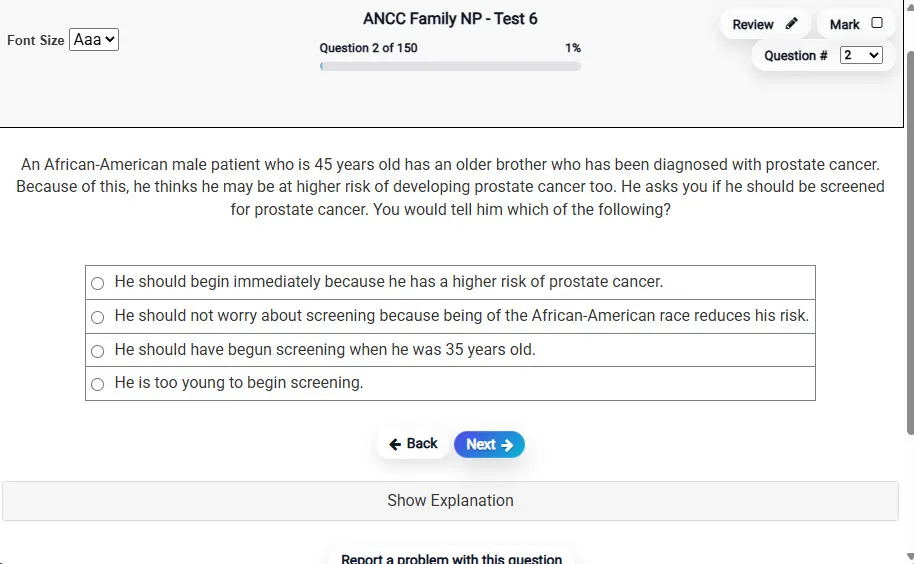
Answering a Question screen – Multiple-choice item view with navigation controls and progress tracker.
Answering a Question Multiple-choice item view with navigation controls and progress tracker.

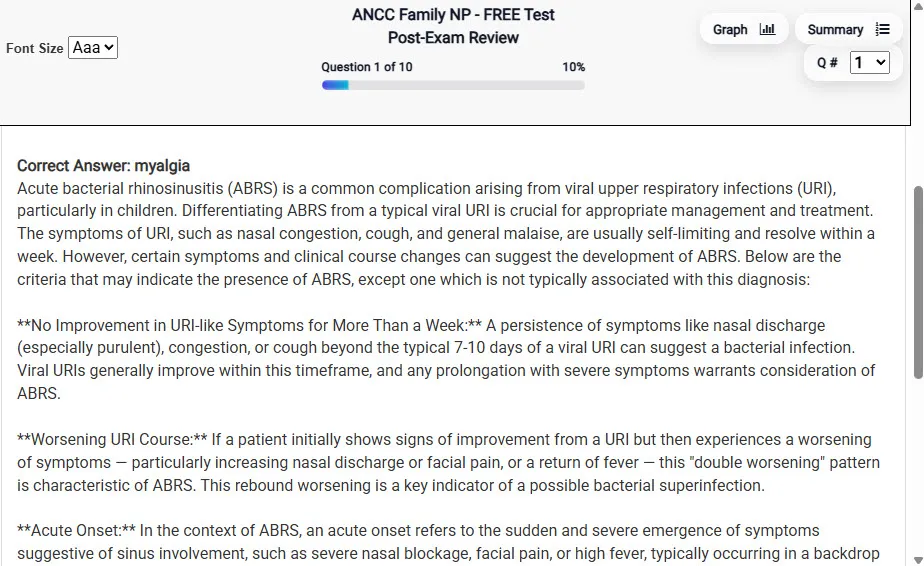
                           Detailed Explanation screen – 
                         Review mode showing chosen answer and rationale and references.
Detailed Explanation Review mode showing chosen answer and rationale and references.

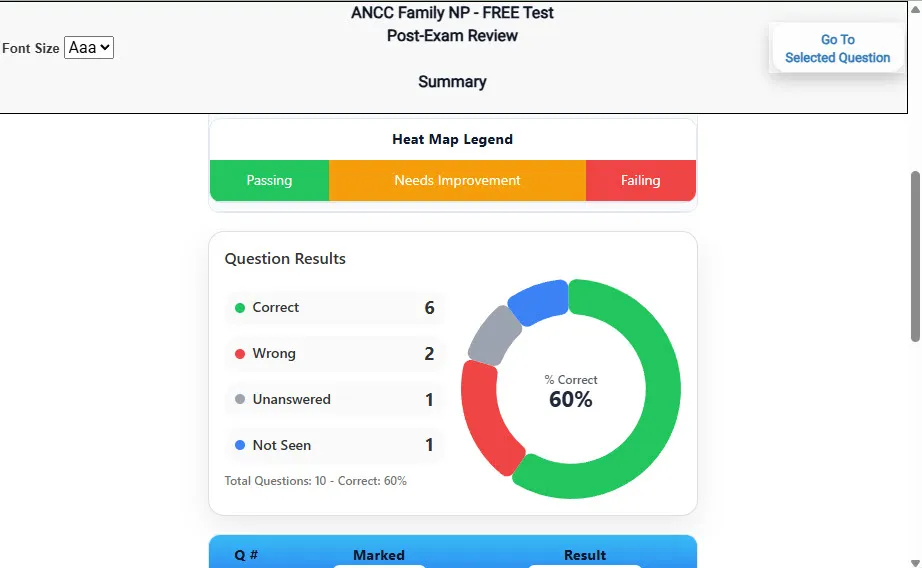
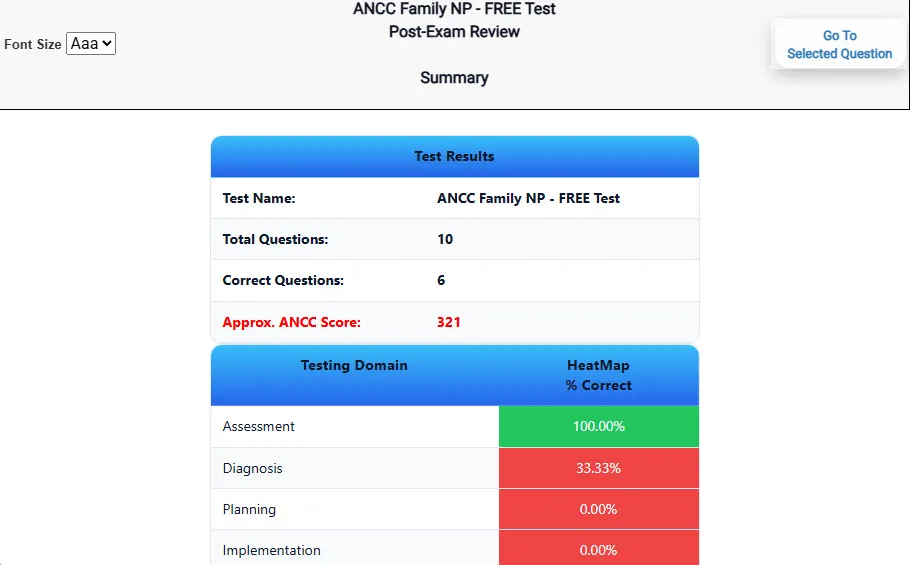
                           Review Summary 1 screen – 
                         Summary with counts for correct/wrong/unanswered and not seen items.
Review Summary 1 Summary with counts for correct/wrong/unanswered and not seen items.

                           Review Summary 2 screen – 
                         Advanced summary with category/domain breakdown and performance insights.
Review Summary 2 Advanced summary with category/domain breakdown and performance insights.

What Each Screen Shows

Answer Question Screen

  • Clean multiple-choice interface with progress bar.
  • Mark for review feature.
  • Matches real test pacing.

Detailed Explanation

  • Correct answer plus rationale.
  • Key concepts and guidelines highlighted.
  • Move between questions to fill knowledge gaps.

Review Summary 1

  • Overall results with total questions and scaled score.
  • Domain heatmap shows strengths and weaknesses.
  • Quick visual feedback on study priorities.

Review Summary 2

  • Chart of correct, wrong, unanswered, not seen.
  • Color-coded results for easy review.
  • Links back to missed items.

Top 10 Reasons to Use Exam Edge for your TExES Life Science 7-12 Exam Prep

  1. Focused on the TExES Life Science 7-12 Exam

    Our practice tests are built specifically for the TExES Life Science 7-12 exam — every question mirrors the real topics, format, and difficulty so you're studying exactly what matters.

  2. Real Exam Simulation

    We match the per-question time limits and pressure of the actual TExES exam, so test day feels familiar and stress-free.

  3. 20 Full Practice Tests & 2,000 Unique Questions

    You'll have more than enough material to master every TExES Life Science 7-12 concept — no repeats, no fluff.

  4. Lower Cost Than a Retake

    Ordering 5 practice exams costs less than retaking the TExES Life Science 7-12 exam after a failure. One low fee could save you both time and money.

  5. Flexible Testing

    Need to step away mid-exam? Pick up right where you left off — with your remaining time intact.

  6. Instant Scoring & Feedback

    See your raw score and an estimated TExES Life Science 7-12 score immediately after finishing each practice test.

  7. Detailed Explanations for Every Question

    Review correct and incorrect answers with clear, step-by-step explanations so you truly understand each topic.

  8. Trusted & Accredited

    We're fully accredited by the Better Business Bureau and uphold the highest standards of trust and transparency.

  9. Web-Based & Always Available

    No software to install. Access your TExES Life Science 7-12 practice exams 24/7 from any computer or mobile device.

  10. Expert Support When You Need It

    Need extra help? Our specialized tutors are highly qualified and ready to support your TExES exam prep.


Pass the TExES Life Science 7-12 Exam with Realistic Practice Tests from Exam Edge

Preparing for your upcoming TExES Life Science 7-12 (238) Certification Exam can feel overwhelming — but the right practice makes all the difference. Exam Edge gives you the tools, structure, and confidence to pass on your first try. Our online practice exams are built to match the real TExES Life Science 7-12 exam in content, format, and difficulty.

  • 📝 20 TExES Life Science 7-12 Practice Tests: Access 20 full-length exams with 100 questions each, covering every major TExES Life Science 7-12 topic in depth.
  • Instant Online Access: Start practicing right away — no software, no waiting.
  • 🧠 Step-by-Step Explanations: Understand the reasoning behind every correct answer so you can master TExES Life Science 7-12 exam concepts.
  • 🔄 Retake Each Exam Up to 4 Times: Build knowledge through repetition and track your improvement over time.
  • 🌐 Web-Based & Available 24/7: Study anywhere, anytime, on any device.
  • 🧘 Boost Your Test-Day Confidence: Familiarity with the TExES format reduces anxiety and helps you perform under pressure.

These TExES Life Science 7-12 practice exams are designed to simulate the real testing experience by matching question types, timing, and difficulty level. This approach helps you get comfortable not just with the exam content, but also with the testing environment, so you walk into your exam day focused and confident.


Exam Edge TEXES Reviews


The practice tests allowed me to practice with questions that were of similar content and construction as the real test. I took several practice tests and was able to focus my studying on what I missed. I felt the rigor of the questions matched the real test as well. After taking the real test and r ...
Read More
Lucy, Texes

Exam edge really prepared me for my exam. I passed!!! Thank you so much!

Mary, Houston, TX

Just wanted to tell you how helpful your site and tests were. I have taught HS English for 16 years and challenged this test to make myself more marketable. I ended up buying three tests, studying all the answer reasons, and using the info to make notes to study. I passed on the first try. Actually, ...
Read More
Wendy, Texes

Pleased with using Exam Edge. I have learned many other terms and related information using Exam Edge. I started with one examination to ready myself for the state examination and ended up purchasing all 10. Exam Edge also gave me some additional information after purchasing 10 exams.

Barb N, TX

Excellent experience!

Agnes , San Antonio, Texas

Great exam site that helped me pass my tests.

June , Murphy, Texas


TExES Life Science 7-12 Aliases Test Name

Here is a list of alternative names used for this exam.

  • TExES Life Science 7-12
  • TExES Life Science 7-12 test
  • TExES Life Science 7-12 Certification Test
  • TEXES
  • TEXES 238
  • 238 test
  • TExES Life Science 7-12 (238)
  • TExES Life Science 7-12 certification