This is the content of the pop-over!

TExES Deaf and Hard-of-Hearing (181) Practice Tests & Test Prep by Exam Edge


TExES Deaf and Hard-of-Hearing  product image
(4.6)
Based on 29 Reviews

  • Real Exam Simulation: Timed questions and matching content build comfort for your TExES Deaf and Hard-of-Hearing test day.
  • Instant, 24/7 Access: Web-based TExES Deaf and Hard-of-Hearing practice exams with no software needed.
  • Clear Explanations: Step-by-step answers and explanations for your TExES exam to strengthen understanding.
  • Boosted Confidence: Reduces anxiety and improves test-taking skills to ace your TExES Deaf and Hard-of-Hearing (181).

Featured on

TExES Deaf and Hard-of-Hearing Online Practice Test Bundles

BEST VALUE
5 practice tests

$69.75

$199.75

SAVE $130

Only $13.95 per test!

  • 100% Pass Guarantee
  • 5 online practice tests
  • 100 questions per test
  • Bonus: 100 Flash Cards + Study Guide
  • Instant access
  • Detailed Explanations
  • Practice tests never expire
  • Timed, untimed, or study guide mode
1 practice test

$39.95

  • 1 online practice test
  • 100 questions per test
  • Instant access
  • Detailed Explanations
  • Practice tests never expire
  • Timed, untimed, or study guide mode
Quick Select
Tap to choose a bundle

** All Prices are in US Dollars (USD) **


TExES Deaf and Hard-of-Hearing (181) Resources

Jump to the section you need most.

Understanding the exact breakdown of the TExES Deaf and Hard-of-Hearing test will help you know what to expect and how to most effectively prepare. The TExES Deaf and Hard-of-Hearing has 100 multiple-choice questions . The exam will be broken down into the sections below:

TExES Deaf and Hard-of-Hearing Exam Blueprint
Domain Name % Number of
Questions
Understanding Students Who Are Deaf or Hard-of-Hearing 27% 27
Promoting Student Learning and Development 33% 33
Promoting Student Achievement in English Language Arts and Reading 20% 20
Understanding the Professional Environment 20% 20

TExES Deaf and Hard-of-Hearing Study Tips by Domain

  • Differentiate degrees/types of hearing loss and likely access needs; red flag: assuming “mild” loss means minimal classroom impact, especially in noise.
  • Match communication modalities (ASL, PSE, oral/aural, cued speech, AAC) to student language history; priority rule: do not change a student’s primary language plan without the IEP/ARD team.
  • Interpret audiograms and IEP language/access statements to predict listening conditions; common trap: focusing on “dB loss” while ignoring configuration and speech perception.
  • Recognize how delayed language exposure affects cognition and academics; threshold cue: persistent gaps in narrative/grammar suggest language deprivation risk, not “low ability.”
  • Identify appropriate use/limits of amplification (hearing aids, cochlear implants, FM/DM); contraindication: relying on technology alone without visual access and communication supports.
  • Address Deaf culture/identity and family perspectives respectfully; red flag: treating ASL or Deaf community involvement as a barrier rather than an asset for development.
  • Implement IEP-driven access supports (interpreting, captioning, note support, visual aids); priority rule: access services must be in place before instruction is evaluated for effectiveness.
  • Design language-rich instruction with explicit vocabulary and syntax teaching; common trap: simplifying content instead of teaching the language needed to access grade-level concepts.
  • Use visual scaffolds (graphic organizers, anchored charts, demonstrations) strategically; red flag: too many visuals at once can overload attention and reduce comprehension.
  • Manage classroom communication norms (one speaker at a time, clear sightlines, wait time); threshold: if the student frequently misses who is speaking, restructure discussion routines immediately.
  • Plan for incidental learning gaps (overhearing, side comments, announcements); priority rule: pre-teach and debrief key information that hearing peers pick up informally.
  • Support social-emotional development and peer access (structured cooperative roles, direct pragmatics instruction); red flag: “compliant” isolation often indicates limited peer communication access.
  • Teach phonological/phonemic skills using appropriate pathways (visual phonics, cued speech, print-based strategies) aligned to the student’s access; common trap: insisting on purely auditory phonics when auditory access is insufficient.
  • Build background knowledge and vocabulary with repeated, contextualized exposure; threshold: if a word is essential to comprehension, teach it before the text rather than during breakdowns.
  • Develop reading comprehension through explicit text-structure instruction and signing/print connections; red flag: accurate signing of a passage does not guarantee understanding of inferencing or cohesion.
  • Teach writing with explicit grammar, morphology, and sentence combining; priority rule: address meaning and organization first, then conventions, to avoid overcorrecting and reducing output.
  • Use valid assessments and accommodations (ASL-based directions, extended time, alternate response modes); contraindication: altering the construct (e.g., reading test read aloud) unless the assessment is designed for it.
  • Integrate language objectives into ELA lessons (narratives, argument, academic discourse); common trap: treating language goals as separate from literacy instruction rather than embedded daily.
  • Follow IDEA/Section 504 requirements for IEP implementation and documentation; red flag: providing informal accommodations without documenting services and progress monitoring.
  • Collaborate with interpreters, SLPs, audiologists, and general educators using role clarity; priority rule: the teacher plans instruction—interpreters provide access, not curriculum decisions.
  • Maintain confidentiality and ethical communication with families and teams; common trap: discussing a student’s hearing status or implant use in public spaces or with uninvolved staff.
  • Ensure accessibility and safety in the environment (visual alarms, emergency plans, substitute plans); threshold: if emergency instructions are not visually accessible, the plan is not compliant or safe.
  • Use data-driven decision-making (language samples, curriculum measures, functional listening checks); red flag: attributing low scores to “hearing loss” without analyzing access and instruction variables.
  • Advocate for equitable participation in school activities (assemblies, field trips, extracurriculars); priority rule: plan access supports ahead of time rather than providing “make-up” access afterward.


Built to Fit Into Your Busy Life

Everything you need to prepare with confidence—without wasting a minute.

Three Study Modes

Timed, No Time Limit, or Explanation mode.

Actionable Analytics

Heatmaps and scaled scores highlight weak areas.

High-Yield Rationales

Concise explanations emphasize key concepts.

Realistic Interface

Matches the feel of the actual exam environment.

Accessible by Design

Clean layout reduces cognitive load.

Anytime, Anywhere

Web-based access 24/7 on any device.
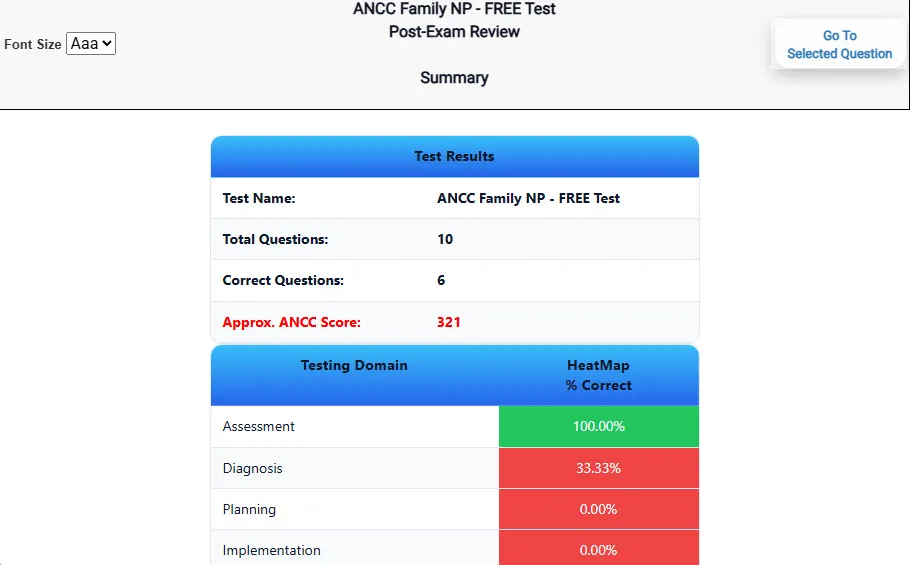
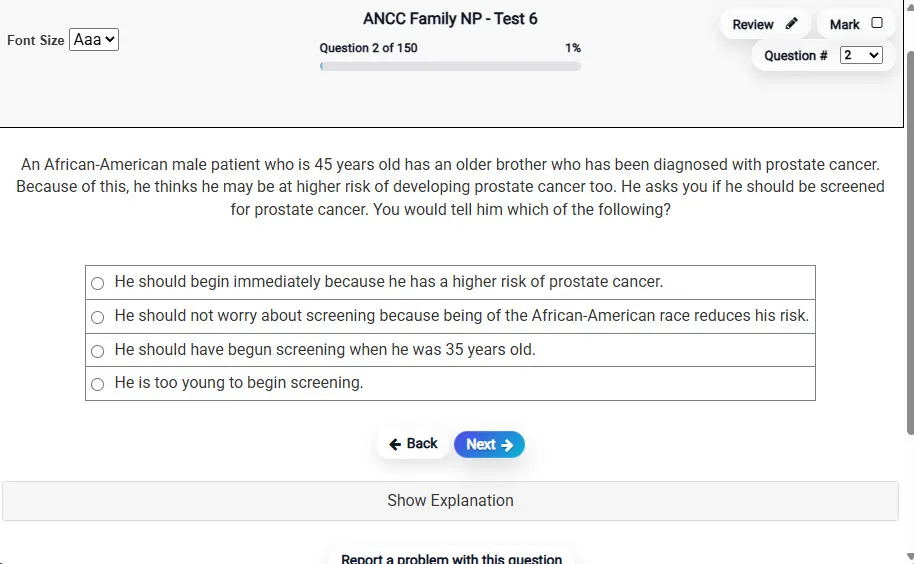
Answering a Question screen – Multiple-choice item view with navigation controls and progress tracker.
Answering a Question Multiple-choice item view with navigation controls and progress tracker.

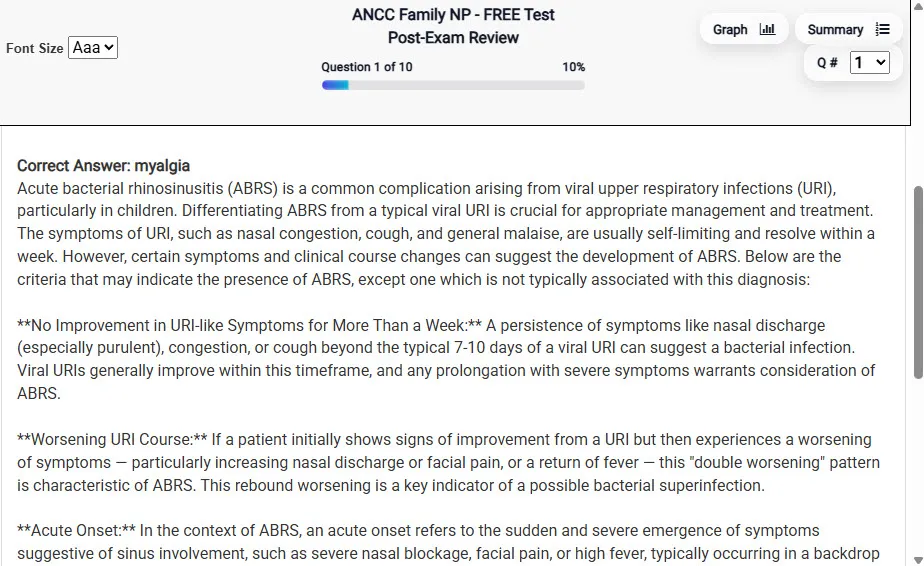
                           Detailed Explanation screen – 
                         Review mode showing chosen answer and rationale and references.
Detailed Explanation Review mode showing chosen answer and rationale and references.

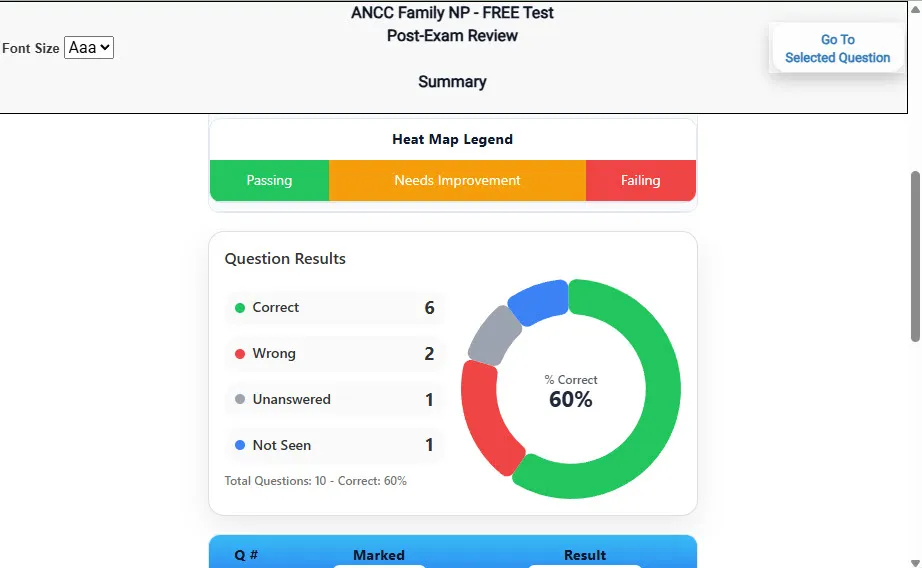
                           Review Summary 1 screen – 
                         Summary with counts for correct/wrong/unanswered and not seen items.
Review Summary 1 Summary with counts for correct/wrong/unanswered and not seen items.

                           Review Summary 2 screen – 
                         Advanced summary with category/domain breakdown and performance insights.
Review Summary 2 Advanced summary with category/domain breakdown and performance insights.

What Each Screen Shows

Answer Question Screen

  • Clean multiple-choice interface with progress bar.
  • Mark for review feature.
  • Matches real test pacing.

Detailed Explanation

  • Correct answer plus rationale.
  • Key concepts and guidelines highlighted.
  • Move between questions to fill knowledge gaps.

Review Summary 1

  • Overall results with total questions and scaled score.
  • Domain heatmap shows strengths and weaknesses.
  • Quick visual feedback on study priorities.

Review Summary 2

  • Chart of correct, wrong, unanswered, not seen.
  • Color-coded results for easy review.
  • Links back to missed items.

Top 10 Reasons to Use Exam Edge for your TExES Deaf and Hard-of-Hearing Exam Prep

  1. Focused on the TExES Deaf and Hard-of-Hearing Exam

    Our practice tests are built specifically for the TExES Deaf and Hard-of-Hearing exam — every question mirrors the real topics, format, and difficulty so you're studying exactly what matters.

  2. Real Exam Simulation

    We match the per-question time limits and pressure of the actual TExES exam, so test day feels familiar and stress-free.

  3. 5 Full Practice Tests & 500 Unique Questions

    You'll have more than enough material to master every TExES Deaf and Hard-of-Hearing concept — no repeats, no fluff.

  4. Lower Cost Than a Retake

    Ordering 5 practice exams costs less than retaking the TExES Deaf and Hard-of-Hearing exam after a failure. One low fee could save you both time and money.

  5. Flexible Testing

    Need to step away mid-exam? Pick up right where you left off — with your remaining time intact.

  6. Instant Scoring & Feedback

    See your raw score and an estimated TExES Deaf and Hard-of-Hearing score immediately after finishing each practice test.

  7. Detailed Explanations for Every Question

    Review correct and incorrect answers with clear, step-by-step explanations so you truly understand each topic.

  8. Trusted & Accredited

    We're fully accredited by the Better Business Bureau and uphold the highest standards of trust and transparency.

  9. Web-Based & Always Available

    No software to install. Access your TExES Deaf and Hard-of-Hearing practice exams 24/7 from any computer or mobile device.

  10. Expert Support When You Need It

    Need extra help? Our specialized tutors are highly qualified and ready to support your TExES exam prep.


Pass the TExES Deaf and Hard-of-Hearing Exam with Realistic Practice Tests from Exam Edge

Preparing for your upcoming TExES Deaf and Hard-of-Hearing (181) Certification Exam can feel overwhelming — but the right practice makes all the difference. Exam Edge gives you the tools, structure, and confidence to pass on your first try. Our online practice exams are built to match the real TExES Deaf and Hard-of-Hearing exam in content, format, and difficulty.

  • 📝 5 TExES Deaf and Hard-of-Hearing Practice Tests: Access 5 full-length exams with 100 questions each, covering every major TExES Deaf and Hard-of-Hearing topic in depth.
  • Instant Online Access: Start practicing right away — no software, no waiting.
  • 🧠 Step-by-Step Explanations: Understand the reasoning behind every correct answer so you can master TExES Deaf and Hard-of-Hearing exam concepts.
  • 🔄 Retake Each Exam Up to 4 Times: Build knowledge through repetition and track your improvement over time.
  • 🌐 Web-Based & Available 24/7: Study anywhere, anytime, on any device.
  • 🧘 Boost Your Test-Day Confidence: Familiarity with the TExES format reduces anxiety and helps you perform under pressure.

These TExES Deaf and Hard-of-Hearing practice exams are designed to simulate the real testing experience by matching question types, timing, and difficulty level. This approach helps you get comfortable not just with the exam content, but also with the testing environment, so you walk into your exam day focused and confident.


Exam Edge TEXES Reviews


I still can't believe I passed my TEXES exams on my first attempt. I always thought “Practice makes perfect” was a cliche, but after using your product, I now know that “Practice does make perfect.” Unlike several of my classmates, I walked into the tests feeling confident and prepared. Thank you fo ...
Read More
Hal, Huston

Logging in was a little difficult.

Monica , Odessa, Texas

I am writing this to inform you and anyone else who is thinking of purchasing these practice questions that they were the best investment I made as far as time and money. I had failed my EC-6 exam twice, and after practicing these tests, about 20 of them, I was more than prepared to pass the test. T ...
Read More
Carlos , Texes

There were several questions that I could not see the graphics on - to be able to answer the questions. This affected my ability and my score!

Renee , San Antonio, Texas

Great resources!!!

Adelia , Richmond, Texas

I used Exam Edge to help me pass my Science 4-8 TExES exam on my first try! The practice exams look exactly how the real test looked and the timer helped me be a little less nervous. Now I’m using their practice exams to help me prepare to take my Science 7-12 TExES exam. W ...
Read More
Shamai , TX


TExES Deaf and Hard-of-Hearing Aliases Test Name

Here is a list of alternative names used for this exam.

  • TExES Deaf and Hard-of-Hearing
  • TExES Deaf and Hard-of-Hearing test
  • TExES Deaf and Hard-of-Hearing Certification Test
  • TEXES
  • TEXES 181
  • 181 test
  • TExES Deaf and Hard-of-Hearing (181)
  • TExES Deaf and Hard-of-Hearing certification