This is the content of the pop-over!

TExES Core Subjects EC-6 - Math (802) Practice Tests & Test Prep by Exam Edge


TExES Core Subjects EC-6  (802)- Math  product image
(4.7)
Based on 32 Reviews

  • Real Exam Simulation: Timed questions and matching content build comfort for your TExES Core Subjects EC-6 (802)- Math test day.
  • Instant, 24/7 Access: Web-based TExES Core Subjects EC-6 (802)- Math practice exams with no software needed.
  • Clear Explanations: Step-by-step answers and explanations for your TExES exam to strengthen understanding.
  • Boosted Confidence: Reduces anxiety and improves test-taking skills to ace your TExES Core Subjects EC-6 (802)- Math (802).

Featured on

TExES Core Subjects EC-6 (802)- Math Online Practice Test Bundles

BEST VALUE
15 practice tests

$149.25

$599.25

SAVE $450

Only $9.95 per test!

  • 100% Pass Guarantee
  • 15 online practice tests
  • 47 questions per test
  • Bonus: 100 Flash Cards + Study Guide
  • Instant access
  • Detailed Explanations
  • Practice tests never expire
  • Timed, untimed, or study guide mode
MOST POPULAR
10 practice tests

$99.50

$399.50

SAVE $300

Only $9.95 per test!

  • 10 online practice tests
  • 47 questions per test
  • Bonus: 100 Flash Cards + Study Guide
  • Instant access
  • Detailed Explanations
  • Practice tests never expire
  • Timed, untimed, or study guide mode
5 practice tests

$69.75

$199.75

SAVE $130

Only $13.95 per test!

  • 5 online practice tests
  • 47 questions per test
  • Bonus: 100 Flash Cards
  • Instant access
  • Detailed Explanations
  • Practice tests never expire
  • Timed, untimed, or study guide mode
1 practice test

$39.95

  • 1 online practice test
  • 47 questions per test
  • Instant access
  • Detailed Explanations
  • Practice tests never expire
  • Timed, untimed, or study guide mode
Quick Select
Tap to choose a bundle

** All Prices are in US Dollars (USD) **


TExES Core Subjects EC-6 (802)- Math (802) Resources

Jump to the section you need most.

Understanding the exact breakdown of the TExES Core Subjects EC-6 (802)- Math test will help you know what to expect and how to most effectively prepare. The TExES Core Subjects EC-6 (802)- Math has 47 multiple-choice questions . The exam will be broken down into the sections below:

TExES Core Subjects EC-6 (802)- Math Exam Blueprint
Domain Name
Number Concepts  
Patterns and Algebra  
Geometry and Measurement  
Probability and Statistics  
Mathematical Processes  
Mathematical Perspectives  
Mathematical Learning and Instruction  
Professional Development  

TExES Core Subjects EC-6 (802)- Math Study Tips by Domain

  • Fluently represent whole numbers, fractions, decimals, and percents in multiple forms (expanded form, number lines, models) and justify equivalence; red flag: assuming 0.4 = 0.40 = 0.04.
  • Apply place-value reasoning to compare, order, and round decimals through thousandths and multi-digit whole numbers using benchmarks; common trap: rounding 3.45 to the nearest tenth as 3.4 instead of 3.5.
  • Demonstrate fraction meaning via part-whole, set, and measurement interpretations and use common denominators or benchmark fractions for comparison; priority rule: the denominator alone doesn’t determine size without a common whole.
  • Use standard algorithms and strategies (models, mental math, estimation) for operations with whole numbers, fractions, and decimals and check reasonableness; red flag: forgetting to align decimal points when adding or subtracting decimals.
  • Explain integer concepts (opposites, absolute value, order) with number-line reasoning and model addition/subtraction; common trap: treating subtraction as always making a number smaller (e.g., 5 − (−2)).
  • Connect ratios, rates, and percent to real contexts (unit rate, scaling, discounts, tax) and solve proportion problems with clear setup; threshold cue: always label units to avoid mixing rate comparisons (e.g., miles/hour vs. hours/mile).
  • Translate between representations (table, graph, verbal rule, algebraic expression) and check consistency; red flag: a rule that fits only one or two points but fails the rest of the table.
  • Distinguish additive vs. multiplicative patterns (constant difference vs. constant ratio) and justify with data; common trap: calling a pattern “linear” just because the numbers increase.
  • Write and interpret rules for growing patterns using input-output language and variables, including finding an unknown term; priority rule: state what the variable represents before solving.
  • Use the order of operations and parentheses correctly when evaluating expressions; red flag: substituting a value without grouping (e.g., treating 3x+2 as 3(x+2)).
  • Solve one-step and simple two-step equations/inequalities in context and verify with substitution; common trap: reversing the inequality sign incorrectly (only flip when multiplying/dividing by a negative).
  • Model relationships with linear functions and interpret slope and intercept in real situations; red flag: misreading the y-intercept as “starting at x=0” when the context doesn’t allow x=0.
  • Distinguish and classify 2D figures by defining attributes (e.g., number of sides, parallel/perpendicular lines) rather than appearance—red flag: students call a rotated square a “diamond” as a different shape.
  • Use properties of triangles and quadrilaterals (e.g., sum of angles, opposite sides parallel in a parallelogram) to justify conclusions—common trap: assuming “looks like a rectangle” without proving right angles.
  • Connect perimeter/area/volume to meaning and units; always label squared units for area and cubic units for volume—priority rule: if the unit isn’t squared/cubed, the measure is likely wrong.
  • Apply measurement formulas in context (rectangle area, triangle area as ½bh, circumference 2πr)—common trap: mixing radius and diameter when using circumference.
  • Work fluently with measurement conversions within and across customary/metric systems using ratios or place value—red flag: converting area/volume by applying a linear conversion factor only once instead of squaring/cubing it.
  • Model and compute with time, length, weight/mass, capacity, and temperature using appropriate tools and estimation—contraindication: choosing an overly precise tool (e.g., millimeters) when estimation to the nearest unit is expected.
  • Differentiate experimental vs. theoretical probability and use relative frequency to justify claims; red flag: assuming small-sample results (e.g., 5 trials) “prove” the true probability.
  • Interpret data displays (picture/bar/line plots, histograms, stem-and-leaf, box plots) for center, spread, and shape; common trap: confusing the “tallest bar” with the mean rather than the mode or most frequent interval.
  • Compute and compare mean, median, mode, and range and choose the most appropriate measure; priority rule: use the median for skewed data or when outliers are present.
  • Understand variability using range, interquartile range (IQR), and outliers (often defined as beyond 1.5×IQR); red flag: treating an outlier as an “error” automatically instead of checking context.
  • Apply counting and sample space reasoning (lists, tables, tree diagrams) to find probabilities of simple and compound events; common trap: double-counting outcomes or forgetting that order matters in some situations.
  • Distinguish independent vs. dependent events and interpret conditional probability in context; red flag: using addition for “and” situations (should multiply) or multiplying for “or” without accounting for overlap.
  • Use the problem-solving cycle (understand → plan → solve → check) and always validate reasonableness with estimation; red flag: an exact answer that contradicts a quick estimate or unit sense.
  • Represent situations flexibly (concrete models, drawings, tables, graphs, equations) and translate among them; common trap: choosing a representation that hides the relationship (e.g., using a bar model when a number line better shows subtraction as distance).
  • Communicate mathematical thinking with clear labels, units, and complete sentences tied to the question; priority rule: if the question asks “how many” or “how much,” the final statement must include the correct unit and context.
  • Justify and critique reasoning using definitions and properties (not just examples); red flag: a student claim based on one case (e.g., “it worked once, so it’s always true”) without a general argument.
  • Use strategic tools (manipulatives, calculators, ruler/protractor, graph paper, spreadsheets) appropriately and know when they can mislead; common trap: calculator/measurement results accepted without checking for input errors, rounding, or scale issues.
  • Attend to precision in computation and measurement, including rounding rules and significant digit/precision expectations; threshold cue: rounding should occur at the end unless directions specify otherwise, or accumulated rounding error can change the outcome.
  • Choose representations strategically (concrete → pictorial → abstract) and require students to explain connections; red flag: treating models as separate “tricks” with no translation among them.
  • Use multiple solution strategies (e.g., number line, place-value reasoning, standard algorithm) and compare efficiency/accuracy; common trap: marking a correct answer wrong because it doesn’t match the teacher’s preferred method.
  • Emphasize mathematical language and precision (unit labels, inequality wording, “at least” vs “more than”) with student-friendly definitions; red flag: vocabulary drills without applying terms in reasoning and justification.
  • Attend to common misconceptions (e.g., longer decimals are larger, area vs perimeter confusion) by eliciting thinking before correcting; priority rule: diagnose the misconception from student work before reteaching procedures.
  • Integrate real-world contexts with attention to reasonableness and units (money, time, measurement) rather than just “word-problem keywords”; common trap: using keyword-only strategies that ignore the situation.
  • Promote productive struggle and a growth-oriented stance toward errors by using mistakes as data; red flag: immediately rescuing students or over-scaffolding so they never choose a strategy.
  • Sequence instruction from concrete to representational to abstract (CRA)—red flag: jumping straight to symbols (e.g., 3/4) before students can model with area/set/number line representations.
  • Use purposeful questioning to surface misconceptions (e.g., “How do you know?”)—common trap: accepting correct answers without probing reasoning, which masks fragile understanding.
  • Plan explicit vocabulary and language supports (sum, difference, factor, equivalent, compare)—priority rule: pre-teach and repeatedly use terms in context to reduce math errors driven by wording, not computation.
  • Differentiate through multiple representations and entry points—red flag: giving “easier numbers” only, instead of adjusting representation, scaffolds, or task complexity while keeping the same learning goal.
  • Use formative assessment cycles (quick checks, error analysis, exit tickets) to adjust instruction—common trap: reteaching the same way after low performance rather than targeting the specific misconception shown in student work.
  • Promote productive struggle with clear success criteria and timely feedback—contraindication: rescuing too quickly (over-scaffolding) or leaving students stuck without a strategic hint (e.g., “Try a number line”).
  • Align math instruction to Texas standards and campus scope-and-sequence; red flag: teaching favorite activities that don’t map to specific TEKS/SEs and assessed readiness expectations.
  • Use assessment ethically and purposefully—screen, monitor progress, and respond instructionally; common trap: using a single test score for high-stakes decisions without corroborating evidence (work samples, observations, multiple measures).
  • Implement RTI/MTSS with documented interventions, fidelity checks, and data-based adjustments; priority rule: intensify support (time, grouping, explicitness) when progress-monitoring trends stay flat across several data points.
  • Differentiate for ELs and students with disabilities by targeting language demands and providing access supports; contraindication: reducing cognitive rigor (watering down) instead of scaffolding vocabulary, representations, and discourse.
  • Maintain a safe, equitable math community with clear norms for discourse and error analysis; red flag: participation patterns where the same students answer while others are consistently silent or excluded.
  • Engage in ongoing professional learning and collaboration (PLCs, coaching, family communication) tied to student outcomes; common trap: collecting resources without a plan to implement, reflect, and revise based on evidence.


Built to Fit Into Your Busy Life

Everything you need to prepare with confidence—without wasting a minute.

Three Study Modes

Timed, No Time Limit, or Explanation mode.

Actionable Analytics

Heatmaps and scaled scores highlight weak areas.

High-Yield Rationales

Concise explanations emphasize key concepts.

Realistic Interface

Matches the feel of the actual exam environment.

Accessible by Design

Clean layout reduces cognitive load.

Anytime, Anywhere

Web-based access 24/7 on any device.
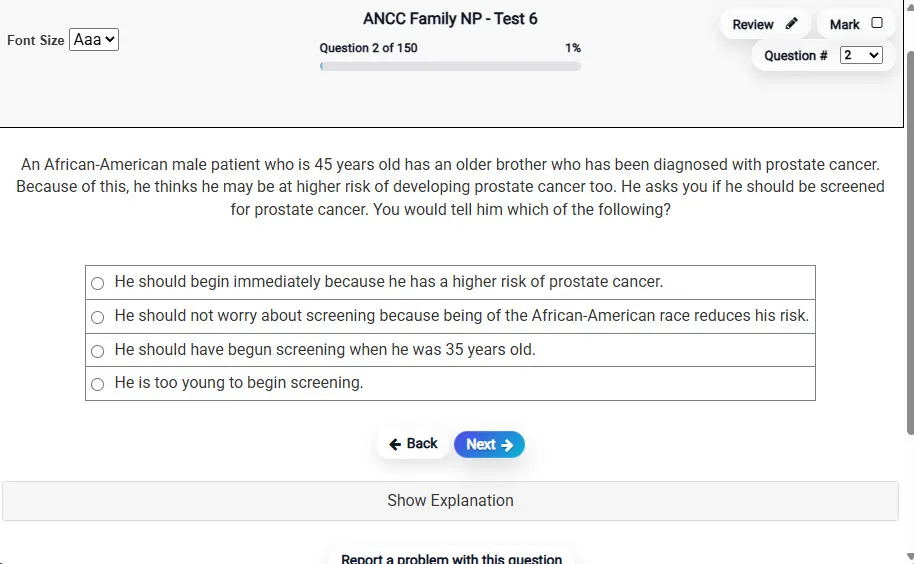
Answering a Question screen – Multiple-choice item view with navigation controls and progress tracker.
Answering a Question Multiple-choice item view with navigation controls and progress tracker.

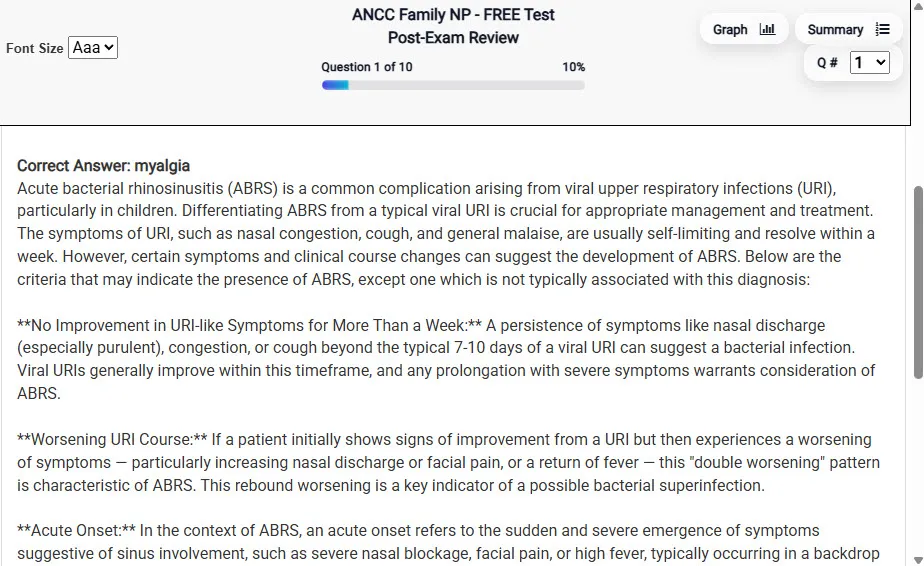
                           Detailed Explanation screen – 
                         Review mode showing chosen answer and rationale and references.
Detailed Explanation Review mode showing chosen answer and rationale and references.

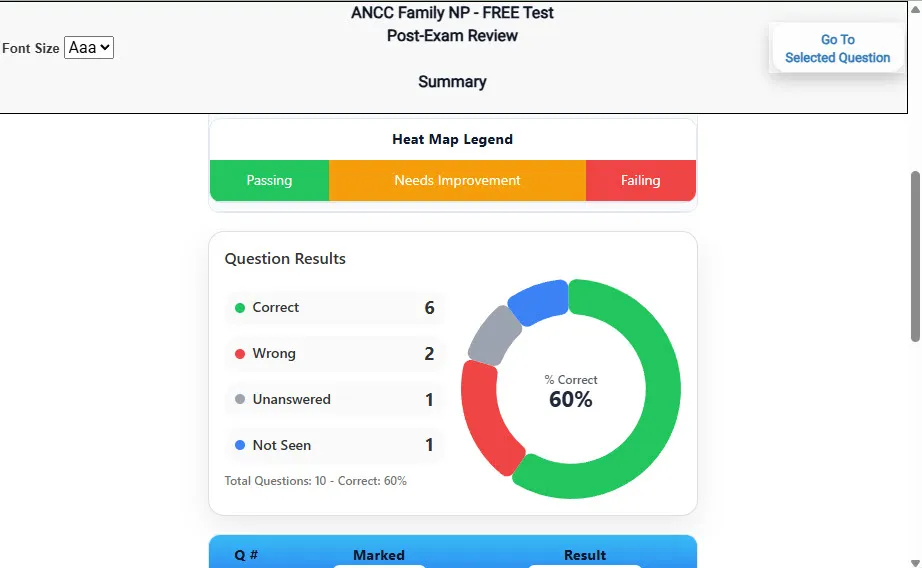
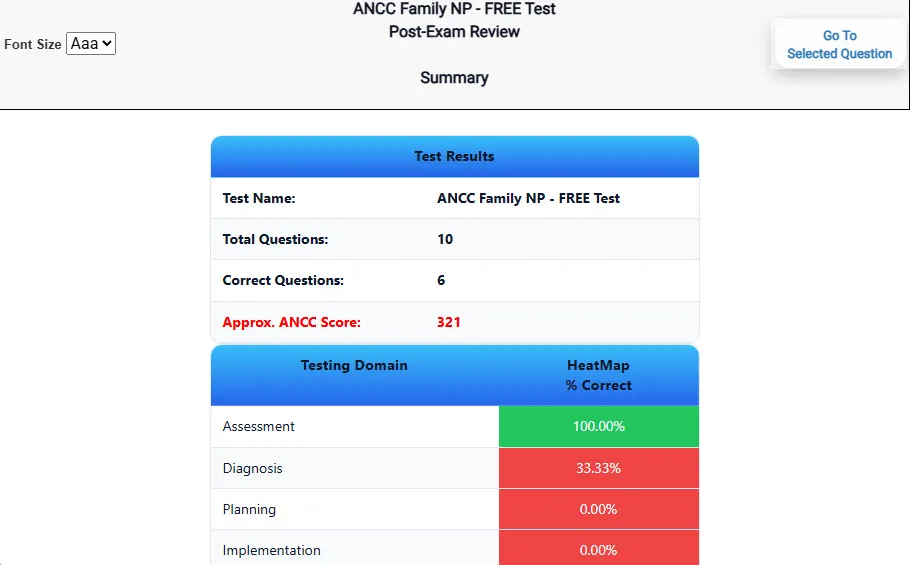
                           Review Summary 1 screen – 
                         Summary with counts for correct/wrong/unanswered and not seen items.
Review Summary 1 Summary with counts for correct/wrong/unanswered and not seen items.

                           Review Summary 2 screen – 
                         Advanced summary with category/domain breakdown and performance insights.
Review Summary 2 Advanced summary with category/domain breakdown and performance insights.

What Each Screen Shows

Answer Question Screen

  • Clean multiple-choice interface with progress bar.
  • Mark for review feature.
  • Matches real test pacing.

Detailed Explanation

  • Correct answer plus rationale.
  • Key concepts and guidelines highlighted.
  • Move between questions to fill knowledge gaps.

Review Summary 1

  • Overall results with total questions and scaled score.
  • Domain heatmap shows strengths and weaknesses.
  • Quick visual feedback on study priorities.

Review Summary 2

  • Chart of correct, wrong, unanswered, not seen.
  • Color-coded results for easy review.
  • Links back to missed items.

Top 10 Reasons to Use Exam Edge for your TExES Core Subjects EC-6 (802)- Math Exam Prep

  1. Focused on the TExES Core Subjects EC-6 (802)- Math Exam

    Our practice tests are built specifically for the TExES Core Subjects EC-6 (802)- Math exam — every question mirrors the real topics, format, and difficulty so you're studying exactly what matters.

  2. Real Exam Simulation

    We match the per-question time limits and pressure of the actual TExES exam, so test day feels familiar and stress-free.

  3. 15 Full Practice Tests & 705 Unique Questions

    You'll have more than enough material to master every TExES Core Subjects EC-6 (802)- Math concept — no repeats, no fluff.

  4. Lower Cost Than a Retake

    Ordering 5 practice exams costs less than retaking the TExES Core Subjects EC-6 (802)- Math exam after a failure. One low fee could save you both time and money.

  5. Flexible Testing

    Need to step away mid-exam? Pick up right where you left off — with your remaining time intact.

  6. Instant Scoring & Feedback

    See your raw score and an estimated TExES Core Subjects EC-6 (802)- Math score immediately after finishing each practice test.

  7. Detailed Explanations for Every Question

    Review correct and incorrect answers with clear, step-by-step explanations so you truly understand each topic.

  8. Trusted & Accredited

    We're fully accredited by the Better Business Bureau and uphold the highest standards of trust and transparency.

  9. Web-Based & Always Available

    No software to install. Access your TExES Core Subjects EC-6 (802)- Math practice exams 24/7 from any computer or mobile device.

  10. Expert Support When You Need It

    Need extra help? Our specialized tutors are highly qualified and ready to support your TExES exam prep.


Pass the TExES Core Subjects EC-6 (802)- Math Exam with Realistic Practice Tests from Exam Edge

Preparing for your upcoming TExES Core Subjects EC-6 (802)- Math (802) Certification Exam can feel overwhelming — but the right practice makes all the difference. Exam Edge gives you the tools, structure, and confidence to pass on your first try. Our online practice exams are built to match the real TExES Core Subjects EC-6 (802)- Math exam in content, format, and difficulty.

  • 📝 15 TExES Core Subjects EC-6 (802)- Math Practice Tests: Access 15 full-length exams with 47 questions each, covering every major TExES Core Subjects EC-6 (802)- Math topic in depth.
  • Instant Online Access: Start practicing right away — no software, no waiting.
  • 🧠 Step-by-Step Explanations: Understand the reasoning behind every correct answer so you can master TExES Core Subjects EC-6 (802)- Math exam concepts.
  • 🔄 Retake Each Exam Up to 4 Times: Build knowledge through repetition and track your improvement over time.
  • 🌐 Web-Based & Available 24/7: Study anywhere, anytime, on any device.
  • 🧘 Boost Your Test-Day Confidence: Familiarity with the TExES format reduces anxiety and helps you perform under pressure.

These TExES Core Subjects EC-6 (802)- Math practice exams are designed to simulate the real testing experience by matching question types, timing, and difficulty level. This approach helps you get comfortable not just with the exam content, but also with the testing environment, so you walk into your exam day focused and confident.


Exam Edge TEXES Reviews


Great resources!!!

Adelia , Richmond, Texas

I used Exam Edge to help me pass my Science 4-8 TExES exam on my first try! The practice exams look exactly how the real test looked and the timer helped me be a little less nervous. Now I’m using their practice exams to help me prepare to take my Science 7-12 TExES exam. W ...
Read More
Shamai , TX

I still can't believe I passed my TEXES exams on my first attempt. I always thought “Practice makes perfect” was a cliche, but after using your product, I now know that “Practice does make perfect.” Unlike several of my classmates, I walked into the tests feeling confident and prepared. Thank you fo ...
Read More
Hal, Huston

Logging in was a little difficult.

Monica , Odessa, Texas

I am writing this to inform you and anyone else who is thinking of purchasing these practice questions that they were the best investment I made as far as time and money. I had failed my EC-6 exam twice, and after practicing these tests, about 20 of them, I was more than prepared to pass the test. T ...
Read More
Carlos , Texes

There were several questions that I could not see the graphics on - to be able to answer the questions. This affected my ability and my score!

Renee , San Antonio, Texas


TExES Core Subjects EC-6 (802)- Math Aliases Test Name

Here is a list of alternative names used for this exam.

  • TExES Core Subjects EC-6 (802)- Math
  • TExES Core Subjects EC-6 (802)- Math test
  • TExES Core Subjects EC-6 (802)- Math Certification Test
  • TEXES
  • TEXES 802
  • 802 test
  • TExES Core Subjects EC-6 (802)- Math (802)
  • TExES Core Subjects EC-6 (802)- Math certification