This is the content of the pop-over!

TExES Core Subjects EC-6 - ELAR (801) Practice Tests & Test Prep by Exam Edge


TExES Core Subjects EC-6 (801) - English Language Arts and Reading   product image
(4.7)
Based on 32 Reviews

  • Real Exam Simulation: Timed questions and matching content build comfort for your TExES Core Subjects EC-6 (801) - ELAR test day.
  • Instant, 24/7 Access: Web-based TExES Core Subjects EC-6 (801) - English Language Arts and Reading practice exams with no software needed.
  • Clear Explanations: Step-by-step answers and explanations for your TExES exam to strengthen understanding.
  • Boosted Confidence: Reduces anxiety and improves test-taking skills to ace your TExES Core Subjects EC-6 (801) - English Language Arts and Reading (801).

Featured on

TExES Core Subjects EC-6 (801) - English Language Arts and Reading Online Practice Test Bundles

BEST VALUE
20 practice tests

$174.00

$799.00

SAVE $625

Only $8.70 per test!

  • 100% Pass Guarantee
  • 20 online practice tests
  • 75 questions per test
  • Bonus: 100 Flash Cards + Study Guide
  • Instant access
  • Detailed Explanations
  • Practice tests never expire
  • Timed, untimed, or study guide mode
MOST POPULAR
10 practice tests

$99.50

$399.50

SAVE $300

Only $9.95 per test!

  • 10 online practice tests
  • 75 questions per test
  • Bonus: 100 Flash Cards + Study Guide
  • Instant access
  • Detailed Explanations
  • Practice tests never expire
  • Timed, untimed, or study guide mode
5 practice tests

$69.75

$199.75

SAVE $130

Only $13.95 per test!

  • 5 online practice tests
  • 75 questions per test
  • Bonus: 100 Flash Cards
  • Instant access
  • Detailed Explanations
  • Practice tests never expire
  • Timed, untimed, or study guide mode
1 practice test

$39.95

  • 1 online practice test
  • 75 questions per test
  • Instant access
  • Detailed Explanations
  • Practice tests never expire
  • Timed, untimed, or study guide mode
Quick Select
Tap to choose a bundle

** All Prices are in US Dollars (USD) **


TExES Core Subjects EC-6 (801) - ELAR (801) Resources

Jump to the section you need most.

Understanding the exact breakdown of the TExES Core Subjects EC-6 (801) - English Language Arts and Reading test will help you know what to expect and how to most effectively prepare. The TExES Core Subjects EC-6 (801) - English Language Arts and Reading has 75 multiple-choice questions . The exam will be broken down into the sections below:

TExES Core Subjects EC-6 (801) - English Language Arts and Reading Exam Blueprint
Domain Name
Oral Language:  
Phonological and Phonemic Awareness  
Alphabetic Principle  
Literacy Development and Practice  
Word Analysis and Decoding  
Reading Fluency  
Reading Comprehension  
Development of Written Communication  
Writing Conventions  
Assessment and Instruction of Developing Literacy  
Research and Inquiry Skills  
Viewing and Representing  

TExES Core Subjects EC-6 (801) - English Language Arts and Reading Study Tips by Domain

  • Plan daily structured talk that targets vocabulary and syntax (e.g., sentence frames, revoicing) because oral language is a primary driver of later comprehension; red flag: most student talk is single-word or choral responses.
  • Differentiate between social language (BICS) and academic language (CALP) and explicitly teach the language of explanations, comparisons, and cause/effect; common trap: assuming conversational fluency means students can handle grade-level academic tasks.
  • Use interactive read-alouds and dialogic questioning (open-ended prompts, follow-ups) to build background knowledge and expressive language; priority rule: require evidence-based oral responses (“What in the text/picture makes you say that?”).
  • Support multilingual learners with comprehensible input and purposeful output (visuals, gestures, modeling, structured partner talk) without over-correcting; contraindication: correcting every error during discussion can shut down participation.
  • Teach and practice conversation norms (turn-taking, active listening, clarifying questions) and academic discussion moves (“I agree because…”); red flag: one or two students dominate while others stay silent.
  • Monitor oral language with quick, targeted checks (retell quality, sentence complexity, vocabulary use) and adjust instruction immediately; common trap: relying only on end-of-unit assessments instead of frequent informal observations.
  • Distinguish phonological awareness (larger sound units like words, syllables, onset-rime) from phonemic awareness (individual phonemes); red flag: confusing letter names with sounds during sound tasks.
  • Teach skills in a typical progression—rhyming/alliteration → sentence/word segmentation → syllables → onset-rime → phoneme isolation/blending/segmenting/manipulating; common trap: starting with phoneme deletion before students can blend and segment.
  • Use oral, no-print activities first (e.g., “say it slow,” Elkonin boxes with tokens) because phonemic awareness is about sounds, not spelling; priority rule: remove letters if students begin guessing based on print.
  • Phoneme blending and segmenting are the highest-leverage early predictors of decoding; cue: if a student can segment /m/ /a/ /t/ but can’t read “mat,” the missing link is explicit phonics/decoding, not more phonemic drills.
  • When assessing, use brief, timed-less tasks such as phoneme isolation, blending, segmenting, and manipulation, and note error patterns; red flag: counting letters instead of phonemes (e.g., saying “ship” has 4 sounds because it has 4 letters).
  • Provide targeted supports for multilingual learners and students with speech/hearing differences by modeling mouth movements and using continuous sounds when possible; contraindication: penalizing accent-related sound differences that don’t change phoneme awareness (focus on the sound contrast being assessed).
  • Emphasize that letters (graphemes) represent sounds (phonemes) and that mapping must be explicit and systematic; red flag: relying on memorizing whole words before students can connect sounds to print.
  • Teach common sound–symbol correspondences first (e.g., single consonants and short vowels) before moving to more complex patterns; trap: introducing multiple new graphemes in one lesson without enough guided practice.
  • Use quick checks that require students to read and spell CVC words to confirm they can apply letter–sound knowledge; priority rule: if a student can name letters but cannot use them to decode, instruction must shift to sound mapping.
  • Address consonant digraphs and common vowel teams as new spellings for known sounds, not as isolated lists; red flag: students can chant “sh, ch, th” but can’t read words containing them.
  • Connect encoding to decoding by having students build words with letters and then read them back; common trap: only practicing reading, which can mask weak alphabetic knowledge that shows up in spelling.
  • Differentiate for English learners and students with dyslexia risk by using multisensory routines and immediate corrective feedback on sound confusions; contraindication: correcting only the whole word instead of the specific grapheme–phoneme error.
  • Plan literacy instruction across a gradual release sequence (modeled → shared → guided → independent) and match the text/task to students’ current control of skills; red flag: moving to independent work before students can demonstrate it with scaffolds.
  • Use authentic reading and writing (read-alouds, shared reading, writer’s workshop) with explicit mini-lessons tied to a clear objective; common trap: activities (centers/crafts) that aren’t anchored to a specific literacy skill or standard.
  • Build background knowledge and vocabulary through intentional read-aloud routines, discussion, and content-area texts; priority rule: preteach only the most essential terms/concepts so you don’t reduce productive struggle.
  • Differentiate through flexible grouping and targeted instruction using ongoing evidence (running records, observation notes, work samples); red flag: keeping students in static groups after data show growth or new needs.
  • Create a print-rich environment that supports independence (class library by genre/level, anchor charts, word walls used in writing) and teach students how to use these tools; common trap: decorative displays that aren’t referenced during instruction.
  • Promote motivation and stamina with student choice, goal setting, and accountable independent reading/writing routines; red flag: using point systems or logs as the main driver rather than conferring and feedback on habits and comprehension.
  • Teach decoding explicitly from simple to complex (VC/CVC → blends → digraphs → vowel teams/r-controlled); red flag: students guessing from pictures instead of mapping graphemes to phonemes.
  • Use morphology (roots, prefixes, suffixes) to decode multisyllabic words; common trap: focusing only on syllable-splitting and ignoring meaning-changing morphemes (e.g., re-, un-, -ed, -tion).
  • Apply structural analysis strategies like spotting affixes, locating vowel patterns, and checking syllable types; priority rule: teach students to try a pronunciation, then self-correct using context and word meaning.
  • Differentiate irregular high-frequency words (e.g., said, one) by teaching the “regular part” and the “unexpected part”; red flag: rote memorization lists without linking to phonics patterns students already know.
  • Address common orthographic patterns and constraints (e.g., ck after a short vowel, silent-e impact, y as vowel); common trap: overgeneralizing a rule (e.g., “two vowels always make the first say its name”) without teaching exceptions.
  • Use error analysis to target instruction (substitution, omission, reversal, vowel confusion) and select decodables that match the taught pattern; threshold cue: if accuracy is below about 90–95% in a controlled text, the pattern likely needs reteaching before adding complexity.
  • Reading fluency is accurate, automatic word recognition plus appropriate rate and prosody; red flag: a student reads quickly but with frequent miscues or monotone phrasing.
  • Use repeated reading with a short, instructional-level passage and immediate feedback; common trap: practicing on frustration-level text makes errors stick and reduces confidence.
  • Track progress with oral reading fluency measures (e.g., words correct per minute) and note accuracy and expression; priority rule: if accuracy is below about 90–95%, focus on decoding/word recognition before pushing rate.
  • Build prosody through teacher modeling, echo/choral reading, and phrase-cued text; red flag: word-by-word reading without attention to punctuation signals limited automaticity and phrasing.
  • Differentiate supports—for English learners, preteach key vocabulary and model intonation without penalizing accent; common trap: treating language proficiency issues as a fluency deficit alone.
  • Connect fluency to comprehension by requiring a brief retell or a couple of text-dependent questions after oral reading; contraindication: drilling speed (WCPM) as the only goal can lower comprehension and increase guessing.
  • Teach comprehension explicitly through before/during/after routines (preview → monitor → summarize) and model metacognitive “think-alouds”; red flag: assuming students who can decode automatically understand.
  • Use text structure instruction (cause/effect, compare/contrast, sequence, problem/solution) with signal words to support informational text comprehension; common trap: focusing only on story elements for all genres.
  • Build vocabulary and background knowledge strategically (morphemes, context, domain terms) before complex texts; priority rule: pre-teach only high-utility/essential words—over-preteaching everything reduces productive struggle.
  • Teach comprehension monitoring and repair strategies (reread, clarify pronouns, adjust pace, ask questions, use context) and require evidence from the text; red flag: answers based on opinions without specific textual support.
  • Differentiate for English learners and struggling readers with supports like visuals, sentence stems, and guided questions while still targeting the same meaning-making goal; contraindication: simplifying the text so much that key ideas and academic language are removed.
  • Assess comprehension with a mix of retellings, targeted questions, graphic organizers, and written responses aligned to TEKS; common trap: using only multiple-choice items, which can mask gaps in inference and synthesis.
  • Match writing instruction to developmental stages (egocentric → socialized → conscious craft) and use mentor texts to make moves visible; red flag: grading early drafts like final products shuts down risk-taking.
  • Teach writing as a process (plan → draft → revise → edit → publish) with explicit mini-lessons at each step; common trap: focusing on editing mechanics before students have a clear purpose and organization.
  • Develop ideas and organization by having students write to a specific audience/purpose and use graphic organizers (story maps, boxes-and-bullets); priority rule: if a piece lacks focus, revise for meaning before fixing conventions.
  • Build sentence-level control (simple/compound/complex, sentence combining, varied beginnings) to improve clarity and style; red flag: repeated fragments/run-ons often signal the need for oral rehearsal and modeled sentence construction.
  • Strengthen voice and word choice through precise verbs, concrete nouns, and sensory details while avoiding empty adjectives; common trap: “add more details” feedback without modeling what effective elaboration looks like.
  • Use targeted feedback and conferencing aligned to one or two writing goals (e.g., lead, transitions, conclusion) and track progress with rubrics/checklists; red flag: correcting every error at once overwhelms and doesn’t change writing behavior.
  • Differentiate editing from revising—editing targets conventions (spelling, punctuation, capitalization, grammar), and a common trap is grading ideas/organization as “conventions” errors.
  • Teach punctuation as meaning-making (commas in a series vs. after introductory elements vs. in compound sentences); red flag: students add random commas where they “hear a pause” rather than following a rule.
  • Address sentence boundaries (fragments and run-ons) using explicit strategies like combining/splitting sentences; priority rule: fix complete subject–verb structures before fine-tuning style.
  • Build capitalization and usage rules (proper nouns, titles, I, days/months) with immediate application in students’ drafts; common trap: students overcapitalize common nouns because they look “important.”
  • Support spelling through patterns and morphology (inflectional endings, prefixes/suffixes) rather than memorizing lists; red flag: repeated errors on the same pattern (e.g., dropping silent e before -ing) indicate a needed mini-lesson.
  • Use proofreading routines with focused passes (one pass for punctuation, one for spelling, one for grammar); contraindication: asking students to “fix everything” at once typically lowers accuracy and independence.
  • Use screening, diagnostic, and progress-monitoring data to target instruction; red flag: relying on a single benchmark score instead of patterns across measures and time.
  • Match assessment to purpose and skill (e.g., phonemic awareness vs. decoding vs. fluency); common trap: using running records to diagnose phonemic deficits.
  • Plan explicit, systematic instruction with a clear I-do/We-do/You-do release; priority rule: teach the smallest missing prerequisite first before adding complexity.
  • Provide immediate, specific feedback and corrective practice during guided reading/writing; red flag: students repeating errors because feedback is delayed or only evaluative (“good job”).
  • Differentiate using flexible small groups and adjust intensity by need (more modeling, more practice, fewer items); threshold cue: if progress-monitoring shows a flat trend for 2–3 data points, change the instructional plan.
  • Integrate language supports for multilingual learners (visuals, sentence frames, oral rehearsal) while keeping the literacy objective constant; common trap: lowering text or task demand instead of scaffolding access.
  • Teach the full research cycle (question → plan → gather → evaluate → synthesize → present), and use checklists so students don’t skip evaluation of sources—a common trap is going straight from Googling to copying notes.
  • Require a focused, researchable question with clear key terms and subquestions; red flag: prompts that are too broad (“Texas history”) or too opinion-based to be supported with evidence.
  • Model source evaluation using currency, authority, purpose, and evidence, and prioritize primary/credible secondary sources; common trap: treating a .org site or an infographic as automatically reliable.
  • Explicitly teach paraphrasing, summarizing, and direct quotation with citation expectations; red flag: patchwriting (minor word swaps) that still counts as plagiarism.
  • Build note-taking routines (e.g., two-column notes or source cards) that separate facts from inferences and track where each idea came from; common trap: notes without page/URL details that prevent accurate citations.
  • Assess synthesis by requiring students to combine evidence across multiple sources and explain agreements/conflicts; priority rule: claims must be backed by more than one source when possible, not a single “good quote.”
  • Teach students to identify how visuals, layout, color, and sound shape meaning and audience response; red flag: students only retell content without naming a creator’s choices.
  • Emphasize media literacy by distinguishing fact, opinion, and advertising/propaganda techniques (e.g., bandwagon, testimonials); common trap: treating a “professional-looking” graphic as automatically credible.
  • Use text features (captions, labels, headings, legends, scales) to support comprehension of charts/diagrams; priority rule: require students to cite the specific feature that answers the question.
  • Have students infer implicit messages and bias in images and multimedia by asking who benefits, who is missing, and what is emphasized; red flag: accepting a single image as a complete story.
  • Teach students to create representations (storyboards, posters, slides, graphs) that match purpose and audience; threshold cue: include a clear central message and at least two supporting visual elements aligned to the topic.
  • Incorporate digital citizenship and copyright basics when using or creating media; contraindication: using uncredited images or sharing student work publicly without required permissions.


Built to Fit Into Your Busy Life

Everything you need to prepare with confidence—without wasting a minute.

Three Study Modes

Timed, No Time Limit, or Explanation mode.

Actionable Analytics

Heatmaps and scaled scores highlight weak areas.

High-Yield Rationales

Concise explanations emphasize key concepts.

Realistic Interface

Matches the feel of the actual exam environment.

Accessible by Design

Clean layout reduces cognitive load.

Anytime, Anywhere

Web-based access 24/7 on any device.
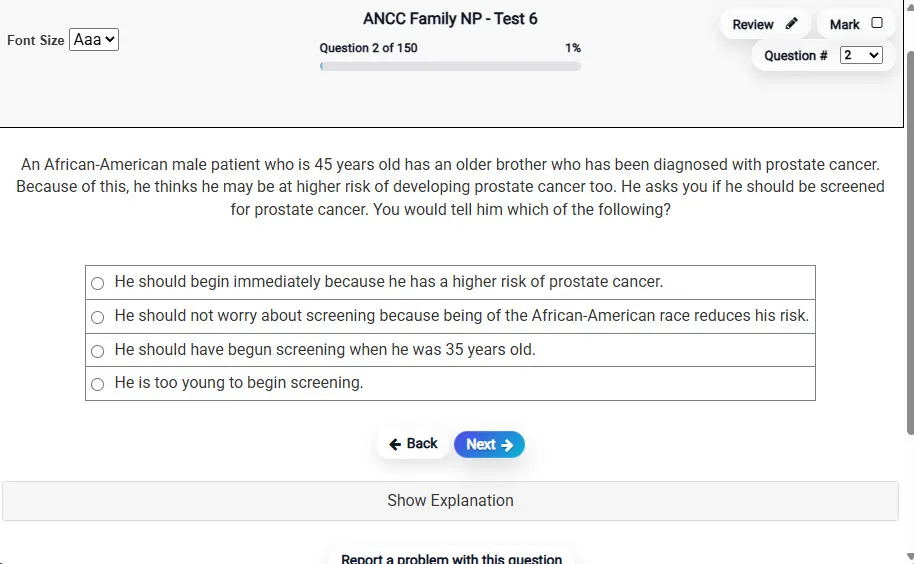
Answering a Question screen – Multiple-choice item view with navigation controls and progress tracker.
Answering a Question Multiple-choice item view with navigation controls and progress tracker.

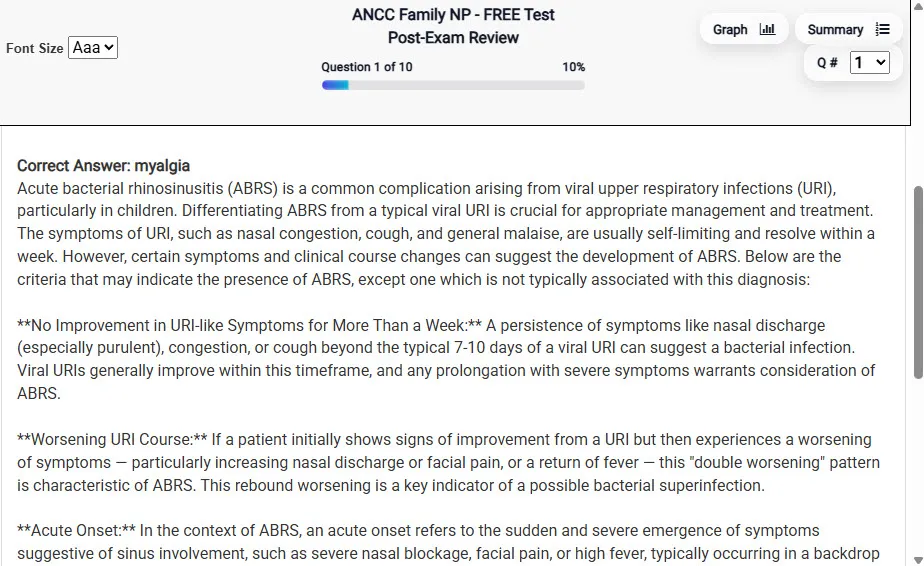
                           Detailed Explanation screen – 
                         Review mode showing chosen answer and rationale and references.
Detailed Explanation Review mode showing chosen answer and rationale and references.

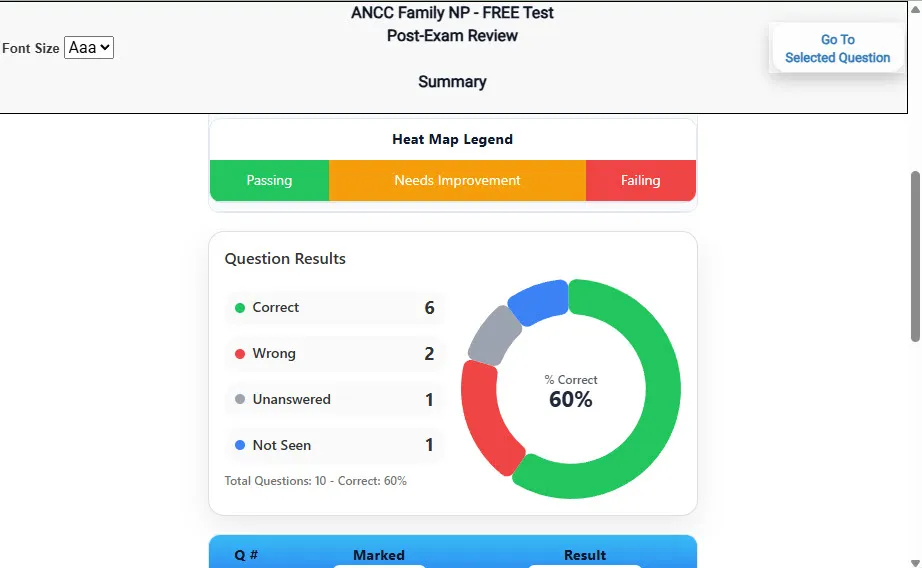
                           Review Summary 1 screen – 
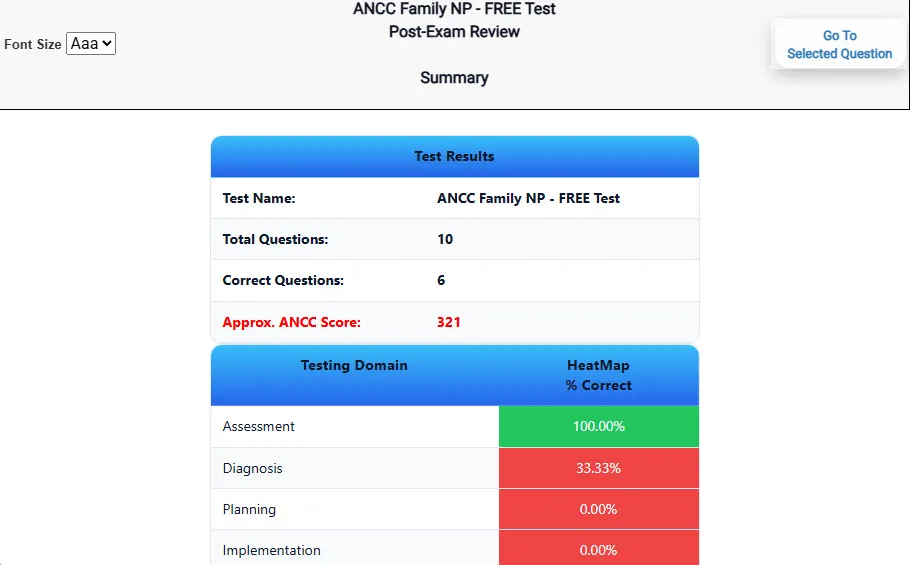
                         Summary with counts for correct/wrong/unanswered and not seen items.
Review Summary 1 Summary with counts for correct/wrong/unanswered and not seen items.

                           Review Summary 2 screen – 
                         Advanced summary with category/domain breakdown and performance insights.
Review Summary 2 Advanced summary with category/domain breakdown and performance insights.

What Each Screen Shows

Answer Question Screen

  • Clean multiple-choice interface with progress bar.
  • Mark for review feature.
  • Matches real test pacing.

Detailed Explanation

  • Correct answer plus rationale.
  • Key concepts and guidelines highlighted.
  • Move between questions to fill knowledge gaps.

Review Summary 1

  • Overall results with total questions and scaled score.
  • Domain heatmap shows strengths and weaknesses.
  • Quick visual feedback on study priorities.

Review Summary 2

  • Chart of correct, wrong, unanswered, not seen.
  • Color-coded results for easy review.
  • Links back to missed items.

Top 10 Reasons to Use Exam Edge for your TExES Core Subjects EC-6 (801) - English Language Arts and Reading Exam Prep

  1. Focused on the TExES Core Subjects EC-6 (801) - English Language Arts and Reading Exam

    Our practice tests are built specifically for the TExES Core Subjects EC-6 (801) - ELAR exam — every question mirrors the real topics, format, and difficulty so you're studying exactly what matters.

  2. Real Exam Simulation

    We match the per-question time limits and pressure of the actual TExES exam, so test day feels familiar and stress-free.

  3. 20 Full Practice Tests & 1,500 Unique Questions

    You'll have more than enough material to master every TExES Core Subjects EC-6 (801) - ELAR concept — no repeats, no fluff.

  4. Lower Cost Than a Retake

    Ordering 5 practice exams costs less than retaking the TExES Core Subjects EC-6 (801) - English Language Arts and Reading exam after a failure. One low fee could save you both time and money.

  5. Flexible Testing

    Need to step away mid-exam? Pick up right where you left off — with your remaining time intact.

  6. Instant Scoring & Feedback

    See your raw score and an estimated TExES Core Subjects EC-6 (801) - English Language Arts and Reading score immediately after finishing each practice test.

  7. Detailed Explanations for Every Question

    Review correct and incorrect answers with clear, step-by-step explanations so you truly understand each topic.

  8. Trusted & Accredited

    We're fully accredited by the Better Business Bureau and uphold the highest standards of trust and transparency.

  9. Web-Based & Always Available

    No software to install. Access your TExES Core Subjects EC-6 (801) - ELAR practice exams 24/7 from any computer or mobile device.

  10. Expert Support When You Need It

    Need extra help? Our specialized tutors are highly qualified and ready to support your TExES exam prep.


Pass the TExES Core Subjects EC-6 (801) - English Language Arts and Reading Exam with Realistic Practice Tests from Exam Edge

Preparing for your upcoming TExES Core Subjects EC-6 (801) - English Language Arts and Reading (801) Certification Exam can feel overwhelming — but the right practice makes all the difference. Exam Edge gives you the tools, structure, and confidence to pass on your first try. Our online practice exams are built to match the real TExES Core Subjects EC-6 (801) - ELAR exam in content, format, and difficulty.

  • 📝 20 TExES Core Subjects EC-6 (801) - English Language Arts and Reading Practice Tests: Access 20 full-length exams with 75 questions each, covering every major TExES Core Subjects EC-6 (801) - English Language Arts and Reading topic in depth.
  • Instant Online Access: Start practicing right away — no software, no waiting.
  • 🧠 Step-by-Step Explanations: Understand the reasoning behind every correct answer so you can master TExES Core Subjects EC-6 (801) - ELAR exam concepts.
  • 🔄 Retake Each Exam Up to 4 Times: Build knowledge through repetition and track your improvement over time.
  • 🌐 Web-Based & Available 24/7: Study anywhere, anytime, on any device.
  • 🧘 Boost Your Test-Day Confidence: Familiarity with the TExES format reduces anxiety and helps you perform under pressure.

These TExES Core Subjects EC-6 (801) - English Language Arts and Reading practice exams are designed to simulate the real testing experience by matching question types, timing, and difficulty level. This approach helps you get comfortable not just with the exam content, but also with the testing environment, so you walk into your exam day focused and confident.


Exam Edge TEXES Reviews


Great resources!!!

Adelia , Richmond, Texas

I used Exam Edge to help me pass my Science 4-8 TExES exam on my first try! The practice exams look exactly how the real test looked and the timer helped me be a little less nervous. Now I’m using their practice exams to help me prepare to take my Science 7-12 TExES exam. W ...
Read More
Shamai , TX

I still can't believe I passed my TEXES exams on my first attempt. I always thought “Practice makes perfect” was a cliche, but after using your product, I now know that “Practice does make perfect.” Unlike several of my classmates, I walked into the tests feeling confident and prepared. Thank you fo ...
Read More
Hal, Huston

Logging in was a little difficult.

Monica , Odessa, Texas

I am writing this to inform you and anyone else who is thinking of purchasing these practice questions that they were the best investment I made as far as time and money. I had failed my EC-6 exam twice, and after practicing these tests, about 20 of them, I was more than prepared to pass the test. T ...
Read More
Carlos , Texes

There were several questions that I could not see the graphics on - to be able to answer the questions. This affected my ability and my score!

Renee , San Antonio, Texas


TExES Core Subjects EC-6 (801) - English Language Arts and Reading Aliases Test Name

Here is a list of alternative names used for this exam.

  • TExES Core Subjects EC-6 (801) - English Language Arts and Reading
  • TExES Core Subjects EC-6 (801) - English Language Arts and Reading test
  • TExES Core Subjects EC-6 (801) - English Language Arts and Reading Certification Test
  • TExES Core Subjects EC-6 (801) - ELAR test
  • TEXES
  • TEXES 801
  • 801 test
  • TExES Core Subjects EC-6 (801) - English Language Arts and Reading (801)
  • TExES Core Subjects EC-6 (801) - English Language Arts and Reading certification