This is the content of the pop-over!

TEAS Combined Practice Tests & Test Prep by Exam Edge


TEAS Test of Essential Academic Skills Combined 7 product image
(4.4)
Based on 22 Reviews

  • Real Exam Simulation: Timed questions and matching content build comfort for your TEAS Combined 7 test day.
  • Instant, 24/7 Access: Web-based TEAS Test of Essential Academic Skills Combined 7 practice exams with no software needed.
  • Clear Explanations: Step-by-step answers and explanations for your TEAS exam to strengthen understanding.
  • Boosted Confidence: Reduces anxiety and improves test-taking skills to ace your TEAS Test of Essential Academic Skills Combined 7 .

Featured on

TEAS Test of Essential Academic Skills Combined 7 Online Practice Test Bundles

BEST VALUE
20 practice tests

$174.00

$799.00

SAVE $625

Only $8.70 per test!

  • 100% Pass Guarantee
  • 20 online practice tests
  • 170 questions per test
  • Bonus: 100 Flash Cards + Study Guide
  • Instant access
  • Detailed Explanations
  • Practice tests never expire
  • Timed, untimed, or study guide mode
MOST POPULAR
10 practice tests

$99.50

$399.50

SAVE $300

Only $9.95 per test!

  • 10 online practice tests
  • 170 questions per test
  • Bonus: 100 Flash Cards + Study Guide
  • Instant access
  • Detailed Explanations
  • Practice tests never expire
  • Timed, untimed, or study guide mode
5 practice tests

$69.75

$199.75

SAVE $130

Only $13.95 per test!

  • 5 online practice tests
  • 170 questions per test
  • Bonus: 100 Flash Cards
  • Instant access
  • Detailed Explanations
  • Practice tests never expire
  • Timed, untimed, or study guide mode
1 practice test

$39.95

  • 1 online practice test
  • 170 questions per test
  • Instant access
  • Detailed Explanations
  • Practice tests never expire
  • Timed, untimed, or study guide mode
MOST FLEXIBLE
Question Bank

As low as $59.95

850 Questions

Choose 1, 3, 6, or 12 months
A second login is required.

  • Exam Edge content in a powerful question bank
  • Customize Tests
  • Multiple Test & Flash Card Modes
  • Track performance over time
  • Instant access
  • Detailed Explanations
Quick Select
Tap to choose a bundle

** All Prices are in US Dollars (USD) **


TEAS Combined 7 () Resources

Jump to the section you need most.

Understanding the exact breakdown of the TEAS Test of Essential Academic Skills Combined 7 test will help you know what to expect and how to most effectively prepare. The TEAS Test of Essential Academic Skills Combined 7 has 170 multiple-choice questions . The exam will be broken down into the sections below:

TEAS Test of Essential Academic Skills Combined 7 Exam Blueprint
Domain Name
Reading  
     Paragraph and Passage  
     Informational Source Comprehension
 
Mathematics  
     Numbers and Operations  
     Measurement  
     Data Interpretation  
     Algebraic Applications
 
Science  
     Scientific Reasoning  
     Human Body Science  
     Life Science  
     Algebraic Applications
 
English & Language Usage  
     Grammar and Word Meaning In Context  
     Spelling and Punctuation  
     Structure
 

TEAS Test of Essential Academic Skills Combined 7 Study Tips by Domain

  • Start with the question stem (main idea, inference, author’s purpose) and scan for the specific lines that support the answer—red flag: choices that sound true but aren’t stated or supported in the passage.
  • Differentiate main idea vs. key detail: main idea summarizes the whole passage, while details support it—common trap: picking a detail (or example) as the main idea.
  • For inference items, choose the option that is most strongly supported by the text, not what you believe is likely—priority rule: infer only one logical step beyond what is stated.
  • Use context clues for vocabulary-in-context: check nearby sentences for contrast words (however, although) or examples—red flag: selecting the most common definition when the passage uses a specialized meaning.
  • Track tone and author’s purpose (inform, persuade, entertain, explain) by noting loaded words and claims—common trap: confusing the topic (what) with the purpose (why).
  • When a question asks for the best evidence/support, eliminate choices that are too broad or include information not in the passage—threshold: the correct answer must be directly verifiable in the text.
  • Identify the main idea by focusing on what most sentences support; red flag: choosing a vivid detail or example as the main point.
  • Use context to infer meaning and tone from surrounding sentences (not a single word); common trap: picking an option that is true but not supported by the passage.
  • Track purpose and organization (compare/contrast, cause/effect, problem/solution, sequence) to predict what comes next; cue: transitions like “however,” “for example,” and “as a result” signal structure.
  • For author’s claim questions, separate facts from opinions and note qualifying words (“may,” “often,” “best”); trap: answers that overgeneralize beyond the passage.
  • When asked for supporting evidence, match the answer to a specific line or sentence; priority rule: if you can’t point to the text, it’s not the best choice.
  • For summary questions, include only key points in logical order and omit minor details; red flag: summaries that add new information or use absolute language not used in the passage.
  • Identify the author’s purpose (to inform/persuade/explain) and match it to the source type; red flag: confusing a persuasive tone in an ad/editorial with a neutral informational article.
  • Use headings, subheadings, captions, and section titles to locate answers fast; common trap: pulling a detail from the wrong section because you ignored the label or figure caption.
  • Interpret graphics (tables, charts, maps, diagrams) by checking units, scales, and legends first; priority rule: verify what each axis/label represents before comparing values.
  • Distinguish fact from opinion and note qualifying language (e.g., “may,” “often,” “most”); red flag: treating a generalization or claim as a proven fact.
  • Make inferences only when supported by multiple details in the source; common trap: adding outside knowledge or assuming “what should be true” instead of what the text shows.
  • Synthesize information across two sources by finding agreements, contradictions, and scope differences; threshold cue: if sources conflict, prefer the one with clearer data, definitions, and fewer assumptions.
  • Know TEAS-style order of operations (PEMDAS) and grouping symbols; red flag: missing a negative sign when distributing (e.g., −3(x−2)).
  • Work confidently with fractions/decimals/percents and conversions; common trap: reversing the percent-to-decimal move (divide by 100, don’t multiply).
  • Set up ratio/proportion and solve multi-step word problems by labeling units; priority rule: check unit consistency before you calculate (e.g., hours vs minutes).
  • Handle basic algebra: isolate variables, combine like terms, and solve linear equations/inequalities; red flag: flipping the inequality sign when multiplying/dividing by a negative.
  • Use measurement and geometry formulas (perimeter, area, volume) accurately; common trap: using radius instead of diameter (or forgetting to square units for area).
  • Interpret tables/graphs and compute averages and rates; priority rule: read the axis labels and scale first to avoid misreading increments or categorical vs numerical data.
  • Convert between fractions, decimals, and percents quickly; red flag: forgetting to move the decimal two places for percent conversions (e.g., 0.08 ↔ 8%).
  • Apply order of operations (PEMDAS) with integers and exponents; common trap: treating a leading minus as part of an exponent (e.g., −32 ≠ (−3)2).
  • Use ratio, rate, and proportion setups with consistent units; priority rule: label units in each step to avoid mixing “per” rates (e.g., miles/hour vs minutes/mile).
  • Handle signed numbers and absolute value on a number line; red flag: subtracting a negative should increase the value (a − (−b) = a + b).
  • Estimate and round to check reasonableness; common trap: rounding too early in multi-step problems and drifting from the correct final value.
  • Work with prime factorization, GCF, and LCM for simplifying and common denominators; priority cue: use GCF to reduce fractions and LCM to add/subtract unlike fractions.
  • Always convert to the same system before computing (e.g., 1 in = 2.54 cm; 1 lb = 16 oz); red flag: mixing metric and U.S. customary in one step.
  • Use dimensional analysis and cancel units each line; common trap: flipping a conversion factor (e.g., multiplying by 12 ft/in instead of 12 in/ft).
  • Area and volume scale nonlinearly—if a length doubles, area ×4 and volume ×8; red flag: treating a unit change as linear for squared/cubed units.
  • Know key formulas and match units: perimeter (linear), area (square units), volume (cubic units); common trap: reporting cm when the question asks for cm² or cm³.
  • Time and rate problems require consistent units (mph vs ft/s, min vs hr); priority rule: convert time first before using distance = rate × time.
  • Estimate and check reasonableness with benchmarks (e.g., 1 L ≈ 1000 mL, 1 kg ≈ 2.2 lb); red flag: answers off by a factor of 10 from a misplaced decimal.
  • When interpreting tables, first confirm units and whether values are totals vs. per-category; red flag: mixing percentages with raw counts without converting.
  • For graphs, read the axis labels and scale before comparing bars/lines; common trap: a truncated y-axis exaggerates differences.
  • Use percent change = (new − old) ÷ old × 100 and state increase/decrease; priority rule: pick the correct “old” baseline from the prompt.
  • On mean/median/mode questions, choose median when data are skewed or have outliers; red flag: one extreme value pulls the mean away from the typical value.
  • For probability and proportions from a chart, compute favorable outcomes ÷ total outcomes and simplify; common trap: using the wrong total (e.g., subgroup total instead of overall).
  • When asked for a trend or inference, select only what the data directly support; contraindication: claiming causation from a correlation or from a single data point.
  • Translate word problems into equations by defining a variable first; red flag: mixing up “less than” (reverses order) and “at least” (≥) vs “at most” (≤).
  • Solve one- and two-step linear equations while keeping operations balanced; common trap: forgetting to distribute a negative sign across parentheses.
  • Work with proportions and ratios using cross-multiplication; priority rule: confirm units match before solving (e.g., minutes vs hours) or your answer will be off by a factor.
  • Convert between decimals, fractions, and percents in applied contexts; red flag: percent change uses the original value in the denominator, not the new value.
  • Evaluate expressions using order of operations (PEMDAS); common trap: treating exponentiation and negation as the same (e.g., −32 ≠ (−3)2).
  • Set up and solve simple linear inequalities from constraints; priority rule: when multiplying or dividing by a negative, you must flip the inequality sign.
  • Designing experiments: identify the independent vs. dependent variable and the control group—red flag if a conclusion claims causation from a study that only shows correlation.
  • Graph and table interpretation: read axes/units first and check trends over time—common trap is answering from the title or legend without verifying scale (e.g., per 100 mL vs. per L).
  • Chemistry basics: balance equations by conserving atoms and use pH as a logarithmic scale—priority rule: each 1-unit pH change equals a 10× change in [H+].
  • Biology fundamentals: connect structure to function in cells/tissues and use basic genetics terms correctly—common trap is mixing up mitosis (growth/repair) with meiosis (gametes/variation).
  • Anatomy & physiology integration: relate organ systems to homeostasis (e.g., respiratory and renal roles in acid–base balance)—red flag if an answer ignores negative feedback as the usual control mechanism.
  • Scientific reasoning: separate observation, hypothesis, and inference and choose the claim best supported by evidence—common trap is overgeneralizing from a small sample size or a single trial.
  • Identify independent vs. dependent variables and the control group in an experiment—red flag: choosing the “control” as the group receiving the new treatment.
  • Connect a hypothesis to testable, measurable outcomes—common trap: writing a conclusion or opinion (not testable) instead of a prediction that can be measured.
  • Evaluate experimental design for validity by checking for one manipulated variable and consistent procedures—priority rule: if multiple variables change at once, you cannot attribute causation.
  • Interpret graphs/tables by using axis labels, units, and scale before comparing values—red flag: confusing correlation on a trend line with proof of cause-and-effect.
  • Apply scientific reasoning to sample size, replication, and outliers—common trap: treating a single trial or an extreme outlier as definitive evidence.
  • Judge claims by distinguishing observation, inference, and conclusion—priority rule: the conclusion must be supported by the data presented, not by outside knowledge.
  • Differentiate directional terms fast (anterior/posterior, medial/lateral, proximal/distal)—red flag: mixing up “proximal” and “distal” when a question references limbs.
  • Know organ system functions and major organs (e.g., endocrine glands vs. exocrine)—common trap: calling the pancreas only “digestive” and forgetting its insulin/glucagon role.
  • Memorize heart blood flow order (vena cavae → right heart → lungs → left heart → aorta)—priority rule: if oxygenation status is asked, pulmonary veins carry oxygenated blood.
  • Link lungs to gas exchange (alveoli) and ventilation mechanics—red flag: thinking inhalation is passive; diaphragm contraction increases thoracic volume to draw air in.
  • Track digestion/absorption sites—common trap: assigning most nutrient absorption to the stomach; most occurs in the small intestine (villi/microvilli).
  • Understand kidney basics (nephron filtration → reabsorption → secretion)—priority rule: glucose should be reabsorbed; glucose in urine is a clinical red flag (e.g., hyperglycemia).
  • Differentiate DNA vs RNA vs proteins: DNA stores code, RNA carries/uses it, proteins do the work—red flag: mixing up base pairing (DNA A–T, C–G; RNA uses U instead of T).
  • Know mitosis vs meiosis outcomes: mitosis makes 2 identical diploid cells; meiosis makes 4 nonidentical haploid gametes—common trap: claiming crossing over happens in mitosis (it occurs in prophase I of meiosis).
  • Use natural selection logic: variation + heritability + differential survival/reproduction—priority rule: populations evolve, not individuals (watch for questions implying individuals “adapt” within a lifetime genetically).
  • Read basic genetics problems (Punnett squares): genotype vs phenotype; dominant/recessive; homozygous/heterozygous—threshold cue: use probabilities (e.g., 25% = 1 in 4) and don’t add percentages across mutually exclusive outcomes incorrectly.
  • Distinguish levels of ecological organization and interactions: organism, population, community, ecosystem; predation, competition, mutualism, parasitism—red flag: confusing energy flow with matter cycling (energy flows one-way; matter recycles).
  • Interpret food chains/webs and trophic levels: producers form the base; energy decreases at higher levels (often ~10% transfer)—common trap: placing decomposers as a trophic “top” level rather than organisms that recycle nutrients from all levels.
  • Translate word phrases to expressions before solving: “of” means multiply and “less than” reverses order (trap: writing 5 less than x as 5 − x instead of x − 5).
  • Solve one- and two-step linear equations using inverse operations; priority rule: whatever you do to one side, you must do to the other (red flag: forgetting to distribute a negative).
  • Set up proportions for percent problems using part/whole = percent/100; practical cue: percent increase/decrease uses change/original, not change/new (common trap on TEAS-style items).
  • Simplify and evaluate expressions with order of operations (PEMDAS); cue: parentheses include absolute value bars and fraction bars that act like grouping symbols.
  • Work with exponents and roots using basic rules (e.g., aman = am+n); red flag: (a + b)2 is not a2 + b2.
  • Interpret and write linear relationships from tables or context using slope = rise/run; priority rule: check units (e.g., dollars per hour) to confirm the slope makes sense.
  • Match pronouns to a clear antecedent in number and person; red flag: a pronoun like “they” referring to a singular noun (or an unclear noun) in the prior sentence.
  • Keep subject–verb agreement with tricky subjects (prepositional phrases, indefinite pronouns); trap: letting the noun after “of” control the verb (e.g., “A list of items are”).
  • Use commas to prevent misreading—after introductory clauses and around nonessential appositives; trap: omitting the second comma in a nonessential phrase (creates a run-on feel and changes meaning).
  • Avoid sentence boundary errors by fixing run-ons and fragments; cue: if you can insert a period where a comma sits, you likely need a semicolon, conjunction, or restructure.
  • Choose verb tense and voice for clarity and consistency; red flag: shifting from past to present mid-paragraph without a time cue, or using passive voice that hides who did the action.
  • Prefer precise word choice and correct commonly confused words; priority rule: pick the option that matches context meaning (e.g., affect/effect, its/it’s) rather than what “sounds right.”
  • Use context clues (definition, example, contrast, cause/effect) to determine meaning; red flag: picking the most familiar definition instead of the one that fits the sentence’s tone and logic.
  • Watch for connotation (positive/negative/neutral) even when denotation is similar; common trap: treating “slender” and “skinny” as interchangeable.
  • Ensure pronoun-antecedent agreement and clarity; priority rule: if “it/they/this” could refer to more than one noun, rewrite or choose the option that removes ambiguity.
  • Maintain subject-verb agreement, especially with prepositional phrases and indefinite pronouns; cue: the verb agrees with the true subject, not a noun after “of” (e.g., “A list of items is…”).
  • Use correct verb tense and consistency across a sentence/paragraph; red flag: an answer choice that shifts tense without a time cue (e.g., “yesterday”, “since”, “by the time”).
  • Choose the most precise word (idiom, homophone, commonly confused words); common trap: mixing up affect/effect, fewer/less, and imply/infer.
  • Check commonly confused words (e.g., their/there/they’re, affect/effect); red flag: choosing based on sound instead of meaning in context.
  • Use commas after introductory clauses and around nonessential appositives; common trap: skipping the second comma when inserting an interrupting phrase.
  • Place apostrophes for possession (singular ’s; plural s’); red flag: using apostrophes to make plurals (“RN’s”) which is incorrect.
  • Ensure subject–verb agreement, especially with indefinite pronouns (each/either/neither = singular); common trap: matching the verb to the nearest noun instead of the true subject.
  • Choose the correct end punctuation and avoid run-ons; priority rule: if two independent clauses aren’t joined by a coordinating conjunction, use a period or semicolon.
  • Watch capitalization and abbreviations (proper nouns, titles, acronyms); red flag: inconsistent capitalization within the same sentence or term.
  • Use parallel structure in lists and paired ideas (e.g., “to assess, to plan, and to implement”); red flag: one item changes form (noun vs. verb vs. clause).
  • Maintain clear modifier placement so the modifier touches what it describes; common trap: dangling modifiers (e.g., “Walking to class, the exam was started”).
  • Keep subject–verb agreement, especially with prepositional phrases and collective nouns; red flag: the verb matches the nearest noun instead of the true subject (e.g., “A list of rules are”).
  • Avoid sentence fragments by ensuring an independent clause (subject + finite verb) stands alone; common trap: starting with “Because/Although/When” and never completing the thought.
  • Fix run-ons and comma splices by using a period, semicolon, or comma + FANBOYS; priority rule: two independent clauses cannot be joined by a comma alone.
  • Ensure pronoun clarity and correct case (who/whom, I/me) to avoid ambiguity; red flag: more than one possible antecedent for “it/they/this” in the sentence.


Built to Fit Into Your Busy Life

Everything you need to prepare with confidence—without wasting a minute.

Three Study Modes

Timed, No Time Limit, or Explanation mode.

Actionable Analytics

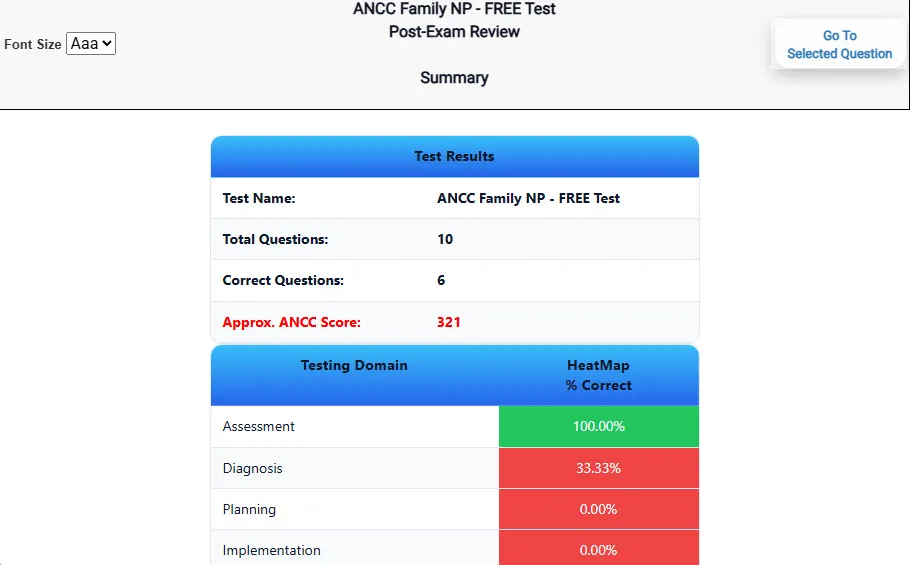
Heatmaps and scaled scores highlight weak areas.

High-Yield Rationales

Concise explanations emphasize key concepts.

Realistic Interface

Matches the feel of the actual exam environment.

Accessible by Design

Clean layout reduces cognitive load.

Anytime, Anywhere

Web-based access 24/7 on any device.
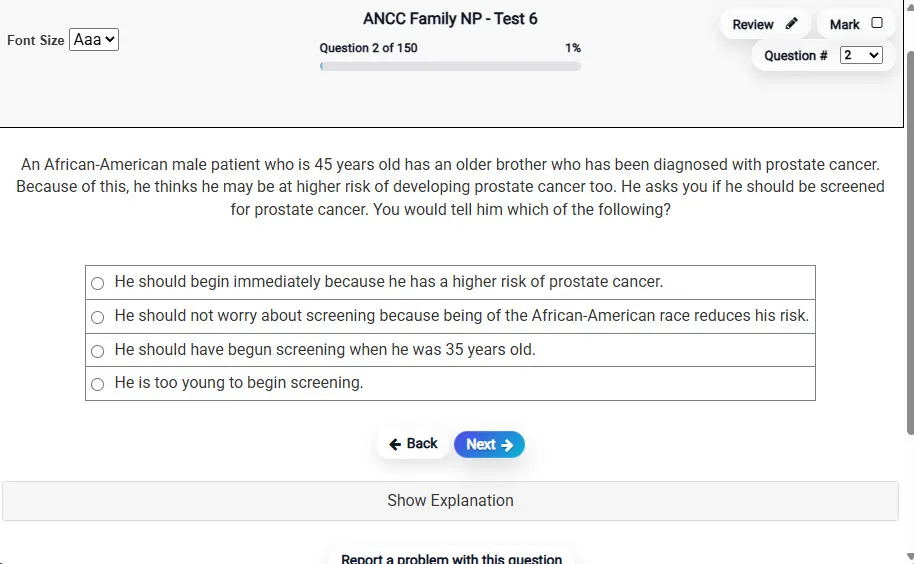
Answering a Question screen – Multiple-choice item view with navigation controls and progress tracker.
Answering a Question Multiple-choice item view with navigation controls and progress tracker.

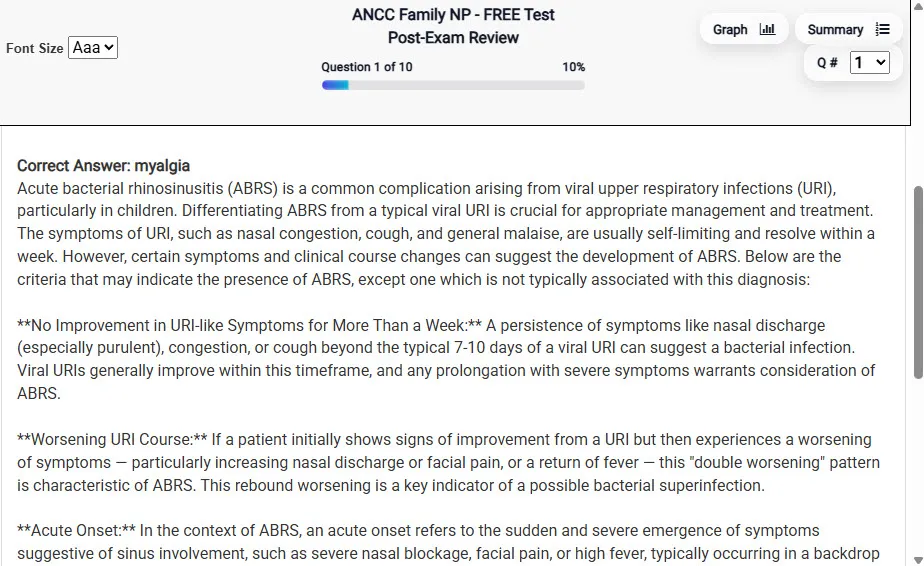
                           Detailed Explanation screen – 
                         Review mode showing chosen answer and rationale and references.
Detailed Explanation Review mode showing chosen answer and rationale and references.

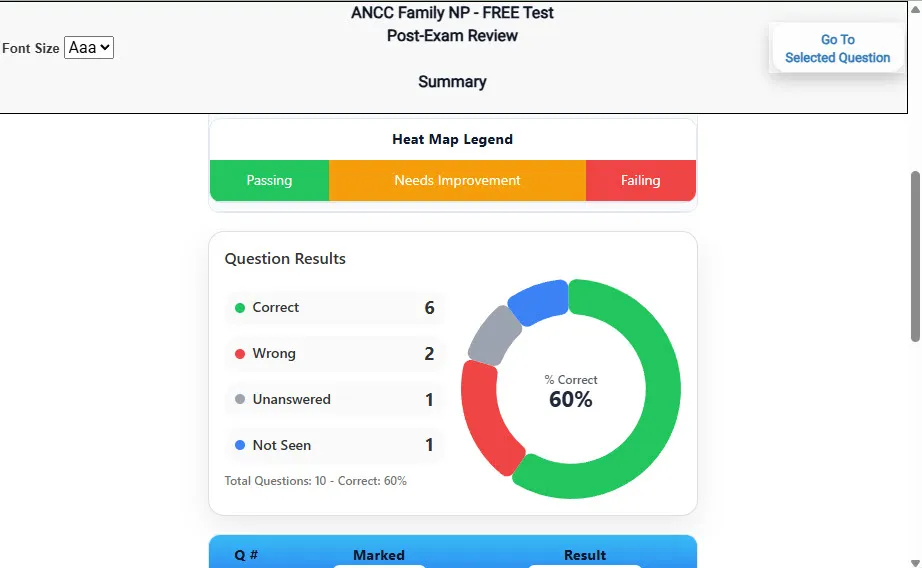
                           Review Summary 1 screen – 
                         Summary with counts for correct/wrong/unanswered and not seen items.
Review Summary 1 Summary with counts for correct/wrong/unanswered and not seen items.

                           Review Summary 2 screen – 
                         Advanced summary with category/domain breakdown and performance insights.
Review Summary 2 Advanced summary with category/domain breakdown and performance insights.

What Each Screen Shows

Answer Question Screen

  • Clean multiple-choice interface with progress bar.
  • Mark for review feature.
  • Matches real test pacing.

Detailed Explanation

  • Correct answer plus rationale.
  • Key concepts and guidelines highlighted.
  • Move between questions to fill knowledge gaps.

Review Summary 1

  • Overall results with total questions and scaled score.
  • Domain heatmap shows strengths and weaknesses.
  • Quick visual feedback on study priorities.

Review Summary 2

  • Chart of correct, wrong, unanswered, not seen.
  • Color-coded results for easy review.
  • Links back to missed items.

Top 10 Reasons to Use Exam Edge for your TEAS Test of Essential Academic Skills Combined 7 Exam Prep

  1. Focused on the TEAS Test of Essential Academic Skills Combined 7 Exam

    Our practice tests are built specifically for the TEAS Combined 7 exam — every question mirrors the real topics, format, and difficulty so you're studying exactly what matters.

  2. Real Exam Simulation

    We match the per-question time limits and pressure of the actual TEAS exam, so test day feels familiar and stress-free.

  3. 20 Full Practice Tests & 3,400 Unique Questions

    You'll have more than enough material to master every TEAS Combined 7 concept — no repeats, no fluff.

  4. Lower Cost Than a Retake

    Ordering 5 practice exams costs less than retaking the TEAS Test of Essential Academic Skills Combined 7 exam after a failure. One low fee could save you both time and money.

  5. Flexible Testing

    Need to step away mid-exam? Pick up right where you left off — with your remaining time intact.

  6. Instant Scoring & Feedback

    See your raw score and an estimated TEAS Test of Essential Academic Skills Combined 7 score immediately after finishing each practice test.

  7. Detailed Explanations for Every Question

    Review correct and incorrect answers with clear, step-by-step explanations so you truly understand each topic.

  8. Trusted & Accredited

    We're fully accredited by the Better Business Bureau and uphold the highest standards of trust and transparency.

  9. Web-Based & Always Available

    No software to install. Access your TEAS Combined 7 practice exams 24/7 from any computer or mobile device.

  10. Expert Support When You Need It

    Need extra help? Our specialized tutors are highly qualified and ready to support your TEAS exam prep.


Pass the TEAS Test of Essential Academic Skills Combined 7 Exam with Realistic Practice Tests from Exam Edge

Preparing for your upcoming TEAS Test of Essential Academic Skills Combined 7 () Certification Exam can feel overwhelming — but the right practice makes all the difference. Exam Edge gives you the tools, structure, and confidence to pass on your first try. Our online practice exams are built to match the real TEAS Combined 7 exam in content, format, and difficulty.

  • 📝 20 TEAS Test of Essential Academic Skills Combined 7 Practice Tests: Access 20 full-length exams with 170 questions each, covering every major TEAS Test of Essential Academic Skills Combined 7 topic in depth.
  • Instant Online Access: Start practicing right away — no software, no waiting.
  • 🧠 Step-by-Step Explanations: Understand the reasoning behind every correct answer so you can master TEAS Combined 7 exam concepts.
  • 🔄 Retake Each Exam Up to 4 Times: Build knowledge through repetition and track your improvement over time.
  • 🌐 Web-Based & Available 24/7: Study anywhere, anytime, on any device.
  • 🧘 Boost Your Test-Day Confidence: Familiarity with the TEAS format reduces anxiety and helps you perform under pressure.

These TEAS Test of Essential Academic Skills Combined 7 practice exams are designed to simulate the real testing experience by matching question types, timing, and difficulty level. This approach helps you get comfortable not just with the exam content, but also with the testing environment, so you walk into your exam day focused and confident.

Exam Edge TEAS Reviews


TEAS Test of Essential Academic Skills Combined 7 Aliases Test Name

Here is a list of alternative names used for this exam.

  • TEAS Test of Essential Academic Skills Combined 7
  • TEAS Test of Essential Academic Skills Combined 7 test
  • TEAS Test of Essential Academic Skills Combined 7 Certification Test
  • TEAS Combined 7 test
  • TEAS
  • TEAS
  • test
  • TEAS Test of Essential Academic Skills Combined 7 ()
  • Test of Essential Academic Skills Combined 7 certification