This is the content of the pop-over!

Lightning Deal Alert – 12% Off Ends at Midnight!

Strike while the savings are hot! Use promo code FlashSale at checkout for 12% off any Exam Edge test or bundle. Hurry—the clock is ticking!

TABE Reading Practice Tests & Test Prep by Exam Edge


Test of Adult Basic Education Reading  product image
(5.0)
Based on 29 Reviews

  • Real Exam Simulation: Timed questions and matching content build comfort for your TABE Reading test day.
  • Instant, 24/7 Access: Web-based Test of Adult Basic Education Reading practice exams with no software needed.
  • Clear Explanations: Step-by-step answers and explanations for your TABE exam to strengthen understanding.
  • Boosted Confidence: Reduces anxiety and improves test-taking skills to ace your Test of Adult Basic Education Reading .

Featured on

Test of Adult Basic Education Reading Online Practice Test Bundles

BEST VALUE
20 practice tests

$174.00

$799.00

SAVE $625

Only $8.70 per test!

  • 100% Pass Guarantee
  • 20 online practice tests
  • 50 questions per test
  • Bonus: Study Guide
  • Instant access
  • Detailed Explanations
  • Practice tests never expire
  • Timed, untimed, or study guide mode
MOST POPULAR
10 practice tests

$99.50

$399.50

SAVE $300

Only $9.95 per test!

  • 10 online practice tests
  • 50 questions per test
  • Bonus: Study Guide
  • Instant access
  • Detailed Explanations
  • Practice tests never expire
  • Timed, untimed, or study guide mode
5 practice tests

$69.75

$199.75

SAVE $130

Only $13.95 per test!

  • 5 online practice tests
  • 50 questions per test
  • Instant access
  • Detailed Explanations
  • Practice tests never expire
  • Timed, untimed, or study guide mode
1 practice test

$39.95

  • 1 online practice test
  • 50 questions per test
  • Instant access
  • Detailed Explanations
  • Practice tests never expire
  • Timed, untimed, or study guide mode
Quick Select
Tap to choose a bundle

** All Prices are in US Dollars (USD) **


TABE Reading () Resources

Jump to the section you need most.

Understanding the exact breakdown of the Test of Adult Basic Education Reading test will help you know what to expect and how to most effectively prepare. The Test of Adult Basic Education Reading has multiple-choice questions . The exam will be broken down into the sections below:

Test of Adult Basic Education Reading Exam Blueprint
Domain Name
Reading  
     Phonological Awareness  
     Phonics and Word Recognition  
     Key Ideas and Details  
     Craft and Structure  
     Integration of Knowledge and Ideas  

Test of Adult Basic Education Reading Study Tips by Domain

  • Check the question stem first (e.g., “best evidence,” “main idea,” “meaning of a word”) and match your strategy to it—red flag: answering from prior knowledge instead of the passage.
  • Use a two-pass approach: quick skim for purpose and structure, then reread only the lines tied to the question—common trap: rereading the entire passage for every item and running out of time.
  • For vocabulary-in-context, reread the sentence before/after and substitute the answer choice into the sentence—red flag: picking the most familiar definition instead of the one that fits the context.
  • For inference questions, choose the option that is most supported (not the most exciting) and can be backed by a specific phrase or detail—common trap: selecting an answer that could be true but isn’t proven.
  • When two answers seem right, eliminate the one with extreme words (e.g., “always,” “never,” “completely”) unless the passage is equally absolute—priority rule: stick to what the text states or strongly implies.
  • Monitor comprehension by pausing at paragraph breaks to paraphrase in one sentence what you just read—red flag: realizing at the questions that you can’t explain what the passage was mainly about.
  • Practice segmenting spoken words into phonemes (e.g., “ship” = /sh/ /i/ /p/) because TABE items often hinge on sound-by-sound accuracy—red flag: guessing based on spelling.
  • Work on blending phonemes to form a word quickly; a common trap is blending only the first two sounds and then guessing the rest.
  • Train to identify the first, middle, and final sound in a word; priority rule: isolate one position at a time so you don’t confuse the vowel sound with nearby consonants.
  • Use phoneme deletion and substitution (say “smile” without /s/; change /m/ to /t/) as a check for true sound awareness—red flag: changing letters instead of sounds.
  • Distinguish syllables vs. phonemes (e.g., “cat” = 1 syllable, 3 phonemes); common trap: counting claps (syllables) when the question asks for individual sounds.
  • Watch for digraphs and blends in spoken form (e.g., /ch/, /sh/, /th/ vs. /s/+/t/); contraindication: treating /ch/ as two separate sounds when it’s one phoneme.
  • Use letter–sound patterns (CVC, CVCC, CCVC, silent-e) to decode quickly; red flag: guessing a word from the first letter instead of sounding through.
  • Apply common vowel teams/digraphs (ea, ai, oa, oi/oy, sh, ch, th) and confirm with context; trap: assuming every “ea” says /e/ (e.g., “head”).
  • Recognize r-controlled vowels (ar, er/ir/ur, or) as one unit to avoid mispronunciations; priority rule: treat “er/ir/ur” as the same sound in most TABE items.
  • Use syllable types (closed, open, vowel-consonant-e, vowel team, r-controlled) to read multisyllabic words; cue: divide between doubled consonants (rab-bit) and don’t over-split blends.
  • Identify prefixes/suffixes and base words (un-, re-, -tion, -ed, -ly) to decode and predict meaning; contraindication: adding extra sounds (saying “walk-ed” with two syllables) when -ed is /t/ or /d/.
  • Track irregular high-frequency words (said, does, have, one) and read them by sight when decoding fails; red flag: repeatedly sounding out the same sight word instead of recognizing it.
  • Identify the central idea and choose the option that restates it most broadly — red flag: answers that zoom in on one example or statistic from the passage.
  • Determine the author’s main purpose (inform, persuade, explain, entertain) by checking the overall tone and evidence — common trap: picking a purpose based on the topic, not what the author actually does.
  • Locate explicit details quickly by scanning for proper nouns, numbers, dates, and repeated key terms — priority rule: match wording precisely to the question to avoid near-synonym distractors.
  • Make text-based inferences only when the passage provides enough clues — red flag: any answer requiring outside knowledge or assumptions beyond what’s stated or implied.
  • Summarize a section in one sentence using “somebody/wanted/but/so” (for narratives) or “topic/claim/support” (for informational text) — common trap: including minor details instead of the big idea.
  • Track sequence and cause-and-effect using signal words (first, then, because, therefore, as a result) — threshold cue: if two choices are plausible, pick the one supported by multiple lines, not a single phrase.
  • Determine meaning of a word or phrase in context by checking nearby clues (definition, example, contrast)—red flag: choosing a familiar meaning that doesn’t fit the sentence.
  • Identify the author’s purpose (to inform, explain, persuade, entertain) using tone and details—common trap: labeling it “persuade” just because the author has an opinion.
  • Analyze how a paragraph or sentence functions (introduces, supports, contrasts, concludes, gives an example)—priority rule: pick the choice that describes the job it does in the passage, not what you think is important.
  • Recognize point of view and its impact (first-person vs. third-person, limited vs. omniscient)—red flag: assuming you know characters’ thoughts when the narrator doesn’t state them.
  • Compare how two texts treat the same topic (focus, tone, evidence, structure)—common trap: answering from outside knowledge instead of what each text actually says.
  • Use text features and structure (chronological, cause/effect, problem/solution, compare/contrast) to locate information fast—threshold cue: if a question asks “how is it organized,” look for signal words like “because,” “as a result,” “however,” and “first.”
  • Synthesize ideas across two passages on the same topic (compare claims, evidence, and conclusions) — red flag: answering from only one text when the question says “both” or “across passages.”
  • Evaluate an author’s argument by checking whether reasons actually support the claim and whether evidence is relevant and sufficient — common trap: confusing an example or statistic with proof if it doesn’t match the claim.
  • Use visuals (charts, tables, timelines, captions) to confirm or revise what the text says — priority rule: if the question points to a figure, pull the exact value/trend from it instead of guessing from the paragraph.
  • Distinguish fact from opinion and notice loaded language or bias — red flag: words like “always,” “never,” or emotional labels often signal opinion or overstatement.
  • Assess whether a source is credible by noting author expertise, date, and whether claims are supported by verifiable details — common trap: treating a confident tone as reliability.
  • Explain how multiple sources connect (cause/effect, problem/solution, sequence) — threshold cue: identify the shared topic first, then state one clear relationship using evidence from each source.


Built to Fit Into Your Busy Life

Everything you need to prepare with confidence—without wasting a minute.

Three Study Modes

Timed, No Time Limit, or Explanation mode.

Actionable Analytics

Heatmaps and scaled scores highlight weak areas.

High-Yield Rationales

Concise explanations emphasize key concepts.

Realistic Interface

Matches the feel of the actual exam environment.

Accessible by Design

Clean layout reduces cognitive load.

Anytime, Anywhere

Web-based access 24/7 on any device.
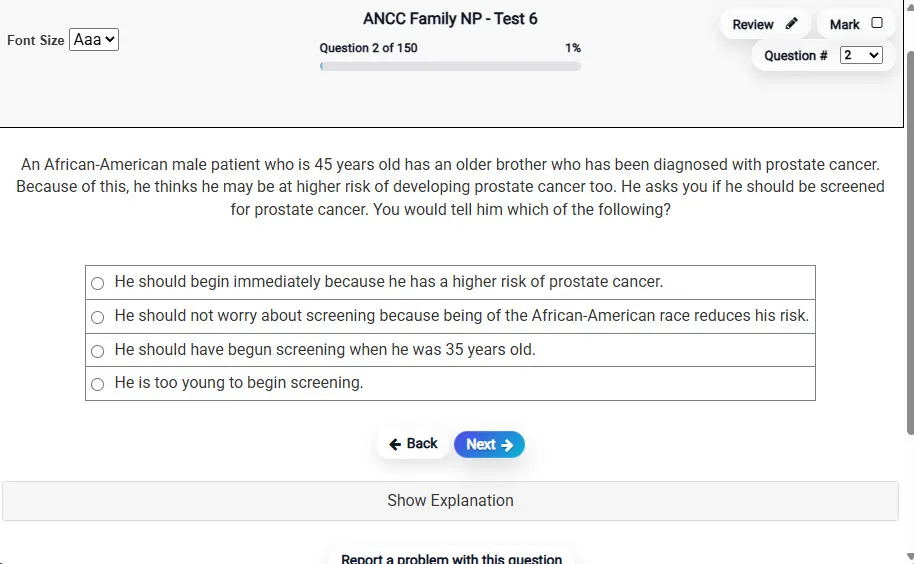
Answering a Question screen – Multiple-choice item view with navigation controls and progress tracker.
Answering a Question Multiple-choice item view with navigation controls and progress tracker.

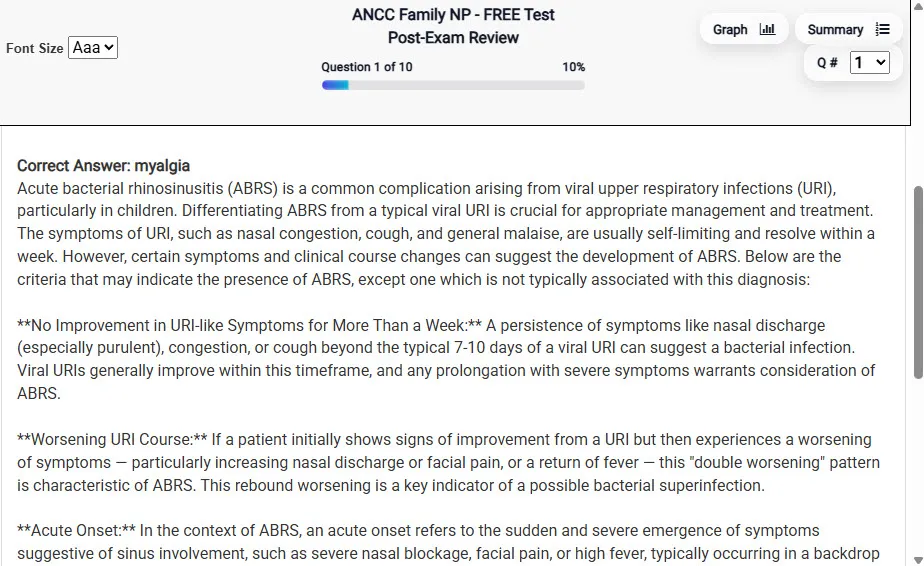
                           Detailed Explanation screen – 
                         Review mode showing chosen answer and rationale and references.
Detailed Explanation Review mode showing chosen answer and rationale and references.

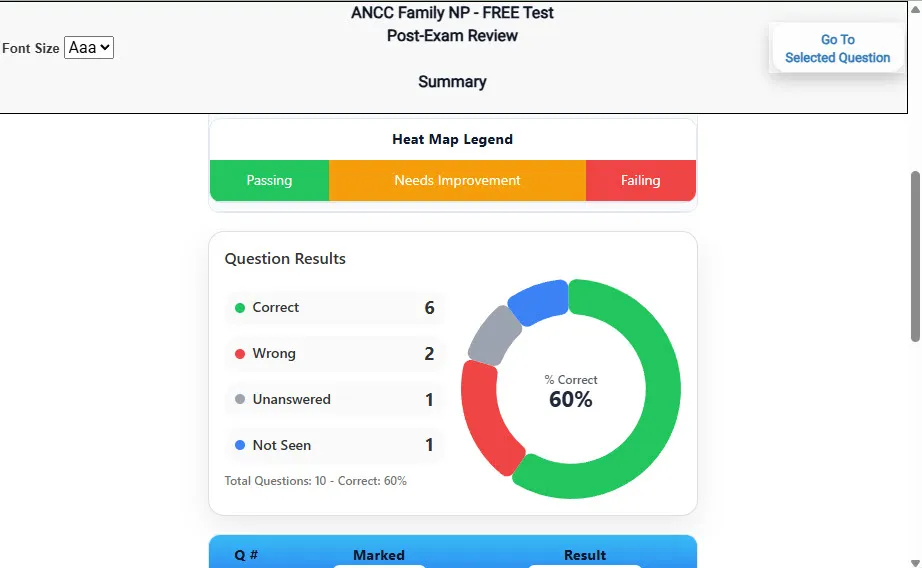
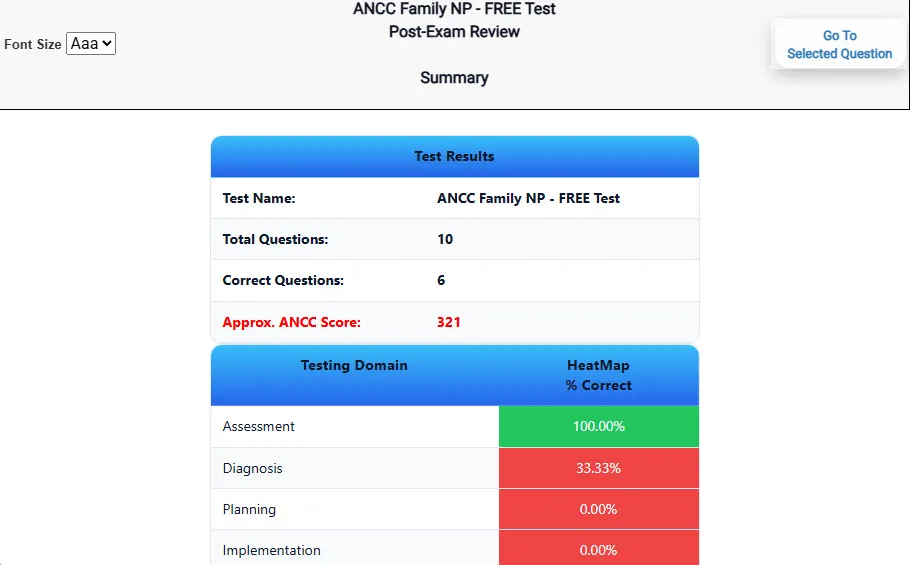
                           Review Summary 1 screen – 
                         Summary with counts for correct/wrong/unanswered and not seen items.
Review Summary 1 Summary with counts for correct/wrong/unanswered and not seen items.

                           Review Summary 2 screen – 
                         Advanced summary with category/domain breakdown and performance insights.
Review Summary 2 Advanced summary with category/domain breakdown and performance insights.

What Each Screen Shows

Answer Question Screen

  • Clean multiple-choice interface with progress bar.
  • Mark for review feature.
  • Matches real test pacing.

Detailed Explanation

  • Correct answer plus rationale.
  • Key concepts and guidelines highlighted.
  • Move between questions to fill knowledge gaps.

Review Summary 1

  • Overall results with total questions and scaled score.
  • Domain heatmap shows strengths and weaknesses.
  • Quick visual feedback on study priorities.

Review Summary 2

  • Chart of correct, wrong, unanswered, not seen.
  • Color-coded results for easy review.
  • Links back to missed items.

Top 10 Reasons to Use Exam Edge for your Test of Adult Basic Education Reading Exam Prep

  1. Focused on the Test of Adult Basic Education Reading Exam

    Our practice tests are built specifically for the TABE Reading exam — every question mirrors the real topics, format, and difficulty so you're studying exactly what matters.

  2. Real Exam Simulation

    We match the per-question time limits and pressure of the actual TABE exam, so test day feels familiar and stress-free.

  3. 20 Full Practice Tests & 1,000 Unique Questions

    You'll have more than enough material to master every TABE Reading concept — no repeats, no fluff.

  4. Lower Cost Than a Retake

    Ordering 5 practice exams costs less than retaking the Test of Adult Basic Education Reading exam after a failure. One low fee could save you both time and money.

  5. Flexible Testing

    Need to step away mid-exam? Pick up right where you left off — with your remaining time intact.

  6. Instant Scoring & Feedback

    See your raw score and an estimated Test of Adult Basic Education Reading score immediately after finishing each practice test.

  7. Detailed Explanations for Every Question

    Review correct and incorrect answers with clear, step-by-step explanations so you truly understand each topic.

  8. Trusted & Accredited

    We're fully accredited by the Better Business Bureau and uphold the highest standards of trust and transparency.

  9. Web-Based & Always Available

    No software to install. Access your TABE Reading practice exams 24/7 from any computer or mobile device.

  10. Expert Support When You Need It

    Need extra help? Our specialized tutors are highly qualified and ready to support your TABE exam prep.


Pass the Test of Adult Basic Education Reading Exam with Realistic Practice Tests from Exam Edge

Preparing for your upcoming Test of Adult Basic Education Reading () Certification Exam can feel overwhelming — but the right practice makes all the difference. Exam Edge gives you the tools, structure, and confidence to pass on your first try. Our online practice exams are built to match the real TABE Reading exam in content, format, and difficulty.

  • 📝 20 Test of Adult Basic Education Reading Practice Tests: Access 20 full-length exams with 50 questions each, covering every major Test of Adult Basic Education Reading topic in depth.
  • Instant Online Access: Start practicing right away — no software, no waiting.
  • 🧠 Step-by-Step Explanations: Understand the reasoning behind every correct answer so you can master TABE Reading exam concepts.
  • 🔄 Retake Each Exam Up to 4 Times: Build knowledge through repetition and track your improvement over time.
  • 🌐 Web-Based & Available 24/7: Study anywhere, anytime, on any device.
  • 🧘 Boost Your Test-Day Confidence: Familiarity with the TABE format reduces anxiety and helps you perform under pressure.

These Test of Adult Basic Education Reading practice exams are designed to simulate the real testing experience by matching question types, timing, and difficulty level. This approach helps you get comfortable not just with the exam content, but also with the testing environment, so you walk into your exam day focused and confident.

Exam Edge TABE Reviews


Test of Adult Basic Education Reading Aliases Test Name

Here is a list of alternative names used for this exam.

  • Test of Adult Basic Education Reading
  • Test of Adult Basic Education Reading test
  • Test of Adult Basic Education Reading Certification Test
  • TABE Reading test
  • TABE
  • TABE
  • test
  • Test of Adult Basic Education Reading ()
  • Test of Adult Basic Education Reading certification