This is the content of the pop-over!

Lightning Deal Alert – 12% Off Ends at Midnight!

Strike while the savings are hot! Use promo code FlashSale at checkout for 12% off any Exam Edge test or bundle. Hurry—the clock is ticking!

CA Food Safety Manager Practice Tests & Test Prep by Exam Edge


CA Food Safety Manager   product image
(5.0)
Based on 29 Reviews

  • Real Exam Simulation: Timed questions and matching content build comfort for your CA Food Safety Manager test day.
  • Instant, 24/7 Access: Web-based CA Food Safety Manager practice exams with no software needed.
  • Clear Explanations: Step-by-step answers and explanations for your ServSafe exam to strengthen understanding.
  • Boosted Confidence: Reduces anxiety and improves test-taking skills to ace your CA Food Safety Manager .

Featured on

CA Food Safety Manager Online Practice Test Bundles

BEST VALUE
15 practice tests

$149.25

$599.25

SAVE $450

Only $9.95 per test!

  • 100% Pass Guarantee
  • 15 online practice tests
  • 90 questions per test
  • Bonus: 100 Flash Cards + Study Guide
  • Instant access
  • Detailed Explanations
  • Practice tests never expire
  • Timed, untimed, or study guide mode
MOST POPULAR
10 practice tests

$99.50

$399.50

SAVE $300

Only $9.95 per test!

  • 10 online practice tests
  • 90 questions per test
  • Bonus: 100 Flash Cards + Study Guide
  • Instant access
  • Detailed Explanations
  • Practice tests never expire
  • Timed, untimed, or study guide mode
5 practice tests

$69.75

$199.75

SAVE $130

Only $13.95 per test!

  • 5 online practice tests
  • 90 questions per test
  • Bonus: 100 Flash Cards
  • Instant access
  • Detailed Explanations
  • Practice tests never expire
  • Timed, untimed, or study guide mode
1 practice test

$39.95

  • 1 online practice test
  • 90 questions per test
  • Instant access
  • Detailed Explanations
  • Practice tests never expire
  • Timed, untimed, or study guide mode
Quick Select
Tap to choose a bundle

** All Prices are in US Dollars (USD) **


CA Food Safety Manager () Resources

Jump to the section you need most.

Understanding the exact breakdown of the CA Food Safety Manager test will help you know what to expect and how to most effectively prepare. The CA Food Safety Manager has 90 multiple-choice questions . The exam will be broken down into the sections below:

CA Food Safety Manager Exam Blueprint
Domain Name % Number of
Questions
Preventing Contamination and Cross-Contamination 19% 17
Ensuring Personal Hygiene and Employee Health 18% 16
Actively Managing Controls in a Food Establishment 16% 14
Monitoring the Flow of Foods 13% 12
Ensuring Product Time and Temperature 14% 12
Conducting Cleaning and Sanitizing 11% 10
Managing the Physical Facility Design and Maintenance 6% 5
Preventing and Controlling Pests (Insects/Rodents) 4% 4

CA Food Safety Manager Study Tips by Domain

  • Separate raw animal foods from ready-to-eat (RTE) foods in storage and prep; priority rule: store raw poultry below ground meats, below whole cuts, below seafood, with RTE always on top—red flag if raw drips can reach RTE items.
  • Use dedicated, labeled cutting boards/knives for raw vs RTE and clean/sanitize between tasks; common trap: wiping with a cloth (even “looks clean”) instead of proper wash–rinse–sanitize.
  • Prevent bare-hand contact with RTE foods by using gloves, deli tissue, tongs, or spatulas; red flag: glove use without handwashing when changing tasks or after touching nonfood surfaces.
  • Control allergen cross-contact with separate storage, utensils, and clear labeling; priority cue: clean and sanitize shared equipment between allergen and non-allergen runs—common trap is assuming heat “kills” allergens (it doesn’t).
  • Keep food-contact surfaces protected from chemical contamination by storing cleaners/sanitizers away from food and packaging; red flag: spray bottles without labels or chemicals stored above prep areas.
  • Use food-grade containers and avoid reusing single-use packaging (e.g., cardboard produce boxes) for food storage; common trap: storing acidic foods in reactive/unknown containers that can leach contaminants.
  • Exclude or restrict employees based on symptoms and diagnosis—vomiting, diarrhea, jaundice, or sore throat with fever are immediate red flags, and a diagnosed norovirus/salmonella/shigella/STEC/hepatitis A case requires strict exclusion and reporting.
  • Enforce proper handwashing (soap, warm water, 20 seconds, air-dry) at key moments—after restroom use, handling raw foods, touching face/phone, or taking out trash; a common trap is assuming gloves replace handwashing.
  • Glove and utensil use: use gloves/deli tissue/tongs for ready-to-eat foods and change gloves when contaminated or after task changes—red flag is bare-hand contact with RTE foods without an approved alternative procedure.
  • Control employee beverages and eating—allow only in designated areas and require a closed, covered container with a straw/sippy lid; red flag is an open cup stored on a prep table or next to clean utensils.
  • Maintain clean, appropriate attire—hair restraints, clean clothing/aprons, and remove jewelry from hands/arms (except a plain band ring); common trap is wearing the same soiled apron from raw handling into RTE prep.
  • Wound and illness management: cover cuts with an impermeable bandage and a glove/finger cot, and keep ill workers out of food areas; priority rule is to act immediately when jaundice lasts ≥24 hours or when symptoms start during a shift.
  • Set up Active Managerial Control (AMC) by identifying the top risk factors (time/temperature abuse, cross-contamination, poor hygiene, contaminated equipment, unsafe sources) and assigning who checks what each shift—red flag: “no one owns the log” means controls won’t happen consistently.
  • Use a written monitoring system (temps, sanitizer strength, cooling, hot holding) with corrective actions pre-defined—common trap: recording numbers without taking action when a reading is out of range.
  • Verify controls by calibrating thermometers, observing practices, and reviewing records at least daily—priority rule: if you didn’t verify it, assume it drifted (especially sanitizer and cold holding).
  • Implement corrective actions immediately when critical limits aren’t met (e.g., reheat, rapidly cool, discard, re-sanitize) and document what was done—red flag: “we fixed it later” often means product stayed in the danger zone too long.
  • Control approved sources and receiving checks (packaging intact, temps, dates, shellfish tags) before storage—common trap: accepting deliveries without measuring temperatures because “the truck feels cold.”
  • Train and enforce standard procedures (SOPs) for handwashing, glove use, illness reporting, and cleaning schedules, then hold staff accountable—contraindication: letting an ill employee work food prep because they “feel better today” undermines all controls.
  • Verify receiving criteria on arrival—cold TCS foods at 41°F or lower, hot foods at 135°F or higher, and reject anything with off-odors, mold, or thaw/refreeze signs (red flag: wet cartons or swollen cans).
  • Enforce proper thawing flow—in refrigeration (41°F or lower), under running water at 70°F or lower, in the microwave followed by immediate cooking, or as part of cooking (common trap: thawing on the counter).
  • Control cooling steps during prep-to-storage flow—cool 135°F to 70°F within 2 hours and 70°F to 41°F within 4 more hours; if the first step fails, reheat to 165°F and restart or discard.
  • Prevent time/temperature abuse during service and transport—maintain cold holding at 41°F or lower and hot holding at 135°F or higher (red flag: pans overfilled or stacked, blocking cold air circulation).
  • Apply cooking and reheating endpoints as food moves to hot holding—reheat previously cooked TCS foods to 165°F within 2 hours before holding; never “top off” old product with new.
  • Manage date marking and FIFO for ready-to-eat TCS foods held over 24 hours—limit to 7 days at 41°F or lower (day 1 is the prep/open day); discard if date is missing or unclear.
  • Keep TCS food out of the temperature danger zone (41°F–135°F) as a priority rule; red flag: foods held without a thermometer check at least every 4 hours.
  • Verify cooking meets minimum internal temps (e.g., poultry 165°F, ground meats 155°F, seafood/steaks 145°F for 15 seconds) and use a calibrated probe; common trap: relying on color or cook time instead of temp.
  • Hot-hold at 135°F or above and cold-hold at 41°F or below, then take corrective action immediately if out of range; red flag: warming drawers/steam tables used to reheat or cook.
  • Reheat previously cooked TCS foods to 165°F within 2 hours for hot holding; common trap: slow reheating in a steam table or on a buffet line.
  • Cool cooked TCS food from 135°F to 70°F within 2 hours and to 41°F within a total of 6 hours using rapid methods; red flag: deep, covered containers in the cooler.
  • Use time as a control only with written procedures and strict limits (e.g., discard at 4 hours without temperature control) and mark start times; common trap: extending time because the food “still feels cold/warm.”
  • Match the sanitizer to the surface and use test strips every shift—a common trap is “eyeballing” concentration, which can leave food-contact surfaces effectively unsanitized.
  • Follow the correct sequence: scrape/rinse, wash, rinse, sanitize, air-dry—red flag: towel-drying sanitized equipment can re-contaminate it.
  • Maintain proper warewashing temperatures and contact times; priority rule: if a high-temp machine isn’t reaching required final rinse heat, switch to chemical sanitizing and document the corrective action.
  • Change wiping-cloth sanitizer buckets when solution is dirty or below target strength—common trap: storing cloths in plain water or on counters between uses.
  • Clean and sanitize food-contact items at required frequencies (e.g., at least every 4 hours when in continuous use with TCS foods)—red flag: utensils stored in standing water or on prep tables during service.
  • Use the right chemicals and storage practices—contraindication: never mix cleaners (especially bleach and ammonia) and always store chemicals below/away from food and single-use items.
  • Maintain potable water, adequate hot water, and functioning sewage/grease disposal—red flag: slow drains, sewer odors, or grease trap overflow require immediate corrective action to prevent contamination.
  • Keep floors, walls, and ceilings smooth, nonabsorbent, and in good repair—common trap: cracked tiles/grout and peeling paint become harborage and are hard to clean, often cited during inspection.
  • Ensure ventilation and lighting support safe operations—priority rule: exhaust hoods/filters must be maintained and shielded lighting used where food is exposed to prevent glass contamination.
  • Provide accessible, properly stocked handwashing sinks (hot/cold water, soap, single-use towels) where needed—contraindication: blocked sinks or using hand sinks for dumping/utensil storage is a frequent violation.
  • Maintain equipment installation and serviceability—threshold cue: keep adequate clearance for cleaning (or sealed to floor/wall) and don’t ignore torn gaskets, broken thermometers, or damaged food-contact surfaces.
  • Manage refuse and recycling areas to prevent odors, leaks, and pests—red flag: missing lids, unclean dumpsters, or standing liquid around waste containers signals poor facility maintenance and invites pests.
  • Set up an Integrated Pest Management (IPM) plan with routine monitoring logs and a licensed Pest Control Operator as needed—red flag: seeing droppings, gnaw marks, or live insects means you must increase inspections and correct entry/harborage conditions immediately.
  • Exclude pests by sealing gaps (door sweeps, screened vents, pipe penetrations) and keeping doors closed; common trap: leaving receiving doors propped open during deliveries invites rodents and flies.
  • Remove food sources by storing food 6 inches off the floor, in covered, pest-resistant containers, and rotating stock FIFO; red flag: torn bags, open bulk bins, or spilled ingredients under shelving are pest attractants.
  • Eliminate water and harborage by fixing leaks, keeping floor drains clean, and reducing clutter (especially cardboard); common trap: storing unused equipment or boxes against walls blocks inspection and creates nesting sites.
  • Use only approved pesticides and apply per label, kept locked and away from food/food-contact items; contraindication: never spray chemicals near exposed food, clean equipment, or food-contact surfaces without proper protection and post-cleaning.
  • Respond to sightings with corrective actions and documentation (where found, what was done, follow-up date); priority rule: if pests contaminate food or single-use items, discard them and sanitize affected surfaces before resuming service.


Built to Fit Into Your Busy Life

Everything you need to prepare with confidence—without wasting a minute.

Three Study Modes

Timed, No Time Limit, or Explanation mode.

Actionable Analytics

Heatmaps and scaled scores highlight weak areas.

High-Yield Rationales

Concise explanations emphasize key concepts.

Realistic Interface

Matches the feel of the actual exam environment.

Accessible by Design

Clean layout reduces cognitive load.

Anytime, Anywhere

Web-based access 24/7 on any device.
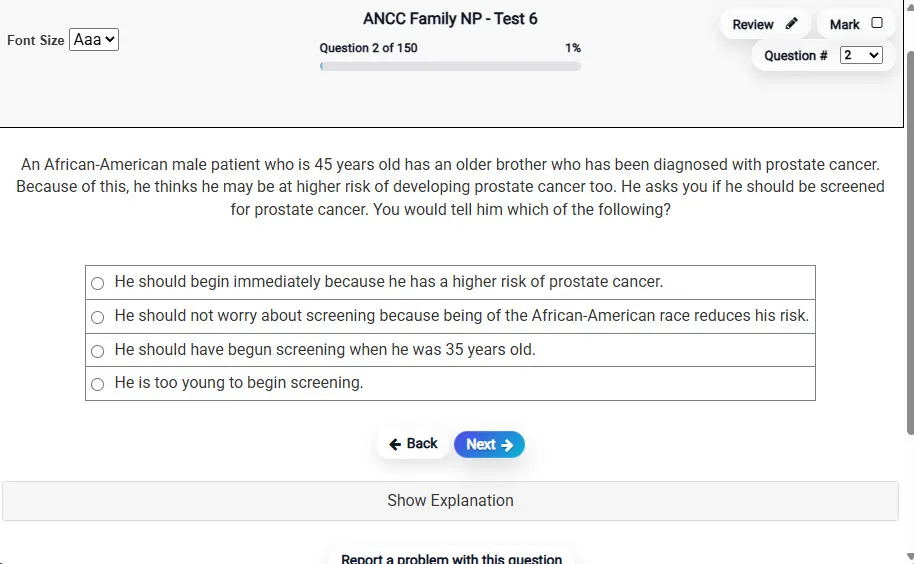
Answering a Question screen – Multiple-choice item view with navigation controls and progress tracker.
Answering a Question Multiple-choice item view with navigation controls and progress tracker.

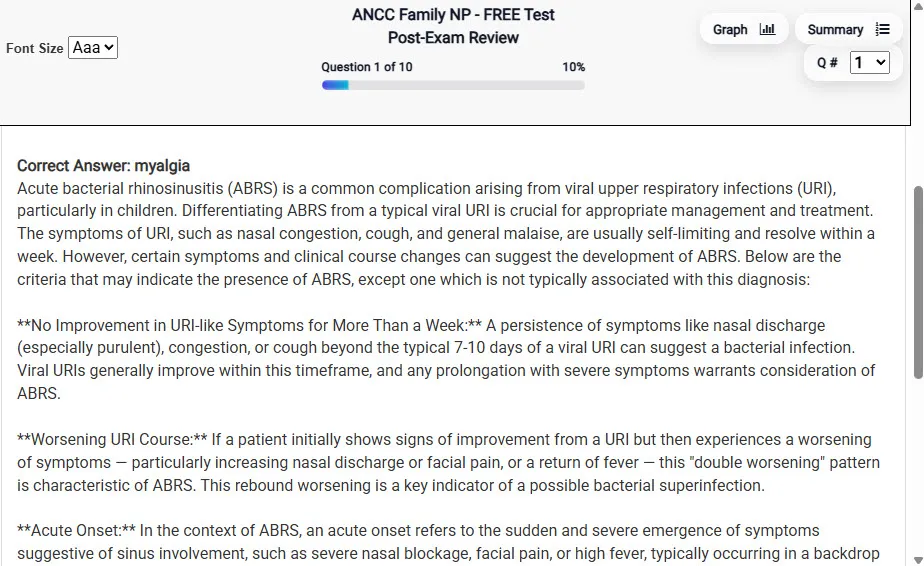
                           Detailed Explanation screen – 
                         Review mode showing chosen answer and rationale and references.
Detailed Explanation Review mode showing chosen answer and rationale and references.

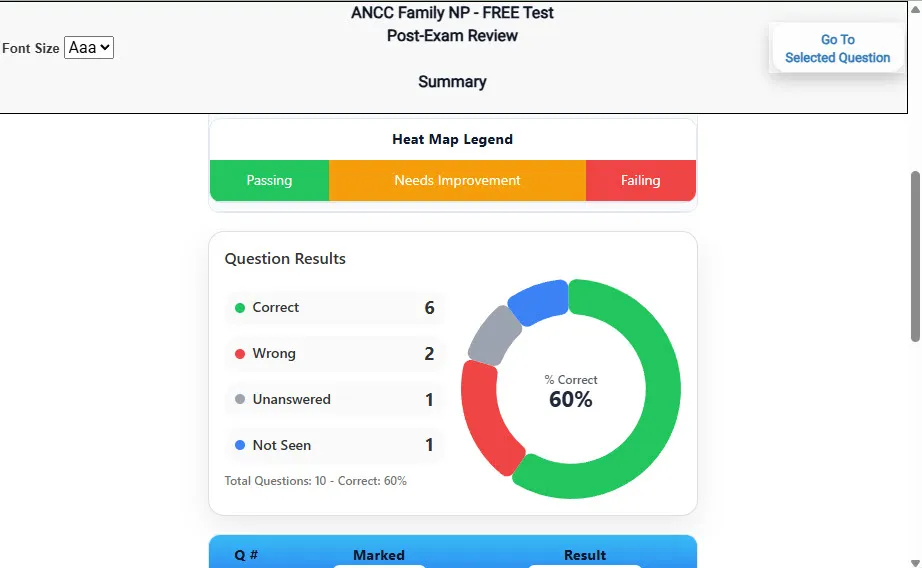
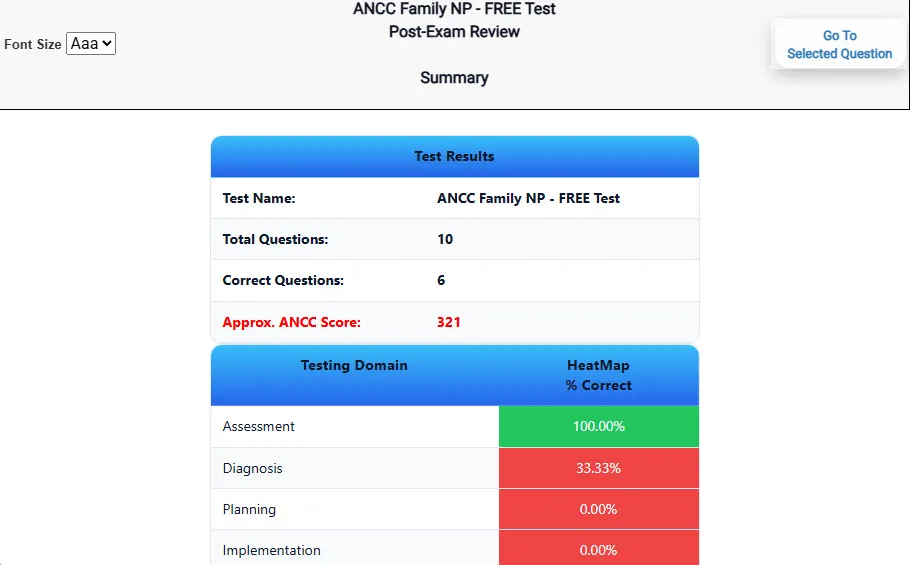
                           Review Summary 1 screen – 
                         Summary with counts for correct/wrong/unanswered and not seen items.
Review Summary 1 Summary with counts for correct/wrong/unanswered and not seen items.

                           Review Summary 2 screen – 
                         Advanced summary with category/domain breakdown and performance insights.
Review Summary 2 Advanced summary with category/domain breakdown and performance insights.

What Each Screen Shows

Answer Question Screen

  • Clean multiple-choice interface with progress bar.
  • Mark for review feature.
  • Matches real test pacing.

Detailed Explanation

  • Correct answer plus rationale.
  • Key concepts and guidelines highlighted.
  • Move between questions to fill knowledge gaps.

Review Summary 1

  • Overall results with total questions and scaled score.
  • Domain heatmap shows strengths and weaknesses.
  • Quick visual feedback on study priorities.

Review Summary 2

  • Chart of correct, wrong, unanswered, not seen.
  • Color-coded results for easy review.
  • Links back to missed items.

Top 10 Reasons to Use Exam Edge for your CA Food Safety Manager Exam Prep

  1. Focused on the CA Food Safety Manager Exam

    Our practice tests are built specifically for the CA Food Safety Manager exam — every question mirrors the real topics, format, and difficulty so you're studying exactly what matters.

  2. Real Exam Simulation

    We match the per-question time limits and pressure of the actual ServSafe exam, so test day feels familiar and stress-free.

  3. 15 Full Practice Tests & 1,350 Unique Questions

    You'll have more than enough material to master every CA Food Safety Manager concept — no repeats, no fluff.

  4. Lower Cost Than a Retake

    Ordering 5 practice exams costs less than retaking the CA Food Safety Manager exam after a failure. One low fee could save you both time and money.

  5. Flexible Testing

    Need to step away mid-exam? Pick up right where you left off — with your remaining time intact.

  6. Instant Scoring & Feedback

    See your raw score and an estimated CA Food Safety Manager score immediately after finishing each practice test.

  7. Detailed Explanations for Every Question

    Review correct and incorrect answers with clear, step-by-step explanations so you truly understand each topic.

  8. Trusted & Accredited

    We're fully accredited by the Better Business Bureau and uphold the highest standards of trust and transparency.

  9. Web-Based & Always Available

    No software to install. Access your CA Food Safety Manager practice exams 24/7 from any computer or mobile device.

  10. Expert Support When You Need It

    Need extra help? Our specialized tutors are highly qualified and ready to support your ServSafe exam prep.


Pass the CA Food Safety Manager Exam with Realistic Practice Tests from Exam Edge

Preparing for your upcoming CA Food Safety Manager () Certification Exam can feel overwhelming — but the right practice makes all the difference. Exam Edge gives you the tools, structure, and confidence to pass on your first try. Our online practice exams are built to match the real CA Food Safety Manager exam in content, format, and difficulty.

  • 📝 15 CA Food Safety Manager Practice Tests: Access 15 full-length exams with 90 questions each, covering every major CA Food Safety Manager topic in depth.
  • Instant Online Access: Start practicing right away — no software, no waiting.
  • 🧠 Step-by-Step Explanations: Understand the reasoning behind every correct answer so you can master CA Food Safety Manager exam concepts.
  • 🔄 Retake Each Exam Up to 4 Times: Build knowledge through repetition and track your improvement over time.
  • 🌐 Web-Based & Available 24/7: Study anywhere, anytime, on any device.
  • 🧘 Boost Your Test-Day Confidence: Familiarity with the ServSafe format reduces anxiety and helps you perform under pressure.

These CA Food Safety Manager practice exams are designed to simulate the real testing experience by matching question types, timing, and difficulty level. This approach helps you get comfortable not just with the exam content, but also with the testing environment, so you walk into your exam day focused and confident.


Exam Edge ServSafe Reviews


I cannot thank you enough. Because of your test practice, I just passed my exam! After practicing 11 exams, I was ready for the exam. The exam was so easy for me because of you. Thank you!

Dania,D, Orlando, FL,


CA Food Safety Manager Aliases Test Name

Here is a list of alternative names used for this exam.

  • CA Food Safety Manager
  • CA Food Safety Manager test
  • CA Food Safety Manager Certification Test
  • ServSafe
  • ServSafe
  • test
  • CA Food Safety Manager ()
  • CA Food Safety Manager certification