This is the content of the pop-over!

SANC Nurse Educator (SANC- Nurse ED) Practice Tests & Test Prep by Exam Edge


SANC Nurse Educator  product image
(4.8)
Based on 22 Reviews

  • Real Exam Simulation: Timed questions and matching content build comfort for your SANC Nurse Educator test day.
  • Instant, 24/7 Access: Web-based SANC Nurse Educator practice exams with no software needed.
  • Clear Explanations: Step-by-step answers and explanations for your SANC exam to strengthen understanding.
  • Boosted Confidence: Reduces anxiety and improves test-taking skills to ace your SANC Nurse Educator (SANC- Nurse ED).

Featured on

SANC Nurse Educator Online Practice Test Bundles

BEST VALUE
15 practice tests

$149.25

$599.25

SAVE $450

Only $9.95 per test!

  • 100% Pass Guarantee
  • 15 online practice tests
  • 100 questions per test
  • Bonus: 100 Flash Cards + Study Guide
  • Instant access
  • Detailed Explanations
  • Practice tests never expire
  • Timed, untimed, or study guide mode
MOST POPULAR
10 practice tests

$99.50

$399.50

SAVE $300

Only $9.95 per test!

  • 10 online practice tests
  • 100 questions per test
  • Bonus: 100 Flash Cards + Study Guide
  • Instant access
  • Detailed Explanations
  • Practice tests never expire
  • Timed, untimed, or study guide mode
5 practice tests

$69.75

$199.75

SAVE $130

Only $13.95 per test!

  • 5 online practice tests
  • 100 questions per test
  • Bonus: 100 Flash Cards
  • Instant access
  • Detailed Explanations
  • Practice tests never expire
  • Timed, untimed, or study guide mode
1 practice test

$39.95

  • 1 online practice test
  • 100 questions per test
  • Instant access
  • Detailed Explanations
  • Practice tests never expire
  • Timed, untimed, or study guide mode
Quick Select
Tap to choose a bundle

** All Prices are in US Dollars (USD) **


SANC Nurse Educator (SANC- Nurse ED) Resources

Jump to the section you need most.

Understanding the exact breakdown of the SANC Nurse Educator test will help you know what to expect and how to most effectively prepare. The SANC Nurse Educator has multiple-choice questions . The exam will be broken down into the sections below:

SANC Nurse Educator Exam Blueprint
Domain Name
Facilitate learning  
Facilitate student development and socialization  
Use assessment and evaluation strategies  
Participate in curriculum design and evaluation of program outcomes  
Function as a change agent and a leader  
Pursue continuous quality improvement in the nurse educator role  
Engage in scholarship  
Professional Practice  
Ethical Practice  
Legal Practice  

SANC Nurse Educator Study Tips by Domain

  • Align every learning activity to explicit outcomes and the SANC scope/competencies; red flag: teaching content that cannot be mapped to a stated outcome or required competence.
  • Select teaching strategies that match learner level and setting (class, skills lab, clinical) and include active practice; common trap: relying on lecture-only for psychomotor or clinical reasoning outcomes.
  • Ensure patient safety and supervision during clinical teaching with clear delegation limits; priority rule: learners may not perform high-risk procedures independently without documented competence and oversight.
  • Use evidence-based resources and current local guidelines when teaching; red flag: outdated protocols or “this is how we’ve always done it” without referencing accepted standards.
  • Communicate expectations and provide timely, specific feedback focused on observable performance; common trap: vague feedback (“good job”) that does not state what was correct or what must change.
  • Create an inclusive learning environment that supports diverse learners and addresses barriers early; contraindication: ignoring repeated absenteeism, language barriers, or distress signals that undermine safe learning and patient care.
  • Set clear professional role expectations early (scope, boundaries, communication, dress) and revisit them after each clinical rotation—red flag: students adopting unit shortcuts that conflict with SANC standards.
  • Provide structured orientation to clinical learning environments (chain of command, documentation norms, patient rights) with a checklist—common trap: assuming students will “pick it up” without explicit briefing.
  • Actively model and coach professional communication (SBAR, handover etiquette, respectful interprofessional behavior)—priority rule: address disrespect or unsafe communication immediately, not at end-of-rotation feedback.
  • Support identity formation through reflective practice (guided journaling or debriefs tied to SANC competencies)—red flag: reflections that describe events only, with no learning points or accountability.
  • Monitor and intervene on learner well-being and fitness-to-practise concerns (fatigue, substance use, repeated errors) using a documented escalation pathway—contraindication: allowing continued independent patient contact when safety is in doubt.
  • Create equitable support and remediation plans with measurable targets (attendance, skills sign-offs, professionalism incidents) and timelines—common trap: vague remediation that cannot be defended if progression decisions are challenged.
  • Align every assessment to stated learning outcomes and scope of practice; red flag: items testing content not taught or beyond registered nurse competencies are likely to be challenged in moderation.
  • Use a blueprint (test plan) to balance cognitive levels, content weighting, and marks; common trap: over-assessing recall when the outcome requires clinical reasoning and safe decision-making.
  • Apply transparent rubrics and checklists for skills and OSCEs with clear criteria and pass thresholds; red flag: “global impressions” without documented criteria undermine fairness and defensibility.
  • Implement standard setting and consistent pass/fail rules (including re-assessment conditions) before the assessment; priority rule: do not change cut-scores or special concessions after seeing results.
  • Ensure reliability and integrity through moderation, marker calibration, and secure handling of papers and scripts; red flag: inconsistent marking between assessors without calibration invites appeals and allegations of bias.
  • Use assessment data for feedback and remediation with timely, specific action plans; common trap: giving only a mark without feedforward, which limits improvement and may breach program quality expectations.
  • Align curriculum outcomes, content, and assessment with SANC scope-of-practice and competency expectations; red flag: outcomes that don’t map clearly to required competencies.
  • Use constructive alignment (outcomes → learning activities → assessment) when building modules; common trap: adding content without an explicit outcome or assessment plan.
  • Design clinical placement requirements to ensure adequate exposure across key service areas; priority rule: if placement capacity can’t support outcomes, adjust sequencing or numbers before implementation.
  • Build a program evaluation plan using multiple data sources (assessment results, clinical evaluations, moderation reports, stakeholder feedback); red flag: relying on pass rates alone as “proof” of quality.
  • Apply internal and external moderation processes to protect standards and fairness; common trap: inconsistent marking rubrics across campuses/clinical sites.
  • Close the loop with documented curriculum review actions, timelines, and responsible persons; threshold cue: if repeated deficits persist across two cycles, escalate to formal curriculum revision and governance approval.
  • Lead change using a structured approach (e.g., problem definition, stakeholder mapping, plan, implementation, review) and document decisions — red flag: implementing a “quick fix” without baseline data or a feedback loop.
  • Model professional leadership behaviours (punctuality, accountability, respectful communication) because students mirror educator conduct — common trap: tolerating minor unprofessionalism that later becomes a patient-safety risk.
  • Prioritise patient safety and public protection in all teaching and clinical placement decisions — contraindication: allowing students to perform beyond scope/competence due to staffing pressures.
  • Use influence ethically by engaging partners (clinical facilities, preceptors, students) early and clarifying roles and escalation pathways — red flag: unclear supervision lines leading to missed reporting of incidents.
  • Lead conflict and resistance management with transparent communication, evidence, and fair processes — common trap: framing change as non-negotiable without listening, which increases noncompliance and undermines team trust.
  • Evaluate change impact with measurable indicators (e.g., competency attainment, clinical incidents, learner feedback) and act on findings — priority rule: if outcomes worsen, pause and remediate before wider rollout.
  • Use a planned CQI cycle (e.g., PDSA) to address teaching/clinical placement gaps and document baseline, intervention, and re-measurement — red flag: changes made without evidence of improvement over time.
  • Track program indicators such as pass rates, clinical competence outcomes, attrition, and student feedback, and set explicit targets — common trap: relying on anecdotal complaints instead of trend data.
  • Close the feedback loop by communicating actions taken from evaluations to students, preceptors, and faculty — priority rule: feedback without documented follow-up is treated as non-actionable.
  • Align CQI actions with SANC requirements, institutional policies, and scope of practice expectations — red flag: implementing curriculum or assessment changes without required approvals or governance sign-off.
  • Use peer review, moderation, and reflective practice to identify educator development needs and plan CPD — common trap: skipping moderation when assessment results look “too good” or unexpectedly poor.
  • Manage quality risks proactively (e.g., unsafe clinical learning environments, repeated assessment irregularities, or high failure clusters) and escalate through the correct channels — threshold cue: repeated incidents require a formal corrective action plan, not informal coaching only.
  • Use current, peer-reviewed evidence to justify teaching strategies and clinical updates; red flag: relying on outdated protocols or “we’ve always done it this way” practices.
  • Formulate clear, answerable questions (e.g., PICO) and document your search strategy and sources; common trap: citing non-credible web content without verifying authorship, date, and relevance to South African practice.
  • Ensure research and scholarly projects comply with ethics approval and informed consent requirements; contraindication: collecting student data for publication without voluntary consent and protections against coercion.
  • Disseminate scholarship through presentations, publications, and teaching resources with accurate attribution; red flag: plagiarism or self-plagiarism, including copying learning materials without permission.
  • Evaluate the impact of educational innovations using measurable outcomes and appropriate methods; priority rule: link changes to learner performance and patient safety rather than satisfaction scores alone.
  • Maintain scholarly professionalism through reflective practice, mentorship, and collaboration; common trap: presenting opinion as evidence or overstating findings beyond the study’s limits.
  • Maintain current SANC registration and practice within your authorized scope—red flag: teaching or supervising procedures you are not legally competent or credentialed to perform.
  • Align teaching, supervision, and documentation with SANC standards and institutional policies—common trap: informal “workarounds” that bypass approved clinical learning pathways.
  • Demonstrate professional boundaries with students and staff—red flag: dual relationships (e.g., financial favors, social media intimacy) that compromise objectivity or safety.
  • Model evidence-informed practice and clinical reasoning in real-time—priority rule: if current evidence conflicts with routine ward practice, escalate and teach the rationale rather than reinforcing outdated habits.
  • Document student supervision, feedback, incidents, and remediation promptly and factually—common trap: vague notes (e.g., “improved”) without dates, criteria, or observed behaviors.
  • Advocate for patient safety and learning conditions in the clinical environment—threshold cue: stop a student activity immediately when there is risk of harm, then report through the prescribed chain of command.
  • Maintain clear professional boundaries with students and clinical staff—red flag: dual relationships (e.g., social/financial/romantic involvement) that could bias supervision or assessment.
  • Protect confidentiality of student records and patient information at all times; common trap: discussing learner performance or patient cases in public spaces or on social media, even without names.
  • Ensure fairness and transparency in assessment decisions; priority rule: apply the same published criteria and moderation process to all students—avoid changing requirements mid-rotation.
  • Model ethical clinical teaching by prioritizing patient safety and consent; contraindication: allowing students to perform procedures beyond competence or without appropriate supervision because the unit is busy.
  • Address academic integrity proactively; red flag: repeated similarity in assignments, unexplained shifts in writing style, or “group work” submitted as individual work—document and follow institutional processes.
  • Manage conflicts of interest and gifts ethically; common trap: accepting inducements from vendors or clinical sites that influence placement, procurement, or evaluation decisions—declare and recuse when required.


Built to Fit Into Your Busy Life

Everything you need to prepare with confidence—without wasting a minute.

Three Study Modes

Timed, No Time Limit, or Explanation mode.

Actionable Analytics

Heatmaps and scaled scores highlight weak areas.

High-Yield Rationales

Concise explanations emphasize key concepts.

Realistic Interface

Matches the feel of the actual exam environment.

Accessible by Design

Clean layout reduces cognitive load.

Anytime, Anywhere

Web-based access 24/7 on any device.
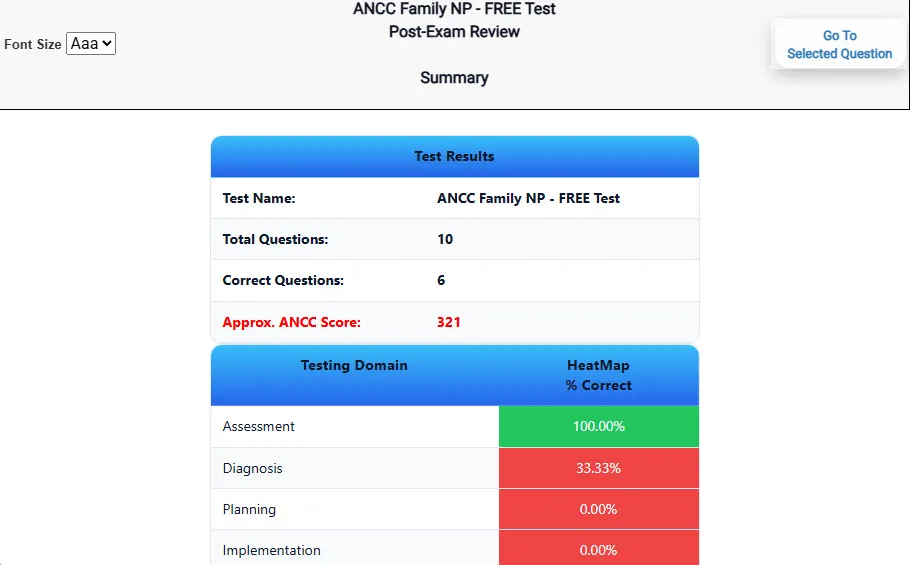
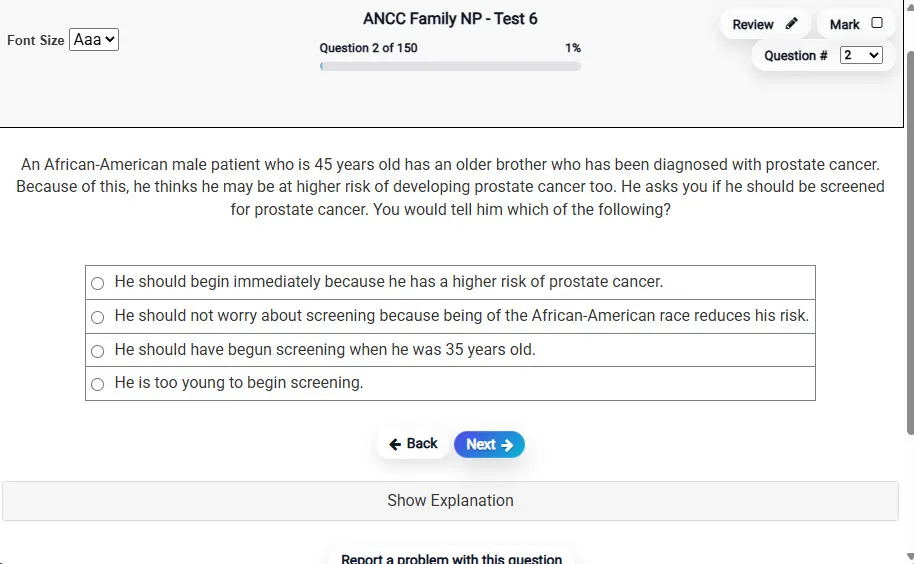
Answering a Question screen – Multiple-choice item view with navigation controls and progress tracker.
Answering a Question Multiple-choice item view with navigation controls and progress tracker.

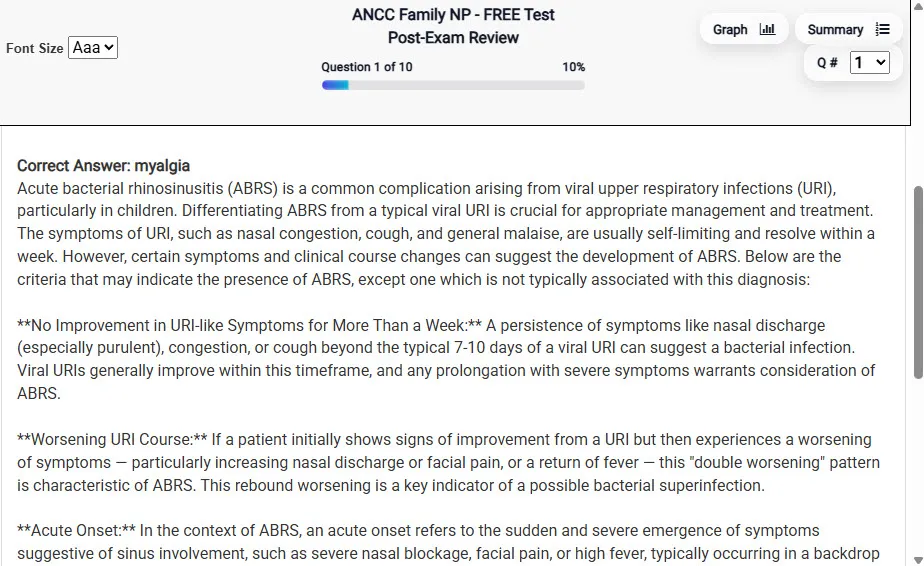
                           Detailed Explanation screen – 
                         Review mode showing chosen answer and rationale and references.
Detailed Explanation Review mode showing chosen answer and rationale and references.

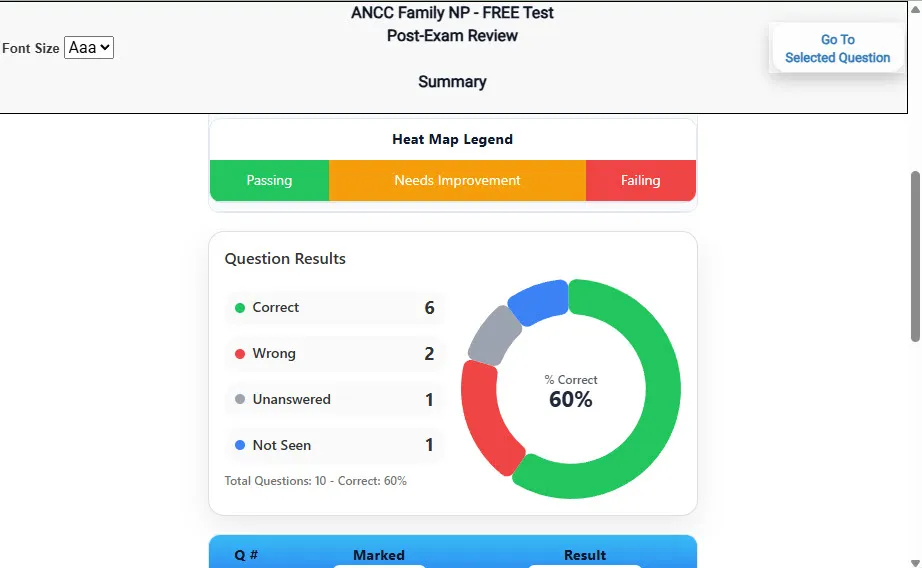
                           Review Summary 1 screen – 
                         Summary with counts for correct/wrong/unanswered and not seen items.
Review Summary 1 Summary with counts for correct/wrong/unanswered and not seen items.

                           Review Summary 2 screen – 
                         Advanced summary with category/domain breakdown and performance insights.
Review Summary 2 Advanced summary with category/domain breakdown and performance insights.

What Each Screen Shows

Answer Question Screen

  • Clean multiple-choice interface with progress bar.
  • Mark for review feature.
  • Matches real test pacing.

Detailed Explanation

  • Correct answer plus rationale.
  • Key concepts and guidelines highlighted.
  • Move between questions to fill knowledge gaps.

Review Summary 1

  • Overall results with total questions and scaled score.
  • Domain heatmap shows strengths and weaknesses.
  • Quick visual feedback on study priorities.

Review Summary 2

  • Chart of correct, wrong, unanswered, not seen.
  • Color-coded results for easy review.
  • Links back to missed items.

Top 10 Reasons to Use Exam Edge for your SANC Nurse Educator Exam Prep

  1. Focused on the SANC Nurse Educator Exam

    Our practice tests are built specifically for the SANC Nurse Educator exam — every question mirrors the real topics, format, and difficulty so you're studying exactly what matters.

  2. Real Exam Simulation

    We match the per-question time limits and pressure of the actual SANC exam, so test day feels familiar and stress-free.

  3. 15 Full Practice Tests & 1,500 Unique Questions

    You'll have more than enough material to master every SANC Nurse Educator concept — no repeats, no fluff.

  4. Lower Cost Than a Retake

    Ordering 5 practice exams costs less than retaking the SANC Nurse Educator exam after a failure. One low fee could save you both time and money.

  5. Flexible Testing

    Need to step away mid-exam? Pick up right where you left off — with your remaining time intact.

  6. Instant Scoring & Feedback

    See your raw score and an estimated SANC Nurse Educator score immediately after finishing each practice test.

  7. Detailed Explanations for Every Question

    Review correct and incorrect answers with clear, step-by-step explanations so you truly understand each topic.

  8. Trusted & Accredited

    We're fully accredited by the Better Business Bureau and uphold the highest standards of trust and transparency.

  9. Web-Based & Always Available

    No software to install. Access your SANC Nurse Educator practice exams 24/7 from any computer or mobile device.

  10. Expert Support When You Need It

    Need extra help? Our specialized tutors are highly qualified and ready to support your SANC exam prep.


Pass the SANC Nurse Educator Exam with Realistic Practice Tests from Exam Edge

Preparing for your upcoming SANC Nurse Educator (SANC- Nurse ED) Certification Exam can feel overwhelming — but the right practice makes all the difference. Exam Edge gives you the tools, structure, and confidence to pass on your first try. Our online practice exams are built to match the real SANC Nurse Educator exam in content, format, and difficulty.

  • 📝 15 SANC Nurse Educator Practice Tests: Access 15 full-length exams with 100 questions each, covering every major SANC Nurse Educator topic in depth.
  • Instant Online Access: Start practicing right away — no software, no waiting.
  • 🧠 Step-by-Step Explanations: Understand the reasoning behind every correct answer so you can master SANC Nurse Educator exam concepts.
  • 🔄 Retake Each Exam Up to 4 Times: Build knowledge through repetition and track your improvement over time.
  • 🌐 Web-Based & Available 24/7: Study anywhere, anytime, on any device.
  • 🧘 Boost Your Test-Day Confidence: Familiarity with the SANC format reduces anxiety and helps you perform under pressure.

These SANC Nurse Educator practice exams are designed to simulate the real testing experience by matching question types, timing, and difficulty level. This approach helps you get comfortable not just with the exam content, but also with the testing environment, so you walk into your exam day focused and confident.


Exam Edge SANC Reviews


SANC Nurse Educator Aliases Test Name

Here is a list of alternative names used for this exam.

  • SANC Nurse Educator
  • SANC Nurse Educator test
  • SANC Nurse Educator Certification Test
  • SANC
  • SANC SANC- Nurse ED
  • SANC- Nurse ED test
  • SANC Nurse Educator (SANC- Nurse ED)
  • Nurse Educator certification