This is the content of the pop-over!

Lightning Deal Alert – 12% Off Ends at Midnight!

Strike while the savings are hot! Use promo code FlashSale at checkout for 12% off any Exam Edge test or bundle. Hurry—the clock is ticking!

RNCB Certified Rehabilitation Registered Nurse (CRRN) Practice Tests & Test Prep by Exam Edge


RNCB Certified Rehabilitation Registered Nurse product image
(4.6)
Based on 17 Reviews

  • Real Exam Simulation: Timed questions and matching content build comfort for your RNCB Certified Rehabilitation Registered Nurse test day.
  • Instant, 24/7 Access: Web-based RNCB Certified Rehabilitation Registered Nurse practice exams with no software needed.
  • Clear Explanations: Step-by-step answers and explanations for your RNCB exam to strengthen understanding.
  • Boosted Confidence: Reduces anxiety and improves test-taking skills to ace your RNCB Certified Rehabilitation Registered Nurse (CRRN).

Featured on

RNCB Certified Rehabilitation Registered Nurse Online Practice Test Bundles

BEST VALUE
5 practice tests

$69.75

$199.75

SAVE $130

Only $13.95 per test!

  • 100% Pass Guarantee
  • 5 online practice tests
  • 150 questions per test
  • Bonus: 100 Flash Cards + Study Guide
  • Instant access
  • Detailed Explanations
  • Practice tests never expire
  • Timed, untimed, or study guide mode
1 practice test

$39.95

  • 1 online practice test
  • 150 questions per test
  • Instant access
  • Detailed Explanations
  • Practice tests never expire
  • Timed, untimed, or study guide mode
Quick Select
Tap to choose a bundle

** All Prices are in US Dollars (USD) **


RNCB Certified Rehabilitation Registered Nurse (CRRN) Resources

Jump to the section you need most.

Understanding the exact breakdown of the RNCB Certified Rehabilitation Registered Nurse test will help you know what to expect and how to most effectively prepare. The RNCB Certified Rehabilitation Registered Nurse has 150 multiple-choice questions . The exam will be broken down into the sections below:

RNCB Certified Rehabilitation Registered Nurse Exam Blueprint
Domain Name % Number of
Questions
Rehabilitation nursing models and theories 6% 9
Functional health patterns (theories - physiology - assessment - standards of care interventions in individuals with injury - chronic illness disability across the lifespan) 58% 87
The function of the rehabilitation team and community reintegration 13% 20
Legislative - economic - ethical legal issues 23% 35

RNCB Certified Rehabilitation Registered Nurse Study Tips by Domain

  • Apply the nursing process within a rehab framework (assessment → goals → interventions → evaluation) and write goals as functional, measurable, and time-bound; red flag: goals that describe tasks (e.g., “PT will ambulate”) rather than patient outcomes.
  • Use the International Classification of Functioning, Disability and Health (ICF) to separate impairment, activity limitation, participation restriction, and environmental factors; common trap: documenting only diagnoses/impairments and missing barriers like transportation, caregiver support, or home layout.
  • Leverage Orem’s Self-Care Deficit Theory to grade assistance and promote independence; priority rule: choose the least restrictive level of assistance that still maintains safety to avoid fostering learned dependence.
  • Integrate Roy’s Adaptation Model by assessing physiologic, self-concept, role function, and interdependence modes; red flag: unmet psychosocial adaptation (e.g., depression, role loss) masquerading as “noncompliance” with therapy.
  • Apply Neuman’s Systems Model to identify stressors and strengthen lines of defense with primary/secondary/tertiary prevention; contraindication cue: escalating demands (therapy intensity, new self-care tasks) during acute instability can worsen setbacks (fatigue, autonomic symptoms, delirium).
  • Use the Biopsychosocial model and motivational interviewing to support behavior change and self-management; common trap: education-only plans without assessing readiness, health literacy, or the patient’s stated goals, leading to poor carryover at home.
  • Anchor assessment to Gordon’s Functional Health Patterns and validate findings with objective data (e.g., daily weights, I&O, skin inspection) — red flag: relying on self-report when cognition, aphasia, or neglect may distort symptoms.
  • Prioritize airway, skin, bowel/bladder, and mobility risks using physiology and level-of-injury/impairment; threshold cue: new SpO2 decline, fever, or sudden weakness warrants immediate escalation for complications (e.g., aspiration, infection, stroke progression).
  • Use standardized measures (e.g., FIM, Berg Balance, Braden, PHQ-9, CAM) to track function and safety — common trap: documenting “improving” without a baseline score and a time-stamped re-evaluation plan.
  • Apply standards of care for secondary prevention (pressure injury prevention, DVT prophylaxis, fall precautions, contracture management) — red flag: an immobile patient without a turning schedule, heel offloading, and device checks each shift.
  • Implement person-centered, lifespan-appropriate interventions (energy conservation, adaptive equipment training, caregiver education, sexual health counseling) — priority rule: teach-back is required when new devices/medication regimens are introduced to reduce readmissions.
  • Manage common neuro/SCI/brain injury complications with specific cues: autonomic dysreflexia requires immediate trigger removal and BP monitoring; red flag: pounding headache, flushing, or diaphoresis in a patient with injury at/above T6.
  • Clarify roles early (RN, PT/OT/SLP, physiatry, case management, social work, psychology, recreation, prosthetics/orthotics) and set shared functional goals; red flag: duplicate or conflicting plans when disciplines document in silos.
  • Use interdisciplinary goal-setting tied to function (e.g., transfers, bowel/bladder program, communication, cognition) with measurable timelines; common trap: writing impairment-only goals that don’t translate to participation at home/work/school.
  • Prioritize safe handoffs across care settings (acute rehab → SNF → home health → outpatient) with medication, equipment, and therapy carryover; red flag: missing durable medical equipment delivery or training before discharge.
  • Drive community reintegration planning that addresses transportation, home accessibility, caregiver capacity, and return-to-work/school; priority rule: match services to the least restrictive environment that still meets safety and supervision needs.
  • Coordinate caregiver and patient education with teach-back and return-demonstration for high-risk skills (safe transfers, skin inspection, bowel/bladder routine, dysphagia precautions); common trap: assuming understanding because education was “provided” without competency validation.
  • Implement risk management in the community (falls, pressure injury, autonomic dysreflexia, depression/substance use, driving safety) and ensure follow-up resources; red flag: discharging without clear emergency action steps for predictable complications.


Built to Fit Into Your Busy Life

Everything you need to prepare with confidence—without wasting a minute.

Three Study Modes

Timed, No Time Limit, or Explanation mode.

Actionable Analytics

Heatmaps and scaled scores highlight weak areas.

High-Yield Rationales

Concise explanations emphasize key concepts.

Realistic Interface

Matches the feel of the actual exam environment.

Accessible by Design

Clean layout reduces cognitive load.

Anytime, Anywhere

Web-based access 24/7 on any device.
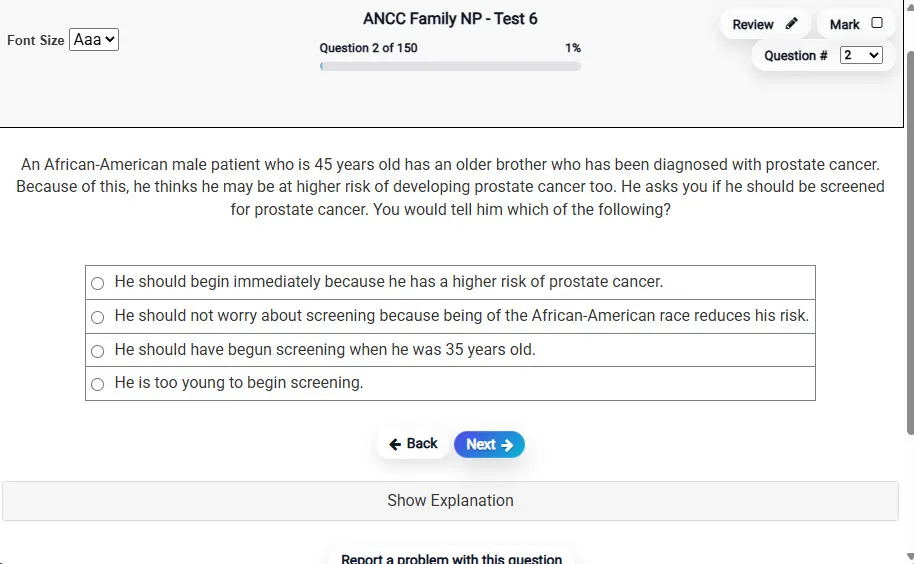
Answering a Question screen – Multiple-choice item view with navigation controls and progress tracker.
Answering a Question Multiple-choice item view with navigation controls and progress tracker.

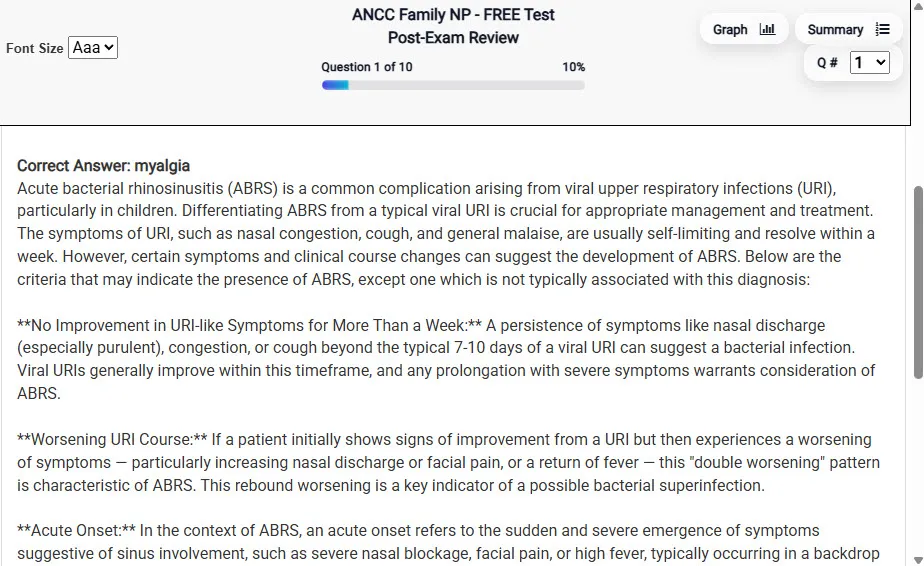
                           Detailed Explanation screen – 
                         Review mode showing chosen answer and rationale and references.
Detailed Explanation Review mode showing chosen answer and rationale and references.

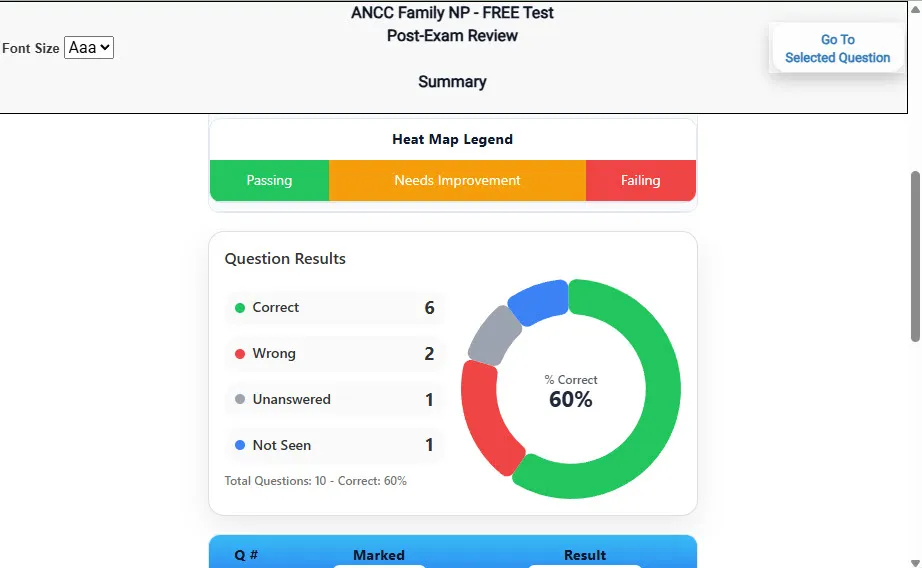
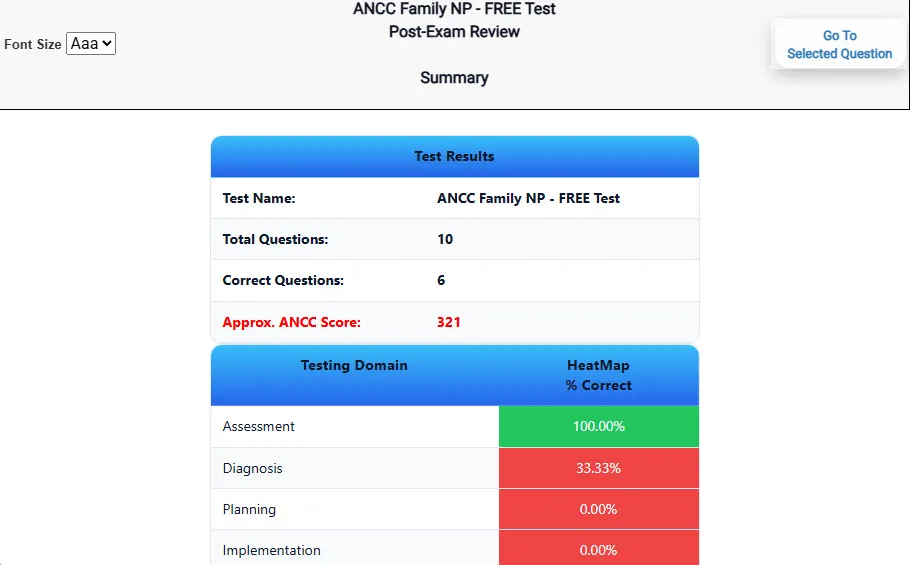
                           Review Summary 1 screen – 
                         Summary with counts for correct/wrong/unanswered and not seen items.
Review Summary 1 Summary with counts for correct/wrong/unanswered and not seen items.

                           Review Summary 2 screen – 
                         Advanced summary with category/domain breakdown and performance insights.
Review Summary 2 Advanced summary with category/domain breakdown and performance insights.

What Each Screen Shows

Answer Question Screen

  • Clean multiple-choice interface with progress bar.
  • Mark for review feature.
  • Matches real test pacing.

Detailed Explanation

  • Correct answer plus rationale.
  • Key concepts and guidelines highlighted.
  • Move between questions to fill knowledge gaps.

Review Summary 1

  • Overall results with total questions and scaled score.
  • Domain heatmap shows strengths and weaknesses.
  • Quick visual feedback on study priorities.

Review Summary 2

  • Chart of correct, wrong, unanswered, not seen.
  • Color-coded results for easy review.
  • Links back to missed items.

Top 10 Reasons to Use Exam Edge for your RNCB Certified Rehabilitation Registered Nurse Exam Prep

  1. Focused on the RNCB Certified Rehabilitation Registered Nurse Exam

    Our practice tests are built specifically for the RNCB Certified Rehabilitation Registered Nurse exam — every question mirrors the real topics, format, and difficulty so you're studying exactly what matters.

  2. Real Exam Simulation

    We match the per-question time limits and pressure of the actual RNCB exam, so test day feels familiar and stress-free.

  3. 5 Full Practice Tests & 750 Unique Questions

    You'll have more than enough material to master every RNCB Certified Rehabilitation Registered Nurse concept — no repeats, no fluff.

  4. Lower Cost Than a Retake

    Ordering 5 practice exams costs less than retaking the RNCB Certified Rehabilitation Registered Nurse exam after a failure. One low fee could save you both time and money.

  5. Flexible Testing

    Need to step away mid-exam? Pick up right where you left off — with your remaining time intact.

  6. Instant Scoring & Feedback

    See your raw score and an estimated RNCB Certified Rehabilitation Registered Nurse score immediately after finishing each practice test.

  7. Detailed Explanations for Every Question

    Review correct and incorrect answers with clear, step-by-step explanations so you truly understand each topic.

  8. Trusted & Accredited

    We're fully accredited by the Better Business Bureau and uphold the highest standards of trust and transparency.

  9. Web-Based & Always Available

    No software to install. Access your RNCB Certified Rehabilitation Registered Nurse practice exams 24/7 from any computer or mobile device.

  10. Expert Support When You Need It

    Need extra help? Our specialized tutors are highly qualified and ready to support your RNCB exam prep.


Pass the RNCB Certified Rehabilitation Registered Nurse Exam with Realistic Practice Tests from Exam Edge

Preparing for your upcoming RNCB Certified Rehabilitation Registered Nurse (CRRN) Certification Exam can feel overwhelming — but the right practice makes all the difference. Exam Edge gives you the tools, structure, and confidence to pass on your first try. Our online practice exams are built to match the real RNCB Certified Rehabilitation Registered Nurse exam in content, format, and difficulty.

  • 📝 5 RNCB Certified Rehabilitation Registered Nurse Practice Tests: Access 5 full-length exams with 150 questions each, covering every major RNCB Certified Rehabilitation Registered Nurse topic in depth.
  • Instant Online Access: Start practicing right away — no software, no waiting.
  • 🧠 Step-by-Step Explanations: Understand the reasoning behind every correct answer so you can master RNCB Certified Rehabilitation Registered Nurse exam concepts.
  • 🔄 Retake Each Exam Up to 4 Times: Build knowledge through repetition and track your improvement over time.
  • 🌐 Web-Based & Available 24/7: Study anywhere, anytime, on any device.
  • 🧘 Boost Your Test-Day Confidence: Familiarity with the RNCB format reduces anxiety and helps you perform under pressure.

These RNCB Certified Rehabilitation Registered Nurse practice exams are designed to simulate the real testing experience by matching question types, timing, and difficulty level. This approach helps you get comfortable not just with the exam content, but also with the testing environment, so you walk into your exam day focused and confident.


Exam Edge ARN RNCB Reviews


RNCB Certified Rehabilitation Registered Nurse Aliases Test Name

Here is a list of alternative names used for this exam.

  • RNCB Certified Rehabilitation Registered Nurse
  • RNCB Certified Rehabilitation Registered Nurse test
  • RNCB Certified Rehabilitation Registered Nurse Certification Test
  • ARN RNCB
  • ARN RNCB CRRN
  • CRRN test
  • RNCB Certified Rehabilitation Registered Nurse (CRRN)
  • RNCB Certified Rehabilitation Registered Nurse certification