This is the content of the pop-over!

PTCE (PTCE) Practice Tests & Test Prep by Exam Edge


Pharmacy Technician Certification Exam  product image
(5.0)
Based on 17 Reviews

  • Real Exam Simulation: Timed questions and matching content build comfort for your PTCE test day.
  • Instant, 24/7 Access: Web-based Pharmacy Technician Certification Exam practice exams with no software needed.
  • Clear Explanations: Step-by-step answers and explanations for your Pharmacy exam to strengthen understanding.
  • Boosted Confidence: Reduces anxiety and improves test-taking skills to ace your Pharmacy Technician Certification Exam (PTCE).

Featured on

Pharmacy Technician Certification Exam Online Practice Test Bundles

BEST VALUE
25 practice tests

$218.75

$998.75

SAVE $780

Only $8.75 per test!

  • 100% Pass Guarantee
  • 25 online practice tests
  • 90 questions per test
  • Bonus: 100 Flash Cards + Study Guide
  • Instant access
  • Detailed Explanations
  • Practice tests never expire
  • Timed, untimed, or study guide mode
MOST POPULAR
10 practice tests

$99.50

$399.50

SAVE $300

Only $9.95 per test!

  • 10 online practice tests
  • 90 questions per test
  • Bonus: 100 Flash Cards + Study Guide
  • Instant access
  • Detailed Explanations
  • Practice tests never expire
  • Timed, untimed, or study guide mode
5 practice tests

$69.75

$199.75

SAVE $130

Only $13.95 per test!

  • 5 online practice tests
  • 90 questions per test
  • Bonus: 100 Flash Cards
  • Instant access
  • Detailed Explanations
  • Practice tests never expire
  • Timed, untimed, or study guide mode
1 practice test

$39.95

  • 1 online practice test
  • 90 questions per test
  • Instant access
  • Detailed Explanations
  • Practice tests never expire
  • Timed, untimed, or study guide mode
MOST FLEXIBLE
Question Bank

As low as $59.95

450 Questions

Choose 1, 3, 6, or 12 months
A second login is required.

  • Exam Edge content in a powerful question bank
  • Customize Tests
  • Multiple Test & Flash Card Modes
  • Track performance over time
  • Instant access
  • Detailed Explanations
Quick Select
Tap to choose a bundle

** All Prices are in US Dollars (USD) **


PTCE (PTCE) Resources

Jump to the section you need most.

Understanding the exact breakdown of the Pharmacy Technician Certification Exam test will help you know what to expect and how to most effectively prepare. The Pharmacy Technician Certification Exam has multiple-choice questions . The exam will be broken down into the sections below:

Pharmacy Technician Certification Exam Exam Blueprint
Domain Name % Number of
Questions
Pharmacology for Technicians 13.75% 12
Pharmacy Law and Regulations 12.50% 11
Sterile and Non-Sterile Compounding 8.75% 8
Medication Safety 12.50% 11
Pharmacy Quality Assurance 7.50% 7
Medication Order Entry and Fill Process 17.50% 16
Pharmacy Inventory Management 8.75% 8
Pharmacy Billing and Reimbursement 8.75% 8
Pharmacy Information System Usage and Application 10.0% 9

Pharmacy Technician Certification Exam Study Tips by Domain

  • Classify common drug classes by core indication and key adverse effects (e.g., beta blockers — bradycardia/bronchospasm; ACE inhibitors — cough/angioedema); red flag: new facial/lip swelling after an ACE inhibitor warrants urgent escalation.
  • Recognize high-alert medications and look-alike/sound-alike pitfalls tied to pharmacology (e.g., insulin, opioids, anticoagulants); common trap: confusing U-100 vs U-500 insulin concentrations.
  • Use basic pharmacokinetics to anticipate timing issues (onset, peak, duration, half-life) and dosing schedules; priority rule: check renal/hepatic impairment flags because many doses require adjustment.
  • Identify major drug–drug interactions by mechanism (CYP induction/inhibition, additive CNS depression, bleeding risk); red flag: warfarin plus TMP-SMX or metronidazole markedly increases INR/bleeding risk.
  • Match routes and dosage forms to therapeutic intent (IR vs ER, topical vs systemic, inhaled vs oral); common trap: crushing or splitting ER/EC products can cause dose dumping or GI irritation.
  • Know key contraindications and counseling triggers linked to pharmacology (pregnancy, QT prolongation, MAOIs, live vaccines); red flag: nitrates with PDE-5 inhibitors can cause severe hypotension and must be intercepted.
  • Know which laws govern what: FDA controls drug approval/labeling, DEA enforces controlled substances, and state boards set practice rules—red flag if a question mixes federal scheduling with state refill limits.
  • Controlled substances: Schedule II generally has no refills and requires tighter documentation; common trap is assuming partial fills or emergency oral C-II orders are always allowed without strict follow-up and records.
  • HIPAA: Only the minimum necessary PHI may be disclosed, and patient counseling should protect privacy—red flag if PHI is shared with family/friends without documented permission or verification.
  • Prescription validity requirements (varies by state) typically include patient, prescriber, drug, directions, and date; common trap is accepting missing prescriber identifiers (e.g., DEA/NPI where required) or unclear sig without pharmacist clarification.
  • Technician scope: technicians may collect information and process orders but should not perform clinical judgment (e.g., DUR, therapeutic substitutions, final verification)—priority rule: when judgment is required, stop and escalate to the pharmacist.
  • Recordkeeping and audits: retain prescription/controlled substance records, inventories, and transfer logs per legal timelines; red flag is incomplete C-II inventory counts or poor separation/labeling of C records that triggers DEA/state board citations.
  • Verify ingredients and calculations before mixing (especially ratio strength, % w/w vs % w/v, and dilutions); red flag: compounding from an ambiguous master formula or missing beyond-use date (BUD).
  • Assign BUDs correctly for non-sterile preparations based on dosage form and ingredients; common trap: using an expiration date from a stock bottle instead of the compounded BUD.
  • For sterile compounding, maintain aseptic technique in the primary engineering control (e.g., LAFW/BSC) and work “first air” — red flag: blocking airflow with hands, labels, or supplies.
  • Select proper garbing and cleaning sequence (hand hygiene, gowning, then disinfecting with sterile 70% IPA as required) — common trap: sanitizing gloves once and then touching non-sterile surfaces (phone, face, cart) without re-disinfecting.
  • Use correct components for sterile preparations (syringe size, needle/filter needle when indicated, and compatible diluents/containers) — contraindication: using a filter needle to inject into a final container.
  • Label compounded products completely (ingredients/strength, route, storage, BUD, auxiliary warnings) and segregate hazardous drugs when required; red flag: missing route-specific warnings (e.g., “For IV use only” vs “Not for IV use”).
  • Apply the “5 rights” (right patient, drug, dose, route, time) at every handoff; red flag: any mismatch between label, MAR/profile, and the original order requires pharmacist verification before dispensing.
  • Use Tall Man lettering and separate storage for look-alike/sound-alike (LASA) meds; common trap: selecting the wrong strength or formulation (ER vs IR) during picking or data entry.
  • Identify high-alert medications (e.g., insulin, anticoagulants, opioids, concentrated electrolytes) and follow required independent double-checks; priority rule: never bypass a double-check for heparin/insulin doses or pump settings.
  • Handle controlled substances with strict count, documentation, and discrepancy resolution; red flag: any count variance or unexplained wastage must be reported immediately per policy and never “fixed later.”
  • Prevent allergy/interactions errors by confirming patient identifiers and allergy status before processing; common trap: assuming a patient’s “NKDA” is current when the profile is outdated or from another location.
  • Respond to errors and near-misses using incident reporting and root-cause thinking; priority rule: report promptly even if the error was caught before reaching the patient to prevent recurrence.
  • Follow QA workflows for dispensing accuracy (data entry → product selection → final check), and treat look-alike/sound-alike drug names as a red-flag requiring extra verification.
  • Perform NDC/strength/dosage form checks against the label and stock bottle, and never bypass barcode scanning when available—workarounds are a common trap cited in QA audits.
  • Document and report errors and near-misses using the pharmacy’s incident system, and prioritize “near-miss” reporting because it is a key leading indicator in PTCB-style QA scenarios.
  • Use appropriate auxiliary labels and patient-specific instructions, and treat missing warnings (e.g., “may cause drowsiness”) as a contraindication to releasing the prescription.
  • Maintain temperature logs, beyond-use dating, and cleaning schedules per site policy, and consider any unexplained temperature excursion a red flag requiring quarantine/manager notification.
  • Support recall and return-to-stock processes by tracking lot numbers/expiration dates when required, and do not restock meds with questionable storage history or tampered packaging—this is a frequent QA failure point.
  • Verify the medication order is complete before entry (patient identifiers, drug, strength, dose, route, frequency, quantity, prescriber) — red flag: missing route/frequency or unclear sig requires clarification, not guessing.
  • During data entry, use leading zeros for doses <1 (e.g., 0.5 mg) and never use trailing zeros (e.g., 5.0 mg) — common trap tested by PTCB: decimal point errors that create 10-fold dosing mistakes.
  • Select the correct product by matching NDC, dosage form, and strength — red flag: look-alike/sound-alike names or different salt forms (e.g., metoprolol tartrate vs succinate) that are not interchangeable.
  • When filling, perform the “triple check” (label-to-order, drug-to-label, final product-to-label) — priority rule: if anything doesn’t match exactly, stop and recheck rather than “fixing” it at the register.
  • Apply accurate auxiliary labels and packaging requirements (e.g., “shake well,” “refrigerate,” child-resistant cap unless waived) — common trap: missing storage/handling cues that affect stability and patient safety.
  • Document substitutions, partial fills, and backorders correctly in the workflow — red flag: dispensing a different manufacturer/strength without updating the record or notifying the pharmacist per policy.
  • Apply FIFO/FEFO rotation and remove short-dated stock early; red flag: shelving newly received items in front of older lots increases expiration-related waste and patient risk.
  • Maintain controlled substance inventory with perpetual counts and reconcile discrepancies immediately; common trap: delaying a count variance investigation can trigger diversion suspicion and audit findings.
  • Verify order accuracy on receiving (NDC, strength, dosage form, quantity, lot/expiration, and temperature indicators); priority rule: do not place look-alike/sound-alike products into active stock until labeling/barcoding is confirmed.
  • Store medications per manufacturer requirements (room temp, refrigerated, frozen, light protection) and document excursions; red flag: returning a product to stock after an undocumented temperature excursion can invalidate potency and reimbursement.
  • Manage recalls by lot number and quarantine affected inventory promptly; common trap: pulling by drug name only (not lot) can miss recalled units and leave them available for dispensing.
  • Handle returns and reverse distribution per policy and vendor rules, separating expired vs. damaged vs. recalled items; red flag: mixing creditable returns with hazardous or controlled substances can create compliance and financial losses.
  • Verify payer requirements before processing: match patient identifiers, BIN/PCN/group/ID, and prescriber NPI to avoid a hard reject—red flag is a claim that rejects for “invalid member” or “prescriber not covered.”
  • Know when prior authorization (PA) is needed (often high-cost, non-formulary, or quantity-limit exceptions)—common trap is repeatedly resubmitting the same claim instead of initiating PA and documenting the key details.
  • Apply correct day-supply and quantity calculations (e.g., insulin, eye drops, inhalers) because many plans enforce quantity limits—red flag is a sudden copay spike or reject for “exceeds maximum daily dose/quantity.”
  • Understand coordination of benefits (primary vs secondary) and patient eligibility dates—common trap is billing secondary as primary, leading to reversals or recoupments.
  • Use appropriate transaction steps: submit, reverse if needed, and rebill with corrected info—priority rule is to reverse the original paid claim before changing drug/NDC, quantity, or days supply to prevent duplicate billing.
  • Maintain audit-ready records for third-party billing (signature logs, delivery proof, DAW/substitution rationale, and coupon coordination rules)—red flag is using manufacturer coupons with federally funded plans where prohibited.
  • Verify patient identity using at least two identifiers (e.g., name and DOB) before selecting a profile in the system—red flag: similar names or multiple profiles that can lead to wrong-patient fills.
  • Enter orders using standardized sig codes and required fields (dose, route, frequency, duration) and resolve abbreviations that are not system-approved—common trap: free-text instructions that bypass safety checks.
  • Use clinical decision support appropriately by reviewing allergy, interaction, and duplicate-therapy alerts and escalating high-severity warnings—priority rule: never override without documenting the reason per workflow.
  • Process e-prescriptions, faxes, and refill requests by matching prescriber, patient, and medication details before converting to a fillable order—red flag: auto-populated drug or quantity that doesn’t match the original message.
  • Manage barcode scanning and label generation so NDC, strength, dosage form, and quantity align at product selection and final verification steps—common trap: scanning the outer package or wrong size that maps to a different NDC.
  • Protect PHI and system integrity by using unique logins, role-based access, and automatic timeouts and by logging off shared terminals—contraindication: using another user’s credentials or leaving screens visible in public areas.


Built to Fit Into Your Busy Life

Everything you need to prepare with confidence—without wasting a minute.

Three Study Modes

Timed, No Time Limit, or Explanation mode.

Actionable Analytics

Heatmaps and scaled scores highlight weak areas.

High-Yield Rationales

Concise explanations emphasize key concepts.

Realistic Interface

Matches the feel of the actual exam environment.

Accessible by Design

Clean layout reduces cognitive load.

Anytime, Anywhere

Web-based access 24/7 on any device.
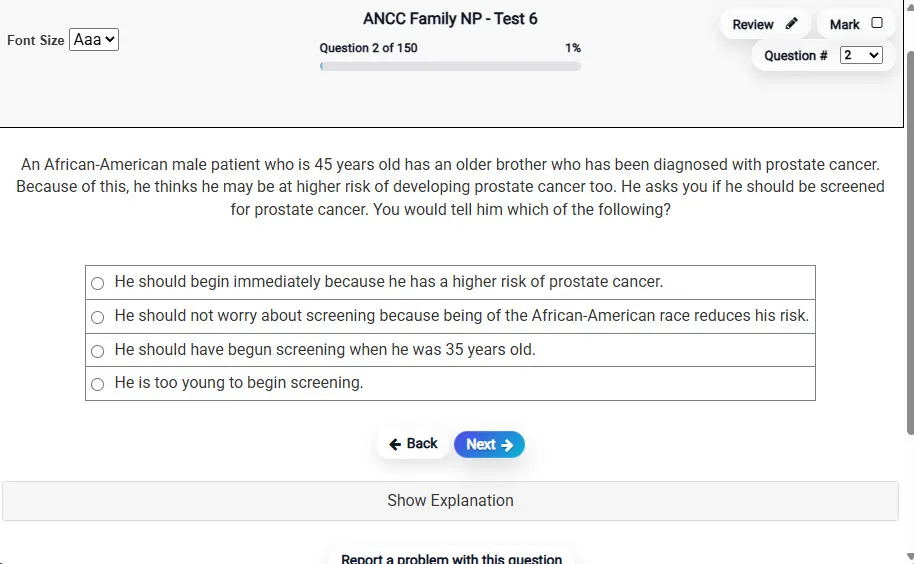
Answering a Question screen – Multiple-choice item view with navigation controls and progress tracker.
Answering a Question Multiple-choice item view with navigation controls and progress tracker.

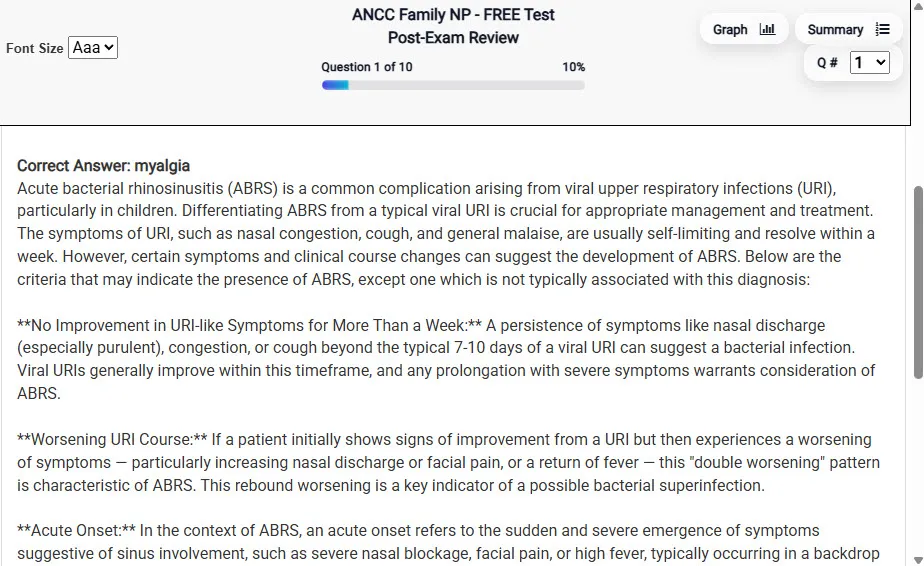
                           Detailed Explanation screen – 
                         Review mode showing chosen answer and rationale and references.
Detailed Explanation Review mode showing chosen answer and rationale and references.

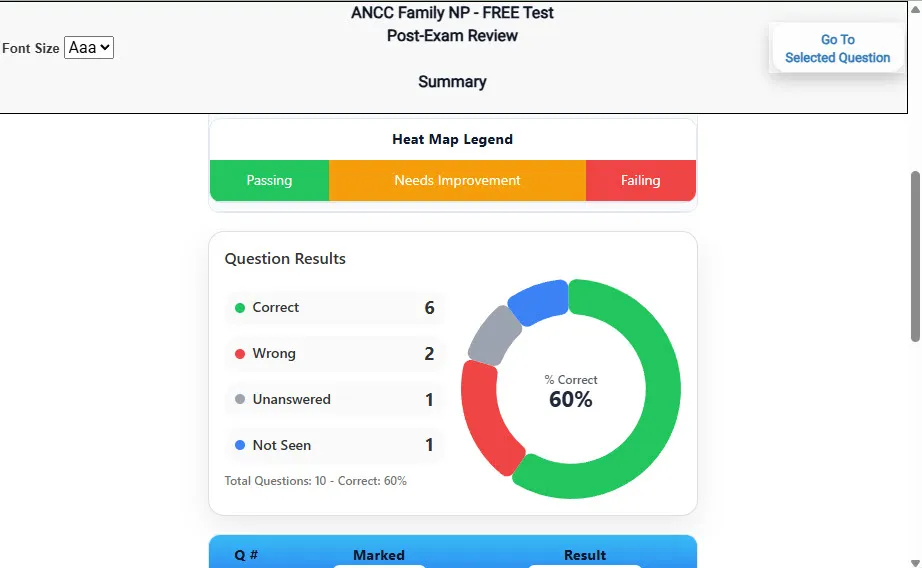
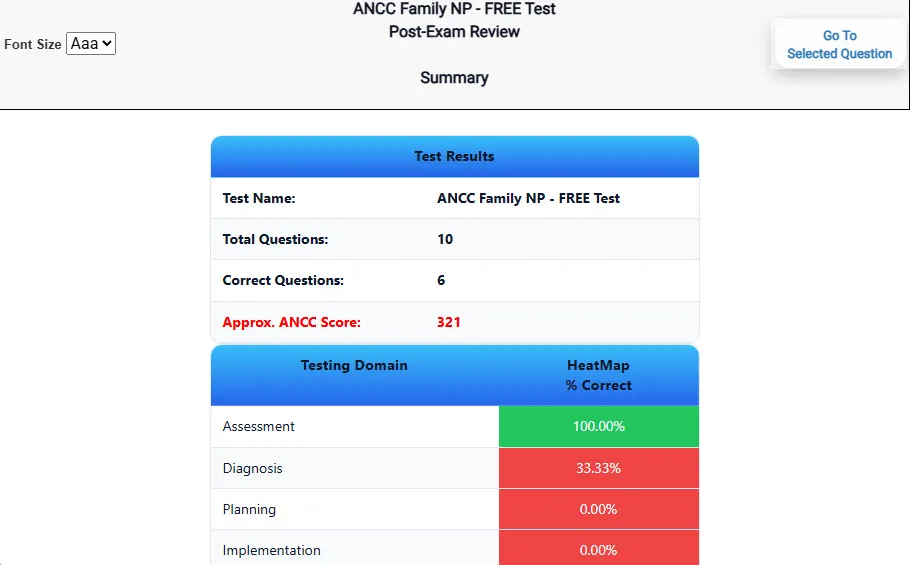
                           Review Summary 1 screen – 
                         Summary with counts for correct/wrong/unanswered and not seen items.
Review Summary 1 Summary with counts for correct/wrong/unanswered and not seen items.

                           Review Summary 2 screen – 
                         Advanced summary with category/domain breakdown and performance insights.
Review Summary 2 Advanced summary with category/domain breakdown and performance insights.

What Each Screen Shows

Answer Question Screen

  • Clean multiple-choice interface with progress bar.
  • Mark for review feature.
  • Matches real test pacing.

Detailed Explanation

  • Correct answer plus rationale.
  • Key concepts and guidelines highlighted.
  • Move between questions to fill knowledge gaps.

Review Summary 1

  • Overall results with total questions and scaled score.
  • Domain heatmap shows strengths and weaknesses.
  • Quick visual feedback on study priorities.

Review Summary 2

  • Chart of correct, wrong, unanswered, not seen.
  • Color-coded results for easy review.
  • Links back to missed items.

Top 10 Reasons to Use Exam Edge for your Pharmacy Technician Certification Exam Exam Prep

  1. Focused on the Pharmacy Technician Certification Exam Exam

    Our practice tests are built specifically for the PTCE exam — every question mirrors the real topics, format, and difficulty so you're studying exactly what matters.

  2. Real Exam Simulation

    We match the per-question time limits and pressure of the actual Pharmacy exam, so test day feels familiar and stress-free.

  3. 25 Full Practice Tests & 2,250 Unique Questions

    You'll have more than enough material to master every PTCE concept — no repeats, no fluff.

  4. Lower Cost Than a Retake

    Ordering 5 practice exams costs less than retaking the Pharmacy Technician Certification Exam exam after a failure. One low fee could save you both time and money.

  5. Flexible Testing

    Need to step away mid-exam? Pick up right where you left off — with your remaining time intact.

  6. Instant Scoring & Feedback

    See your raw score and an estimated Pharmacy Technician Certification Exam score immediately after finishing each practice test.

  7. Detailed Explanations for Every Question

    Review correct and incorrect answers with clear, step-by-step explanations so you truly understand each topic.

  8. Trusted & Accredited

    We're fully accredited by the Better Business Bureau and uphold the highest standards of trust and transparency.

  9. Web-Based & Always Available

    No software to install. Access your PTCE practice exams 24/7 from any computer or mobile device.

  10. Expert Support When You Need It

    Need extra help? Our specialized tutors are highly qualified and ready to support your Pharmacy exam prep.


Pass the Pharmacy Technician Certification Exam Exam with Realistic Practice Tests from Exam Edge

Preparing for your upcoming Pharmacy Technician Certification Exam (PTCE) Certification Exam can feel overwhelming — but the right practice makes all the difference. Exam Edge gives you the tools, structure, and confidence to pass on your first try. Our online practice exams are built to match the real PTCE exam in content, format, and difficulty.

  • 📝 25 Pharmacy Technician Certification Exam Practice Tests: Access 25 full-length exams with 90 questions each, covering every major Pharmacy Technician Certification Exam topic in depth.
  • Instant Online Access: Start practicing right away — no software, no waiting.
  • 🧠 Step-by-Step Explanations: Understand the reasoning behind every correct answer so you can master PTCE exam concepts.
  • 🔄 Retake Each Exam Up to 4 Times: Build knowledge through repetition and track your improvement over time.
  • 🌐 Web-Based & Available 24/7: Study anywhere, anytime, on any device.
  • 🧘 Boost Your Test-Day Confidence: Familiarity with the Pharmacy format reduces anxiety and helps you perform under pressure.

These Pharmacy Technician Certification Exam practice exams are designed to simulate the real testing experience by matching question types, timing, and difficulty level. This approach helps you get comfortable not just with the exam content, but also with the testing environment, so you walk into your exam day focused and confident.


Exam Edge PTCB Reviews


Thanks, I passed the PTCB exam on my first attempt. It is a great collection of questions with good explanations. I could not have passed without it.

shailaja , Maryland

I just passed my PTCB exam on the first try. Your 10 test package was the best way for me to study. Thanks very much

Joe, Florida


Pharmacy Technician Certification Exam Aliases Test Name

Here is a list of alternative names used for this exam.

  • Pharmacy Technician Certification Exam
  • Pharmacy Technician Certification Exam test
  • Pharmacy Technician Certification Exam Certification Test
  • PTCE test
  • PTCB
  • PTCB PTCE
  • PTCE test
  • Pharmacy Technician Certification Exam (PTCE)
  • Pharmacy Technician Certification Exam certification