This is the content of the pop-over!

PSAE Math Grade 11 Practice Tests & Test Prep by Exam Edge


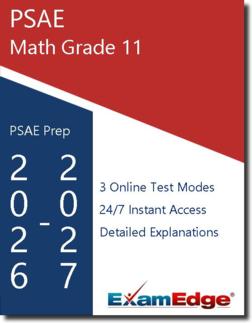
PSAE Mathematics Grade 11  product image
(5.0)
Based on 34 Reviews

  • Real Exam Simulation: Timed questions and matching content build comfort for your PSAE Math Grade 11 test day.
  • Instant, 24/7 Access: Web-based PSAE Mathematics Grade 11 practice exams with no software needed.
  • Clear Explanations: Step-by-step answers and explanations for your PSAE exam to strengthen understanding.
  • Boosted Confidence: Reduces anxiety and improves test-taking skills to ace your PSAE Mathematics Grade 11 .

Featured on

PSAE Mathematics Grade 11 Online Practice Test Bundles

BEST VALUE
20 practice tests

$174.00

$799.00

SAVE $625

Only $8.70 per test!

  • 100% Pass Guarantee
  • 20 online practice tests
  • 60 questions per test
  • Bonus: 100 Flash Cards + Study Guide
  • Instant access
  • Detailed Explanations
  • Practice tests never expire
  • Timed, untimed, or study guide mode
MOST POPULAR
10 practice tests

$99.50

$399.50

SAVE $300

Only $9.95 per test!

  • 10 online practice tests
  • 60 questions per test
  • Bonus: 100 Flash Cards + Study Guide
  • Instant access
  • Detailed Explanations
  • Practice tests never expire
  • Timed, untimed, or study guide mode
5 practice tests

$69.75

$199.75

SAVE $130

Only $13.95 per test!

  • 5 online practice tests
  • 60 questions per test
  • Bonus: 100 Flash Cards
  • Instant access
  • Detailed Explanations
  • Practice tests never expire
  • Timed, untimed, or study guide mode
1 practice test

$39.95

  • 1 online practice test
  • 60 questions per test
  • Instant access
  • Detailed Explanations
  • Practice tests never expire
  • Timed, untimed, or study guide mode
Quick Select
Tap to choose a bundle

** All Prices are in US Dollars (USD) **


PSAE Math Grade 11 () Resources

Jump to the section you need most.

Understanding the exact breakdown of the PSAE Mathematics Grade 11 test will help you know what to expect and how to most effectively prepare. The PSAE Mathematics Grade 11 has multiple-choice questions . The exam will be broken down into the sections below:

PSAE Mathematics Grade 11 Exam Blueprint
Domain Name % Number of
Questions
Pre-Algebra 23% 14
Elementary Algebra 17% 10
Intermediate Algebra 15% 9
Coordinate Geometry 15% 9
Plane Geometry 23% 14
Trigonometry 7% 4

PSAE Mathematics Grade 11 Study Tips by Domain

  • Order of operations (PEMDAS) must respect grouping and exponents first; red flag: applying division before multiplication left-to-right or treating a negative sign as an exponent (e.g., −32).
  • Fractions and decimals: convert accurately and simplify before calculating; common trap: adding/subtracting fractions without a common denominator or rounding too early on multi-step items.
  • Ratios, rates, and proportions: set up equivalent ratios with consistent units; priority rule: cancel units and watch for “per” conversions (e.g., minutes to hours) as a frequent error source.
  • Percent problems: translate “of” as multiplication and distinguish percent increase/decrease from percent of original; red flag: using the new value as the base when the question asks relative to the original.
  • Signed numbers and absolute value: apply sign rules for multiplication/division and interpret |x| as distance from 0; common trap: assuming |a − b| = |a| − |b| or dropping negative signs when distributing.
  • Exponents and roots basics: use am·an=am+n and (am)n=amn; red flag: distributing exponents over addition (e.g., (a+b)2 ≠ a2+b2).
  • Use order of operations (PEMDAS) carefully—a common trap is treating a leading minus as subtraction; always rewrite “−(a + b)” as “−a − b” before combining terms.
  • Simplify expressions by combining like terms and using the distributive property; red flag: you can only combine terms with identical variable parts (e.g., 3x and −5x, not 3x and 3x2).
  • When solving linear equations, keep balance by doing the same operation to both sides; common trap: forgetting to reverse the inequality sign when multiplying or dividing by a negative number.
  • Solve literal equations by isolating the target variable step-by-step; priority rule: clear fractions early by multiplying both sides by the least common denominator (LCD) to avoid arithmetic mistakes.
  • Work with exponents using the core rules (product, quotient, power of a power); red flag: (a + b)2 is not a2 + b2, so expand carefully.
  • Factor and simplify polynomials using GCF and special products (difference of squares, perfect square trinomials); common trap: canceling terms across addition (you can cancel factors only, not terms separated by +/−).
  • Solve linear inequalities and express solutions in interval notation; red flag: multiplying or dividing by a negative requires flipping the inequality sign.
  • Work with quadratic expressions and equations (factoring, completing the square, quadratic formula); common trap: losing solutions when dividing by a variable expression that could be zero.
  • Simplify and solve rational expressions/equations; priority rule: state domain restrictions first and always check for extraneous solutions created by clearing denominators.
  • Use exponent rules and radicals, including rational exponents; red flag: \sqrt{a+b} \neq \sqrt{a}+\sqrt{b} and even roots require nonnegative radicands in real-number contexts.
  • Manipulate functions (evaluate, interpret, compose, find inverses when possible); common trap: assuming an inverse exists without a one-to-one check (e.g., failing the horizontal line test).
  • Solve systems of equations (linear–linear and linear–quadratic) by substitution/elimination; red flag: arithmetic slips during elimination can hide special cases (no solution vs. infinitely many solutions).
  • Use slope carefully: m = (y2 − y1)/(x2 − x1); red flag — a vertical line has undefined slope and its equation is x = constant (not y = constant).
  • Write line equations in the best form for the task: point-slope for quick setup, slope-intercept for graphing; common trap — mixing up which value is the y-intercept (it’s b in y = mx + b).
  • Apply the distance formula d = √((x2 − x1)^2 + (y2 − y1)^2); priority rule — square before adding, and don’t forget the square root at the end.
  • Use the midpoint formula M = ((x1 + x2)/2, (y1 + y2)/2); threshold cue — if endpoints are integers, a midpoint with halves is valid and shouldn’t be rounded.
  • Check parallel vs perpendicular lines via slopes: parallel means equal slopes, perpendicular means m1m2 = −1; common trap — vertical/horizontal pairs are perpendicular even though one slope is undefined.
  • For circles, convert between (x − h)^2 + (y − k)^2 = r^2 and general form; red flag — r^2 must be nonnegative, so a negative value after completing the square signals an error or “no real circle.”
  • Use angle facts (linear pair sums to 180°, vertical angles are equal, angles around a point sum to 360°) and mark them on the diagram first; red flag: mixing up complementary (90°) vs supplementary (180°).
  • For triangles, apply the angle sum (180°) and exterior angle theorem (exterior equals sum of remote interiors); common trap: treating an exterior angle as supplementary to a non-adjacent interior angle.
  • Prove or use triangle congruence with SSS, SAS, ASA, AAS (not SSA); priority rule: if given two sides and a non-included angle, check ambiguity—do not claim congruence.
  • With parallel lines cut by a transversal, match angle pairs correctly (corresponding and alternate interior are equal; same-side interior sum to 180°); red flag: assuming all opposite-side angles are equal without parallel marks.
  • For quadrilaterals, use defining properties (e.g., parallelogram opposite sides parallel and equal, diagonals bisect; rectangle has right angles; rhombus diagonals perpendicular); common trap: assuming diagonals of any parallelogram are equal.
  • Apply perimeter and area formulas carefully (triangle area = ½bh, parallelogram = bh, trapezoid = ½(b1+b2)h, circle area = πr2, circumference = 2πr); red flag: using diameter where radius is required.
  • Convert between degrees and radians using π radians = 180°; red flag: mixing degree-mode and radian-mode in the calculator will throw off every trig value.
  • Use SOH–CAH–TOA in right triangles and label the reference angle clearly; common trap: using the wrong angle when the diagram gives the complementary angle.
  • Apply special-angle values (0°, 30°, 45°, 60°, 90°) from the unit circle; cue: if you don’t know exact values, don’t round early—keep radicals until the final step.
  • Determine the sign of sin, cos, and tan by quadrant (ASTC); red flag: tan is undefined at 90° + 180°k because cos = 0.
  • Solve basic trig equations by finding all angles in [0, 2π) (or [0°, 360°]) then add periodic solutions; priority rule: include both reference-angle solutions when the trig value is positive or negative in multiple quadrants.
  • Model periodic behavior with y = A sin(Bx − C) + D or y = A cos(Bx − C) + D; common trap: period is 2π/|B| (not 2πB) and amplitude is |A| (not A + D).


Built to Fit Into Your Busy Life

Everything you need to prepare with confidence—without wasting a minute.

Three Study Modes

Timed, No Time Limit, or Explanation mode.

Actionable Analytics

Heatmaps and scaled scores highlight weak areas.

High-Yield Rationales

Concise explanations emphasize key concepts.

Realistic Interface

Matches the feel of the actual exam environment.

Accessible by Design

Clean layout reduces cognitive load.

Anytime, Anywhere

Web-based access 24/7 on any device.
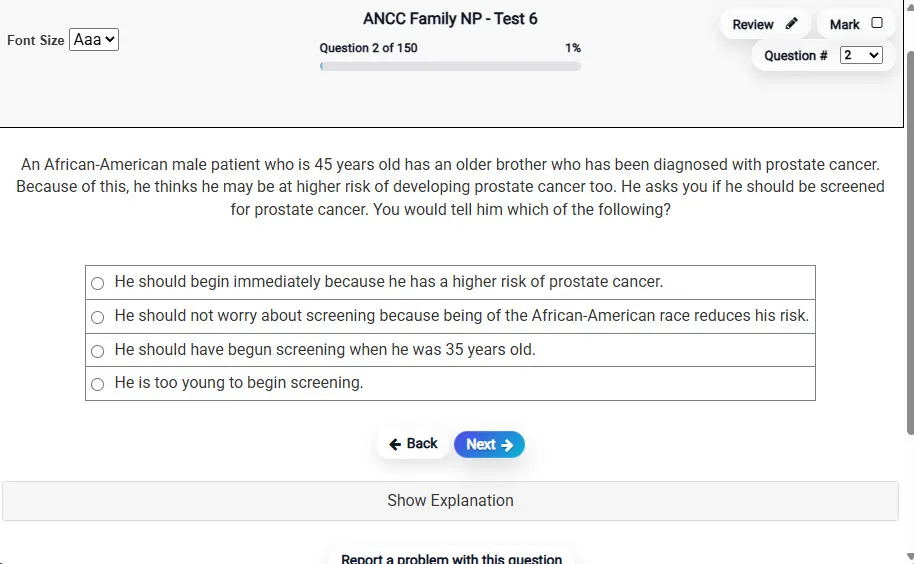
Answering a Question screen – Multiple-choice item view with navigation controls and progress tracker.
Answering a Question Multiple-choice item view with navigation controls and progress tracker.

                           Detailed Explanation screen – 
                         Review mode showing chosen answer and rationale and references.
Detailed Explanation Review mode showing chosen answer and rationale and references.

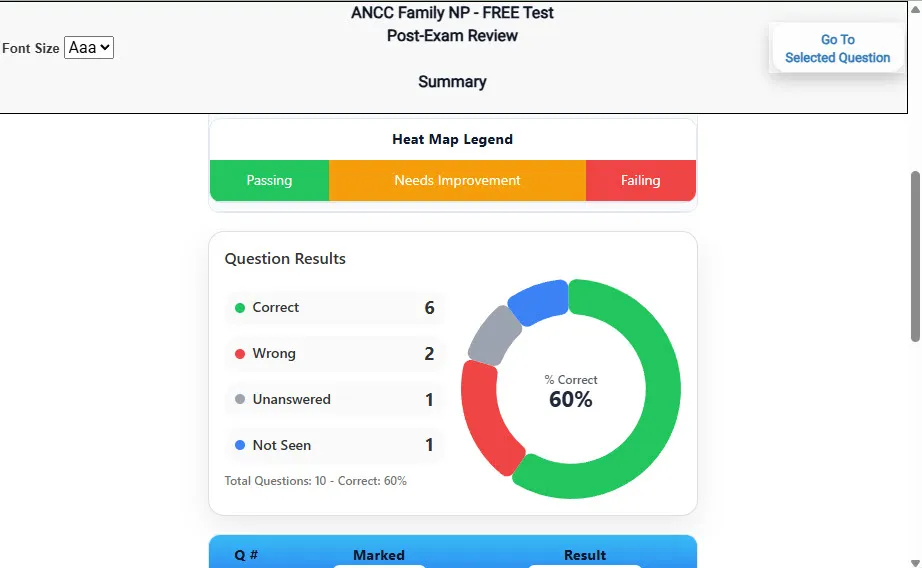
                           Review Summary 1 screen – 
                         Summary with counts for correct/wrong/unanswered and not seen items.
Review Summary 1 Summary with counts for correct/wrong/unanswered and not seen items.

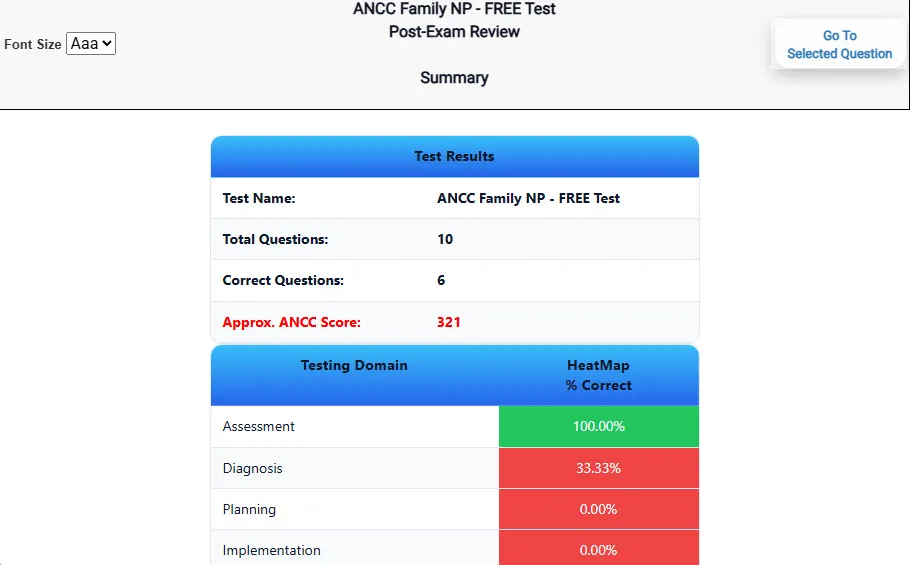
                           Review Summary 2 screen – 
                         Advanced summary with category/domain breakdown and performance insights.
Review Summary 2 Advanced summary with category/domain breakdown and performance insights.

What Each Screen Shows

Answer Question Screen

  • Clean multiple-choice interface with progress bar.
  • Mark for review feature.
  • Matches real test pacing.

Detailed Explanation

  • Correct answer plus rationale.
  • Key concepts and guidelines highlighted.
  • Move between questions to fill knowledge gaps.

Review Summary 1

  • Overall results with total questions and scaled score.
  • Domain heatmap shows strengths and weaknesses.
  • Quick visual feedback on study priorities.

Review Summary 2

  • Chart of correct, wrong, unanswered, not seen.
  • Color-coded results for easy review.
  • Links back to missed items.

Top 10 Reasons to Use Exam Edge for your PSAE Mathematics Grade 11 Exam Prep

  1. Focused on the PSAE Mathematics Grade 11 Exam

    Our practice tests are built specifically for the PSAE Math Grade 11 exam — every question mirrors the real topics, format, and difficulty so you're studying exactly what matters.

  2. Real Exam Simulation

    We match the per-question time limits and pressure of the actual PSAE exam, so test day feels familiar and stress-free.

  3. 20 Full Practice Tests & 1,200 Unique Questions

    You'll have more than enough material to master every PSAE Math Grade 11 concept — no repeats, no fluff.

  4. Lower Cost Than a Retake

    Ordering 5 practice exams costs less than retaking the PSAE Mathematics Grade 11 exam after a failure. One low fee could save you both time and money.

  5. Flexible Testing

    Need to step away mid-exam? Pick up right where you left off — with your remaining time intact.

  6. Instant Scoring & Feedback

    See your raw score and an estimated PSAE Mathematics Grade 11 score immediately after finishing each practice test.

  7. Detailed Explanations for Every Question

    Review correct and incorrect answers with clear, step-by-step explanations so you truly understand each topic.

  8. Trusted & Accredited

    We're fully accredited by the Better Business Bureau and uphold the highest standards of trust and transparency.

  9. Web-Based & Always Available

    No software to install. Access your PSAE Math Grade 11 practice exams 24/7 from any computer or mobile device.

  10. Expert Support When You Need It

    Need extra help? Our specialized tutors are highly qualified and ready to support your PSAE exam prep.


Pass the PSAE Mathematics Grade 11 Exam with Realistic Practice Tests from Exam Edge

Preparing for your upcoming PSAE Mathematics Grade 11 () Certification Exam can feel overwhelming — but the right practice makes all the difference. Exam Edge gives you the tools, structure, and confidence to pass on your first try. Our online practice exams are built to match the real PSAE Math Grade 11 exam in content, format, and difficulty.

  • 📝 20 PSAE Mathematics Grade 11 Practice Tests: Access 20 full-length exams with 60 questions each, covering every major PSAE Mathematics Grade 11 topic in depth.
  • Instant Online Access: Start practicing right away — no software, no waiting.
  • 🧠 Step-by-Step Explanations: Understand the reasoning behind every correct answer so you can master PSAE Math Grade 11 exam concepts.
  • 🔄 Retake Each Exam Up to 4 Times: Build knowledge through repetition and track your improvement over time.
  • 🌐 Web-Based & Available 24/7: Study anywhere, anytime, on any device.
  • 🧘 Boost Your Test-Day Confidence: Familiarity with the PSAE format reduces anxiety and helps you perform under pressure.

These PSAE Mathematics Grade 11 practice exams are designed to simulate the real testing experience by matching question types, timing, and difficulty level. This approach helps you get comfortable not just with the exam content, but also with the testing environment, so you walk into your exam day focused and confident.

Exam Edge PSAE Reviews


PSAE Mathematics Grade 11 Aliases Test Name

Here is a list of alternative names used for this exam.

  • PSAE Mathematics Grade 11
  • PSAE Mathematics Grade 11 test
  • PSAE Mathematics Grade 11 Certification Test
  • PSAE Math Grade 11 test
  • PSAE
  • PSAE
  • test
  • PSAE Mathematics Grade 11 ()
  • Mathematics Grade 11 certification