This is the content of the pop-over!

CPNP Pediatric Nursing (CPNP) Practice Tests & Test Prep by Exam Edge


Pediatric Nursing Practitioner Primary Care  product image
(4.5)
Based on 32 Reviews

  • Real Exam Simulation: Timed questions and matching content build comfort for your CPNP Pediatric Nursing test day.
  • Instant, 24/7 Access: Web-based Pediatric Nursing Practitioner Primary Care practice exams with no software needed.
  • Clear Explanations: Step-by-step answers and explanations for your Pediatric exam to strengthen understanding.
  • Boosted Confidence: Reduces anxiety and improves test-taking skills to ace your Pediatric Nursing Practitioner Primary Care (CPNP).

Featured on

Pediatric Nursing Practitioner Primary Care Online Practice Test Bundles

BEST VALUE
15 practice tests

$149.25

$599.25

SAVE $450

Only $9.95 per test!

  • 100% Pass Guarantee
  • 15 online practice tests
  • 100 questions per test
  • Bonus: 100 Flash Cards + Study Guide
  • Instant access
  • Detailed Explanations
  • Practice tests never expire
  • Timed, untimed, or study guide mode
MOST POPULAR
10 practice tests

$99.50

$399.50

SAVE $300

Only $9.95 per test!

  • 10 online practice tests
  • 100 questions per test
  • Bonus: 100 Flash Cards + Study Guide
  • Instant access
  • Detailed Explanations
  • Practice tests never expire
  • Timed, untimed, or study guide mode
5 practice tests

$69.75

$199.75

SAVE $130

Only $13.95 per test!

  • 5 online practice tests
  • 100 questions per test
  • Bonus: 100 Flash Cards
  • Instant access
  • Detailed Explanations
  • Practice tests never expire
  • Timed, untimed, or study guide mode
1 practice test

$39.95

  • 1 online practice test
  • 100 questions per test
  • Instant access
  • Detailed Explanations
  • Practice tests never expire
  • Timed, untimed, or study guide mode
Quick Select
Tap to choose a bundle

** All Prices are in US Dollars (USD) **


CPNP Pediatric Nursing (CPNP) Resources

Jump to the section you need most.

Understanding the exact breakdown of the Pediatric Nursing Practitioner Primary Care test will help you know what to expect and how to most effectively prepare. The Pediatric Nursing Practitioner Primary Care has multiple-choice questions . The exam will be broken down into the sections below:

Pediatric Nursing Practitioner Primary Care Exam Blueprint
Domain Name % Number of
Questions
Assessment 28 % 28
Health Promotion 1 % 1
Management 51 % 51
Professional Role 20 % 20

Pediatric Nursing Practitioner Primary Care Study Tips by Domain

  • Prioritize ABCs and appearance/work of breathing/circulation first; red flag: any lethargy, cyanosis, grunting, or poor perfusion warrants urgent escalation even if vitals look “okay.”
  • Interpret vital signs by age and trend rather than a single value; common trap: missing compensated shock when tachycardia and delayed cap refill precede hypotension.
  • Use growth parameters correctly (weight/length/HC percentiles and velocity) and plot on the right chart; red flag: crossing ≥2 major percentile lines or weight-for-length <5th or >95th percentile triggers deeper nutrition/medical evaluation.
  • Apply structured developmental and behavioral screening at recommended intervals (e.g., autism screening at 18 and 24 months); common trap: relying on clinical impression instead of a validated tool when parent concern is present.
  • Take a focused history that includes prenatal/birth history, feeding pattern, elimination, sleep, exposures, and family history; red flag: inconsistent injury history, delayed care, or bruising in non-ambulatory infants suggests possible maltreatment.
  • Choose physical exam maneuvers by age and complaint (e.g., hip exam in infants, scoliosis screening in adolescents) and tailor privacy/modesty for teens; priority rule: confidential adolescent sexual/substance history should be obtained without caregivers present unless safety concerns arise.
  • Apply Bright Futures–style anticipatory guidance at every well visit and document it; red flag: missing counseling on sleep, screen time, or injury prevention is a common audit gap.
  • Use immunization best practices (check contraindications, minimum intervals, and catch-up schedules) and counsel with a presumptive recommendation; trap: delaying vaccines for mild illness or “antibiotics” is not a valid reason.
  • Prioritize injury prevention by age (rear-facing car seat until max height/weight, safe sleep, drowning and firearm safety); red flag: inconsistent caregiver reports about supervision or unsecured firearms warrants immediate safety planning.
  • Screen and intervene early for nutrition and activity (breastfeeding support, iron/vitamin D needs, obesity prevention); trap: overlooking sugary drinks and frequent snacks as primary drivers of excess weight gain.
  • Integrate developmental, behavioral, and mental health promotion with standardized screening and timely referral; red flag: regression, loss of skills, or school refusal requires prompt evaluation rather than “watchful waiting.”
  • Address adolescent preventive care confidentially (sexual health, substance use, depression, safety) while balancing parental involvement; priority rule: explain limits of confidentiality up front, especially around self-harm, abuse, or threats to safety.
  • Use evidence-based algorithms for common pediatric conditions (e.g., AOM, asthma, UTI) and document severity/control — red flag: treating without meeting diagnostic criteria (e.g., AOM without bulging TM or acute otorrhea) is a common PNCB-style trap.
  • Prescribe weight-based meds with a mg/kg/day check and include max daily dose — contraindication cue: avoid aspirin in viral illness (Reye syndrome risk) and verify acetaminophen/ibuprofen dosing to prevent duplicate OTC overdosing.
  • Manage asthma by matching therapy to impairment/risk and stepping up/down appropriately — priority rule: frequent SABA use or nocturnal symptoms signals poor control and need to reassess adherence, technique, and triggers before simply increasing dose.
  • Treat dehydration by severity and choose ORT vs IV fluids accordingly — red flag: altered mental status, poor perfusion, or inability to tolerate ORT warrants urgent escalation rather than outpatient management.
  • Address behavioral/mental health concerns with safety-first planning and timely referral — priority rule: any suicidal ideation, plan, or access to lethal means requires immediate safety measures and higher level of care.
  • Coordinate chronic care (e.g., diabetes, ADHD, seizures) with clear follow-up intervals and monitoring parameters — common trap: starting/adjusting stimulants without baseline BP/HR (and ongoing monitoring) or neglecting controlled-substance and school-plan documentation.
  • Protect confidentiality while recognizing mandatory reporting duties; red flag: suspected abuse/neglect, trafficking, or impaired caregiver capacity requires reporting per law even if the family objects.
  • Use consent/assent correctly in pediatrics; common trap: assuming a minor can always consent—verify state rules (e.g., STI care, contraception, substance use, mental health) and document who has legal decision-making.
  • Follow evidence-based guidelines and document the rationale when deviating; priority rule: if it isn’t documented (including counseling, shared decisions, and follow-up plan), it didn’t happen for legal/quality purposes.
  • Coordinate care across school, specialists, and community resources; red flag: releasing records to schools/daycares without a valid ROI or FERPA-aware process can be a privacy violation.
  • Maintain safe prescribing and controlled-substance stewardship; common trap: skipping PDMP checks, weight-based dosing verification, or clear refill boundaries—set expectations and monitor for diversion risk.
  • Practice within scope and use appropriate delegation/supervision; red flag: independently managing high-risk conditions (e.g., suicidality, unstable asthma, neonatal fever) without timely escalation or consultation increases patient and licensure risk.


Built to Fit Into Your Busy Life

Everything you need to prepare with confidence—without wasting a minute.

Three Study Modes

Timed, No Time Limit, or Explanation mode.

Actionable Analytics

Heatmaps and scaled scores highlight weak areas.

High-Yield Rationales

Concise explanations emphasize key concepts.

Realistic Interface

Matches the feel of the actual exam environment.

Accessible by Design

Clean layout reduces cognitive load.

Anytime, Anywhere

Web-based access 24/7 on any device.
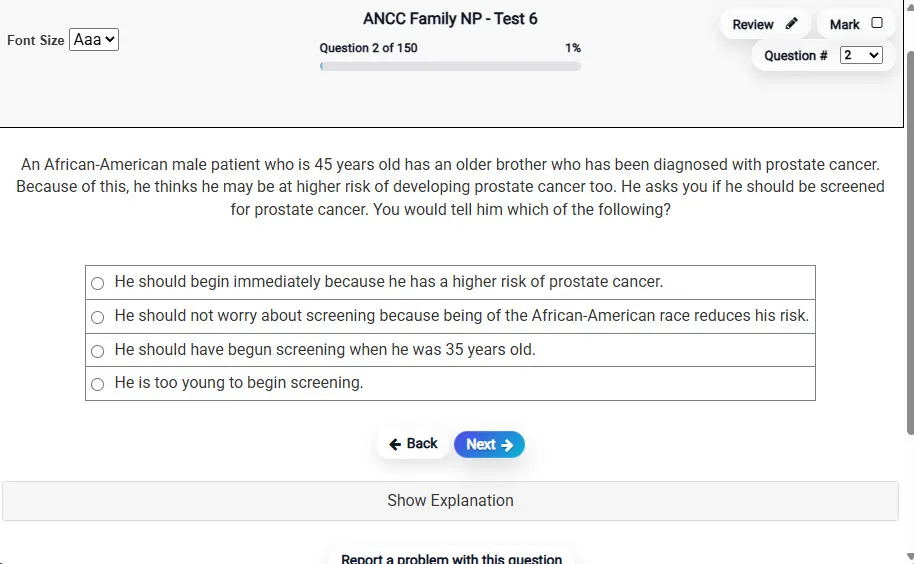
Answering a Question screen – Multiple-choice item view with navigation controls and progress tracker.
Answering a Question Multiple-choice item view with navigation controls and progress tracker.

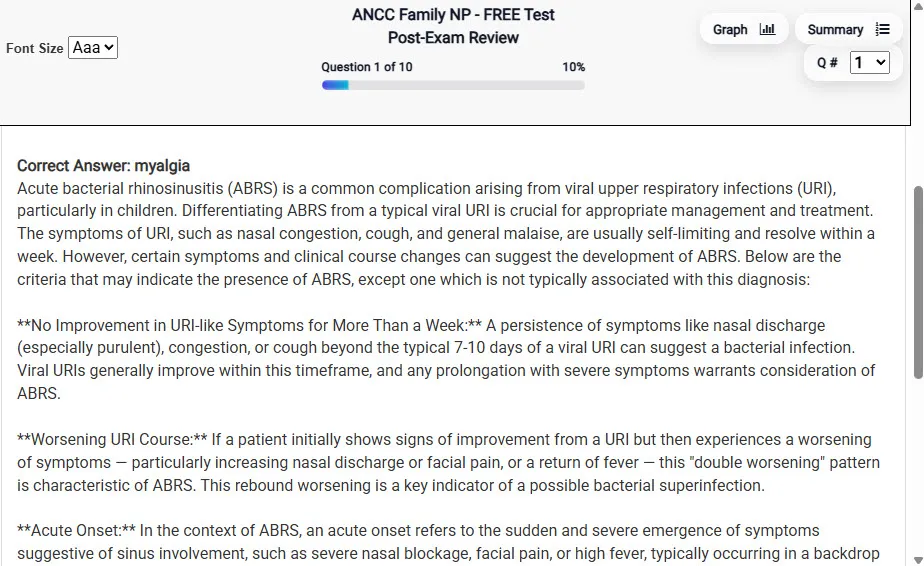
                           Detailed Explanation screen – 
                         Review mode showing chosen answer and rationale and references.
Detailed Explanation Review mode showing chosen answer and rationale and references.

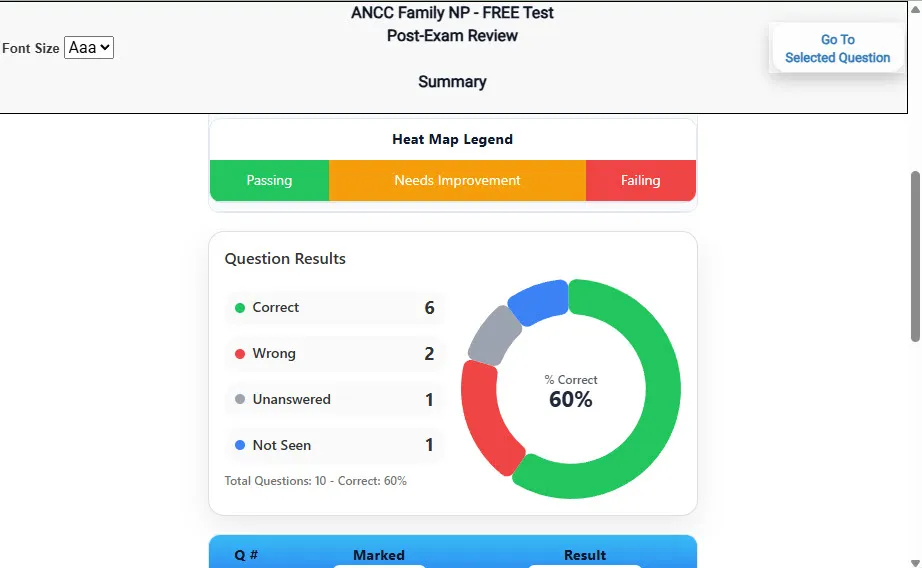
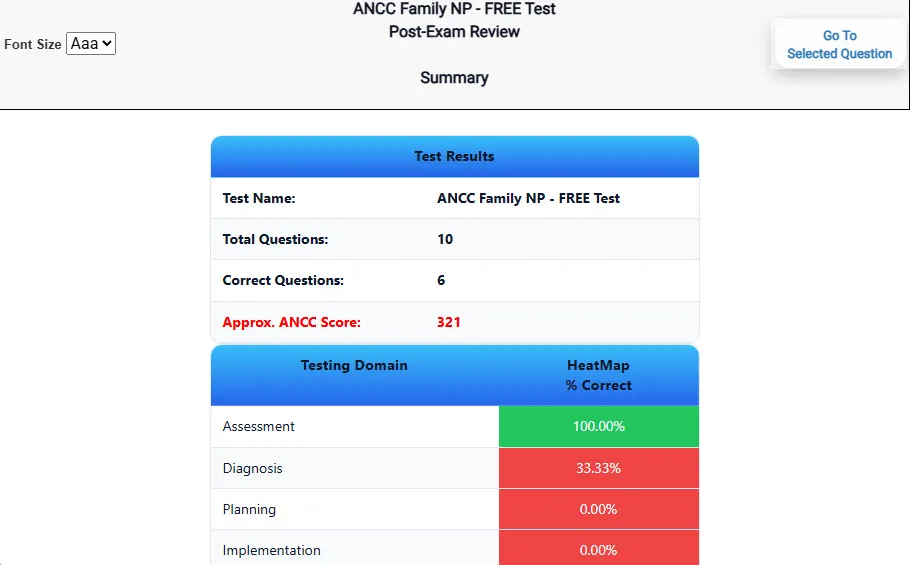
                           Review Summary 1 screen – 
                         Summary with counts for correct/wrong/unanswered and not seen items.
Review Summary 1 Summary with counts for correct/wrong/unanswered and not seen items.

                           Review Summary 2 screen – 
                         Advanced summary with category/domain breakdown and performance insights.
Review Summary 2 Advanced summary with category/domain breakdown and performance insights.

What Each Screen Shows

Answer Question Screen

  • Clean multiple-choice interface with progress bar.
  • Mark for review feature.
  • Matches real test pacing.

Detailed Explanation

  • Correct answer plus rationale.
  • Key concepts and guidelines highlighted.
  • Move between questions to fill knowledge gaps.

Review Summary 1

  • Overall results with total questions and scaled score.
  • Domain heatmap shows strengths and weaknesses.
  • Quick visual feedback on study priorities.

Review Summary 2

  • Chart of correct, wrong, unanswered, not seen.
  • Color-coded results for easy review.
  • Links back to missed items.

Top 10 Reasons to Use Exam Edge for your Pediatric Nursing Practitioner Primary Care Exam Prep

  1. Focused on the Pediatric Nursing Practitioner Primary Care Exam

    Our practice tests are built specifically for the CPNP Pediatric Nursing exam — every question mirrors the real topics, format, and difficulty so you're studying exactly what matters.

  2. Real Exam Simulation

    We match the per-question time limits and pressure of the actual Pediatric exam, so test day feels familiar and stress-free.

  3. 15 Full Practice Tests & 1,500 Unique Questions

    You'll have more than enough material to master every CPNP Pediatric Nursing concept — no repeats, no fluff.

  4. Lower Cost Than a Retake

    Ordering 5 practice exams costs less than retaking the Pediatric Nursing Practitioner Primary Care exam after a failure. One low fee could save you both time and money.

  5. Flexible Testing

    Need to step away mid-exam? Pick up right where you left off — with your remaining time intact.

  6. Instant Scoring & Feedback

    See your raw score and an estimated Pediatric Nursing Practitioner Primary Care score immediately after finishing each practice test.

  7. Detailed Explanations for Every Question

    Review correct and incorrect answers with clear, step-by-step explanations so you truly understand each topic.

  8. Trusted & Accredited

    We're fully accredited by the Better Business Bureau and uphold the highest standards of trust and transparency.

  9. Web-Based & Always Available

    No software to install. Access your CPNP Pediatric Nursing practice exams 24/7 from any computer or mobile device.

  10. Expert Support When You Need It

    Need extra help? Our specialized tutors are highly qualified and ready to support your Pediatric exam prep.


Pass the Pediatric Nursing Practitioner Primary Care Exam with Realistic Practice Tests from Exam Edge

Preparing for your upcoming Pediatric Nursing Practitioner Primary Care (CPNP) Certification Exam can feel overwhelming — but the right practice makes all the difference. Exam Edge gives you the tools, structure, and confidence to pass on your first try. Our online practice exams are built to match the real CPNP Pediatric Nursing exam in content, format, and difficulty.

  • 📝 15 Pediatric Nursing Practitioner Primary Care Practice Tests: Access 15 full-length exams with 100 questions each, covering every major Pediatric Nursing Practitioner Primary Care topic in depth.
  • Instant Online Access: Start practicing right away — no software, no waiting.
  • 🧠 Step-by-Step Explanations: Understand the reasoning behind every correct answer so you can master CPNP Pediatric Nursing exam concepts.
  • 🔄 Retake Each Exam Up to 4 Times: Build knowledge through repetition and track your improvement over time.
  • 🌐 Web-Based & Available 24/7: Study anywhere, anytime, on any device.
  • 🧘 Boost Your Test-Day Confidence: Familiarity with the Pediatric format reduces anxiety and helps you perform under pressure.

These Pediatric Nursing Practitioner Primary Care practice exams are designed to simulate the real testing experience by matching question types, timing, and difficulty level. This approach helps you get comfortable not just with the exam content, but also with the testing environment, so you walk into your exam day focused and confident.


Exam Edge PNCB Reviews


Pediatric Nursing Practitioner Primary Care Aliases Test Name

Here is a list of alternative names used for this exam.

  • Pediatric Nursing Practitioner Primary Care
  • Pediatric Nursing Practitioner Primary Care test
  • Pediatric Nursing Practitioner Primary Care Certification Test
  • CPNP Pediatric Nursing test
  • PNCB
  • PNCB CPNP
  • CPNP test
  • Pediatric Nursing Practitioner Primary Care (CPNP)
  • Pediatric Nursing Practitioner Primary Care certification