This is the content of the pop-over!

PCAT Math ( Math) Practice Tests & Test Prep by Exam Edge


Pharmacy College Admission Test -  Math  product image
(5.0)
Based on 20 Reviews

  • Real Exam Simulation: Timed questions and matching content build comfort for your PCAT Math test day.
  • Instant, 24/7 Access: Web-based Pharmacy College Admission Test - Math practice exams with no software needed.
  • Clear Explanations: Step-by-step answers and explanations for your PCAT exam to strengthen understanding.
  • Boosted Confidence: Reduces anxiety and improves test-taking skills to ace your Pharmacy College Admission Test - Math ( Math).

Featured on

Pharmacy College Admission Test - Math Online Practice Test Bundles

BEST VALUE
20 practice tests

$174.00

$799.00

SAVE $625

Only $8.70 per test!

  • 100% Pass Guarantee
  • 20 online practice tests
  • 48 questions per test
  • Bonus: 100 Flash Cards + Study Guide
  • Instant access
  • Detailed Explanations
  • Practice tests never expire
  • Timed, untimed, or study guide mode
MOST POPULAR
10 practice tests

$99.50

$399.50

SAVE $300

Only $9.95 per test!

  • 10 online practice tests
  • 48 questions per test
  • Bonus: 100 Flash Cards + Study Guide
  • Instant access
  • Detailed Explanations
  • Practice tests never expire
  • Timed, untimed, or study guide mode
5 practice tests

$69.75

$199.75

SAVE $130

Only $13.95 per test!

  • 5 online practice tests
  • 48 questions per test
  • Bonus: 100 Flash Cards
  • Instant access
  • Detailed Explanations
  • Practice tests never expire
  • Timed, untimed, or study guide mode
1 practice test

$39.95

  • 1 online practice test
  • 48 questions per test
  • Instant access
  • Detailed Explanations
  • Practice tests never expire
  • Timed, untimed, or study guide mode
Quick Select
Tap to choose a bundle

** All Prices are in US Dollars (USD) **


PCAT Math ( Math) Resources

Jump to the section you need most.

Understanding the exact breakdown of the Pharmacy College Admission Test - Math test will help you know what to expect and how to most effectively prepare. The Pharmacy College Admission Test - Math has multiple-choice questions . The exam will be broken down into the sections below:

Pharmacy College Admission Test - Math Exam Blueprint
Domain Name % Number of
Questions
Basic Math 15% 7
Algebra 20% 10
Probability & Statistics 20% 10
Precalculus 22% 11
Calculus 22% 11

Pharmacy College Admission Test - Math Study Tips by Domain

  • Convert between fractions, decimals, and percents quickly (e.g., 0.125 = 1/8 = 12.5%) — red flag: moving the decimal the wrong direction when converting percent to decimal.
  • Use order of operations (PEMDAS) and be strict with parentheses, especially with negatives — common trap: interpreting -3^2 as 9 instead of -9.
  • Set up ratio/proportion problems with consistent units (mg, g, mL, L) — priority rule: cancel units as you go to catch setup errors early.
  • Work confidently with exponents and roots (including fractional exponents) — red flag: assuming (a + b)^2 = a^2 + b^2.
  • Estimate to validate answers (round inputs, check magnitude) — common trap: picking an answer that is off by a factor of 10 due to place-value mistakes.
  • Translate word statements into arithmetic carefully (sum, difference, “of,” per, total) — red flag: reversing “less than” or mixing up “per” rates with totals.
  • Manipulate linear equations/inequalities efficiently (including compound and absolute value forms); red flag: when multiplying/dividing by a negative in an inequality, the sign must flip.
  • Solve systems of equations (substitution/elimination) and interpret solution count; common trap: dependent equations can yield infinitely many solutions, not a single ordered pair.
  • Work fluently with exponents and radicals (simplify, rationalize, solve); priority rule: keep domain restrictions in mind when taking even roots (e.g., principal square root is nonnegative).
  • Factor and solve polynomials (quadratics via factoring/formula, higher degree via factoring patterns); red flag: after clearing denominators, check for extraneous roots created by multiplying by an expression that can be zero.
  • Simplify and solve rational expressions/equations; threshold cue: explicitly exclude values that make any denominator 0 before solving and verify final answers against those restrictions.
  • Understand functions (notation, composition, inverse, and basic graph features); common trap: an inverse exists only if the function is one-to-one on the stated domain (use a restriction if needed).
  • Translate word problems into events/sets before calculating; red flag: mixing up “and” (intersection) with “or” (union), especially when events can overlap.
  • Use conditional probability correctly: P(A|B)=P(A∩B)/P(B); common trap is assuming independence (P(A|B)=P(A)) without evidence.
  • Know counting rules (permutations vs combinations) and when order matters; red flag: using nCr when arrangements are distinct or when repetition is allowed.
  • Compute and interpret mean/median/mode and variance/standard deviation; priority rule: watch for outliers that pull the mean but not the median.
  • Recognize key distributions and parameters (binomial n,p; geometric p; normal μ,σ); common trap: applying normal formulas without standardizing to z=(x−μ)/σ.
  • Interpret sampling and inference ideas (standard error, confidence intervals, p-values) conceptually; red flag: concluding “no effect” from a non-significant result or confusing correlation with causation.
  • Manipulate functions fluently (composition, inverses, domain/range) and state restrictions explicitly; red flag: canceling factors without excluding the zero(s) from the original denominator.
  • Interpret and use function transformations (shifts, reflections, stretches) from equations and graphs; common trap: mixing up vertical vs. horizontal shifts in forms like f(x−h) vs. f(x)−h.
  • Master exponential/logarithmic rules and solve equations using change of base when needed; priority rule: check for extraneous solutions when you exponentiate both sides.
  • Apply trigonometry fundamentals (unit circle values, identities, solving triangles with Law of Sines/Cosines); red flag: using degrees when the problem context implies radians (or vice versa), especially in arc length/sector area.
  • Solve polynomial and rational equations/inequalities using factoring, synthetic division, and sign charts; common trap: forgetting to test intervals around critical points for rational inequalities.
  • Work with sequences/series (arithmetic/geometric, sigma notation, growth/decay models) and know key formulas; threshold cue: for geometric series, convergence requires |r| < 1 and sum is a1/(1−r).
  • Know derivative rules cold (power, product, quotient, chain) and simplify before differentiating when possible; common trap: forgetting the inner derivative in the chain rule.
  • Master common derivatives and integrals (e.g., e^x, ln x, sin/cos) and use u-substitution when you see an inner function and its derivative; red flag: trying integration by parts when a simple substitution works.
  • Use definite integrals with correct bounds and sign (area vs. net signed area); priority rule: if the interval crosses where f(x)=0, split the integral to avoid missing negative contributions.
  • Apply limits for continuity and end behavior, including one-sided limits and L’Hôpital’s Rule only for 0/0 or ∞/∞ forms; common trap: using L’Hôpital on removable discontinuities without simplifying first.
  • Optimize with first derivative critical points and verify with second derivative or endpoint checks; PCAT-style pitfall: forgetting to include domain restrictions (e.g., x>0 for ln x) or endpoints in word problems.
  • Connect derivatives to rates (tangent slope, velocity/acceleration) and interpret units correctly; red flag: mixing up average rate of change (secant) with instantaneous rate (tangent).


Built to Fit Into Your Busy Life

Everything you need to prepare with confidence—without wasting a minute.

Three Study Modes

Timed, No Time Limit, or Explanation mode.

Actionable Analytics

Heatmaps and scaled scores highlight weak areas.

High-Yield Rationales

Concise explanations emphasize key concepts.

Realistic Interface

Matches the feel of the actual exam environment.

Accessible by Design

Clean layout reduces cognitive load.

Anytime, Anywhere

Web-based access 24/7 on any device.
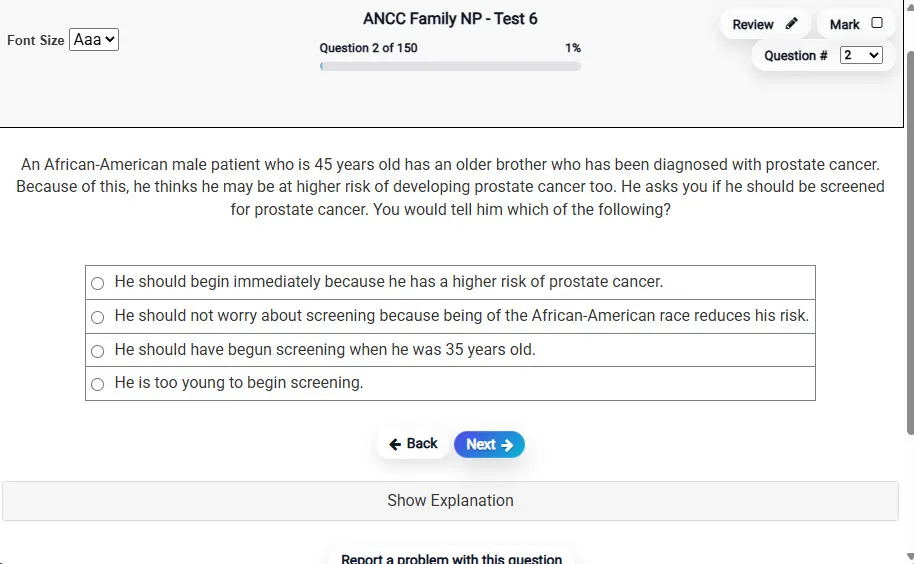
Answering a Question screen – Multiple-choice item view with navigation controls and progress tracker.
Answering a Question Multiple-choice item view with navigation controls and progress tracker.

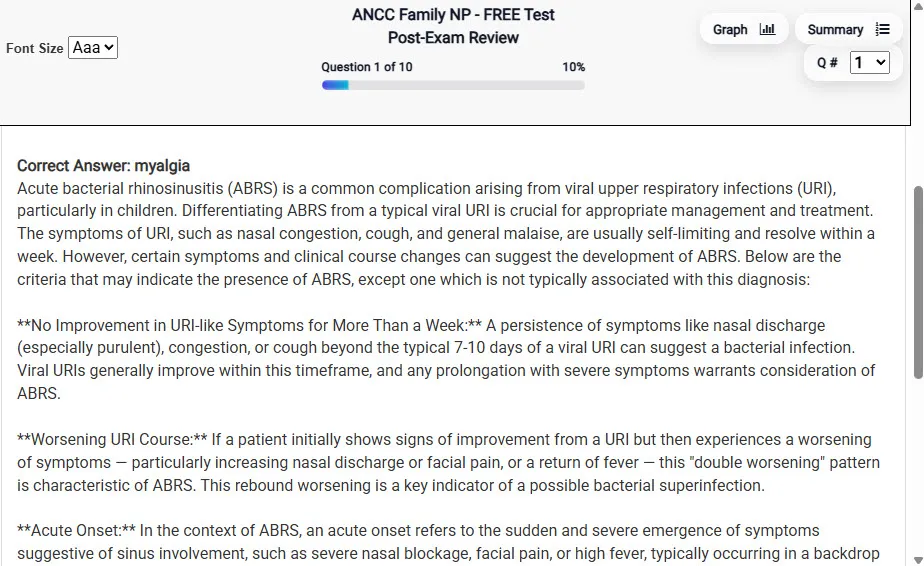
                           Detailed Explanation screen – 
                         Review mode showing chosen answer and rationale and references.
Detailed Explanation Review mode showing chosen answer and rationale and references.

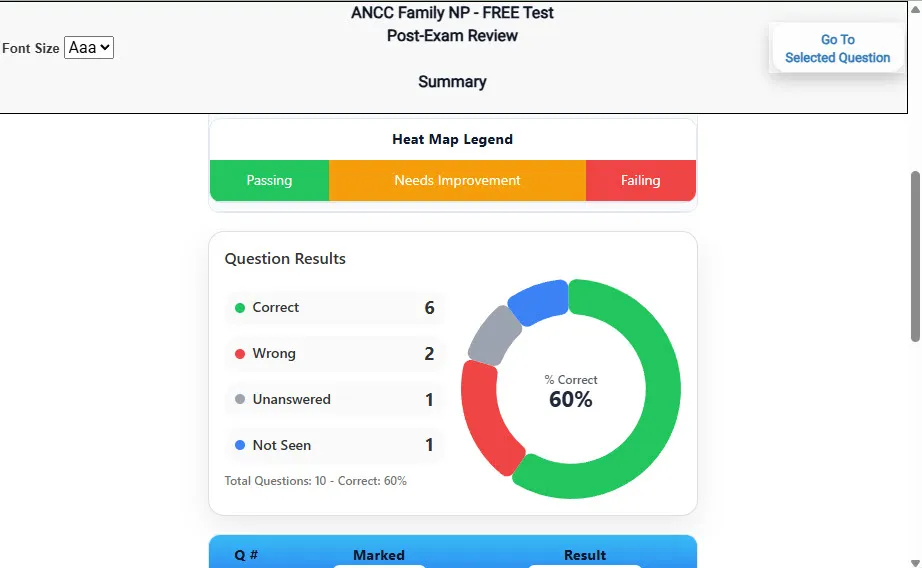
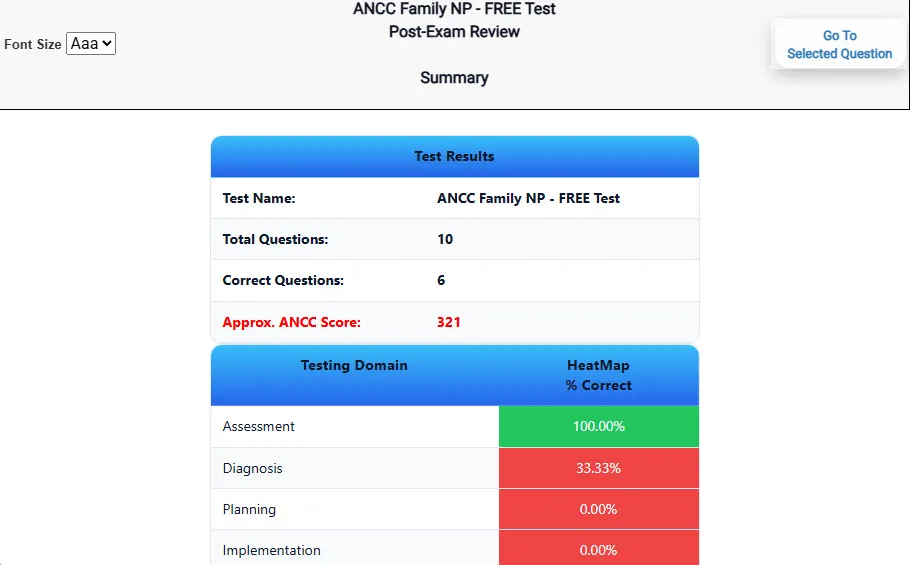
                           Review Summary 1 screen – 
                         Summary with counts for correct/wrong/unanswered and not seen items.
Review Summary 1 Summary with counts for correct/wrong/unanswered and not seen items.

                           Review Summary 2 screen – 
                         Advanced summary with category/domain breakdown and performance insights.
Review Summary 2 Advanced summary with category/domain breakdown and performance insights.

What Each Screen Shows

Answer Question Screen

  • Clean multiple-choice interface with progress bar.
  • Mark for review feature.
  • Matches real test pacing.

Detailed Explanation

  • Correct answer plus rationale.
  • Key concepts and guidelines highlighted.
  • Move between questions to fill knowledge gaps.

Review Summary 1

  • Overall results with total questions and scaled score.
  • Domain heatmap shows strengths and weaknesses.
  • Quick visual feedback on study priorities.

Review Summary 2

  • Chart of correct, wrong, unanswered, not seen.
  • Color-coded results for easy review.
  • Links back to missed items.

Top 10 Reasons to Use Exam Edge for your Pharmacy College Admission Test - Math Exam Prep

  1. Focused on the Pharmacy College Admission Test - Math Exam

    Our practice tests are built specifically for the PCAT Math exam — every question mirrors the real topics, format, and difficulty so you're studying exactly what matters.

  2. Real Exam Simulation

    We match the per-question time limits and pressure of the actual PCAT exam, so test day feels familiar and stress-free.

  3. 20 Full Practice Tests & 960 Unique Questions

    You'll have more than enough material to master every PCAT Math concept — no repeats, no fluff.

  4. Lower Cost Than a Retake

    Ordering 5 practice exams costs less than retaking the Pharmacy College Admission Test - Math exam after a failure. One low fee could save you both time and money.

  5. Flexible Testing

    Need to step away mid-exam? Pick up right where you left off — with your remaining time intact.

  6. Instant Scoring & Feedback

    See your raw score and an estimated Pharmacy College Admission Test - Math score immediately after finishing each practice test.

  7. Detailed Explanations for Every Question

    Review correct and incorrect answers with clear, step-by-step explanations so you truly understand each topic.

  8. Trusted & Accredited

    We're fully accredited by the Better Business Bureau and uphold the highest standards of trust and transparency.

  9. Web-Based & Always Available

    No software to install. Access your PCAT Math practice exams 24/7 from any computer or mobile device.

  10. Expert Support When You Need It

    Need extra help? Our specialized tutors are highly qualified and ready to support your PCAT exam prep.


Pass the Pharmacy College Admission Test - Math Exam with Realistic Practice Tests from Exam Edge

Preparing for your upcoming Pharmacy College Admission Test - Math ( Math) Certification Exam can feel overwhelming — but the right practice makes all the difference. Exam Edge gives you the tools, structure, and confidence to pass on your first try. Our online practice exams are built to match the real PCAT Math exam in content, format, and difficulty.

  • 📝 20 Pharmacy College Admission Test - Math Practice Tests: Access 20 full-length exams with 48 questions each, covering every major Pharmacy College Admission Test - Math topic in depth.
  • Instant Online Access: Start practicing right away — no software, no waiting.
  • 🧠 Step-by-Step Explanations: Understand the reasoning behind every correct answer so you can master PCAT Math exam concepts.
  • 🔄 Retake Each Exam Up to 4 Times: Build knowledge through repetition and track your improvement over time.
  • 🌐 Web-Based & Available 24/7: Study anywhere, anytime, on any device.
  • 🧘 Boost Your Test-Day Confidence: Familiarity with the PCAT format reduces anxiety and helps you perform under pressure.

These Pharmacy College Admission Test - Math practice exams are designed to simulate the real testing experience by matching question types, timing, and difficulty level. This approach helps you get comfortable not just with the exam content, but also with the testing environment, so you walk into your exam day focused and confident.

Exam Edge PCAT Reviews


Pharmacy College Admission Test - Math Aliases Test Name

Here is a list of alternative names used for this exam.

  • Pharmacy College Admission Test - Math
  • Pharmacy College Admission Test - Math test
  • Pharmacy College Admission Test - Math Certification Test
  • PCAT Math test
  • PCAT
  • PCAT Math
  • Math test
  • Pharmacy College Admission Test - Math ( Math)
  • Pharmacy College Admission Test - Math certification