
This is the content of the pop-over!

PCAT Combined (PCAT) Practice Tests & Test Prep by Exam Edge


Pharmacy College Admission Test Combined product image
(5.0)
Based on 32 Reviews

  • Real Exam Simulation: Timed questions and matching content build comfort for your PCAT Combined test day.
  • Instant, 24/7 Access: Web-based Pharmacy College Admission Test Combined practice exams with no software needed.
  • Clear Explanations: Step-by-step answers and explanations for your PCAT exam to strengthen understanding.
  • Boosted Confidence: Reduces anxiety and improves test-taking skills to ace your Pharmacy College Admission Test Combined (PCAT).

Featured on

Pharmacy College Admission Test Combined Online Practice Test Bundles

BEST VALUE
10 practice tests

$99.50

$399.50

SAVE $300

Only $9.95 per test!

  • 100% Pass Guarantee
  • 10 online practice tests
  • 234 questions per test
  • Bonus: 100 Flash Cards + Study Guide
  • Instant access
  • Detailed Explanations
  • Practice tests never expire
  • Timed, untimed, or study guide mode
5 practice tests

$69.75

$199.75

SAVE $130

Only $13.95 per test!

  • 5 online practice tests
  • 234 questions per test
  • Bonus: 100 Flash Cards + Study Guide
  • Instant access
  • Detailed Explanations
  • Practice tests never expire
  • Timed, untimed, or study guide mode
1 practice test

$39.95

  • 1 online practice test
  • 234 questions per test
  • Instant access
  • Detailed Explanations
  • Practice tests never expire
  • Timed, untimed, or study guide mode
Quick Select
Tap to choose a bundle

** All Prices are in US Dollars (USD) **


PCAT Combined (PCAT) Resources

Jump to the section you need most.

Understanding the exact breakdown of the Pharmacy College Admission Test Combined test will help you know what to expect and how to most effectively prepare. The Pharmacy College Admission Test Combined has multiple-choice questions . The exam will be broken down into the sections below:

Pharmacy College Admission Test Combined Exam Blueprint
Domain Name % Number of
Questions
Biology  
     General Biology 50% 23
     Microbiology 20% 9
     Human Anatomy and Physiology 30% 14
Chemistry  
     General Chemistry 50% 23
     Organic Chemistry 30% 14
     Basic Biochemistry Processes 20% 9
Math  
     Basic Math 15% 7
     Algebra 20% 9
     Probability & Statistics 20% 9
     Precalculus 22% 10
     Calculus 22% 10
Reading  
     Comprehension 30% 14
     Analysis 40% 19
     Evaluation 30% 14
Verbal  
     Analogies 50% 23
     Sentence Completion 50% 23

Pharmacy College Admission Test Combined Study Tips by Domain

  • Know how information flows DNA → RNA → protein and be ready to spot the red flag that RNA polymerase (not DNA polymerase) drives transcription.
  • Translate Mendelian ratios quickly (e.g., 3:1, 9:3:3:1) and watch the common trap of confusing genotype ratios with phenotype ratios when dominance is complete.
  • Master cell cycle checkpoints and mitosis vs. meiosis; a key cue is that nondisjunction risk rises when homologs/sister chromatids fail to separate in anaphase I/II.
  • Link enzymes to reaction behavior (Vmax, Km) and remember the priority rule that competitive inhibition increases Km but does not change Vmax.
  • For membranes and transport, use the cue that ATP use implies active transport, while movement down a concentration gradient without ATP indicates diffusion/facilitated diffusion.
  • In ecology/evolution items, treat “fitness” as reproductive success (not strength) and flag questions where selection acts on phenotypes but changes allele frequencies in populations.
  • Master cell structure/function and membranes (diffusion, osmosis, transporters); red flag: mixing up hypertonic vs hypotonic effects on animal vs plant cells.
  • Know metabolism fundamentals (enzymes, ATP, glycolysis, Krebs, oxidative phosphorylation, fermentation); common trap: assuming “more substrate” always increases rate—Vmax limits still apply.
  • Cover genetics and inheritance (DNA replication, transcription/translation, Mendelian vs non-Mendelian patterns); priority rule: when a pedigree suggests sex-linkage, check father-to-son transmission (it shouldn’t occur for X-linked traits).
  • Understand cell division and reproduction (mitosis vs meiosis, crossing over, nondisjunction); red flag: placing crossing over in mitosis or outside prophase I of meiosis.
  • Review evolution and ecology (Hardy–Weinberg, natural selection, population interactions, cycles); threshold cue: H–W requires no selection, mutation, migration, drift, and random mating—one violation breaks equilibrium assumptions.
  • Know classification and physiology basics across major taxa (plants, animals, microbes) and homeostasis; common trap: confusing positive vs negative feedback—negative feedback stabilizes a set point.
  • Differentiate major groups quickly: bacteria (peptidoglycan), fungi (chitin), protozoa (no cell wall), viruses (obligate intracellular)—red flag: assuming antibiotics treat viral infections.
  • Know Gram stain logic (crystal violet retention with thick peptidoglycan) and what it implies for drug susceptibility—common trap: mixing up Gram-negative outer membrane/LPS with Gram-positive teichoic acids.
  • Track bacterial gene exchange (transformation, transduction, conjugation) and how it spreads resistance—priority rule: conjugation via plasmids is a rapid route for multidrug resistance.
  • Master growth phases and what affects culture results (lag, log, stationary, death)—common trap: expecting bactericidal agents to work best when cells are not actively dividing.
  • Contrast innate vs adaptive immunity basics relevant to pathogens (inflammation, complement, antibodies, T cells)—red flag: confusing antigen presentation (MHC) with antibody production sites.
  • Apply aseptic technique and sterilization/disinfection principles conceptually—threshold cue: endospores require true sterilization (e.g., autoclaving), not just routine disinfectants.
  • Link structure to function: e.g., alveoli and capillaries maximize diffusion for gas exchange—red flag if an option reverses the direction of O2/CO2 movement or ignores partial pressure gradients.
  • Know homeostatic control loops (stimulus → sensor → integrator → effector) for temperature, blood glucose, and blood pressure—common trap is labeling positive feedback (labor, clotting) as negative feedback.
  • Master cardiovascular basics: CO = HR × SV and MAP ≈ CO × TPR—priority rule is that baroreceptors respond to pressure (stretch) changes, not directly to blood O2 content (chemoreceptors).
  • Renal physiology: GFR depends on net filtration pressure and filtration coefficient, while ADH increases water reabsorption in collecting ducts—red flag if a choice claims ADH “increases urine volume” or confuses aldosterone (Na+ retention/K+ secretion) with ADH.
  • Nervous and muscle: action potentials are all-or-none, and skeletal muscle force increases via motor unit recruitment and frequency—common trap is mixing up depolarization ions (Na+ in) with repolarization (K+ out) or confusing smooth vs skeletal muscle control.
  • Endocrine: peptide hormones act via membrane receptors/second messengers, while steroid/thyroid hormones act via intracellular receptors to alter transcription—contraindication cue is that onset is typically slower for intracellular receptor hormones, so “immediate effects” is a red flag.
  • Balance equations by conserving atoms (and charge for ionic/redox) before doing any stoichiometry—common trap: starting with mole ratios from an unbalanced equation.
  • Pick the limiting reagent by comparing moles to coefficients (or calculate product from each reactant); red flag: using grams directly without converting to moles first.
  • Acid–base: strong acids/bases fully dissociate, weak ones use Ka/Kb; priority rule: for buffers use Henderson–Hasselbalch only when both conjugate pair species are present in appreciable amounts.
  • Equilibrium: write K correctly (omit pure solids/liquids) and use ICE tables when shifts are non-negligible; common trap: assuming “x is small” without checking the 5% rule.
  • Thermochemistry: q = m c ΔT and sign conventions matter—endothermic has +ΔH; red flag: mixing units (J vs kJ) or using ΔT with reversed sign.
  • Solutions: molarity depends on liters of solution (not solvent) and dilution uses M1V1 = M2V2; common trap: forgetting to convert mL to L or applying molality/molarity interchangeably.
  • Balance equations and do mole-to-mole conversions first; red flag: trying to use grams directly without converting to moles.
  • Gas laws and stoichiometry (PV=nRT, Dalton’s law) are frequent—priority rule: always check units and convert °C to K (K = °C + 273).
  • Solutions: molarity, dilutions (M1V1=M2V2), and limiting reagent in solution problems; common trap: using total volume before mixing is complete or ignoring volume change assumptions.
  • Acid–base: pH/pOH and Ka/Kb relationships; red flag: forgetting that pH + pOH = 14 at 25°C or mixing up strong vs weak electrolytes in equilibrium setups.
  • Thermochemistry and calorimetry (q=mcΔT, ΔH signs); common trap: heat gained by solution is heat lost by reaction (sign flip) and using grams of solvent vs total solution incorrectly.
  • Atomic structure/periodic trends and bonding (electron configurations, IMFs) drive properties; priority rule: compare ions/atoms by effective nuclear charge and size—don’t rely on memorized exceptions without checking charge and period.
  • Prioritize acid–base and resonance logic: compare acidity/basicity by stability of conjugates (inductive, resonance, hybridization) — red flag: choosing the more substituted carbanion as “more stable” without resonance support.
  • Know substitution vs elimination decision rules (substrate class, nucleophile/base strength, solvent, temperature) — common trap: predicting SN2 on a tertiary center or forgetting heat pushes E2/E1.
  • Memorize key carbonyl reactivity patterns (nucleophilic acyl substitution vs addition) — priority rule: acid chlorides > anhydrides > esters ≈ acids > amides; red flag: converting an amide directly to an ester without activation.
  • Track stereochemistry explicitly (R/S, E/Z, anti addition, inversion/retention) — common trap: calling an E2 product without checking antiperiplanar geometry or forgetting racemization in SN1.
  • Use spectroscopy as a fast elimination tool: IR (O–H broad, C=O strong), 1H NMR (integration, splitting, chemical shift), MS (molecular ion/halogen patterns) — red flag: ignoring a halogen M:M+2 pattern (3:1 for Cl, 1:1 for Br).
  • Map multistep synthesis by functional group interconversions and chemoselectivity — common trap: applying strong oxidants/reductants without protecting groups (e.g., oxidizing a primary alcohol in the presence of an alkene you need to keep).
  • Map macromolecule breakdown to energy entry points: carbs → glycolysis, fats → β-oxidation, proteins → deamination — red flag: forgetting that amino acids require nitrogen removal before carbon skeletons feed TCA.
  • Know enzyme fundamentals (active site, saturation, cofactors/coenzymes) and how temperature/pH affect activity — common trap: assuming denaturation is reversible or that more substrate always increases rate indefinitely.
  • Track ATP/NADH/FADH2 flow across glycolysis, TCA, and oxidative phosphorylation — priority rule: NADH generally yields more ATP than FADH2 because it enters earlier in the electron transport chain.
  • Recognize when pathways run “forward” or “backward” (glycolysis vs gluconeogenesis; glycogenesis vs glycogenolysis) — contraindication cue: irreversible steps require bypass enzymes, not simple reversal.
  • Apply basic acid–base and buffering ideas to physiology (e.g., amino acids/zwitterions, pH effects on proteins) — common trap: mixing up pKa logic; at pH > pKa, the group is more deprotonated.
  • Membrane transport and signaling basics: diffusion vs facilitated transport vs active transport, and receptor–ligand specificity — red flag: expecting nonpolar molecules to need carriers while small nonpolar molecules typically diffuse through membranes.
  • Prioritize setup speed: translate word problems into equations/inequalities immediately; red flag—if you start calculating before defining variables, you’re likely to miss what the question actually asks.
  • Master exponent/log rules and algebraic simplification because PCAT-style distractors target sign/parentheses errors; common trap—distributing a negative through parentheses incorrectly.
  • Be fluent with unit conversions and dimensional analysis; priority rule—cancel units every step, and treat mismatched units (e.g., mL vs L) as an automatic error check.
  • Know ratios, proportions, and percent change cold; common trap—confusing percentage points with percent change (e.g., 20% to 30% is +10 points but +50% change).
  • Use estimation to eliminate choices quickly; red flag—if your exact arithmetic yields an answer far outside a reasonable range, re-check rounding and order of operations.
  • Handle graphs/functions basics: identify slope/intercepts, domain/range, and transformations; common trap—mixing up vertical vs horizontal shifts (f(x−2) shifts right, not left).
  • Prioritize order of operations (PEMDAS) with parentheses and exponents—a common trap is distributing a negative sign incorrectly across a subtraction in parentheses.
  • Be fluent with fractions, decimals, and percent conversions; red flag: mixing up “percent of” (multiply) with “percent change” ((new–old)/old).
  • Use ratio/proportion setups for dosage-style word problems; trap: failing to keep units consistent (e.g., mg vs g) before cross-multiplying.
  • Estimate before calculating to catch arithmetic slips; priority rule: if your exact answer is far from the estimate, re-check rounding and place value.
  • Handle signed numbers and absolute value carefully; common error: treating |a–b| as |a|–|b| (not generally true).
  • Translate word statements into equations precisely; red flag words include “at least” (≥) and “no more than” (≤), which are often reversed under time pressure.
  • When solving linear equations/inequalities, keep the “do the same to both sides” rule tight; red flag: multiplying or dividing by a negative flips the inequality sign.
  • Factor first before canceling in rational expressions; common trap: canceling terms across addition/subtraction (only common factors cancel).
  • For exponents and radicals, rewrite consistently (e.g., a^(m/n) = (n√a)^m); red flag: distributing powers over sums ( (a+b)^2 ≠ a^2 + b^2 ).
  • On quadratics, choose the fastest method (factoring, completing the square, quadratic formula); priority rule: if asked for vertex/max/min, completing the square is often quickest.
  • Manage absolute value equations/inequalities by splitting into cases; common trap: forgetting to check candidate solutions back in the original (especially when isolating an absolute value).
  • For systems of equations, decide substitution vs. elimination based on coefficients; red flag: inconsistent systems (parallel lines) yield “no solution,” while dependent systems yield infinitely many solutions.
  • Memorize the “when to use” rules: binomial (fixed n, independent, two outcomes, constant p) vs. geometric (first success) vs. Poisson (rate λ per interval)—red flag: treating a changing p scenario as binomial.
  • For conditional probability, compute P(A|B)=P(A∩B)/P(B) and use complements strategically; common trap: assuming independence and replacing P(A∩B) with P(A)P(B) without evidence.
  • Know counting shortcuts: permutations (order matters) vs. combinations (order doesn’t) and watch for “without replacement” wording; red flag: forgetting to divide by repeated arrangements (e.g., identical letters).
  • Use mean/variance rules: Var(aX+b)=a2Var(X) and for independent sums Var(X+Y)=Var(X)+Var(Y); common trap: adding standard deviations directly instead of variances.
  • For normal problems, standardize with z=(x−μ)/σ and be clear whether you need P(X<x) vs. P(X>x); red flag: mixing up σ and σ2 or misreading “within 1 SD” as one-sided.
  • In inference, match the interval/test to the parameter (mean vs. proportion) and conditions (e.g., approximate normal for a proportion typically needs np and n(1−p) sufficiently large); common trap: interpreting a 95% CI as “95% of data are in the interval” rather than about the parameter.
  • Translate word problems into functions carefully (e.g., revenue/cost, growth/decay)—red flag: mixing units or treating a domain restriction (like time ≥ 0) as optional.
  • Master graph transformations (shift, reflect, stretch/compress) using parent functions—common trap: applying the sign change inside vs. outside the function (e.g., f(−x) vs. −f(x)).
  • For polynomial and rational functions, identify zeros, holes, and vertical/horizontal asymptotes from factorization—priority rule: always simplify first to reveal cancellations (holes) before stating asymptotes.
  • With exponential and logarithmic expressions, enforce domain constraints (log arguments > 0) and inverse relationships—common trap: dropping parentheses so that ln(ab) is mistaken for ln(a)+b.
  • Use trigonometric unit-circle values and radians (not degrees) unless stated—threshold cue: memorize exact values at 0, π/6, π/4, π/3, π/2 because PCAT-style items often hinge on them.
  • Solve systems and inequalities with attention to extraneous solutions—red flag: squaring both sides or multiplying by an expression that could be negative without checking sign changes and solution validity.
  • Differentiate using the correct rule (power/product/quotient/chain), and don’t forget the inner derivative in chain rule—a common trap is treating ln(g(x)) or e^{g(x)} as if g(x) were x.
  • Apply implicit differentiation when variables are mixed (e.g., x and y), and always solve for dy/dx at the end—red flag: leaving dy/dx terms on both sides.
  • Use limits to evaluate continuity and basic derivative ideas, and watch for indeterminate forms like 0/0 that require algebraic simplification first—priority rule: simplify before attempting any special technique.
  • Know antiderivatives of core families (polynomials, 1/x, e^x, sin, cos) and include +C for indefinite integrals—common trap: missing the constant of integration.
  • Use substitution (u-sub) when you see a function and its derivative pattern, and change dx accordingly—red flag: choosing u that doesn’t simplify the integral.
  • Interpret derivative and integral applications (rates of change, area under a curve) with correct units/sign, and don’t confuse average rate (difference quotient) with instantaneous rate (derivative)—common trap on word problems.
  • Do a quick purpose pass first: identify thesis, tone, and paragraph roles before answering details; red flag: jumping to questions without a map usually leads to “true but not answering” choices.
  • For main-idea items, pick the most general statement that covers most paragraphs; common trap: selecting a vivid detail from one section that sounds important but is too narrow.
  • For inference questions, choose what must be true based on the passage, not what could be true; priority rule: if an option needs outside knowledge, eliminate it.
  • For author attitude/tone, anchor your choice to specific word connotations (e.g., “however,” “notably,” “purported”); red flag: extreme tone words (always, absurd, perfect) are rarely correct.
  • For application/strengthen-weaken style questions, match the option to the exact claim or assumption in the passage; common trap: picking an answer that supports a related topic but doesn’t address the stated conclusion.
  • Manage time by reading steadily and using targeted re-reads for line-referenced questions; threshold cue: if you can’t justify an answer with a cited sentence within 30–45 seconds, mark it and move on.
  • Read the question stem first to set a purpose; red flag: answering from background knowledge when the item asks what the passage “states” or “implies.”
  • For main idea, choose the option that matches the passage’s overall claim and scope; common trap: picking a vivid detail or one paragraph’s point.
  • For inference items, pick what must be true given the text, not what could be true; red flag: options using absolute words (e.g., “always,” “never”) when the passage is qualified.
  • Use line/paragraph references by scanning for unique keywords, then read 2–3 sentences around the target; common trap: stopping at the first matching phrase without checking context.
  • For tone/author attitude, base your choice on consistent diction and qualifiers; red flag: selecting “angry” or “enthusiastic” when the passage is mostly neutral/academic.
  • When asked about purpose or function, answer what the sentence/paragraph does (e.g., defines, contrasts, provides evidence); common trap: restating the content instead of its role.
  • Identify the author’s thesis and the function of each paragraph; red flag: answering from an interesting detail rather than the passage’s central claim.
  • Separate fact from inference and opinion; trap: treating a plausible inference as explicitly stated when the question asks what is “stated” or “according to” the passage.
  • Track tone and stance using signal words (however, thus, qualifies, suggests); priority rule: base tone on repeated cues, not one emotionally loaded sentence.
  • Evaluate evidence quality (sample size, controls, confounders) and whether it supports the conclusion; red flag: correlation presented as causation without a mechanism or controlled comparison.
  • Recognize argumentative structure (claim–support–counterargument–rebuttal) and what would strengthen/weaken it; common trap: choosing an answer that adds new information but doesn’t affect the stated conclusion.
  • Handle “EXCEPT”/“NOT” and best-supported questions with elimination; threshold cue: when two options seem right, pick the one most directly tied to the passage’s explicit evidence, not outside knowledge.
  • Identify the author’s main conclusion and separate it from background or examples; red flag: a choice that sounds important but is only a supporting detail.
  • Evaluate whether evidence actually supports the claim by checking relevance and sufficiency; common trap: assuming correlation implies causation.
  • Judge the strength of an argument by spotting unstated assumptions; priority rule: ask what must be true for the conclusion to follow.
  • Assess tone and bias in word choice and framing; red flag: absolute language (“always,” “never”) in answer choices not warranted by the passage.
  • When asked for the best critique, target the weakest link (method, sample, controls, alternative explanations); common trap: criticizing a minor point that doesn’t affect the conclusion.
  • For inference questions, choose what is most directly supported, not what is merely plausible; threshold: if the passage doesn’t justify it, it’s too strong.
  • Analogies: identify the relationship first (function, part–whole, cause–effect) and test it both ways; red flag—choosing an answer that shares a topic word but breaks the relationship.
  • Sentence Completion: use structure cues (contrast words like “however”, “although”) to predict tone before looking at options; common trap—picking a synonym that fits one blank but makes the full sentence illogical.
  • Context over memorization: if a word is unfamiliar, infer meaning from nearby clues, appositives, or examples; priority rule—eliminate choices that don’t match the sentence’s overall direction (positive/negative/neutral).
  • Precision with connotation: distinguish near-synonyms by intensity and tone (e.g., “frugal” vs “stingy”); red flag—extreme words (“always”, “never”) when the context is qualified.
  • Form matters: watch for shifts in part of speech and grammar (noun vs adjective) when completing or matching; common trap—an option that is semantically right but grammatically incompatible with surrounding words.
  • Elimination strategy: cross out options that create redundancy or contradiction, then re-read the stem with your top choice; threshold cue—if two answers both seem plausible, the correct one typically preserves the most specific relationship or meaning, not the most general.
  • Identify the relationship type first (synonym, antonym, part-to-whole, cause-to-effect, degree) before looking at choices—red flag: picking a pair that merely “sounds related.”
  • Use the “A is to B as C is to ?” sentence test and keep the grammar parallel—common trap: mixing noun–verb vs noun–noun relationships.
  • Check directionality and reversibility (e.g., “precursor → product” vs “product → precursor”)—priority rule: the relation must match in the same order, not just both-way association.
  • Match specificity level (general-to-specific vs specific-to-general)—red flag: an answer that is too broad or too narrow compared with the stem pair.
  • Eliminate distractors that share one word’s meaning but not the exact relation (e.g., “tool–user” vs “tool–purpose”)—common trap: settling for a partial match after finding a single similarity.
  • When two choices seem plausible, test for uniqueness by creating a second sentence that captures nuance (degree, intensity, or typicality)—red flag: answers that fit only with a vague “related to” statement.
  • Read the entire sentence first, then predict a word before looking at choices—red flag: picking an option that “sounds right” but contradicts the sentence’s logic.
  • Use structural cue words (e.g., although, however, because, therefore) to set the relationship; common trap: missing a reversal word and choosing a synonym that fits only the first clause.
  • Match tone and intensity (mild vs. extreme, positive vs. negative); priority rule: eliminate options that are too absolute (e.g., “always,” “never”) when the context is qualified.
  • For blanks with paired ideas, ensure both meaning and grammar align (part of speech, tense, agreement); red flag: an option that fits meaning but breaks parallel structure.
  • When two choices look similar, test each by plugging it back in and checking for precision; common trap: choosing a broad word when the context demands a specific scientific/academic nuance.
  • If you’re stuck, eliminate by context constraints (connotation, collocation, and logical necessity) rather than guessing; threshold cue: if an option doesn’t make the sentence unambiguously coherent, cross it out.


Built to Fit Into Your Busy Life

Everything you need to prepare with confidence—without wasting a minute.

Three Study Modes

Timed, No Time Limit, or Explanation mode.

Actionable Analytics

Heatmaps and scaled scores highlight weak areas.

High-Yield Rationales

Concise explanations emphasize key concepts.

Realistic Interface

Matches the feel of the actual exam environment.

Accessible by Design

Clean layout reduces cognitive load.

Anytime, Anywhere

Web-based access 24/7 on any device.
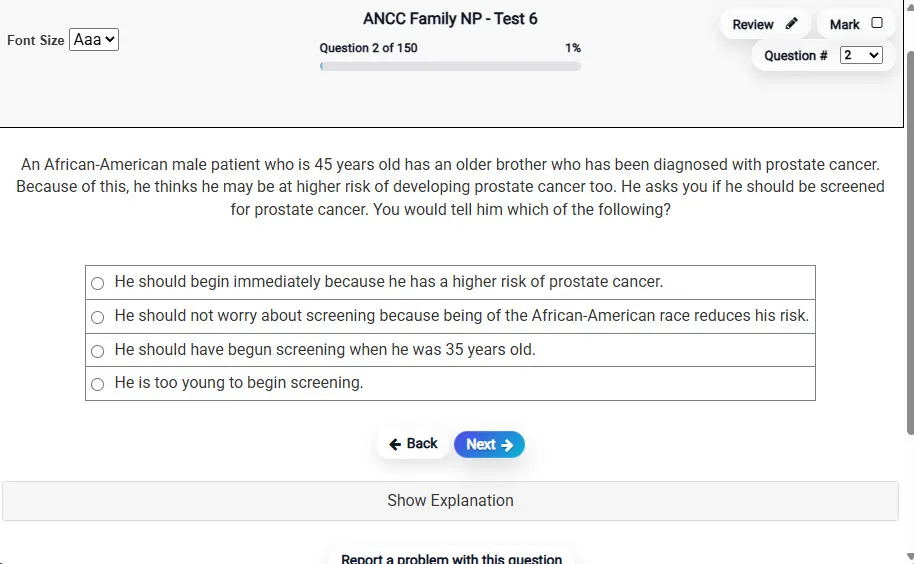
Answering a Question screen – Multiple-choice item view with navigation controls and progress tracker.
Answering a Question Multiple-choice item view with navigation controls and progress tracker.

                           Detailed Explanation screen – 
                         Review mode showing chosen answer and rationale and references.
Detailed Explanation Review mode showing chosen answer and rationale and references.

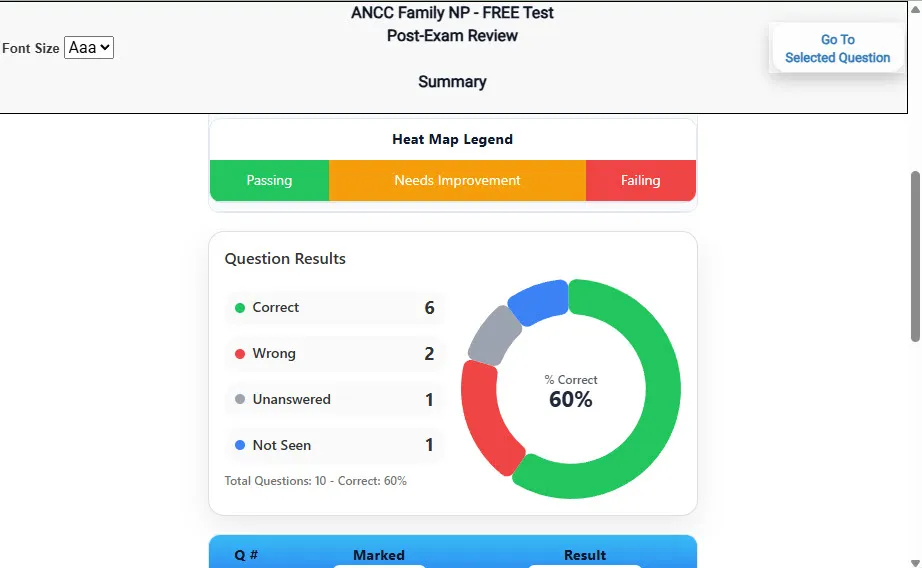
                           Review Summary 1 screen – 
                         Summary with counts for correct/wrong/unanswered and not seen items.
Review Summary 1 Summary with counts for correct/wrong/unanswered and not seen items.

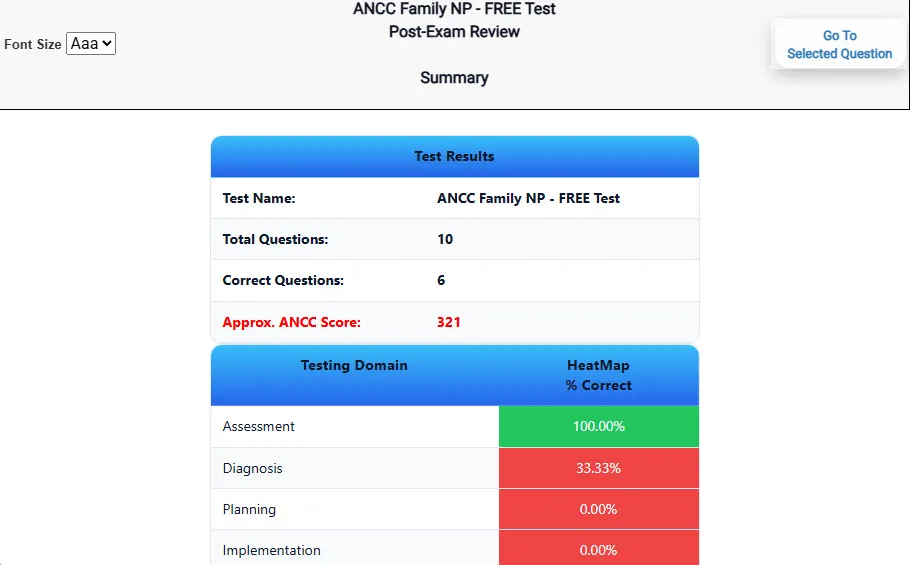
                           Review Summary 2 screen – 
                         Advanced summary with category/domain breakdown and performance insights.
Review Summary 2 Advanced summary with category/domain breakdown and performance insights.

What Each Screen Shows

Answer Question Screen

  • Clean multiple-choice interface with progress bar.
  • Mark for review feature.
  • Matches real test pacing.

Detailed Explanation

  • Correct answer plus rationale.
  • Key concepts and guidelines highlighted.
  • Move between questions to fill knowledge gaps.

Review Summary 1

  • Overall results with total questions and scaled score.
  • Domain heatmap shows strengths and weaknesses.
  • Quick visual feedback on study priorities.

Review Summary 2

  • Chart of correct, wrong, unanswered, not seen.
  • Color-coded results for easy review.
  • Links back to missed items.

Top 10 Reasons to Use Exam Edge for your Pharmacy College Admission Test Combined Exam Prep

  1. Focused on the Pharmacy College Admission Test Combined Exam

    Our practice tests are built specifically for the PCAT Combined exam — every question mirrors the real topics, format, and difficulty so you're studying exactly what matters.

  2. Real Exam Simulation

    We match the per-question time limits and pressure of the actual PCAT exam, so test day feels familiar and stress-free.

  3. 10 Full Practice Tests & 2,340 Unique Questions

    You'll have more than enough material to master every PCAT Combined concept — no repeats, no fluff.

  4. Lower Cost Than a Retake

    Ordering 5 practice exams costs less than retaking the Pharmacy College Admission Test Combined exam after a failure. One low fee could save you both time and money.

  5. Flexible Testing

    Need to step away mid-exam? Pick up right where you left off — with your remaining time intact.

  6. Instant Scoring & Feedback

    See your raw score and an estimated Pharmacy College Admission Test Combined score immediately after finishing each practice test.

  7. Detailed Explanations for Every Question

    Review correct and incorrect answers with clear, step-by-step explanations so you truly understand each topic.

  8. Trusted & Accredited

    We're fully accredited by the Better Business Bureau and uphold the highest standards of trust and transparency.

  9. Web-Based & Always Available

    No software to install. Access your PCAT Combined practice exams 24/7 from any computer or mobile device.

  10. Expert Support When You Need It

    Need extra help? Our specialized tutors are highly qualified and ready to support your PCAT exam prep.


Pass the Pharmacy College Admission Test Combined Exam with Realistic Practice Tests from Exam Edge

Preparing for your upcoming Pharmacy College Admission Test Combined (PCAT) Certification Exam can feel overwhelming — but the right practice makes all the difference. Exam Edge gives you the tools, structure, and confidence to pass on your first try. Our online practice exams are built to match the real PCAT Combined exam in content, format, and difficulty.

  • 📝 10 Pharmacy College Admission Test Combined Practice Tests: Access 10 full-length exams with 234 questions each, covering every major Pharmacy College Admission Test Combined topic in depth.
  • Instant Online Access: Start practicing right away — no software, no waiting.
  • 🧠 Step-by-Step Explanations: Understand the reasoning behind every correct answer so you can master PCAT Combined exam concepts.
  • 🔄 Retake Each Exam Up to 4 Times: Build knowledge through repetition and track your improvement over time.
  • 🌐 Web-Based & Available 24/7: Study anywhere, anytime, on any device.
  • 🧘 Boost Your Test-Day Confidence: Familiarity with the PCAT format reduces anxiety and helps you perform under pressure.

These Pharmacy College Admission Test Combined practice exams are designed to simulate the real testing experience by matching question types, timing, and difficulty level. This approach helps you get comfortable not just with the exam content, but also with the testing environment, so you walk into your exam day focused and confident.

Exam Edge PCAT Reviews


Pharmacy College Admission Test Combined Aliases Test Name

Here is a list of alternative names used for this exam.

  • Pharmacy College Admission Test Combined
  • Pharmacy College Admission Test Combined test
  • Pharmacy College Admission Test Combined Certification Test
  • PCAT Combined test
  • PCAT
  • PCAT PCAT
  • PCAT test
  • Pharmacy College Admission Test Combined (PCAT)
  • Pharmacy College Admission Test Combined certification