This is the content of the pop-over!

TX PACT Science 7 to 12 (736) Practice Tests & Test Prep by Exam Edge


TX PACT Science Grade 7 to 12 product image
(4.7)
Based on 34 Reviews

  • Real Exam Simulation: Timed questions and matching content build comfort for your TX PACT Science 7 to 12 test day.
  • Instant, 24/7 Access: Web-based TX PACT Science Grade 7 to 12 practice exams with no software needed.
  • Clear Explanations: Step-by-step answers and explanations for your TX PACT exam to strengthen understanding.
  • Boosted Confidence: Reduces anxiety and improves test-taking skills to ace your TX PACT Science Grade 7 to 12 (736).

Featured on

TX PACT Science Grade 7 to 12 Online Practice Test Bundles

BEST VALUE
15 practice tests

$149.25

$599.25

SAVE $450

Only $9.95 per test!

  • 100% Pass Guarantee
  • 15 online practice tests
  • 125 questions per test
  • Bonus: 100 Flash Cards + Study Guide
  • Instant access
  • Detailed Explanations
  • Practice tests never expire
  • Timed, untimed, or study guide mode
MOST POPULAR
10 practice tests

$99.50

$399.50

SAVE $300

Only $9.95 per test!

  • 10 online practice tests
  • 125 questions per test
  • Bonus: 100 Flash Cards + Study Guide
  • Instant access
  • Detailed Explanations
  • Practice tests never expire
  • Timed, untimed, or study guide mode
5 practice tests

$69.75

$199.75

SAVE $130

Only $13.95 per test!

  • 5 online practice tests
  • 125 questions per test
  • Bonus: 100 Flash Cards
  • Instant access
  • Detailed Explanations
  • Practice tests never expire
  • Timed, untimed, or study guide mode
1 practice test

$39.95

  • 1 online practice test
  • 125 questions per test
  • Instant access
  • Detailed Explanations
  • Practice tests never expire
  • Timed, untimed, or study guide mode
Quick Select
Tap to choose a bundle

** All Prices are in US Dollars (USD) **


TX PACT Science 7 to 12 (736) Resources

Jump to the section you need most.

Understanding the exact breakdown of the TX PACT Science Grade 7 to 12 test will help you know what to expect and how to most effectively prepare. The TX PACT Science Grade 7 to 12 has 125 multiple-choice questions . The exam will be broken down into the sections below:

TX PACT Science Grade 7 to 12 Exam Blueprint
Domain Name % Number of
Questions
Nature of Science 19% 24
Physical Science 37% 46
Life Science 25% 31
Earth and Space Science 19% 24

TX PACT Science Grade 7 to 12 Study Tips by Domain

  • Differentiate scientific law vs theory vs hypothesis—a common trap is saying theories become laws; theories explain, laws describe, and both are supported by evidence.
  • Identify variables and controls in investigations; red flag: changing more than one independent variable makes causal claims invalid.
  • Evaluate experimental design for replication, sample size, and measurement error; priority rule: repeated trials and clear operational definitions reduce random error and improve reliability.
  • Interpret data using graphs/tables with attention to units, scale, and uncertainty; common trap: inferring causation from correlation or ignoring outliers without justification.
  • Distinguish accuracy vs precision and recognize systematic vs random error; red flag: consistently off-target results suggest systematic bias (e.g., miscalibrated instrument).
  • Apply ethics and safety in scientific work (including proper handling/disposal and truthful reporting); priority rule: document procedures and results in a way that another investigator could reproduce them.
  • Use dimensional analysis every time you convert or combine units; red flag: carrying a mixed unit like m/s2 into an answer labeled m/s without re-checking the algebra.
  • Separate scalar vs. vector quantities (speed vs. velocity, distance vs. displacement) and treat direction with signs or components; common trap: averaging speeds by averaging velocities when direction changes.
  • Apply Newton’s laws with a correct free-body diagram before choosing an equation; priority rule: if forces are unbalanced, start with ΣF = ma rather than jumping to kinematics.
  • Track conservation laws and system boundaries (energy, momentum) and state what is included in the system; red flag: claiming mechanical energy is conserved when friction or deformation is present without accounting for thermal/internal energy.
  • Distinguish heat vs. temperature and use the correct relationship (Q = mcΔT, phase change uses latent heat with no ΔT); common trap: changing temperature during melting/boiling on a heating curve.
  • For electricity and magnetism, keep current direction, voltage polarity, and series/parallel rules straight; red flag: treating parallel resistors as adding directly instead of using 1/Req = Σ(1/R).
  • Differentiate mitosis vs. meiosis and connect each to function (growth/repair vs. genetic variation)—red flag: claiming meiosis produces genetically identical cells or that crossing over occurs in mitosis.
  • Use Mendelian genetics (monohybrid crosses, dominance, segregation, independent assortment) to predict offspring ratios—common trap: confusing genotype with phenotype or assuming dominance means “more common” in a population.
  • Relate DNA → RNA → protein (transcription/translation) and how mutations can change proteins—priority rule: silent vs. missense vs. nonsense mutations have different impacts; don’t assume every mutation is harmful.
  • Explain homeostasis with specific feedback loops (e.g., thermoregulation, blood glucose) and identify stimulus/receptor/control center/effector—red flag: labeling positive feedback as stabilizing or treating it as the default mechanism.
  • Compare photosynthesis and cellular respiration (reactants/products, energy flow, organelles) and how matter cycles while energy dissipates—common trap: stating plants only respire at night or that energy is “recycled.”
  • Analyze ecosystems using trophic levels, food webs, and biogeochemical cycles—threshold cue: expect ~10% energy transfer between trophic levels and watch for claims that higher trophic levels have more available energy/biomass.
  • Use relative dating rules (superposition, cross-cutting, inclusions) before absolute dating; red flag: assuming the bottom layer is always oldest when faults or intrusions are present.
  • Apply plate tectonics evidence (seafloor spreading, paleomagnetism, distribution of earthquakes/volcanoes) to infer boundary type; common trap: calling all mountain building “collision” without checking convergence style.
  • Distinguish weathering/erosion/transport/deposition and link to landforms; priority rule: if particles are being moved, it’s erosion/transport, not weathering.
  • Interpret the rock cycle with energy sources and processes (heat/pressure, melting, crystallization, compaction/cementation); red flag: describing metamorphism as “melting” instead of solid-state change.
  • Explain Earth systems interactions (atmosphere, hydrosphere, geosphere, biosphere) using feedbacks; common trap: treating the greenhouse effect as only human-caused rather than a natural process amplified by added gases.
  • Use celestial mechanics (Earth’s tilt, revolution, rotation) to explain seasons, phases, eclipses, and tides; priority rule: seasons are caused by axial tilt, not Earth–Sun distance.


Built to Fit Into Your Busy Life

Everything you need to prepare with confidence—without wasting a minute.

Three Study Modes

Timed, No Time Limit, or Explanation mode.

Actionable Analytics

Heatmaps and scaled scores highlight weak areas.

High-Yield Rationales

Concise explanations emphasize key concepts.

Realistic Interface

Matches the feel of the actual exam environment.

Accessible by Design

Clean layout reduces cognitive load.

Anytime, Anywhere

Web-based access 24/7 on any device.
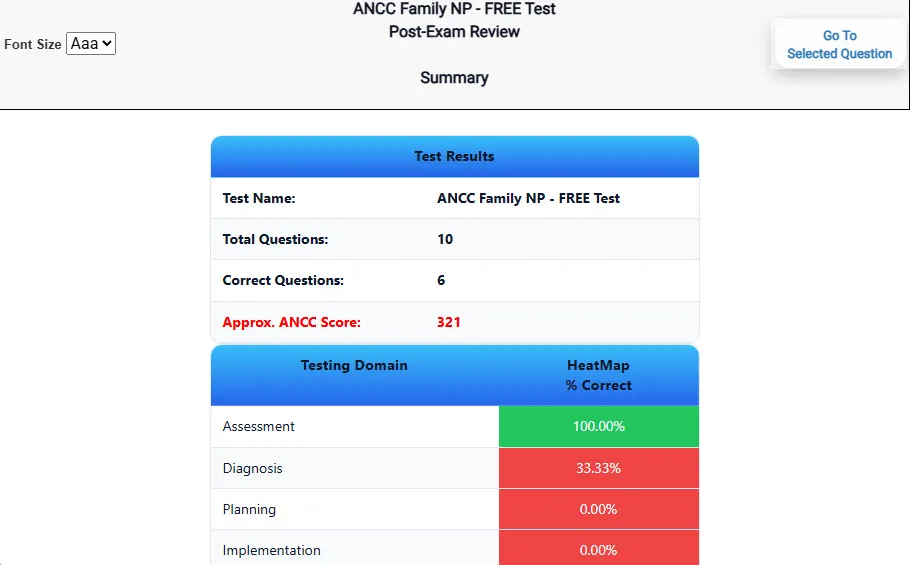
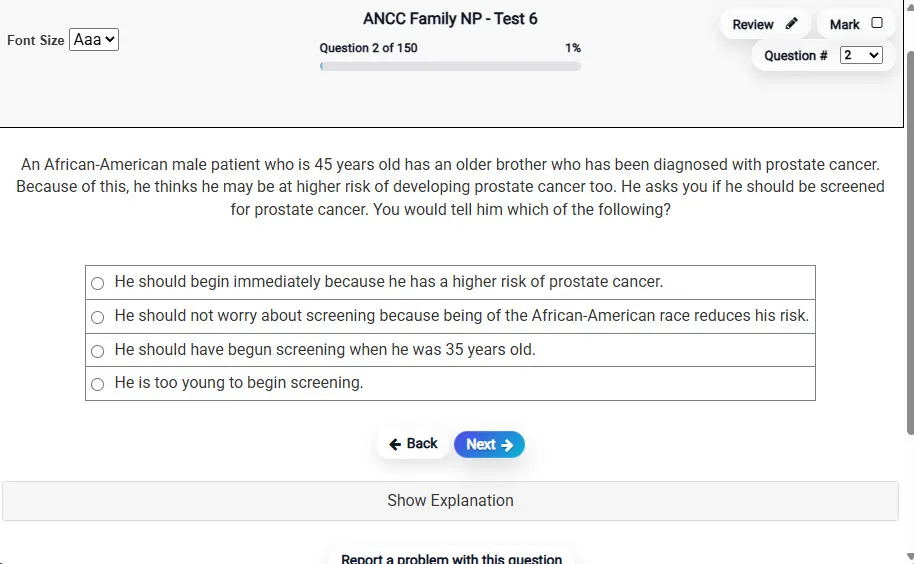
Answering a Question screen – Multiple-choice item view with navigation controls and progress tracker.
Answering a Question Multiple-choice item view with navigation controls and progress tracker.

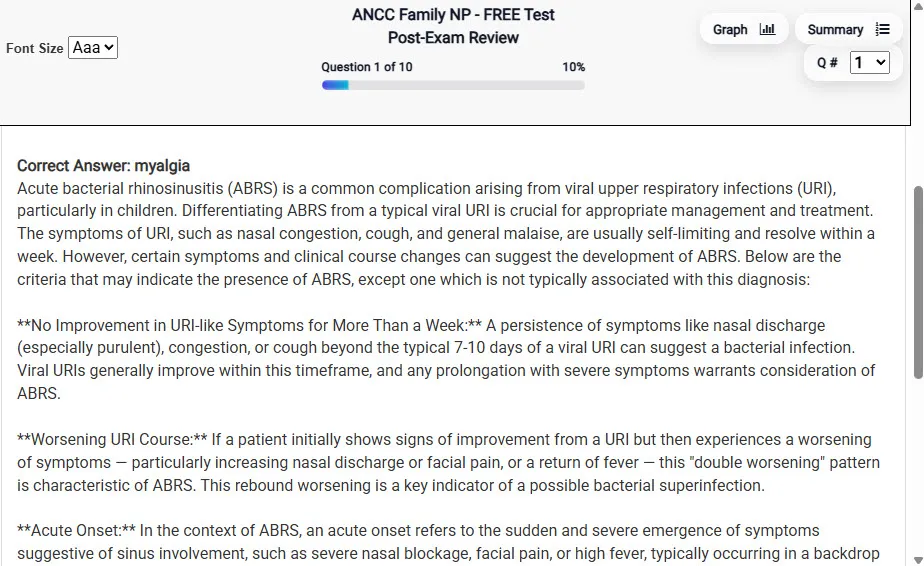
                           Detailed Explanation screen – 
                         Review mode showing chosen answer and rationale and references.
Detailed Explanation Review mode showing chosen answer and rationale and references.

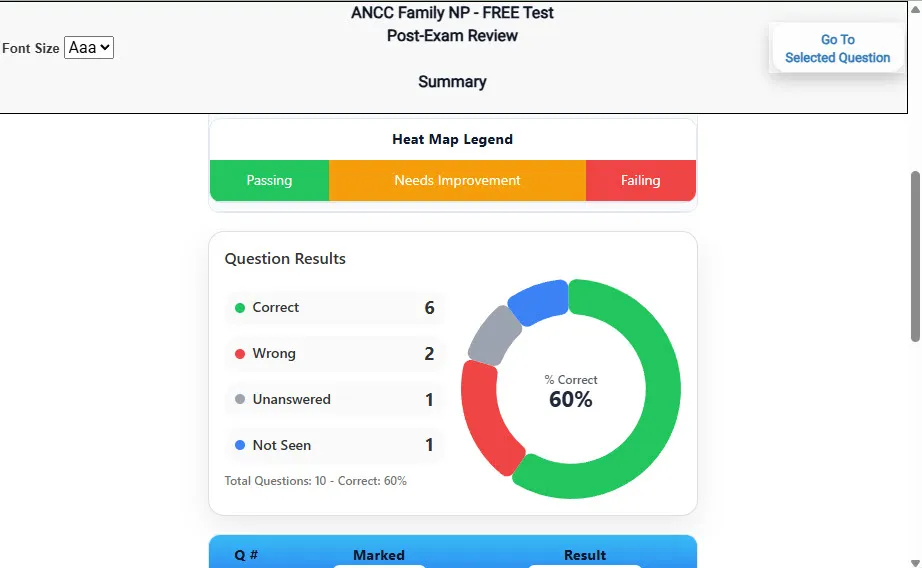
                           Review Summary 1 screen – 
                         Summary with counts for correct/wrong/unanswered and not seen items.
Review Summary 1 Summary with counts for correct/wrong/unanswered and not seen items.

                           Review Summary 2 screen – 
                         Advanced summary with category/domain breakdown and performance insights.
Review Summary 2 Advanced summary with category/domain breakdown and performance insights.

What Each Screen Shows

Answer Question Screen

  • Clean multiple-choice interface with progress bar.
  • Mark for review feature.
  • Matches real test pacing.

Detailed Explanation

  • Correct answer plus rationale.
  • Key concepts and guidelines highlighted.
  • Move between questions to fill knowledge gaps.

Review Summary 1

  • Overall results with total questions and scaled score.
  • Domain heatmap shows strengths and weaknesses.
  • Quick visual feedback on study priorities.

Review Summary 2

  • Chart of correct, wrong, unanswered, not seen.
  • Color-coded results for easy review.
  • Links back to missed items.

Top 10 Reasons to Use Exam Edge for your TX PACT Science Grade 7 to 12 Exam Prep

  1. Focused on the TX PACT Science Grade 7 to 12 Exam

    Our practice tests are built specifically for the TX PACT Science 7 to 12 exam — every question mirrors the real topics, format, and difficulty so you're studying exactly what matters.

  2. Real Exam Simulation

    We match the per-question time limits and pressure of the actual TX PACT exam, so test day feels familiar and stress-free.

  3. 15 Full Practice Tests & 1,875 Unique Questions

    You'll have more than enough material to master every TX PACT Science 7 to 12 concept — no repeats, no fluff.

  4. Lower Cost Than a Retake

    Ordering 5 practice exams costs less than retaking the TX PACT Science Grade 7 to 12 exam after a failure. One low fee could save you both time and money.

  5. Flexible Testing

    Need to step away mid-exam? Pick up right where you left off — with your remaining time intact.

  6. Instant Scoring & Feedback

    See your raw score and an estimated TX PACT Science Grade 7 to 12 score immediately after finishing each practice test.

  7. Detailed Explanations for Every Question

    Review correct and incorrect answers with clear, step-by-step explanations so you truly understand each topic.

  8. Trusted & Accredited

    We're fully accredited by the Better Business Bureau and uphold the highest standards of trust and transparency.

  9. Web-Based & Always Available

    No software to install. Access your TX PACT Science 7 to 12 practice exams 24/7 from any computer or mobile device.

  10. Expert Support When You Need It

    Need extra help? Our specialized tutors are highly qualified and ready to support your TX PACT exam prep.


Pass the TX PACT Science Grade 7 to 12 Exam with Realistic Practice Tests from Exam Edge

Preparing for your upcoming TX PACT Science Grade 7 to 12 (736) Certification Exam can feel overwhelming — but the right practice makes all the difference. Exam Edge gives you the tools, structure, and confidence to pass on your first try. Our online practice exams are built to match the real TX PACT Science 7 to 12 exam in content, format, and difficulty.

  • 📝 15 TX PACT Science Grade 7 to 12 Practice Tests: Access 15 full-length exams with 125 questions each, covering every major TX PACT Science Grade 7 to 12 topic in depth.
  • Instant Online Access: Start practicing right away — no software, no waiting.
  • 🧠 Step-by-Step Explanations: Understand the reasoning behind every correct answer so you can master TX PACT Science 7 to 12 exam concepts.
  • 🔄 Retake Each Exam Up to 4 Times: Build knowledge through repetition and track your improvement over time.
  • 🌐 Web-Based & Available 24/7: Study anywhere, anytime, on any device.
  • 🧘 Boost Your Test-Day Confidence: Familiarity with the TX PACT format reduces anxiety and helps you perform under pressure.

These TX PACT Science Grade 7 to 12 practice exams are designed to simulate the real testing experience by matching question types, timing, and difficulty level. This approach helps you get comfortable not just with the exam content, but also with the testing environment, so you walk into your exam day focused and confident.


Exam Edge TEXES Reviews


This is a good cross sectional review for Educational Diagnosticians, Special Education and Mainstream teachers. The questions were very comprehensible and engaging. Thanks

Linda R, Texas

Very good! Shows a reality of the test

Ivelisse , KATY, Texas

Very good study resource.

Angie , Grapevine , Texas

Purchased the bundle of 5 practice tests for speech 7-12. Passed the state exam on the first try! Very happy with exam edge and the information it provided!

Juan G, Eagle Pass, TX

Exam Edge was exactly what I needed to pass my Technology 171 TEXES exam. The questions prepared me for the real test. I highly recommend their study guide.

Crystalyn , Texes

I am a teacher in Texas who recently passed my Technology Education 6-12 exam. I took five of the practice exams with Examedge, which prepared me well. In fact, on the last practice test I finished, I scored a 265, and on the actual exam, I scored a 262; that’s within one question, extremely a ...
Read More
Adam G, Texas


TX PACT Science Grade 7 to 12 Aliases Test Name

Here is a list of alternative names used for this exam.

  • TX PACT Science Grade 7 to 12
  • TX PACT Science Grade 7 to 12 test
  • TX PACT Science Grade 7 to 12 Certification Test
  • TX PACT Science 7 to 12 test
  • TEXES
  • TEXES 736
  • 736 test
  • TX PACT Science Grade 7 to 12 (736)
  • TX PACT Science Grade 7 to 12 certification