This is the content of the pop-over!

TX PACT Physics 7 to 12 (739) Practice Tests & Test Prep by Exam Edge


TX PACT Physics Grades 7 to 12  product image
(4.6)
Based on 29 Reviews

  • Real Exam Simulation: Timed questions and matching content build comfort for your TX PACT Physics 7 to 12 test day.
  • Instant, 24/7 Access: Web-based TX PACT Physics Grades 7 to 12 practice exams with no software needed.
  • Clear Explanations: Step-by-step answers and explanations for your TX PACT exam to strengthen understanding.
  • Boosted Confidence: Reduces anxiety and improves test-taking skills to ace your TX PACT Physics Grades 7 to 12 (739).

Featured on

TX PACT Physics Grades 7 to 12 Online Practice Test Bundles

BEST VALUE
10 practice tests

$99.50

$399.50

SAVE $300

Only $9.95 per test!

  • 100% Pass Guarantee
  • 10 online practice tests
  • 125 questions per test
  • Bonus: 100 Flash Cards + Study Guide
  • Instant access
  • Detailed Explanations
  • Practice tests never expire
  • Timed, untimed, or study guide mode
5 practice tests

$69.75

$199.75

SAVE $130

Only $13.95 per test!

  • 5 online practice tests
  • 125 questions per test
  • Bonus: 100 Flash Cards + Study Guide
  • Instant access
  • Detailed Explanations
  • Practice tests never expire
  • Timed, untimed, or study guide mode
1 practice test

$39.95

  • 1 online practice test
  • 125 questions per test
  • Instant access
  • Detailed Explanations
  • Practice tests never expire
  • Timed, untimed, or study guide mode
Quick Select
Tap to choose a bundle

** All Prices are in US Dollars (USD) **


TX PACT Physics 7 to 12 (739) Resources

Jump to the section you need most.

Understanding the exact breakdown of the TX PACT Physics Grades 7 to 12 test will help you know what to expect and how to most effectively prepare. The TX PACT Physics Grades 7 to 12 has 125 multiple-choice questions . The exam will be broken down into the sections below:

TX PACT Physics Grades 7 to 12 Exam Blueprint
Domain Name % Number of
Questions
Nature of Science 14% 18
Mechanics 28% 35
Electricity and Magnetism 22% 28
Waves 14% 18
Modern Physics 22% 28

TX PACT Physics Grades 7 to 12 Study Tips by Domain

  • Apply the scientific method as an iterative cycle—state a testable, falsifiable hypothesis and identify what result would refute it (red flag: hypotheses phrased as opinions or unverifiable claims).
  • Distinguish independent, dependent, and controlled variables and write an operational definition for each measured quantity (common trap: confusing the control group with a controlled variable).
  • Design valid investigations by isolating one variable at a time and using appropriate controls and replication (priority rule: larger sample size and repeated trials reduce random error, not systematic bias).
  • Analyze uncertainty using significant figures, precision vs. accuracy, and percent error/percent difference (red flag: reporting more significant figures than the instrument resolution supports).
  • Interpret and construct graphs correctly—choose axes, scale, and best-fit line, and extract slope/intercept with units (common trap: forcing a line through the origin when data support a nonzero intercept).
  • Evaluate claims using peer review, reproducibility, and correlation vs. causation (priority rule: extraordinary claims require strong, repeatable evidence; red flag: conclusions drawn from a single trial or anecdotal data).
  • Draw a labeled free-body diagram before writing any equations; red flag: mixing up action–reaction pairs by putting them on the same object.
  • Use constant-acceleration kinematics only when acceleration is constant; common trap: applying v2=v02+2aΔx when acceleration changes (e.g., with drag or variable force).
  • Apply Newton’s 2nd law component-wise with a consistent sign convention; priority rule: along an incline, choose axes parallel/perpendicular to the plane to avoid incorrect force components.
  • Conserve mechanical energy only when nonconservative work is zero or accounted for; red flag: assuming energy conservation in problems with friction, applied pushes, or tension doing net work without including Wnc.
  • For momentum, check whether external impulse is negligible over the collision interval; common trap: claiming momentum conservation when a significant external force (e.g., friction from ground) acts during the interaction.
  • In circular motion, remember centripetal acceleration is v2/r toward the center, not an extra force; red flag: adding a “centripetal force” in addition to real forces instead of setting ΣFradial=mv2/r.
  • Use Coulomb’s law and superposition for point charges; red flag: forgetting sign/direction or mixing up r vs r2 dependence when comparing forces.
  • Apply E = F/q and relate electric field to potential (E = −∇V in 1D as ΔV/Δx); common trap: treating voltage as a vector or assuming higher V means higher E without distance.
  • For circuits, enforce Kirchhoff’s loop/junction rules with consistent sign conventions; priority rule: always define current directions first, then keep +ΔV for rises (battery) and −IR drops (resistor).
  • Use P = IV = I2R = V2/R to check reasonableness; red flag: claiming a device draws less current when R decreases at fixed V (it draws more, increasing power).
  • For magnetism, use F = qvB sinθ and F = ILB sinθ with right-hand rules; common trap: assuming a stationary charge feels a magnetic force or confusing field direction with force direction.
  • Induction follows Faraday’s and Lenz’s laws (ε = −dΦ/dt); red flag: getting the minus sign wrong—the induced current always opposes the change in flux, not the flux itself.
  • Use the wave equation v = fλ and keep units consistent; red flag: mixing Hz with rad/s or using cm for λ without converting to meters.
  • In interference, apply the path-difference rules precisely (ΔL = mλ for constructive, ΔL = (m + ½)λ for destructive); common trap: forgetting that a phase inversion at reflection adds a half-wavelength shift.
  • For sound, distinguish intensity (I ∝ A2) from loudness and use decibel changes correctly; priority rule: +10 dB means 10× intensity, not 10× amplitude.
  • On standing waves, use boundary conditions (node at fixed end, antinode at open end) to select the correct harmonic series; common trap: using nλ/2 for an open–closed tube, which should be (2n−1)λ/4.
  • Apply Snell’s law and the refraction speed relation v = c/n; red flag: stating frequency changes when a wave enters a new medium—frequency stays constant while speed and wavelength change.
  • For the Doppler effect, get the sign convention and relative motion correct (source vs observer) and check the limiting case; common trap: predicting a higher observed frequency when source and observer move apart.
  • Use photon energy and intensity correctly: E = hf sets photoelectron KE, while intensity changes the number of emitted electrons (current) — red flag if a solution claims brighter light increases maximum KE.
  • Apply de Broglie wavelength λ = h/p and note that increasing a particle’s kinetic energy decreases λ — common trap is mixing up wavelength with speed for relativistic particles.
  • For atomic spectra, use quantized energy levels (e.g., hydrogen En = −13.6 eV/n2) and remember emission occurs when electrons drop to lower n — red flag if a line is assigned to an upward transition.
  • In nuclear physics, conserve nucleon number A and charge Z in decay and reactions — common trap is forgetting that beta decay changes Z but not A (and requires including an electron/positron and (anti)neutrino conceptually).
  • Distinguish fission vs. fusion energetics via mass defect and E = Δmc2; binding energy per nucleon increases toward iron — priority rule: fusion releases energy for light nuclei, fission for very heavy nuclei.
  • For special relativity, use c as invariant and apply time dilation/length contraction only in the appropriate frame — red flag if a calculation treats c as additive (e.g., c + v) or applies both effects without specifying the observer.


Built to Fit Into Your Busy Life

Everything you need to prepare with confidence—without wasting a minute.

Three Study Modes

Timed, No Time Limit, or Explanation mode.

Actionable Analytics

Heatmaps and scaled scores highlight weak areas.

High-Yield Rationales

Concise explanations emphasize key concepts.

Realistic Interface

Matches the feel of the actual exam environment.

Accessible by Design

Clean layout reduces cognitive load.

Anytime, Anywhere

Web-based access 24/7 on any device.
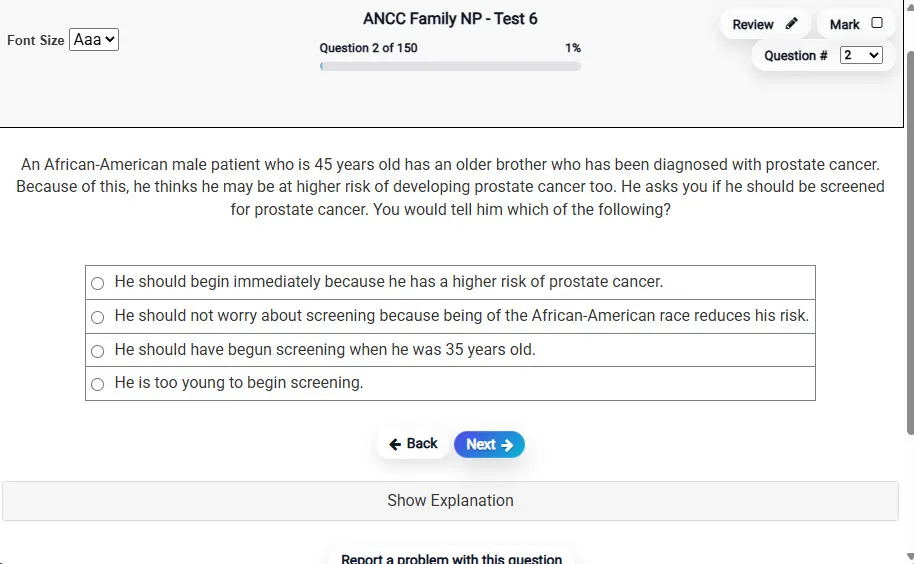
Answering a Question screen – Multiple-choice item view with navigation controls and progress tracker.
Answering a Question Multiple-choice item view with navigation controls and progress tracker.

                           Detailed Explanation screen – 
                         Review mode showing chosen answer and rationale and references.
Detailed Explanation Review mode showing chosen answer and rationale and references.

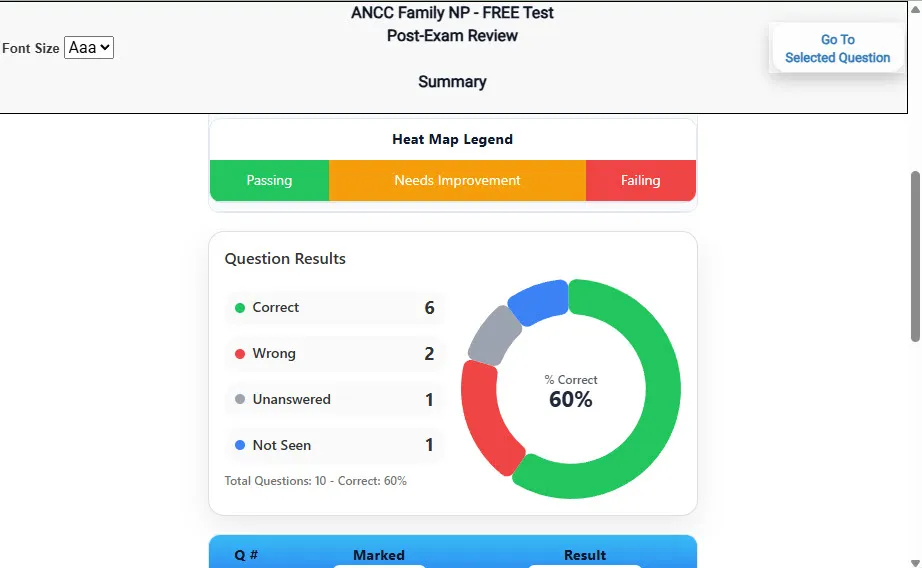
                           Review Summary 1 screen – 
                         Summary with counts for correct/wrong/unanswered and not seen items.
Review Summary 1 Summary with counts for correct/wrong/unanswered and not seen items.

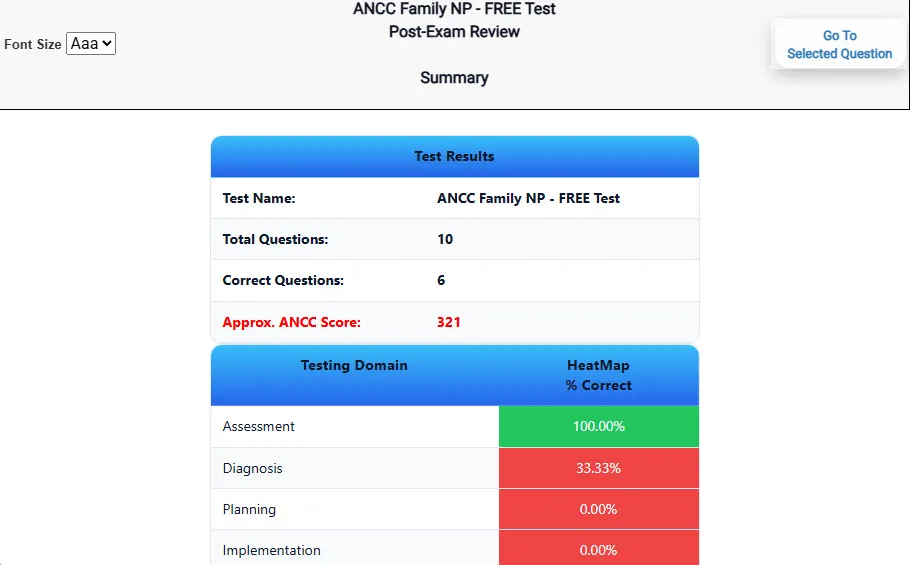
                           Review Summary 2 screen – 
                         Advanced summary with category/domain breakdown and performance insights.
Review Summary 2 Advanced summary with category/domain breakdown and performance insights.

What Each Screen Shows

Answer Question Screen

  • Clean multiple-choice interface with progress bar.
  • Mark for review feature.
  • Matches real test pacing.

Detailed Explanation

  • Correct answer plus rationale.
  • Key concepts and guidelines highlighted.
  • Move between questions to fill knowledge gaps.

Review Summary 1

  • Overall results with total questions and scaled score.
  • Domain heatmap shows strengths and weaknesses.
  • Quick visual feedback on study priorities.

Review Summary 2

  • Chart of correct, wrong, unanswered, not seen.
  • Color-coded results for easy review.
  • Links back to missed items.

Top 10 Reasons to Use Exam Edge for your TX PACT Physics Grades 7 to 12 Exam Prep

  1. Focused on the TX PACT Physics Grades 7 to 12 Exam

    Our practice tests are built specifically for the TX PACT Physics 7 to 12 exam — every question mirrors the real topics, format, and difficulty so you're studying exactly what matters.

  2. Real Exam Simulation

    We match the per-question time limits and pressure of the actual TX PACT exam, so test day feels familiar and stress-free.

  3. 10 Full Practice Tests & 1,250 Unique Questions

    You'll have more than enough material to master every TX PACT Physics 7 to 12 concept — no repeats, no fluff.

  4. Lower Cost Than a Retake

    Ordering 5 practice exams costs less than retaking the TX PACT Physics Grades 7 to 12 exam after a failure. One low fee could save you both time and money.

  5. Flexible Testing

    Need to step away mid-exam? Pick up right where you left off — with your remaining time intact.

  6. Instant Scoring & Feedback

    See your raw score and an estimated TX PACT Physics Grades 7 to 12 score immediately after finishing each practice test.

  7. Detailed Explanations for Every Question

    Review correct and incorrect answers with clear, step-by-step explanations so you truly understand each topic.

  8. Trusted & Accredited

    We're fully accredited by the Better Business Bureau and uphold the highest standards of trust and transparency.

  9. Web-Based & Always Available

    No software to install. Access your TX PACT Physics 7 to 12 practice exams 24/7 from any computer or mobile device.

  10. Expert Support When You Need It

    Need extra help? Our specialized tutors are highly qualified and ready to support your TX PACT exam prep.


Pass the TX PACT Physics Grades 7 to 12 Exam with Realistic Practice Tests from Exam Edge

Preparing for your upcoming TX PACT Physics Grades 7 to 12 (739) Certification Exam can feel overwhelming — but the right practice makes all the difference. Exam Edge gives you the tools, structure, and confidence to pass on your first try. Our online practice exams are built to match the real TX PACT Physics 7 to 12 exam in content, format, and difficulty.

  • 📝 10 TX PACT Physics Grades 7 to 12 Practice Tests: Access 10 full-length exams with 125 questions each, covering every major TX PACT Physics Grades 7 to 12 topic in depth.
  • Instant Online Access: Start practicing right away — no software, no waiting.
  • 🧠 Step-by-Step Explanations: Understand the reasoning behind every correct answer so you can master TX PACT Physics 7 to 12 exam concepts.
  • 🔄 Retake Each Exam Up to 4 Times: Build knowledge through repetition and track your improvement over time.
  • 🌐 Web-Based & Available 24/7: Study anywhere, anytime, on any device.
  • 🧘 Boost Your Test-Day Confidence: Familiarity with the TX PACT format reduces anxiety and helps you perform under pressure.

These TX PACT Physics Grades 7 to 12 practice exams are designed to simulate the real testing experience by matching question types, timing, and difficulty level. This approach helps you get comfortable not just with the exam content, but also with the testing environment, so you walk into your exam day focused and confident.


Exam Edge TEXES Reviews


This is a good cross sectional review for Educational Diagnosticians, Special Education and Mainstream teachers. The questions were very comprehensible and engaging. Thanks

Linda R, Texas

Very good! Shows a reality of the test

Ivelisse , KATY, Texas

Very good study resource.

Angie , Grapevine , Texas

Purchased the bundle of 5 practice tests for speech 7-12. Passed the state exam on the first try! Very happy with exam edge and the information it provided!

Juan G, Eagle Pass, TX

Exam Edge was exactly what I needed to pass my Technology 171 TEXES exam. The questions prepared me for the real test. I highly recommend their study guide.

Crystalyn , Texes

I am a teacher in Texas who recently passed my Technology Education 6-12 exam. I took five of the practice exams with Examedge, which prepared me well. In fact, on the last practice test I finished, I scored a 265, and on the actual exam, I scored a 262; that’s within one question, extremely a ...
Read More
Adam G, Texas


TX PACT Physics Grades 7 to 12 Aliases Test Name

Here is a list of alternative names used for this exam.

  • TX PACT Physics Grades 7 to 12
  • TX PACT Physics Grades 7 to 12 test
  • TX PACT Physics Grades 7 to 12 Certification Test
  • TX PACT Physics 7 to 12 test
  • TEXES
  • TEXES 739
  • 739 test
  • TX PACT Physics Grades 7 to 12 (739)
  • TX PACT Physics Grades 7 to 12 certification