This is the content of the pop-over!

TX PACT Physical Science Grade 6 to 12 (737) Practice Tests & Test Prep by Exam Edge


TX PACT Physical Science Grade 6 to 12  product image
(4.6)
Based on 28 Reviews

  • Real Exam Simulation: Timed questions and matching content build comfort for your TX PACT Physical Science Grade 6 to 12 test day.
  • Instant, 24/7 Access: Web-based TX PACT Physical Science Grade 6 to 12 practice exams with no software needed.
  • Clear Explanations: Step-by-step answers and explanations for your TX PACT exam to strengthen understanding.
  • Boosted Confidence: Reduces anxiety and improves test-taking skills to ace your TX PACT Physical Science Grade 6 to 12 (737).

Featured on

TX PACT Physical Science Grade 6 to 12 Online Practice Test Bundles

BEST VALUE
20 practice tests

$174.00

$799.00

SAVE $625

Only $8.70 per test!

  • 100% Pass Guarantee
  • 20 online practice tests
  • 125 questions per test
  • Bonus: 100 Flash Cards + Study Guide
  • Instant access
  • Detailed Explanations
  • Practice tests never expire
  • Timed, untimed, or study guide mode
MOST POPULAR
10 practice tests

$99.50

$399.50

SAVE $300

Only $9.95 per test!

  • 10 online practice tests
  • 125 questions per test
  • Bonus: 100 Flash Cards + Study Guide
  • Instant access
  • Detailed Explanations
  • Practice tests never expire
  • Timed, untimed, or study guide mode
5 practice tests

$69.75

$199.75

SAVE $130

Only $13.95 per test!

  • 5 online practice tests
  • 125 questions per test
  • Bonus: 100 Flash Cards
  • Instant access
  • Detailed Explanations
  • Practice tests never expire
  • Timed, untimed, or study guide mode
1 practice test

$39.95

  • 1 online practice test
  • 125 questions per test
  • Instant access
  • Detailed Explanations
  • Practice tests never expire
  • Timed, untimed, or study guide mode
Quick Select
Tap to choose a bundle

** All Prices are in US Dollars (USD) **


TX PACT Physical Science Grade 6 to 12 (737) Resources

Jump to the section you need most.

Understanding the exact breakdown of the TX PACT Physical Science Grade 6 to 12 test will help you know what to expect and how to most effectively prepare. The TX PACT Physical Science Grade 6 to 12 has 125 multiple-choice questions . The exam will be broken down into the sections below:

TX PACT Physical Science Grade 6 to 12 Exam Blueprint
Domain Name % Number of
Questions
Nature of Science 8% 10
Mechanics 14% 18
Electricity and Magnetism 11% 14
Waves 8% 10
Modern Physics 10% 13
Matter and Atomic Structure 10% 13
Energy and Chemical Bonding 14% 18
Chemical Reactions 14% 18
Stoichiometry and Solutions 11% 14

TX PACT Physical Science Grade 6 to 12 Study Tips by Domain

  • Use the nature-of-science cycle correctly: observation → question → hypothesis → test → analysis → revise — red flag if a conclusion is stated without data or a repeatable test.
  • Distinguish hypothesis vs. theory vs. law (theories explain; laws describe patterns) — common trap: saying a theory becomes a law after enough evidence.
  • Identify variables and controls precisely (independent, dependent, controlled variables) — priority rule: only one independent variable should change in a fair test.
  • Interpret data with attention to uncertainty and significant figures — red flag if a reported measurement implies more precision than the instrument allows.
  • Recognize correlation vs. causation in graphs and tables — common trap: inferring cause from a trend without a controlled comparison group.
  • Apply safety and ethics in lab design (SDS review, proper PPE, waste disposal) — contraindication: mixing unknowns or heating sealed containers violates standard lab safety expectations.
  • Apply kinematics graphs correctly: slope of x–t is v, slope of v–t is a, and area under v–t is Δx; red flag—confusing slope vs area is a top error.
  • Use vector components for 2D motion (projectiles): separate x (constant v) from y (constant a = −g); common trap—using total speed with g in the x-direction.
  • Write free-body diagrams before equations and resolve forces; priority rule—choose axes along motion or along an incline to avoid sign mistakes.
  • Work Newton’s laws with friction and tension: static friction satisfies 0 ≤ fs ≤ μsN while kinetic is fk = μkN; red flag—treating fs as always μsN.
  • Conservation laws: in isolated systems momentum is conserved in all collisions while kinetic energy is conserved only in elastic ones; common trap—using conservation of energy when external impulse is non-negligible.
  • Rotational motion: relate torque and angular acceleration (τ = Iα) and connect linear/angular with v = rω, at = rα; red flag—forgetting that larger I reduces α for the same torque.
  • Apply Coulomb’s law and the inverse-square relationship; red flag: forgetting that doubling distance makes force one-fourth, not one-half.
  • Use electric field concepts (E = F/q and E = kQ/r2) and field-line rules; common trap: drawing field lines that cross or point toward positive charges.
  • Work potential/voltage problems with ΔV = W/q and V = kQ/r; priority rule: charge moves to lower electric potential energy (U = qV), not always toward lower V.
  • Solve DC circuits with Ohm’s law and series/parallel rules; TEXES-style trap: mixing up what stays the same—series has same current, parallel has same voltage.
  • Analyze magnetic fields and forces with right-hand rules and F = qvB sinθ / F = ILB sinθ; contraindication: if v (or I) is parallel to B, the magnetic force is zero.
  • Apply Faraday’s and Lenz’s laws for induction (emf = −N dΦ/dt); common trap: choosing the induced current direction that reinforces the change in flux instead of opposing it.
  • Use v = fλ as the priority relationship; red flag: mixing up wave speed (set by the medium) with frequency (set by the source).
  • For transverse vs. longitudinal waves, tie particle motion to propagation direction; common trap: calling sound in air transverse because it can reflect or diffract.
  • Apply superposition carefully in interference; red flag: assuming destructive interference “cancels energy” rather than redistributing it spatially.
  • At boundaries, use “fixed end inverts, free end does not” for reflected pulses; common trap: inverting any reflection without checking the boundary condition.
  • For standing waves in strings and open/closed tubes, use node/antinode rules and harmonic patterns; threshold cue: a tube closed at one end supports only odd harmonics.
  • In the EM spectrum, relate wavelength, frequency, and photon energy (E ∝ f); red flag: claiming higher-frequency radiation travels faster in vacuum.
  • Distinguish classical vs modern physics by scale — use quantization and uncertainty when atomic/subatomic behavior is described (common trap: applying continuous-energy or deterministic trajectories to electron behavior).
  • Photoelectric effect: electrons are emitted only if photon frequency exceeds a threshold, regardless of intensity (red flag: claiming higher intensity alone ejects electrons when frequency is below cutoff).
  • Use photon relationships correctly: E = hf and c = λf, so increasing frequency increases photon energy while decreasing wavelength (common trap: mixing up amplitude/intensity effects with frequency/energy).
  • Atomic spectra are discrete because electrons occupy quantized energy levels; absorption corresponds to upward transitions and emission to downward transitions (priority rule: match spectral line energy to ΔE, not to orbital “radius”).
  • Nuclear processes: alpha, beta, and gamma change nuclei differently — conserve mass number and charge in balancing nuclear equations (common trap: treating gamma emission as changing atomic number or mass number).
  • Half-life problems: activity and remaining nuclei decrease exponentially by factors of 1/2 per half-life, independent of initial amount (red flag: using a linear decrease or averaging half-lives).
  • Classify matter by properties (physical vs chemical) and by composition (element, compound, mixture)—trap: confusing a physical change (phase change, dissolving) with a chemical change (new substances formed).
  • Use the particulate model to explain states of matter and phase changes—priority rule: temperature changes average kinetic energy, while phase changes occur at constant temperature as energy changes potential (intermolecular) interactions.
  • Determine atomic structure from atomic number and mass number (p+, n0, e−)—red flag: mass number is not the atomic mass on the periodic table (use rounding only when appropriate).
  • Apply periodic trends (atomic radius, ionization energy, electronegativity) and valence electrons to predict reactivity—common trap: reversing trend directions (IE and EN generally increase up and to the right).
  • Write and interpret isotopic notation and compute average atomic mass using percent abundance—threshold cue: percentages must sum to 100% and masses must be in amu before averaging.
  • Predict ion formation and common ionic charges using group trends and electron configurations—contraindication: transition metals often have multiple charges, so don’t assume a single fixed charge without information.
  • Use the First Law as the priority rule: for any system, ΔE = q + w; red flag if a sign convention is flipped (q > 0 into the system, w > 0 work done on the system).
  • Distinguish endothermic vs. exothermic by observation and diagram: products higher than reactants means ΔH > 0; common trap is confusing activation energy with overall ΔH.
  • Apply calorimetry with the threshold check of units and direction: q = m c ΔT (or q = C ΔT) and heat lost by one part equals heat gained by another; red flag when ΔT sign doesn’t match the scenario.
  • For bonding, use electronegativity difference as the cue: large differences favor ionic, small differences favor covalent; common trap is assuming “polar” bonds always make a molecule polar (geometry can cancel dipoles).
  • Compare ionic, covalent-network, molecular, and metallic solids by properties: high melting point + conductivity only when molten/aqueous suggests ionic; red flag is claiming solid ionic compounds conduct electricity.
  • Relate bond energy to reaction energetics: breaking bonds absorbs energy and forming bonds releases energy; common trap is stating that breaking a bond releases heat because the reaction is exothermic overall.
  • Classify reactions by pattern (synthesis, decomposition, single/double replacement, combustion, acid–base) and by electron transfer (redox); common trap: calling every O2-involving reaction “oxidation” without checking oxidation numbers.
  • Balance equations by conserving atoms and net charge (especially in ionic/redox forms); red flag: coefficients change, subscripts never do.
  • Predict products using driving forces (precipitate, gas formation, water formation, redox) and solubility rules; common trap: writing products for two aqueous salts even when all possible products stay soluble (no reaction).
  • Acid–base reactions: identify conjugate pairs and distinguish strong vs. weak acids/bases; priority rule: strong acids (e.g., HCl, HNO3, H2SO4) are treated as fully dissociated in water.
  • Oxidation number method: assign correctly (Group 1 = +1, Group 2 = +2, F = −1, O usually = −2 except peroxides, H usually = +1 except metal hydrides); trap: forgetting that free elements are 0 and polyatomic ions’ oxidation numbers sum to the ion charge.
  • Reaction rates and equilibrium: apply collision theory (temperature, concentration, surface area, catalysts) and Le Châtelier’s principle; red flag: saying catalysts shift equilibrium—they change rate to reach equilibrium, not K.
  • Use dimensional analysis with unit cancellation as the default method; red flag: switching between g, mol, L, and particles without writing each conversion factor.
  • For reaction stoichiometry, always identify the limiting reactant before calculating yield; common trap: using the excess reactant to compute product amounts.
  • Percent yield = (actual/theoretical)×100 and percent error uses the accepted value in the denominator; red flag: percent yield > 100% signals impurity, wet product, or measurement error.
  • Molarity (M = mol/L) problems often require solving for moles first, then volume; priority rule: in dilution use M1V1 = M2V2 with volumes in the same units.
  • Solution stoichiometry requires a balanced equation plus molarity-to-moles conversion; common trap: treating coefficients as grams or milliliters rather than mole ratios.
  • For solubility and concentration terms (mass %, ppm, saturated/unsaturated), track what is “solute” vs “solution”; red flag: using mass of solvent instead of mass of solution in percent concentration.


Built to Fit Into Your Busy Life

Everything you need to prepare with confidence—without wasting a minute.

Three Study Modes

Timed, No Time Limit, or Explanation mode.

Actionable Analytics

Heatmaps and scaled scores highlight weak areas.

High-Yield Rationales

Concise explanations emphasize key concepts.

Realistic Interface

Matches the feel of the actual exam environment.

Accessible by Design

Clean layout reduces cognitive load.

Anytime, Anywhere

Web-based access 24/7 on any device.
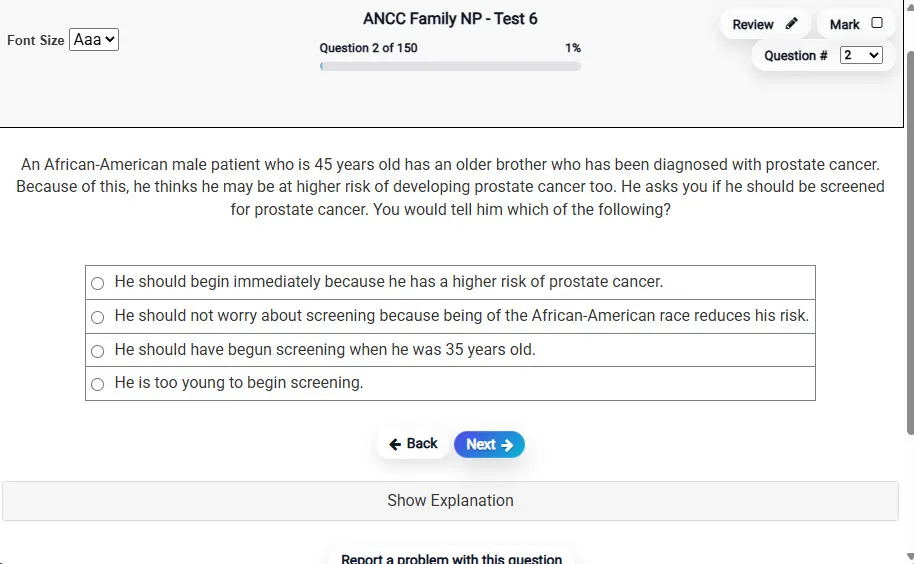
Answering a Question screen – Multiple-choice item view with navigation controls and progress tracker.
Answering a Question Multiple-choice item view with navigation controls and progress tracker.

                           Detailed Explanation screen – 
                         Review mode showing chosen answer and rationale and references.
Detailed Explanation Review mode showing chosen answer and rationale and references.

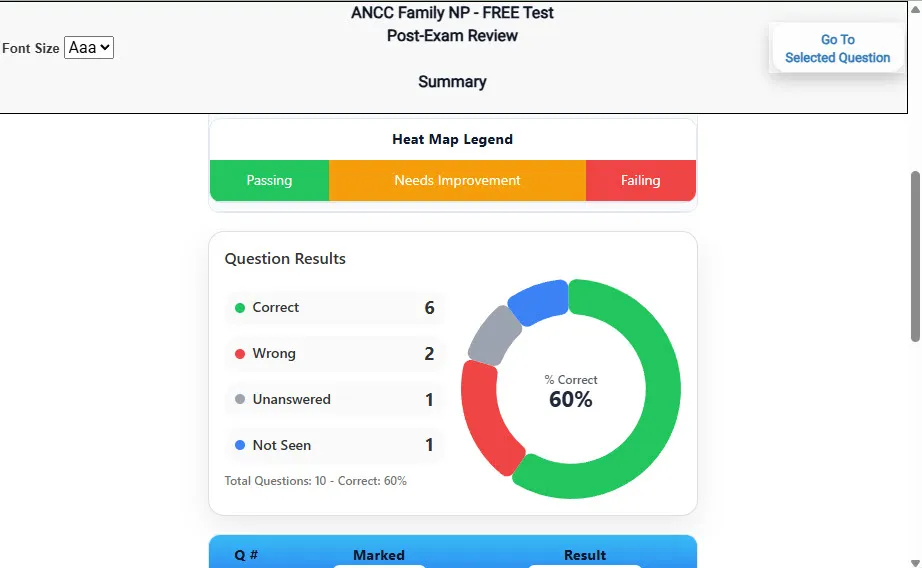
                           Review Summary 1 screen – 
                         Summary with counts for correct/wrong/unanswered and not seen items.
Review Summary 1 Summary with counts for correct/wrong/unanswered and not seen items.

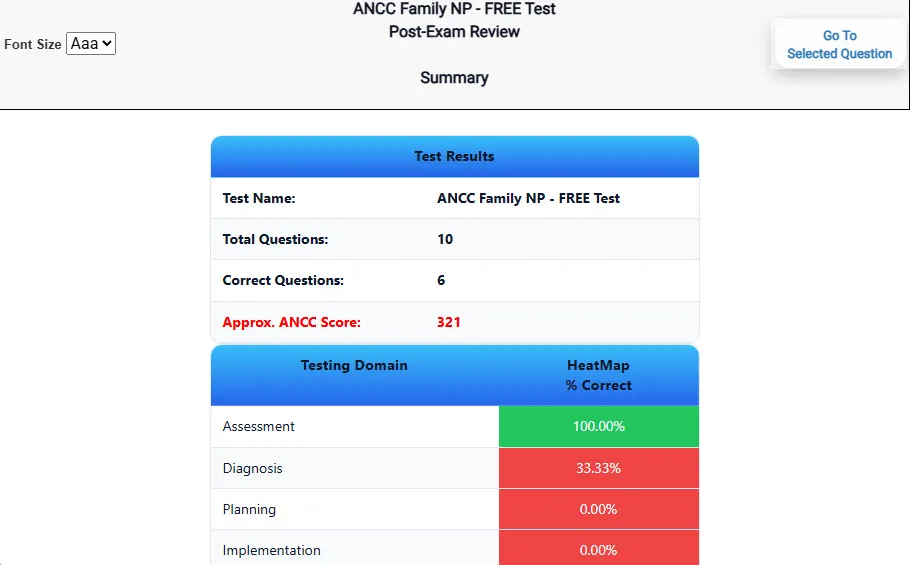
                           Review Summary 2 screen – 
                         Advanced summary with category/domain breakdown and performance insights.
Review Summary 2 Advanced summary with category/domain breakdown and performance insights.

What Each Screen Shows

Answer Question Screen

  • Clean multiple-choice interface with progress bar.
  • Mark for review feature.
  • Matches real test pacing.

Detailed Explanation

  • Correct answer plus rationale.
  • Key concepts and guidelines highlighted.
  • Move between questions to fill knowledge gaps.

Review Summary 1

  • Overall results with total questions and scaled score.
  • Domain heatmap shows strengths and weaknesses.
  • Quick visual feedback on study priorities.

Review Summary 2

  • Chart of correct, wrong, unanswered, not seen.
  • Color-coded results for easy review.
  • Links back to missed items.

Top 10 Reasons to Use Exam Edge for your TX PACT Physical Science Grade 6 to 12 Exam Prep

  1. Focused on the TX PACT Physical Science Grade 6 to 12 Exam

    Our practice tests are built specifically for the TX PACT Physical Science Grade 6 to 12 exam — every question mirrors the real topics, format, and difficulty so you're studying exactly what matters.

  2. Real Exam Simulation

    We match the per-question time limits and pressure of the actual TX PACT exam, so test day feels familiar and stress-free.

  3. 20 Full Practice Tests & 2,500 Unique Questions

    You'll have more than enough material to master every TX PACT Physical Science Grade 6 to 12 concept — no repeats, no fluff.

  4. Lower Cost Than a Retake

    Ordering 5 practice exams costs less than retaking the TX PACT Physical Science Grade 6 to 12 exam after a failure. One low fee could save you both time and money.

  5. Flexible Testing

    Need to step away mid-exam? Pick up right where you left off — with your remaining time intact.

  6. Instant Scoring & Feedback

    See your raw score and an estimated TX PACT Physical Science Grade 6 to 12 score immediately after finishing each practice test.

  7. Detailed Explanations for Every Question

    Review correct and incorrect answers with clear, step-by-step explanations so you truly understand each topic.

  8. Trusted & Accredited

    We're fully accredited by the Better Business Bureau and uphold the highest standards of trust and transparency.

  9. Web-Based & Always Available

    No software to install. Access your TX PACT Physical Science Grade 6 to 12 practice exams 24/7 from any computer or mobile device.

  10. Expert Support When You Need It

    Need extra help? Our specialized tutors are highly qualified and ready to support your TX PACT exam prep.


Pass the TX PACT Physical Science Grade 6 to 12 Exam with Realistic Practice Tests from Exam Edge

Preparing for your upcoming TX PACT Physical Science Grade 6 to 12 (737) Certification Exam can feel overwhelming — but the right practice makes all the difference. Exam Edge gives you the tools, structure, and confidence to pass on your first try. Our online practice exams are built to match the real TX PACT Physical Science Grade 6 to 12 exam in content, format, and difficulty.

  • 📝 20 TX PACT Physical Science Grade 6 to 12 Practice Tests: Access 20 full-length exams with 125 questions each, covering every major TX PACT Physical Science Grade 6 to 12 topic in depth.
  • Instant Online Access: Start practicing right away — no software, no waiting.
  • 🧠 Step-by-Step Explanations: Understand the reasoning behind every correct answer so you can master TX PACT Physical Science Grade 6 to 12 exam concepts.
  • 🔄 Retake Each Exam Up to 4 Times: Build knowledge through repetition and track your improvement over time.
  • 🌐 Web-Based & Available 24/7: Study anywhere, anytime, on any device.
  • 🧘 Boost Your Test-Day Confidence: Familiarity with the TX PACT format reduces anxiety and helps you perform under pressure.

These TX PACT Physical Science Grade 6 to 12 practice exams are designed to simulate the real testing experience by matching question types, timing, and difficulty level. This approach helps you get comfortable not just with the exam content, but also with the testing environment, so you walk into your exam day focused and confident.


Exam Edge TEXES Reviews


This is a good cross sectional review for Educational Diagnosticians, Special Education and Mainstream teachers. The questions were very comprehensible and engaging. Thanks

Linda R, Texas

Very good! Shows a reality of the test

Ivelisse , KATY, Texas

Very good study resource.

Angie , Grapevine , Texas

Purchased the bundle of 5 practice tests for speech 7-12. Passed the state exam on the first try! Very happy with exam edge and the information it provided!

Juan G, Eagle Pass, TX

Exam Edge was exactly what I needed to pass my Technology 171 TEXES exam. The questions prepared me for the real test. I highly recommend their study guide.

Crystalyn , Texes

I am a teacher in Texas who recently passed my Technology Education 6-12 exam. I took five of the practice exams with Examedge, which prepared me well. In fact, on the last practice test I finished, I scored a 265, and on the actual exam, I scored a 262; that’s within one question, extremely a ...
Read More
Adam G, Texas


TX PACT Physical Science Grade 6 to 12 Aliases Test Name

Here is a list of alternative names used for this exam.

  • TX PACT Physical Science Grade 6 to 12
  • TX PACT Physical Science Grade 6 to 12 test
  • TX PACT Physical Science Grade 6 to 12 Certification Test
  • TEXES
  • TEXES 737
  • 737 test
  • TX PACT Physical Science Grade 6 to 12 (737)
  • TX PACT Physical Science Grade 6 to 12 certification