This is the content of the pop-over!

TX PACT Math Grades 7 thru 12 (735) Practice Tests & Test Prep by Exam Edge


TX PACT Mathematics Grades 7 thru 12 product image
(4.5)
Based on 22 Reviews

  • Real Exam Simulation: Timed questions and matching content build comfort for your TX PACT Math Grades 7 thru 12 test day.
  • Instant, 24/7 Access: Web-based TX PACT Mathematics Grades 7 thru 12 practice exams with no software needed.
  • Clear Explanations: Step-by-step answers and explanations for your TX PACT exam to strengthen understanding.
  • Boosted Confidence: Reduces anxiety and improves test-taking skills to ace your TX PACT Mathematics Grades 7 thru 12 (735).

Featured on

TX PACT Mathematics Grades 7 thru 12 Online Practice Test Bundles

BEST VALUE
20 practice tests

$174.00

$799.00

SAVE $625

Only $8.70 per test!

  • 100% Pass Guarantee
  • 20 online practice tests
  • 125 questions per test
  • Bonus: 100 Flash Cards + Study Guide
  • Instant access
  • Detailed Explanations
  • Practice tests never expire
  • Timed, untimed, or study guide mode
MOST POPULAR
10 practice tests

$99.50

$399.50

SAVE $300

Only $9.95 per test!

  • 10 online practice tests
  • 125 questions per test
  • Bonus: 100 Flash Cards + Study Guide
  • Instant access
  • Detailed Explanations
  • Practice tests never expire
  • Timed, untimed, or study guide mode
5 practice tests

$69.75

$199.75

SAVE $130

Only $13.95 per test!

  • 5 online practice tests
  • 125 questions per test
  • Bonus: 100 Flash Cards
  • Instant access
  • Detailed Explanations
  • Practice tests never expire
  • Timed, untimed, or study guide mode
1 practice test

$39.95

  • 1 online practice test
  • 125 questions per test
  • Instant access
  • Detailed Explanations
  • Practice tests never expire
  • Timed, untimed, or study guide mode
Quick Select
Tap to choose a bundle

** All Prices are in US Dollars (USD) **


TX PACT Math Grades 7 thru 12 (735) Resources

Jump to the section you need most.

Understanding the exact breakdown of the TX PACT Mathematics Grades 7 thru 12 test will help you know what to expect and how to most effectively prepare. The TX PACT Mathematics Grades 7 thru 12 has 125 multiple-choice questions . The exam will be broken down into the sections below:

TX PACT Mathematics Grades 7 thru 12 Exam Blueprint
Domain Name % Number of
Questions
Mathematical Processes and Number Sense 19% 24
Patterns - Algebra Functions 24% 30
Measurement and Geometry 19% 24
Trigonometry and Calculus 19% 24
Statistics - Probability Discrete Mathematics 19% 24

TX PACT Mathematics Grades 7 thru 12 Study Tips by Domain

  • When converting between fractions, decimals, and percents, use a quick equivalence check (e.g., 0.25 = 25% = 1/4); red flag: moving the decimal the wrong direction when changing percent to decimal.
  • For integer operations, apply the sign rule first and then the magnitude; common trap: treating subtraction as commutative or forgetting that a-(-b)=a+b.
  • Use the order of operations with explicit grouping (PEMDAS) and rewrite division as multiplication by a reciprocal when appropriate; red flag: distributing an exponent across addition (e.g., (a+b)^2 ? a^2+b^2).
  • When simplifying radicals and rational expressions, state domain restrictions (denominators ? 0, even roots require nonnegative radicands in reals); contraindication: “canceling” terms across addition (e.g., (a+b)/b ? a).
  • Estimate before computing to catch unreasonable results (rounding or benchmark fractions like 1/2, 1/4); priority rule: if the estimate and exact answer differ by more than about 10% in a simple context, recheck arithmetic and units.
  • In proportional reasoning, decide whether the relationship is additive or multiplicative before setting up an equation; common trap: using a constant difference when the situation requires a constant ratio (or vice versa).
  • When solving equations/inequalities, apply inverse operations to both sides and track restrictions (e.g., denominators ? 0); red flag: introducing extraneous solutions after squaring or multiplying by a variable expression.
  • For functions, use function notation correctly and distinguish between f(x+h) and f(x)+h; common trap: treating a transformation as changing x-values when it actually changes y-values (or vice versa).
  • Identify key features from representations: intercepts, vertex, axis of symmetry, asymptotes, and end behavior; priority rule: state domain/range restrictions explicitly before graphing rational or radical functions.
  • Connect arithmetic/geometric sequences to linear/exponential functions; threshold cue: constant difference ? linear model, constant ratio ? exponential model, and mixing them is a frequent misclassification.
  • When simplifying expressions, use exponent and factoring rules carefully (including negatives and fractional exponents); common trap: canceling terms across addition (you can only cancel common factors, not addends).
  • For systems of equations, choose a method based on structure (substitution for isolated variables, elimination for aligned coefficients, graphing for approximate solutions); red flag: concluding “no solution” or “infinitely many” without checking for parallel or identical lines after simplification.
  • When converting units, use dimensional analysis with cancellation; red flag: adding or subtracting measurements before converting to the same unit.
  • For perimeter/area/volume, match the formula to the shape and dimension; common trap: using surface area when the question asks for volume (or vice versa).
  • In coordinate geometry, compute slope and distance with formulas rather than counting grid squares; priority rule: always check for vertical lines (undefined slope) before applying slope-intercept form.
  • For similarity and scale drawings, set up ratios of corresponding lengths consistently; red flag: mixing scale factors for length with those for area (area scales by the square of the linear factor).
  • When using the Pythagorean Theorem, confirm it’s a right triangle and label the hypotenuse opposite the right angle; common trap: plugging the longest side into a leg position.
  • In angle and circle problems, use the correct relationship (central vs inscribed angles, tangent-radius perpendicular); threshold cue: if an inscribed angle intercepts an arc, its measure is half the intercepted arc measure.
  • In right-triangle trig, check that the angle is acute before using SOH-CAH-TOA; red flag: applying it directly to an obtuse or reflex angle without using reference angles or unit-circle definitions.
  • When using inverse trig (e.g., arcsin, arccos), enforce principal-value ranges; common trap: reporting a second-quadrant angle for arcsin or a negative angle for arccos without justification.
  • Convert degrees to radians before applying calculus formulas; priority rule: if the problem involves derivatives/integrals of trig functions, radians are required (degrees will give incorrect results).
  • On trig graphs, identify amplitude, period, and phase shift in that order; red flag: mixing up “inside vs. outside” coefficients so the period of sin(bx) is written as 2p·b instead of 2p/b.
  • In differentiation, apply the chain rule every time the angle is not just x; common trap: writing d/dx[sin(3x)] = cos(3x) instead of 3cos(3x).
  • For integrals, use substitution for compositions and remember +C; threshold cue: if you see f'(x) paired with f(x) inside sin/cos or (1+f(x)^2) in a denominator, u-sub is the priority strategy.
  • Use correct counting methods (permutations vs combinations) and apply the “order matters” cue; a red flag is using nPr when the prompt says “choose” or “select” without regard to order.
  • For probability, verify independence vs mutual exclusivity before multiplying or adding; common trap: treating “A or B” as P(A)+P(B) when events can overlap (must subtract P(AnB)).
  • In conditional probability and Bayes’ theorem, define the sample space and condition first; priority rule: write P(A|B)=P(AnB)/P(B) and check that P(B)?0.
  • When interpreting data displays (histograms, boxplots, scatterplots), focus on center/spread/outliers; red flag: concluding causation from correlation or ignoring an influential outlier that changes the trend.
  • Choose appropriate summary measures: if distribution is skewed or has outliers, use median and IQR (contraindication: using mean and standard deviation in strongly skewed data without justification).
  • In discrete math topics like graphs and networks, check constraints and edge cases; common trap: claiming an Euler path/circuit without verifying the vertex-degree rule (0 or 2 odd degrees for a path; 0 odd degrees for a circuit).


Built to Fit Into Your Busy Life

Everything you need to prepare with confidence—without wasting a minute.

Three Study Modes

Timed, No Time Limit, or Explanation mode.

Actionable Analytics

Heatmaps and scaled scores highlight weak areas.

High-Yield Rationales

Concise explanations emphasize key concepts.

Realistic Interface

Matches the feel of the actual exam environment.

Accessible by Design

Clean layout reduces cognitive load.

Anytime, Anywhere

Web-based access 24/7 on any device.
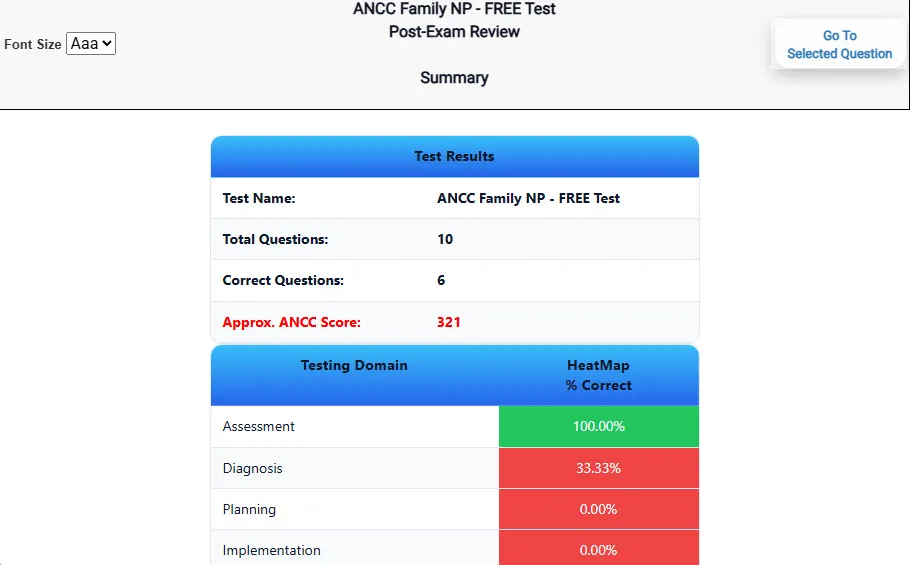
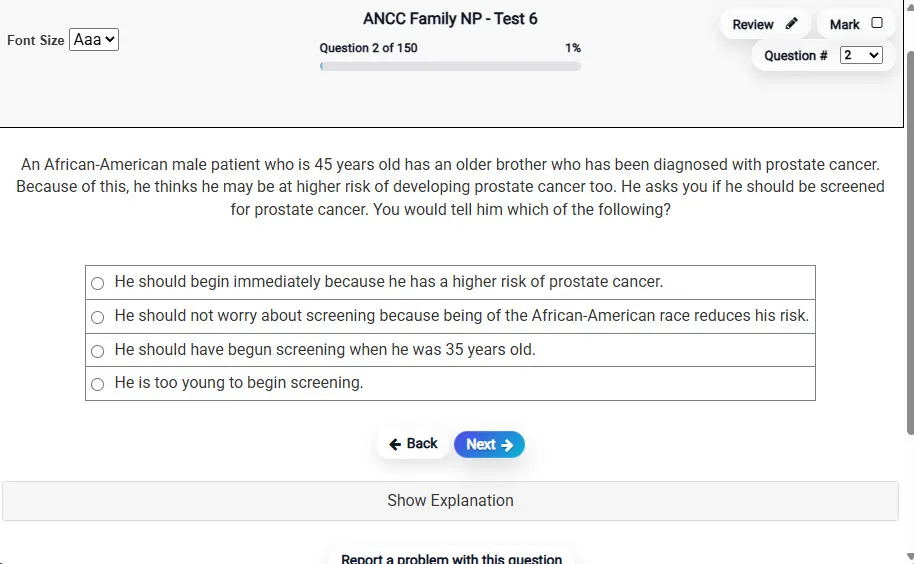
Answering a Question screen – Multiple-choice item view with navigation controls and progress tracker.
Answering a Question Multiple-choice item view with navigation controls and progress tracker.

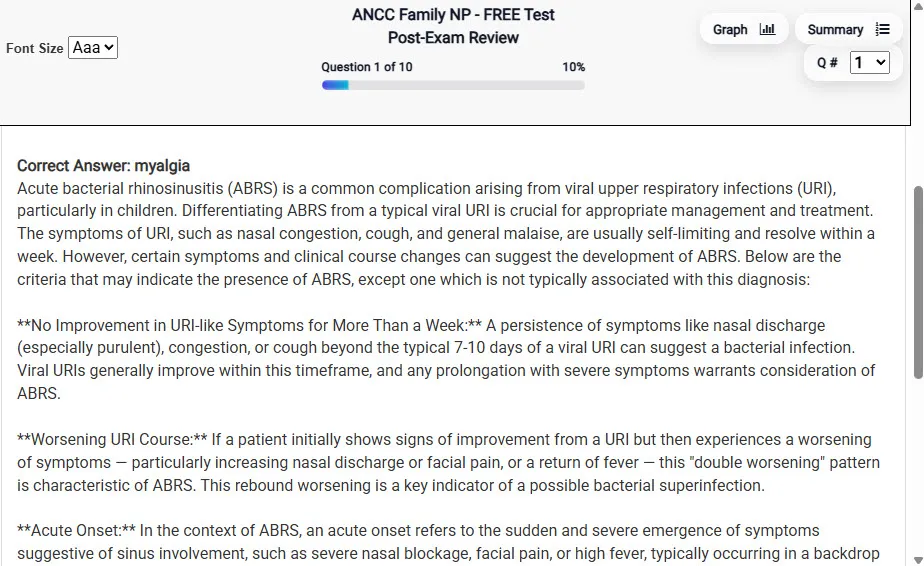
                           Detailed Explanation screen – 
                         Review mode showing chosen answer and rationale and references.
Detailed Explanation Review mode showing chosen answer and rationale and references.

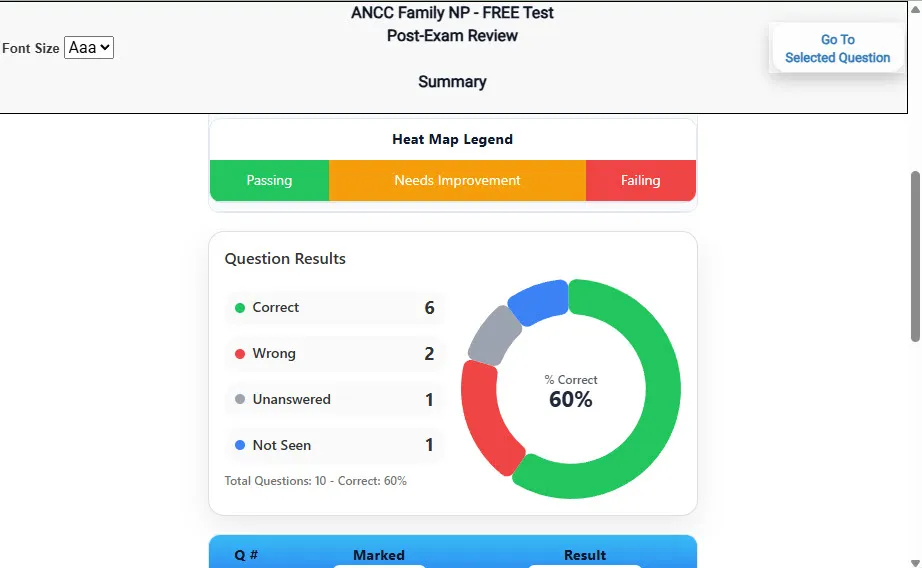
                           Review Summary 1 screen – 
                         Summary with counts for correct/wrong/unanswered and not seen items.
Review Summary 1 Summary with counts for correct/wrong/unanswered and not seen items.

                           Review Summary 2 screen – 
                         Advanced summary with category/domain breakdown and performance insights.
Review Summary 2 Advanced summary with category/domain breakdown and performance insights.

What Each Screen Shows

Answer Question Screen

  • Clean multiple-choice interface with progress bar.
  • Mark for review feature.
  • Matches real test pacing.

Detailed Explanation

  • Correct answer plus rationale.
  • Key concepts and guidelines highlighted.
  • Move between questions to fill knowledge gaps.

Review Summary 1

  • Overall results with total questions and scaled score.
  • Domain heatmap shows strengths and weaknesses.
  • Quick visual feedback on study priorities.

Review Summary 2

  • Chart of correct, wrong, unanswered, not seen.
  • Color-coded results for easy review.
  • Links back to missed items.

Top 10 Reasons to Use Exam Edge for your TX PACT Mathematics Grades 7 thru 12 Exam Prep

  1. Focused on the TX PACT Mathematics Grades 7 thru 12 Exam

    Our practice tests are built specifically for the TX PACT Math Grades 7 thru 12 exam — every question mirrors the real topics, format, and difficulty so you're studying exactly what matters.

  2. Real Exam Simulation

    We match the per-question time limits and pressure of the actual TX PACT exam, so test day feels familiar and stress-free.

  3. 20 Full Practice Tests & 2,500 Unique Questions

    You'll have more than enough material to master every TX PACT Math Grades 7 thru 12 concept — no repeats, no fluff.

  4. Lower Cost Than a Retake

    Ordering 5 practice exams costs less than retaking the TX PACT Mathematics Grades 7 thru 12 exam after a failure. One low fee could save you both time and money.

  5. Flexible Testing

    Need to step away mid-exam? Pick up right where you left off — with your remaining time intact.

  6. Instant Scoring & Feedback

    See your raw score and an estimated TX PACT Mathematics Grades 7 thru 12 score immediately after finishing each practice test.

  7. Detailed Explanations for Every Question

    Review correct and incorrect answers with clear, step-by-step explanations so you truly understand each topic.

  8. Trusted & Accredited

    We're fully accredited by the Better Business Bureau and uphold the highest standards of trust and transparency.

  9. Web-Based & Always Available

    No software to install. Access your TX PACT Math Grades 7 thru 12 practice exams 24/7 from any computer or mobile device.

  10. Expert Support When You Need It

    Need extra help? Our specialized tutors are highly qualified and ready to support your TX PACT exam prep.


Pass the TX PACT Mathematics Grades 7 thru 12 Exam with Realistic Practice Tests from Exam Edge

Preparing for your upcoming TX PACT Mathematics Grades 7 thru 12 (735) Certification Exam can feel overwhelming — but the right practice makes all the difference. Exam Edge gives you the tools, structure, and confidence to pass on your first try. Our online practice exams are built to match the real TX PACT Math Grades 7 thru 12 exam in content, format, and difficulty.

  • 📝 20 TX PACT Mathematics Grades 7 thru 12 Practice Tests: Access 20 full-length exams with 125 questions each, covering every major TX PACT Mathematics Grades 7 thru 12 topic in depth.
  • Instant Online Access: Start practicing right away — no software, no waiting.
  • 🧠 Step-by-Step Explanations: Understand the reasoning behind every correct answer so you can master TX PACT Math Grades 7 thru 12 exam concepts.
  • 🔄 Retake Each Exam Up to 4 Times: Build knowledge through repetition and track your improvement over time.
  • 🌐 Web-Based & Available 24/7: Study anywhere, anytime, on any device.
  • 🧘 Boost Your Test-Day Confidence: Familiarity with the TX PACT format reduces anxiety and helps you perform under pressure.

These TX PACT Mathematics Grades 7 thru 12 practice exams are designed to simulate the real testing experience by matching question types, timing, and difficulty level. This approach helps you get comfortable not just with the exam content, but also with the testing environment, so you walk into your exam day focused and confident.

Exam Edge TEXES Reviews


This is a good cross sectional review for Educational Diagnosticians, Special Education and Mainstream teachers. The questions were very comprehensible and engaging. Thanks

Linda R, Texas

Very good! Shows a reality of the test

Ivelisse , KATY, Texas

Very good study resource.

Angie , Grapevine , Texas

Purchased the bundle of 5 practice tests for speech 7-12. Passed the state exam on the first try! Very happy with exam edge and the information it provided!

Juan G, Eagle Pass, TX

Exam Edge was exactly what I needed to pass my Technology 171 TEXES exam. The questions prepared me for the real test. I highly recommend their study guide.

Crystalyn , Texes

I am a teacher in Texas who recently passed my Technology Education 6-12 exam. I took five of the practice exams with Examedge, which prepared me well. In fact, on the last practice test I finished, I scored a 265, and on the actual exam, I scored a 262; that’s within one question, extremely a ...
Read More
Adam G, Texas


TX PACT Mathematics Grades 7 thru 12 Aliases Test Name

Here is a list of alternative names used for this exam.

  • TX PACT Mathematics Grades 7 thru 12
  • TX PACT Mathematics Grades 7 thru 12 test
  • TX PACT Mathematics Grades 7 thru 12 Certification Test
  • TX PACT Math Grades 7 thru 12 test
  • TEXES
  • TEXES 735
  • 735 test
  • TX PACT Mathematics Grades 7 thru 12 (735)
  • TX PACT Mathematics Grades 7 thru 12 certification