This is the content of the pop-over!

TX PACT Math Grades 4–8 (715) Practice Tests & Test Prep by Exam Edge


TX PACT Mathematics Grades 4-8 product image
(4.5)
Based on 20 Reviews

  • Real Exam Simulation: Timed questions and matching content build comfort for your TX PACT Math Grades 4-8 test day.
  • Instant, 24/7 Access: Web-based TX PACT Mathematics Grades 4-8 practice exams with no software needed.
  • Clear Explanations: Step-by-step answers and explanations for your TX PACT exam to strengthen understanding.
  • Boosted Confidence: Reduces anxiety and improves test-taking skills to ace your TX PACT Mathematics Grades 4-8 (715).

Featured on

TX PACT Mathematics Grades 4-8 Online Practice Test Bundles

BEST VALUE
15 practice tests

$149.25

$599.25

SAVE $450

Only $9.95 per test!

  • 100% Pass Guarantee
  • 15 online practice tests
  • 125 questions per test
  • Bonus: 100 Flash Cards + Study Guide
  • Instant access
  • Detailed Explanations
  • Practice tests never expire
  • Timed, untimed, or study guide mode
MOST POPULAR
10 practice tests

$99.50

$399.50

SAVE $300

Only $9.95 per test!

  • 10 online practice tests
  • 125 questions per test
  • Bonus: 100 Flash Cards + Study Guide
  • Instant access
  • Detailed Explanations
  • Practice tests never expire
  • Timed, untimed, or study guide mode
5 practice tests

$69.75

$199.75

SAVE $130

Only $13.95 per test!

  • 5 online practice tests
  • 125 questions per test
  • Bonus: 100 Flash Cards
  • Instant access
  • Detailed Explanations
  • Practice tests never expire
  • Timed, untimed, or study guide mode
1 practice test

$39.95

  • 1 online practice test
  • 125 questions per test
  • Instant access
  • Detailed Explanations
  • Practice tests never expire
  • Timed, untimed, or study guide mode
Quick Select
Tap to choose a bundle

** All Prices are in US Dollars (USD) **


TX PACT Math Grades 4-8 (715) Resources

Jump to the section you need most.

Understanding the exact breakdown of the TX PACT Mathematics Grades 4-8 test will help you know what to expect and how to most effectively prepare. The TX PACT Mathematics Grades 4-8 has 125 multiple-choice questions . The exam will be broken down into the sections below:

TX PACT Mathematics Grades 4-8 Exam Blueprint
Domain Name % Number of
Questions
Number Sense and Operations 17% 21
Algebra and Functions 33% 41
Measurement and Geometry 25% 31
Statistics - Probability Discrete Mathematics 25% 31

TX PACT Mathematics Grades 4-8 Study Tips by Domain

  • Use place value and powers of 10 to compare and order whole numbers, decimals, and scientific notation; red flag: comparing decimals by length (e.g., thinking 0.52 < 0.6 because 52 < 6).
  • When operating with fractions and mixed numbers, convert mixed numbers to improper fractions before multiplying/dividing; common trap: adding/subtracting denominators or forgetting to apply order of operations.
  • For division and multiplication with decimals, estimate first to set a reasonableness threshold (e.g., 4.8 ÷ 0.6 should be about 8); red flag: placing the decimal without checking magnitude.
  • Apply integer rules on a number line and track the sign carefully, especially with subtraction of negatives; common trap: treating “minus a negative” as “more negative” instead of addition.
  • Use ratios, rates, and proportions with consistent units and label each step; priority rule: cancel units to verify setup (e.g., miles/hour), and watch for the trap of inverting the wrong ratio.
  • Convert between forms—fraction, decimal, percent—and interpret in context; red flag: percent change problems where students compute percent of the new value instead of using the original as the base.
  • Translate verbal statements into algebraic expressions by mapping phrases to operations (e.g., “less than” reverses order); red flag: writing 7 - x for “7 less than x” instead of x - 7.
  • Solve multi-step linear equations/inequalities using inverse operations and maintaining balance; priority rule: when multiplying/dividing an inequality by a negative, you must flip the inequality sign.
  • Work confidently with functions by identifying input/output, evaluating f(x), and interpreting function notation from tables and graphs; common trap: treating f(x) as f · x instead of a function value.
  • Determine slope and y-intercept from graphs, tables, and equations and connect them to rate of change and initial value; threshold cue: a negative slope means the function decreases as x increases, regardless of y-intercept.
  • Use equivalent representations (verbal, table, graph, equation) to compare linear and nonlinear relationships; red flag: assuming a constant first difference in a table guarantees linearity without checking that x-steps are equal.
  • Apply and interpret rules for exponents and integer operations in algebraic simplification; contraindication: you cannot distribute an exponent over addition ( (a + b)^2 ? a^2 + b^2 ).
  • Prioritize unit consistency in perimeter/area/volume problems; red flag: mixing inches and feet (or cm and m) without converting before computing.
  • Use the correct formula for the shape and what’s being asked; common trap: using perimeter when the question asks for area (or using surface area when it asks for volume).
  • Apply scale factor rules precisely: lengths scale by k, areas by k², and volumes by k³; red flag: multiplying area or volume by k instead of k² or k³.
  • For angle and triangle reasoning, check constraints first (triangle inequality and angle sum 180°); contraindication: accepting side lengths that don’t form a triangle or angles that don’t total 180°.
  • In coordinate geometry, compute slope and distance with ordered pairs carefully; common trap: swapping x and y differences or forgetting absolute value when interpreting distance.
  • When transforming figures (translations, rotations, reflections, dilations), identify what stays invariant; priority rule: rigid motions preserve length and angle measure, while dilation changes lengths but preserves angle measures and shape.
  • When interpreting graphs (dot plots, histograms, box plots), match the display to the data type and scale; red flag: uneven bin widths or truncated axes can make comparisons invalid.
  • Use mean/median/mode appropriately and justify with distribution shape; priority rule: for skewed data or outliers, use the median and IQR rather than the mean and range.
  • Compute probability with a clear sample space and note whether outcomes are equally likely; common trap: assuming “equally likely” without verifying the process (e.g., spinner sectors not equal).
  • Apply compound probability correctly using independence/dependence; threshold cue: “without replacement” usually signals dependence, so don’t multiply simple probabilities as if independent.
  • Distinguish theoretical, experimental, and simulation-based results and connect to relative frequency; red flag: small trial counts can swing results, so require enough trials before claiming convergence.
  • For discrete math tasks (patterns, counting, sequences, networks), write an explicit rule and test multiple cases; common trap: using only the first two terms of a pattern or double-counting outcomes in organized lists/tree diagrams.


Built to Fit Into Your Busy Life

Everything you need to prepare with confidence—without wasting a minute.

Three Study Modes

Timed, No Time Limit, or Explanation mode.

Actionable Analytics

Heatmaps and scaled scores highlight weak areas.

High-Yield Rationales

Concise explanations emphasize key concepts.

Realistic Interface

Matches the feel of the actual exam environment.

Accessible by Design

Clean layout reduces cognitive load.

Anytime, Anywhere

Web-based access 24/7 on any device.
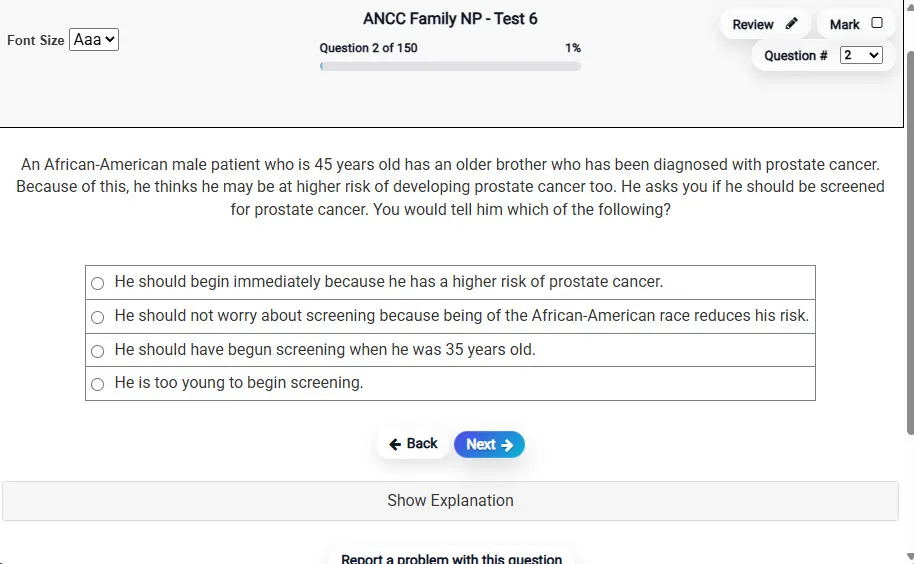
Answering a Question screen – Multiple-choice item view with navigation controls and progress tracker.
Answering a Question Multiple-choice item view with navigation controls and progress tracker.

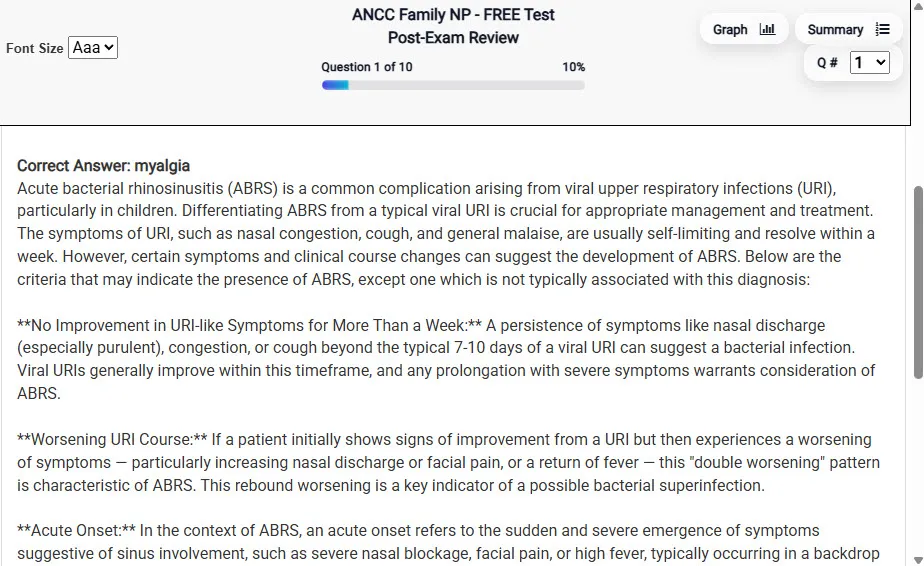
                           Detailed Explanation screen – 
                         Review mode showing chosen answer and rationale and references.
Detailed Explanation Review mode showing chosen answer and rationale and references.

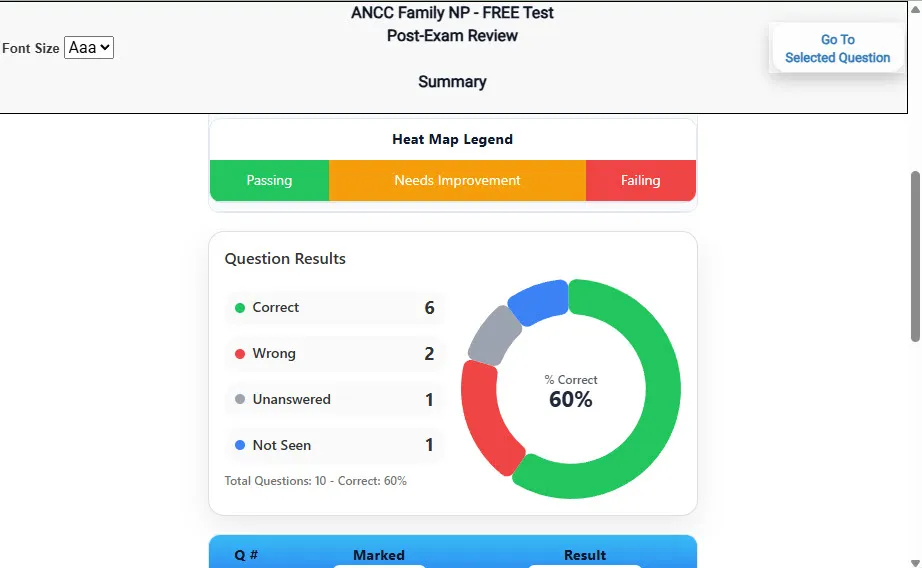
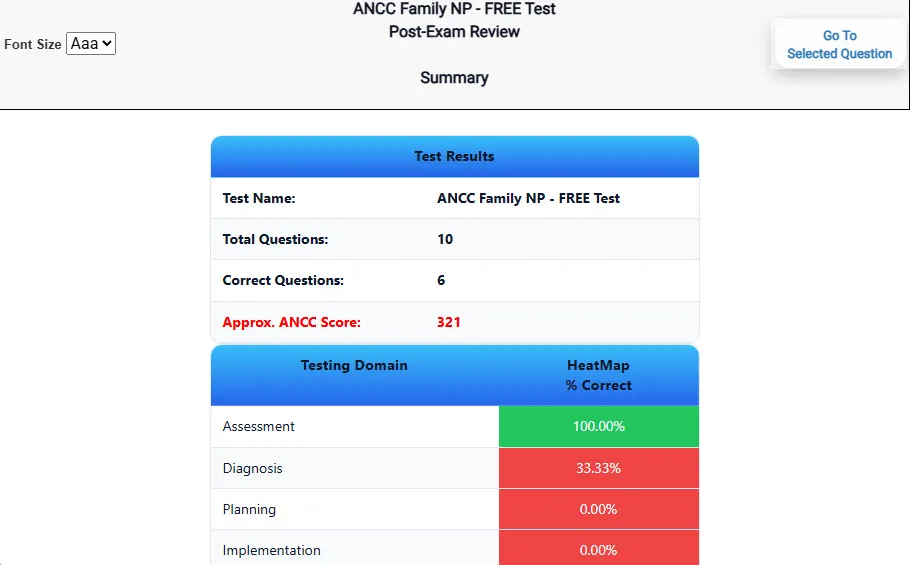
                           Review Summary 1 screen – 
                         Summary with counts for correct/wrong/unanswered and not seen items.
Review Summary 1 Summary with counts for correct/wrong/unanswered and not seen items.

                           Review Summary 2 screen – 
                         Advanced summary with category/domain breakdown and performance insights.
Review Summary 2 Advanced summary with category/domain breakdown and performance insights.

What Each Screen Shows

Answer Question Screen

  • Clean multiple-choice interface with progress bar.
  • Mark for review feature.
  • Matches real test pacing.

Detailed Explanation

  • Correct answer plus rationale.
  • Key concepts and guidelines highlighted.
  • Move between questions to fill knowledge gaps.

Review Summary 1

  • Overall results with total questions and scaled score.
  • Domain heatmap shows strengths and weaknesses.
  • Quick visual feedback on study priorities.

Review Summary 2

  • Chart of correct, wrong, unanswered, not seen.
  • Color-coded results for easy review.
  • Links back to missed items.

Top 10 Reasons to Use Exam Edge for your TX PACT Mathematics Grades 4-8 Exam Prep

  1. Focused on the TX PACT Mathematics Grades 4-8 Exam

    Our practice tests are built specifically for the TX PACT Math Grades 4-8 exam — every question mirrors the real topics, format, and difficulty so you're studying exactly what matters.

  2. Real Exam Simulation

    We match the per-question time limits and pressure of the actual TX PACT exam, so test day feels familiar and stress-free.

  3. 15 Full Practice Tests & 1,875 Unique Questions

    You'll have more than enough material to master every TX PACT Math Grades 4-8 concept — no repeats, no fluff.

  4. Lower Cost Than a Retake

    Ordering 5 practice exams costs less than retaking the TX PACT Mathematics Grades 4-8 exam after a failure. One low fee could save you both time and money.

  5. Flexible Testing

    Need to step away mid-exam? Pick up right where you left off — with your remaining time intact.

  6. Instant Scoring & Feedback

    See your raw score and an estimated TX PACT Mathematics Grades 4-8 score immediately after finishing each practice test.

  7. Detailed Explanations for Every Question

    Review correct and incorrect answers with clear, step-by-step explanations so you truly understand each topic.

  8. Trusted & Accredited

    We're fully accredited by the Better Business Bureau and uphold the highest standards of trust and transparency.

  9. Web-Based & Always Available

    No software to install. Access your TX PACT Math Grades 4-8 practice exams 24/7 from any computer or mobile device.

  10. Expert Support When You Need It

    Need extra help? Our specialized tutors are highly qualified and ready to support your TX PACT exam prep.


Pass the TX PACT Mathematics Grades 4-8 Exam with Realistic Practice Tests from Exam Edge

Preparing for your upcoming TX PACT Mathematics Grades 4-8 (715) Certification Exam can feel overwhelming — but the right practice makes all the difference. Exam Edge gives you the tools, structure, and confidence to pass on your first try. Our online practice exams are built to match the real TX PACT Math Grades 4-8 exam in content, format, and difficulty.

  • 📝 15 TX PACT Mathematics Grades 4-8 Practice Tests: Access 15 full-length exams with 125 questions each, covering every major TX PACT Mathematics Grades 4-8 topic in depth.
  • Instant Online Access: Start practicing right away — no software, no waiting.
  • 🧠 Step-by-Step Explanations: Understand the reasoning behind every correct answer so you can master TX PACT Math Grades 4-8 exam concepts.
  • 🔄 Retake Each Exam Up to 4 Times: Build knowledge through repetition and track your improvement over time.
  • 🌐 Web-Based & Available 24/7: Study anywhere, anytime, on any device.
  • 🧘 Boost Your Test-Day Confidence: Familiarity with the TX PACT format reduces anxiety and helps you perform under pressure.

These TX PACT Mathematics Grades 4-8 practice exams are designed to simulate the real testing experience by matching question types, timing, and difficulty level. This approach helps you get comfortable not just with the exam content, but also with the testing environment, so you walk into your exam day focused and confident.

Exam Edge TEXES Reviews


This is a good cross sectional review for Educational Diagnosticians, Special Education and Mainstream teachers. The questions were very comprehensible and engaging. Thanks

Linda R, Texas

Very good! Shows a reality of the test

Ivelisse , KATY, Texas

Very good study resource.

Angie , Grapevine , Texas

Purchased the bundle of 5 practice tests for speech 7-12. Passed the state exam on the first try! Very happy with exam edge and the information it provided!

Juan G, Eagle Pass, TX

Exam Edge was exactly what I needed to pass my Technology 171 TEXES exam. The questions prepared me for the real test. I highly recommend their study guide.

Crystalyn , Texes

I am a teacher in Texas who recently passed my Technology Education 6-12 exam. I took five of the practice exams with Examedge, which prepared me well. In fact, on the last practice test I finished, I scored a 265, and on the actual exam, I scored a 262; that’s within one question, extremely a ...
Read More
Adam G, Texas


TX PACT Mathematics Grades 4-8 Aliases Test Name

Here is a list of alternative names used for this exam.

  • TX PACT Mathematics Grades 4-8
  • TX PACT Mathematics Grades 4-8 test
  • TX PACT Mathematics Grades 4-8 Certification Test
  • TX PACT Math Grades 4-8 test
  • TEXES
  • TEXES 715
  • 715 test
  • TX PACT Mathematics Grades 4-8 (715)
  • TX PACT Mathematics Grades 4-8 certification