This is the content of the pop-over!

TX PACT Life Science 7–12 (738) Practice Tests & Test Prep by Exam Edge


TX PACT Life Science Grades 7-12 product image
(4.7)
Based on 40 Reviews

  • Real Exam Simulation: Timed questions and matching content build comfort for your TX PACT Life Science 7-12 test day.
  • Instant, 24/7 Access: Web-based TX PACT Life Science Grades 7-12 practice exams with no software needed.
  • Clear Explanations: Step-by-step answers and explanations for your TX PACT exam to strengthen understanding.
  • Boosted Confidence: Reduces anxiety and improves test-taking skills to ace your TX PACT Life Science Grades 7-12 (738).

Featured on

TX PACT Life Science Grades 7-12 Online Practice Test Bundles

BEST VALUE
15 practice tests

$149.25

$599.25

SAVE $450

Only $9.95 per test!

  • 100% Pass Guarantee
  • 15 online practice tests
  • 125 questions per test
  • Bonus: 100 Flash Cards + Study Guide
  • Instant access
  • Detailed Explanations
  • Practice tests never expire
  • Timed, untimed, or study guide mode
MOST POPULAR
10 practice tests

$99.50

$399.50

SAVE $300

Only $9.95 per test!

  • 10 online practice tests
  • 125 questions per test
  • Bonus: 100 Flash Cards + Study Guide
  • Instant access
  • Detailed Explanations
  • Practice tests never expire
  • Timed, untimed, or study guide mode
5 practice tests

$69.75

$199.75

SAVE $130

Only $13.95 per test!

  • 5 online practice tests
  • 125 questions per test
  • Bonus: 100 Flash Cards
  • Instant access
  • Detailed Explanations
  • Practice tests never expire
  • Timed, untimed, or study guide mode
1 practice test

$39.95

  • 1 online practice test
  • 125 questions per test
  • Instant access
  • Detailed Explanations
  • Practice tests never expire
  • Timed, untimed, or study guide mode
Quick Select
Tap to choose a bundle

** All Prices are in US Dollars (USD) **


TX PACT Life Science 7-12 (738) Resources

Jump to the section you need most.

Understanding the exact breakdown of the TX PACT Life Science Grades 7-12 test will help you know what to expect and how to most effectively prepare. The TX PACT Life Science Grades 7-12 has 125 multiple-choice questions . The exam will be broken down into the sections below:

TX PACT Life Science Grades 7-12 Exam Blueprint
Domain Name % Number of
Questions
Nature of Science 20% 25
Biochemistry and Cell Biology 13% 16
Genetics and Evolution 27% 34
Biological Unity and Diversity 20% 25
Ecology and Environment 20% 25

TX PACT Life Science Grades 7-12 Study Tips by Domain

  • Distinguish hypotheses, theories, and laws by their roles in science—don’t claim a theory becomes a law with “enough proof” (common trap).
  • Identify variables correctly: independent (manipulated), dependent (measured), and constants; a red flag is calling the “control group” the independent variable.
  • Evaluate experimental design for validity—use adequate sample size, randomization, and replication; priority rule: one trial is not sufficient evidence.
  • Interpret data with appropriate representations (tables, graphs, statistical summaries) and match claims to evidence; red flag: inferring causation from correlation without controls.
  • Apply measurement principles—SI units, significant figures, and percent error; common trap: reporting more precision than the instrument allows (e.g., extra decimal places).
  • Address scientific ethics and communication—proper citation, transparent methods, and honest reporting; red flag: selectively omitting outlier data without a justified, documented reason.
  • Differentiate macromolecules by monomer, bond type, and primary function—red flag: confusing dehydration synthesis (builds polymers) with hydrolysis (breaks polymers).
  • Use enzyme concepts (active site, specificity, saturation) to predict rate changes with temperature, pH, and substrate concentration—trap: assuming more enzyme always increases rate even when substrate is limiting.
  • Compare photosynthesis and cellular respiration by location, inputs/outputs, and energy carriers (ATP, NADH, NADPH)—priority rule: ATP is generated by chemiosmosis in both via an electron transport chain and proton gradient.
  • Identify cell structures and link organelles to function (e.g., ribosome–protein synthesis, mitochondrion–ATP, chloroplast–sugars)—red flag: mixing up ribosomes (no membrane) with rough ER (membrane-bound network).
  • Apply membrane transport models (diffusion, osmosis, facilitated diffusion, active transport) to scenarios—common trap: saying solutes move “to where there is more water” instead of down their own concentration gradient.
  • Connect the cell cycle (mitosis, cytokinesis) and regulation (checkpoints, cancer) to growth/repair—threshold cue: loss of checkpoint control leads to uncontrolled division even when DNA damage is present.
  • Apply Mendelian inheritance with probability (Punnett squares, testcrosses) and note the common trap: assuming offspring ratios are guaranteed in small samples rather than expected over many trials.
  • Interpret pedigrees for autosomal vs sex-linked vs mitochondrial patterns; red flag—skipping a generation suggests recessive inheritance, while father-to-son transmission rules out X-linked traits.
  • Distinguish meiosis processes that generate variation (crossing over, independent assortment, random fertilization); priority rule—crossing over occurs in prophase I and changes linked gene combinations.
  • Analyze molecular genetics (DNA replication, transcription, translation) and mutation impacts; common trap—a silent mutation changes a codon but not the amino acid, so phenotype may be unchanged.
  • Use population genetics concepts (Hardy–Weinberg) to identify evolution; threshold cue—if p + q ≠ 1 or genotype frequencies deviate from p2:2pq:q2, at least one equilibrium condition is violated.
  • Evaluate evidence and mechanisms of evolution (natural selection, genetic drift, gene flow, speciation); red flag—explaining evolution as individuals “trying” to adapt rather than shifts in allele frequencies across generations.
  • Use a taxonomic key by following paired, mutually exclusive traits in order; red flag: choosing a branch based on habitat or behavior instead of the stated morphological/diagnostic character.
  • Distinguish prokaryotes vs. eukaryotes and plant vs. animal vs. fungal cells using defining features (e.g., nucleus, cell wall composition, chloroplasts); common trap: saying “all cells have cell walls” or that “mitochondria are only in animals.”
  • Compare viruses, bacteria, archaea, protists, fungi, plants, and animals by how they obtain energy and reproduce; priority rule: if it must use a host to replicate, classify it as viral rather than “living” like cellular organisms.
  • Link structure to function across levels (cell–tissue–organ–system) using specific examples; red flag: describing an adaptation without stating the selective advantage it provides in a particular environment.
  • Interpret cladograms/phylogenies using shared derived characters (synapomorphies); common trap: assuming “more closely related” means “more advanced” or reading branch order as a ladder of progress.
  • Explain major animal and plant body plans (symmetry, segmentation, tissue layers, vascular tissue) and how they constrain function; contraindication: don’t generalize a trait to an entire group when it applies only to a subset (e.g., not all invertebrates lack a coelom).
  • Track energy flow with the 10% rule between trophic levels and distinguish it from matter cycling; red flag: treating energy as recycled like nutrients.
  • Use limiting factors (e.g., nitrogen, phosphorus, water) to predict changes in population growth and carrying capacity (K); common trap: confusing density-dependent with density-independent factors.
  • Interpret survivorship curves, exponential vs. logistic growth, and predator–prey cycles from graphs; priority rule: always label axes and units before drawing conclusions.
  • Explain biogeochemical cycles (water, carbon, nitrogen, phosphorus) with reservoirs, fluxes, and human impacts; red flag: claiming the phosphorus cycle has a significant atmospheric component.
  • Evaluate ecological succession (primary vs. secondary), disturbance, and resilience; common trap: assuming succession is always linear and ends in a fixed “climax” community.
  • Connect biodiversity to ecosystem stability and assess pollution impacts (bioaccumulation vs. biomagnification); contraindication: mixing up which increases with trophic level (biomagnification does).


Built to Fit Into Your Busy Life

Everything you need to prepare with confidence—without wasting a minute.

Three Study Modes

Timed, No Time Limit, or Explanation mode.

Actionable Analytics

Heatmaps and scaled scores highlight weak areas.

High-Yield Rationales

Concise explanations emphasize key concepts.

Realistic Interface

Matches the feel of the actual exam environment.

Accessible by Design

Clean layout reduces cognitive load.

Anytime, Anywhere

Web-based access 24/7 on any device.
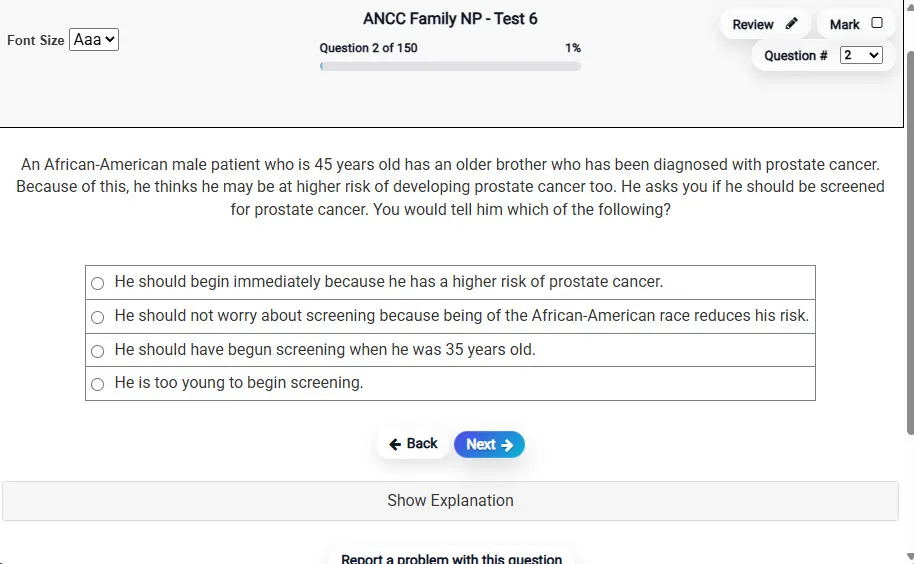
Answering a Question screen – Multiple-choice item view with navigation controls and progress tracker.
Answering a Question Multiple-choice item view with navigation controls and progress tracker.

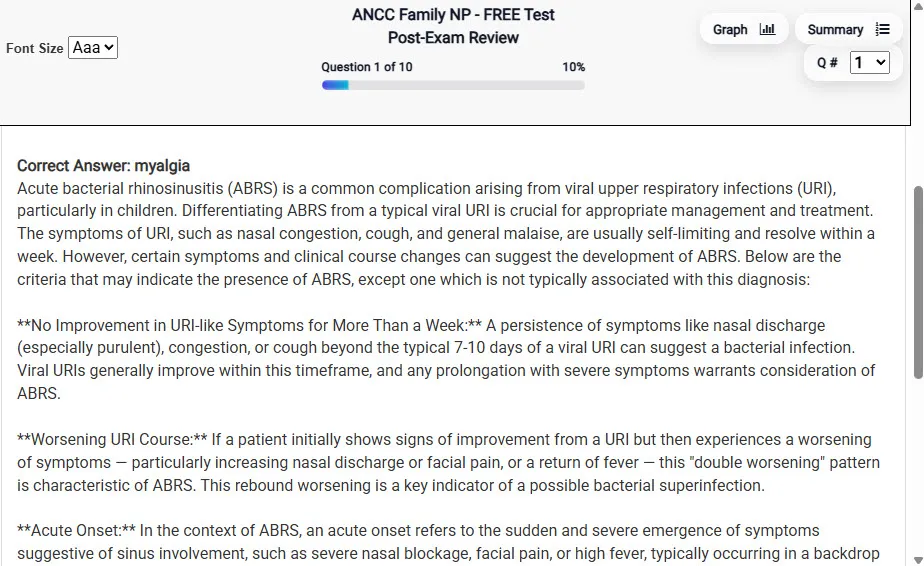
                           Detailed Explanation screen – 
                         Review mode showing chosen answer and rationale and references.
Detailed Explanation Review mode showing chosen answer and rationale and references.

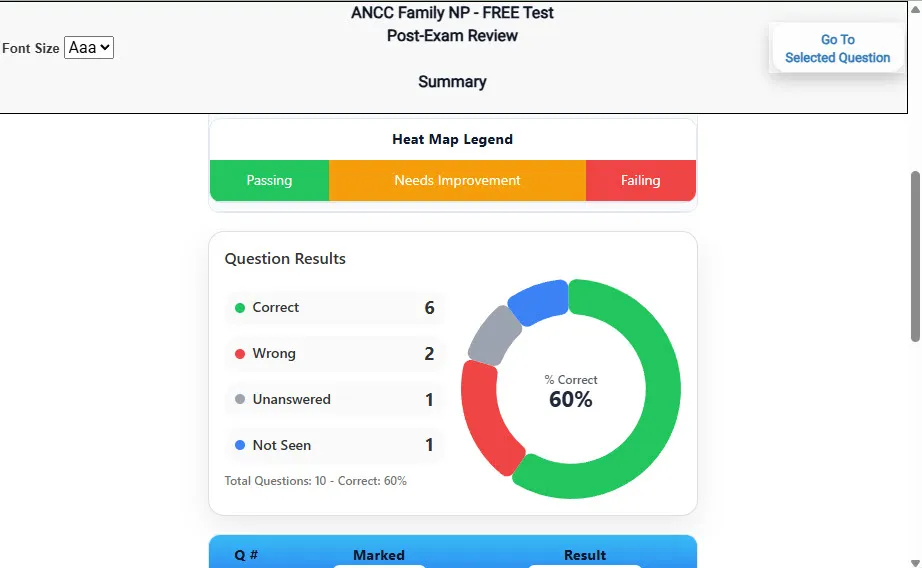
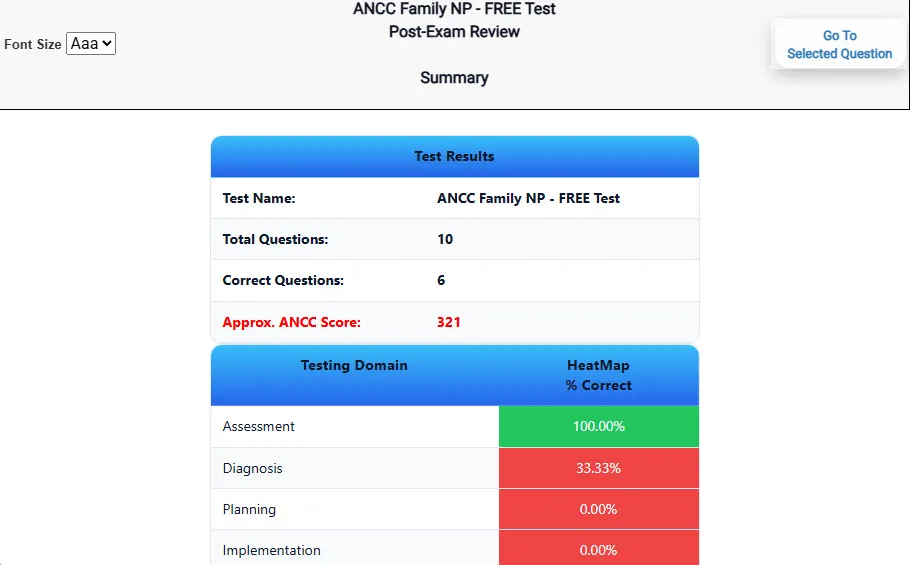
                           Review Summary 1 screen – 
                         Summary with counts for correct/wrong/unanswered and not seen items.
Review Summary 1 Summary with counts for correct/wrong/unanswered and not seen items.

                           Review Summary 2 screen – 
                         Advanced summary with category/domain breakdown and performance insights.
Review Summary 2 Advanced summary with category/domain breakdown and performance insights.

What Each Screen Shows

Answer Question Screen

  • Clean multiple-choice interface with progress bar.
  • Mark for review feature.
  • Matches real test pacing.

Detailed Explanation

  • Correct answer plus rationale.
  • Key concepts and guidelines highlighted.
  • Move between questions to fill knowledge gaps.

Review Summary 1

  • Overall results with total questions and scaled score.
  • Domain heatmap shows strengths and weaknesses.
  • Quick visual feedback on study priorities.

Review Summary 2

  • Chart of correct, wrong, unanswered, not seen.
  • Color-coded results for easy review.
  • Links back to missed items.

Top 10 Reasons to Use Exam Edge for your TX PACT Life Science Grades 7-12 Exam Prep

  1. Focused on the TX PACT Life Science Grades 7-12 Exam

    Our practice tests are built specifically for the TX PACT Life Science 7-12 exam — every question mirrors the real topics, format, and difficulty so you're studying exactly what matters.

  2. Real Exam Simulation

    We match the per-question time limits and pressure of the actual TX PACT exam, so test day feels familiar and stress-free.

  3. 15 Full Practice Tests & 1,875 Unique Questions

    You'll have more than enough material to master every TX PACT Life Science 7-12 concept — no repeats, no fluff.

  4. Lower Cost Than a Retake

    Ordering 5 practice exams costs less than retaking the TX PACT Life Science Grades 7-12 exam after a failure. One low fee could save you both time and money.

  5. Flexible Testing

    Need to step away mid-exam? Pick up right where you left off — with your remaining time intact.

  6. Instant Scoring & Feedback

    See your raw score and an estimated TX PACT Life Science Grades 7-12 score immediately after finishing each practice test.

  7. Detailed Explanations for Every Question

    Review correct and incorrect answers with clear, step-by-step explanations so you truly understand each topic.

  8. Trusted & Accredited

    We're fully accredited by the Better Business Bureau and uphold the highest standards of trust and transparency.

  9. Web-Based & Always Available

    No software to install. Access your TX PACT Life Science 7-12 practice exams 24/7 from any computer or mobile device.

  10. Expert Support When You Need It

    Need extra help? Our specialized tutors are highly qualified and ready to support your TX PACT exam prep.


Pass the TX PACT Life Science Grades 7-12 Exam with Realistic Practice Tests from Exam Edge

Preparing for your upcoming TX PACT Life Science Grades 7-12 (738) Certification Exam can feel overwhelming — but the right practice makes all the difference. Exam Edge gives you the tools, structure, and confidence to pass on your first try. Our online practice exams are built to match the real TX PACT Life Science 7-12 exam in content, format, and difficulty.

  • 📝 15 TX PACT Life Science Grades 7-12 Practice Tests: Access 15 full-length exams with 125 questions each, covering every major TX PACT Life Science Grades 7-12 topic in depth.
  • Instant Online Access: Start practicing right away — no software, no waiting.
  • 🧠 Step-by-Step Explanations: Understand the reasoning behind every correct answer so you can master TX PACT Life Science 7-12 exam concepts.
  • 🔄 Retake Each Exam Up to 4 Times: Build knowledge through repetition and track your improvement over time.
  • 🌐 Web-Based & Available 24/7: Study anywhere, anytime, on any device.
  • 🧘 Boost Your Test-Day Confidence: Familiarity with the TX PACT format reduces anxiety and helps you perform under pressure.

These TX PACT Life Science Grades 7-12 practice exams are designed to simulate the real testing experience by matching question types, timing, and difficulty level. This approach helps you get comfortable not just with the exam content, but also with the testing environment, so you walk into your exam day focused and confident.


Exam Edge TEXES Reviews


Very good! Shows a reality of the test

Ivelisse , KATY, Texas

Very good study resource.

Angie , Grapevine , Texas

Purchased the bundle of 5 practice tests for speech 7-12. Passed the state exam on the first try! Very happy with exam edge and the information it provided!

Juan G, Eagle Pass, TX

Exam Edge was exactly what I needed to pass my Technology 171 TEXES exam. The questions prepared me for the real test. I highly recommend their study guide.

Crystalyn , Texes

I am a teacher in Texas who recently passed my Technology Education 6-12 exam. I took five of the practice exams with Examedge, which prepared me well. In fact, on the last practice test I finished, I scored a 265, and on the actual exam, I scored a 262; that’s within one question, extremely a ...
Read More
Adam G, Texas

I originally purchased flashcards for the exam I was studying for. I feel that if I didn't have this resource, I would not have passed. I will say that at times, some questions were not fully developed and it was aggravating. Comparing this to TEA, please note that they only give multiple choice que ...
Read More
Yvette , Hutto, TX


TX PACT Life Science Grades 7-12 Aliases Test Name

Here is a list of alternative names used for this exam.

  • TX PACT Life Science Grades 7-12
  • TX PACT Life Science Grades 7-12 test
  • TX PACT Life Science Grades 7-12 Certification Test
  • TX PACT Life Science 7-12 test
  • TEXES
  • TEXES 738
  • 738 test
  • TX PACT Life Science Grades 7-12 (738)
  • TX PACT Life Science Grades 7-12 certification