This is the content of the pop-over!

TX PACT History 7/12 (733) Practice Tests & Test Prep by Exam Edge


TX PACT History Grades 7 to 12 product image
(4.7)
Based on 40 Reviews

  • Real Exam Simulation: Timed questions and matching content build comfort for your TX PACT History 7/12 test day.
  • Instant, 24/7 Access: Web-based TX PACT History Grades 7 to 12 practice exams with no software needed.
  • Clear Explanations: Step-by-step answers and explanations for your TX PACT exam to strengthen understanding.
  • Boosted Confidence: Reduces anxiety and improves test-taking skills to ace your TX PACT History Grades 7 to 12 (733).

Featured on

TX PACT History Grades 7 to 12 Online Practice Test Bundles

BEST VALUE
25 practice tests

$218.75

$998.75

SAVE $780

Only $8.75 per test!

  • 100% Pass Guarantee
  • 25 online practice tests
  • 125 questions per test
  • Bonus: 100 Flash Cards + Study Guide
  • Instant access
  • Detailed Explanations
  • Practice tests never expire
  • Timed, untimed, or study guide mode
MOST POPULAR
10 practice tests

$99.50

$399.50

SAVE $300

Only $9.95 per test!

  • 10 online practice tests
  • 125 questions per test
  • Bonus: 100 Flash Cards + Study Guide
  • Instant access
  • Detailed Explanations
  • Practice tests never expire
  • Timed, untimed, or study guide mode
5 practice tests

$69.75

$199.75

SAVE $130

Only $13.95 per test!

  • 5 online practice tests
  • 125 questions per test
  • Bonus: 100 Flash Cards
  • Instant access
  • Detailed Explanations
  • Practice tests never expire
  • Timed, untimed, or study guide mode
1 practice test

$39.95

  • 1 online practice test
  • 125 questions per test
  • Instant access
  • Detailed Explanations
  • Practice tests never expire
  • Timed, untimed, or study guide mode
Quick Select
Tap to choose a bundle

** All Prices are in US Dollars (USD) **


TX PACT History 7/12 (733) Resources

Jump to the section you need most.

Understanding the exact breakdown of the TX PACT History Grades 7 to 12 test will help you know what to expect and how to most effectively prepare. The TX PACT History Grades 7 to 12 has 125 multiple-choice questions . The exam will be broken down into the sections below:

TX PACT History Grades 7 to 12 Exam Blueprint
Domain Name % Number of
Questions
Historiography 12% 15
World History 1450 to the Present 18% 23
Science Learning - Instruction and Assessment 23% 29
U.S. History Precontact to 1877 23% 29
U.S. History 1877 to the Present 23% 29

TX PACT History Grades 7 to 12 Study Tips by Domain

  • Evaluate sources by distinguishing primary vs. secondary and identifying an author’s purpose, audience, and context—red flag: treating a textbook summary as primary evidence.
  • Corroborate claims across multiple sources (including conflicting accounts) and note where evidence is thin—common trap: accepting a single vivid quote as proof without cross-checking.
  • Differentiate historical facts, interpretations, and opinions, and explain how a historian’s questions shape conclusions—priority rule: conclusions must be explicitly tied to evidence.
  • Detect bias and perspective (e.g., class, race, gender, ideology, nationalism) and explain how they influence narrative—red flag: assuming a source is “objective” because it uses formal language.
  • Use periodization and causation carefully by separating short-term triggers from long-term causes and recognizing continuity/change—common trap: post hoc reasoning (because B followed A, A caused B).
  • Interpret historical arguments by identifying thesis, supporting evidence, and reasoning, then assess validity and limitations—threshold: a strong argument addresses counterevidence rather than ignoring it.
  • Anchor 1450+ chronology with turning points (e.g., 1492, 1648, 1750/1800, 1914, 1945, 1991) and always justify a periodization choice; red flag: treating 1450 as a clean break everywhere.
  • Explain state-building and empire in comparative terms (Ottoman, Mughal, Qing, Russia, European colonial empires) using specific evidence like taxation, bureaucracy, or military tech; common trap: attributing expansion to a single cause (e.g., “better guns”) without institutional factors.
  • Connect the Columbian Exchange and Atlantic slavery to demographic and economic change with at least one concrete example (cash crops, disease, silver flows); priority rule: distinguish coerced labor systems (chattel slavery vs. encomienda vs. indenture).
  • Analyze revolutions and ideologies (Enlightenment, liberalism, nationalism, socialism, communism, fascism, decolonization) by linking ideas to social groups and outcomes; red flag: confusing nationalism with imperialism or assuming ideologies are universally applied.
  • Frame industrialization as a global process (Britain to Europe, U.S., Japan, and beyond) and track consequences (urbanization, labor movements, imperial competition); common trap: ignoring how resources, markets, and transportation networks set thresholds for takeoff.
  • For 1914–present, compare causes and consequences of the World Wars and Cold War using alliances, total war, genocide, and proxy conflicts; red flag: overemphasizing leaders while missing structural drivers like treaty terms, economic crises, and bipolar power competition.
  • Plan instruction around TEKS-aligned, measurable objectives (verb + content + criterion) and use backward design; red flag: lessons centered on activities (e.g., “do a lab”) without explicit evidence targets.
  • Use formative assessment frequently (exit tickets, hinge questions) and reteach based on patterns in student data; common trap: averaging scores instead of identifying specific misconceptions to address.
  • Prioritize inquiry with clear question, evidence, reasoning, and communication (CER) in labs and investigations; red flag: conclusions that restate results without linking evidence to scientific principles.
  • Differentiate using scaffolds (sentence stems, graphic organizers, chunked texts) while keeping cognitive demand high; common trap: reducing rigor for multilingual learners instead of providing language supports.
  • Design assessments for validity and reliability with aligned item types (selected response, constructed response, performance tasks) and transparent rubrics; red flag: testing vocabulary in isolation when the target is conceptual understanding.
  • Maintain safety and ethics in labs (PPE, procedures, proper disposal) and model responsible data handling; priority rule: stop and correct any unsafe practice immediately rather than “letting it finish.”
  • Distinguish major precontact societies (e.g., Pueblo, Mississippian, Iroquois) by environment, economy, and governance—common trap: overgeneralizing “Native Americans” as culturally uniform.
  • Compare European motives and colonization patterns (Spanish, French, English) and link them to labor systems and settlement geography—red flag: mixing up encomienda with indentured servitude or slavery.
  • Trace colonial political development (self-government, mercantilism, salutary neglect) and tensions leading to revolution—priority rule: connect specific policies (Stamp Act, Tea Act, Intolerable Acts) to colonial responses.
  • Analyze the American Revolution and founding documents (Declaration, Articles, Constitution, Bill of Rights) for principles and compromises—common trap: confusing federalism with separation of powers.
  • Explain early republic change and continuity (Hamilton vs. Jefferson, Marbury v. Madison, Louisiana Purchase, War of 1812) and how events shift party politics—cue: if asked about judicial review, anchor to Marbury (1803).
  • Assess expansion and sectional conflict (Manifest Destiny, Indian Removal, market revolution, slavery debates, Compromise of 1850, Kansas-Nebraska, Dred Scott) leading to Civil War and early Reconstruction—red flag: treating “states’ rights” as separate from slavery in primary sources.
  • Reconstruction’s end (Compromise of 1877) shifts power to “Redeemer” governments—red flag: assuming 13th–15th Amendments were effectively enforced after 1877 despite Black Codes/Jim Crow workarounds.
  • Industrialization and big business (railroads, trusts, monopolies) drive Gilded Age change—common trap: mixing up Sherman Antitrust Act’s intent with its early use against labor rather than corporations.
  • Progressive Era reforms target urban problems and political corruption—priority rule: connect each reform to a specific problem (e.g., direct primaries to machine politics; Pure Food and Drug Act to consumer protection) rather than listing reforms generically.
  • U.S. foreign policy pivots from imperialism to global leadership (Spanish–American War, WWI, WWII, Cold War)—red flag: confusing Monroe Doctrine, Roosevelt Corollary, and Open Door Policy purposes and regions.
  • The Great Depression to New Deal era emphasizes federal expansion—common trap: treating all New Deal programs as the same; distinguish relief vs. recovery vs. reform and know SS/FDIC as long-term structural reforms.
  • Civil Rights and modern political realignment (1950s–present) hinge on court cases and federal action—threshold cue: be able to pair Brown v. Board, Civil Rights Act (1964), Voting Rights Act (1965), and later rollback debates with concrete outcomes, not just dates.


Built to Fit Into Your Busy Life

Everything you need to prepare with confidence—without wasting a minute.

Three Study Modes

Timed, No Time Limit, or Explanation mode.

Actionable Analytics

Heatmaps and scaled scores highlight weak areas.

High-Yield Rationales

Concise explanations emphasize key concepts.

Realistic Interface

Matches the feel of the actual exam environment.

Accessible by Design

Clean layout reduces cognitive load.

Anytime, Anywhere

Web-based access 24/7 on any device.
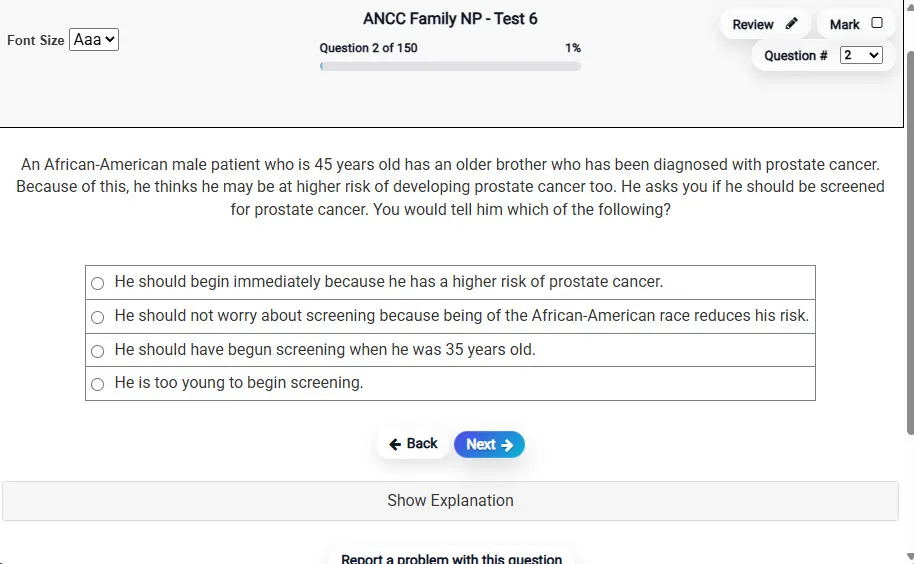
Answering a Question screen – Multiple-choice item view with navigation controls and progress tracker.
Answering a Question Multiple-choice item view with navigation controls and progress tracker.

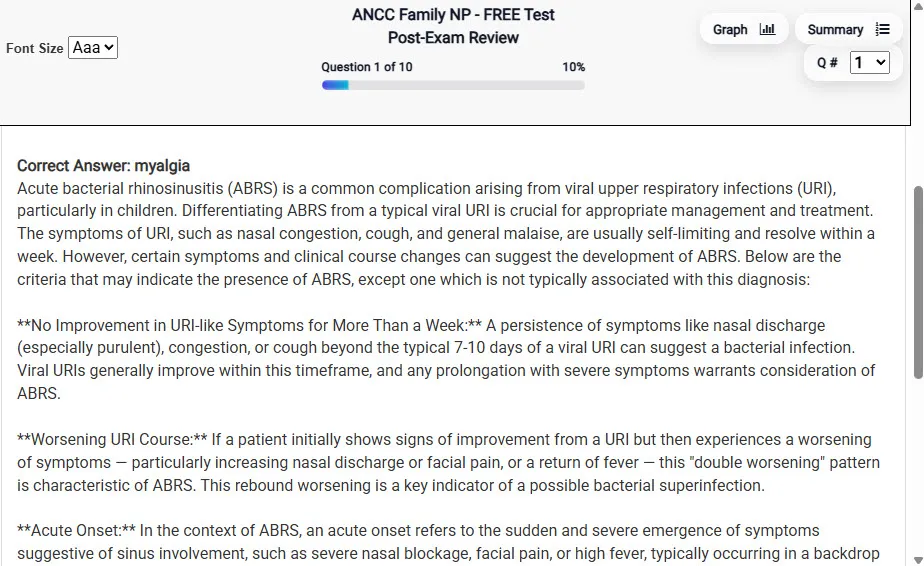
                           Detailed Explanation screen – 
                         Review mode showing chosen answer and rationale and references.
Detailed Explanation Review mode showing chosen answer and rationale and references.

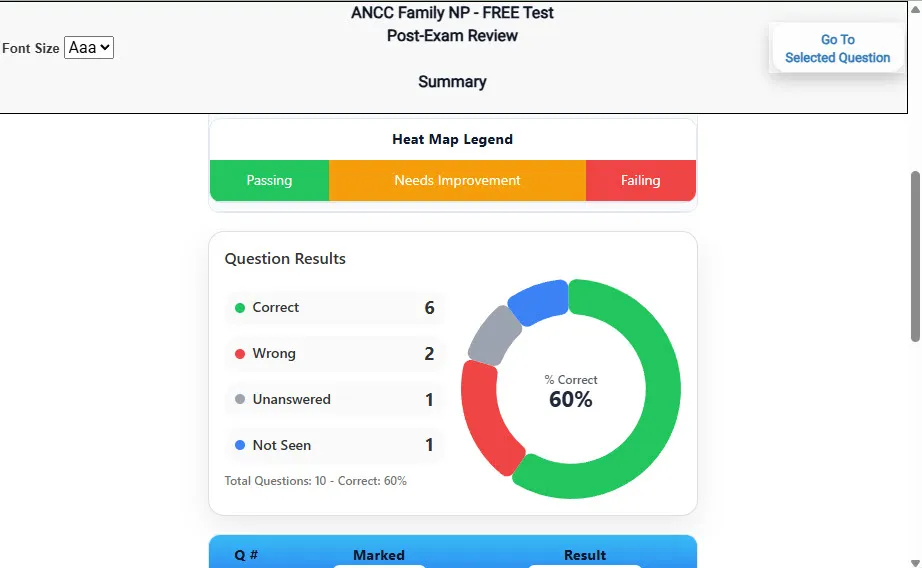
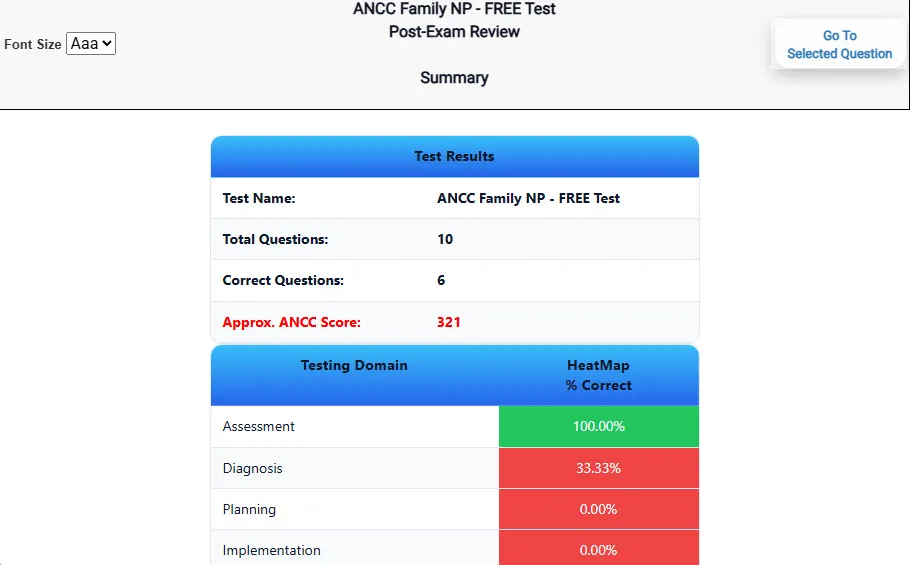
                           Review Summary 1 screen – 
                         Summary with counts for correct/wrong/unanswered and not seen items.
Review Summary 1 Summary with counts for correct/wrong/unanswered and not seen items.

                           Review Summary 2 screen – 
                         Advanced summary with category/domain breakdown and performance insights.
Review Summary 2 Advanced summary with category/domain breakdown and performance insights.

What Each Screen Shows

Answer Question Screen

  • Clean multiple-choice interface with progress bar.
  • Mark for review feature.
  • Matches real test pacing.

Detailed Explanation

  • Correct answer plus rationale.
  • Key concepts and guidelines highlighted.
  • Move between questions to fill knowledge gaps.

Review Summary 1

  • Overall results with total questions and scaled score.
  • Domain heatmap shows strengths and weaknesses.
  • Quick visual feedback on study priorities.

Review Summary 2

  • Chart of correct, wrong, unanswered, not seen.
  • Color-coded results for easy review.
  • Links back to missed items.

Top 10 Reasons to Use Exam Edge for your TX PACT History Grades 7 to 12 Exam Prep

  1. Focused on the TX PACT History Grades 7 to 12 Exam

    Our practice tests are built specifically for the TX PACT History 7/12 exam — every question mirrors the real topics, format, and difficulty so you're studying exactly what matters.

  2. Real Exam Simulation

    We match the per-question time limits and pressure of the actual TX PACT exam, so test day feels familiar and stress-free.

  3. 25 Full Practice Tests & 3,125 Unique Questions

    You'll have more than enough material to master every TX PACT History 7/12 concept — no repeats, no fluff.

  4. Lower Cost Than a Retake

    Ordering 5 practice exams costs less than retaking the TX PACT History Grades 7 to 12 exam after a failure. One low fee could save you both time and money.

  5. Flexible Testing

    Need to step away mid-exam? Pick up right where you left off — with your remaining time intact.

  6. Instant Scoring & Feedback

    See your raw score and an estimated TX PACT History Grades 7 to 12 score immediately after finishing each practice test.

  7. Detailed Explanations for Every Question

    Review correct and incorrect answers with clear, step-by-step explanations so you truly understand each topic.

  8. Trusted & Accredited

    We're fully accredited by the Better Business Bureau and uphold the highest standards of trust and transparency.

  9. Web-Based & Always Available

    No software to install. Access your TX PACT History 7/12 practice exams 24/7 from any computer or mobile device.

  10. Expert Support When You Need It

    Need extra help? Our specialized tutors are highly qualified and ready to support your TX PACT exam prep.


Pass the TX PACT History Grades 7 to 12 Exam with Realistic Practice Tests from Exam Edge

Preparing for your upcoming TX PACT History Grades 7 to 12 (733) Certification Exam can feel overwhelming — but the right practice makes all the difference. Exam Edge gives you the tools, structure, and confidence to pass on your first try. Our online practice exams are built to match the real TX PACT History 7/12 exam in content, format, and difficulty.

  • 📝 25 TX PACT History Grades 7 to 12 Practice Tests: Access 25 full-length exams with 125 questions each, covering every major TX PACT History Grades 7 to 12 topic in depth.
  • Instant Online Access: Start practicing right away — no software, no waiting.
  • 🧠 Step-by-Step Explanations: Understand the reasoning behind every correct answer so you can master TX PACT History 7/12 exam concepts.
  • 🔄 Retake Each Exam Up to 4 Times: Build knowledge through repetition and track your improvement over time.
  • 🌐 Web-Based & Available 24/7: Study anywhere, anytime, on any device.
  • 🧘 Boost Your Test-Day Confidence: Familiarity with the TX PACT format reduces anxiety and helps you perform under pressure.

These TX PACT History Grades 7 to 12 practice exams are designed to simulate the real testing experience by matching question types, timing, and difficulty level. This approach helps you get comfortable not just with the exam content, but also with the testing environment, so you walk into your exam day focused and confident.


Exam Edge TEXES Reviews


Very good! Shows a reality of the test

Ivelisse , KATY, Texas

Very good study resource.

Angie , Grapevine , Texas

Purchased the bundle of 5 practice tests for speech 7-12. Passed the state exam on the first try! Very happy with exam edge and the information it provided!

Juan G, Eagle Pass, TX

Exam Edge was exactly what I needed to pass my Technology 171 TEXES exam. The questions prepared me for the real test. I highly recommend their study guide.

Crystalyn , Texes

I am a teacher in Texas who recently passed my Technology Education 6-12 exam. I took five of the practice exams with Examedge, which prepared me well. In fact, on the last practice test I finished, I scored a 265, and on the actual exam, I scored a 262; that’s within one question, extremely a ...
Read More
Adam G, Texas

I originally purchased flashcards for the exam I was studying for. I feel that if I didn't have this resource, I would not have passed. I will say that at times, some questions were not fully developed and it was aggravating. Comparing this to TEA, please note that they only give multiple choice que ...
Read More
Yvette , Hutto, TX


TX PACT History Grades 7 to 12 Aliases Test Name

Here is a list of alternative names used for this exam.

  • TX PACT History Grades 7 to 12
  • TX PACT History Grades 7 to 12 test
  • TX PACT History Grades 7 to 12 Certification Test
  • TX PACT History 7/12 test
  • TEXES
  • TEXES 733
  • 733 test
  • TX PACT History Grades 7 to 12 (733)
  • TX PACT History Grades 7 to 12 certification