This is the content of the pop-over!

TX PACT Chemistry (740) Practice Tests & Test Prep by Exam Edge


TX PACT Chemistry Grades 7-12  product image
(4.8)
Based on 28 Reviews

  • Real Exam Simulation: Timed questions and matching content build comfort for your TX PACT Chemistry test day.
  • Instant, 24/7 Access: Web-based TX PACT Chemistry Grades 7-12 practice exams with no software needed.
  • Clear Explanations: Step-by-step answers and explanations for your TX PACT exam to strengthen understanding.
  • Boosted Confidence: Reduces anxiety and improves test-taking skills to ace your TX PACT Chemistry Grades 7-12 (740).

Featured on

TX PACT Chemistry Grades 7-12 Online Practice Test Bundles

BEST VALUE
15 practice tests

$149.25

$599.25

SAVE $450

Only $9.95 per test!

  • 100% Pass Guarantee
  • 15 online practice tests
  • 100 questions per test
  • Bonus: 100 Flash Cards + Study Guide
  • Instant access
  • Detailed Explanations
  • Practice tests never expire
  • Timed, untimed, or study guide mode
MOST POPULAR
10 practice tests

$99.50

$399.50

SAVE $300

Only $9.95 per test!

  • 10 online practice tests
  • 100 questions per test
  • Bonus: 100 Flash Cards + Study Guide
  • Instant access
  • Detailed Explanations
  • Practice tests never expire
  • Timed, untimed, or study guide mode
5 practice tests

$69.75

$199.75

SAVE $130

Only $13.95 per test!

  • 5 online practice tests
  • 100 questions per test
  • Bonus: 100 Flash Cards
  • Instant access
  • Detailed Explanations
  • Practice tests never expire
  • Timed, untimed, or study guide mode
1 practice test

$39.95

  • 1 online practice test
  • 100 questions per test
  • Instant access
  • Detailed Explanations
  • Practice tests never expire
  • Timed, untimed, or study guide mode
Quick Select
Tap to choose a bundle

** All Prices are in US Dollars (USD) **


TX PACT Chemistry (740) Resources

Jump to the section you need most.

Understanding the exact breakdown of the TX PACT Chemistry Grades 7-12 test will help you know what to expect and how to most effectively prepare. The TX PACT Chemistry Grades 7-12 has 125 multiple-choice questions . The exam will be broken down into the sections below:

TX PACT Chemistry Grades 7-12 Exam Blueprint
Domain Name % Number of
Questions
Nature of Science 18% 23
Matter and Atomic Structure 18% 23
Energy and Chemical Bonding 23% 29
Chemical Reactions 23% 29
Stoichiometry and Solutions 18% 23

TX PACT Chemistry Grades 7-12 Study Tips by Domain

  • Distinguish observation vs inference and law vs theory—red flag: claiming a theory becomes a law with enough evidence.
  • Identify variables and controls in an experiment; common trap: changing more than one independent variable and still drawing causal conclusions.
  • Evaluate data quality (precision, accuracy, significant figures, and uncertainty); priority rule: reported precision cannot exceed the measuring instrument’s smallest division.
  • Interpret graphs/tables with units and scales; red flag: reading a line of best fit as if every point must lie on it or ignoring nonzero intercepts when they matter.
  • Apply safe lab practices and chemical hygiene (PPE, labeling, SDS, waste disposal); contraindication: using water on reactive-metal or electrical fires—use the correct extinguisher class.
  • Use scientific reasoning and peer review to assess claims; common trap: confusing correlation with causation or relying on anecdotal evidence over reproducible results.
  • Use the periodic table to predict valence electrons and typical ion charges for main-group elements; red flag: confusing group number with period number when determining valence.
  • Differentiate atomic number, mass number, and average atomic mass (weighted by isotopic abundance); common trap: treating the periodic-table atomic mass as a whole-number mass number.
  • Write electron configurations and orbital diagrams using Aufbau, Pauli exclusion, and Hund’s rule; priority rule: don’t pair electrons in degenerate orbitals until each has one electron.
  • Interpret trends (atomic radius, ionization energy, electronegativity) and explain them via effective nuclear charge and shielding; red flag: claiming radius increases across a period for neutral atoms.
  • Apply the concept of isotopes and nuclear stability (e.g., neutron-to-proton ratio) to predict relative stability; common trap: assuming increasing protons always increases stability for heavier nuclei.
  • Classify substances as elements, compounds, or mixtures and distinguish physical vs. chemical properties; contraindication: using a change of state (melting/boiling) as evidence of a chemical change.
  • Use Lewis structures to predict bonding and geometry (VSEPR) and connect shape to polarity; red flag: forgetting lone pairs change bond angles and molecular polarity.
  • Differentiate ionic, covalent (polar/nonpolar), and metallic bonding by particle model and properties (conductivity, melting point, brittleness); common trap: assuming all covalent compounds have low melting points (network covalent doesn’t).
  • Apply electronegativity differences to bond type and dipole direction; priority rule: assign partial negative (δ−) to the more electronegative atom and don’t confuse bond polarity with overall molecular polarity.
  • Explain intermolecular forces (LDF, dipole–dipole, hydrogen bonding) and their effects on boiling point, viscosity, and solubility; red flag: calling any H–X bond “hydrogen bonding” (only N, O, or F qualifies).
  • Use potential energy curves and bond energies to compare stability and energy changes; common trap: mixing up that breaking bonds requires energy while forming bonds releases energy.
  • Relate electron configuration/valence electrons to bonding capacity and periodic trends (atomic radius, ionization energy, electronegativity); priority rule: ions form to reach noble-gas configurations, but transition metals often have multiple charges—don’t assume only one oxidation state.
  • Balance equations by conserving atoms and charge; red flag: changing subscripts to “balance” instead of using coefficients.
  • Classify reaction types (synthesis, decomposition, single/double replacement, combustion, acid–base, redox) and predict products; common trap: forgetting diatomic elements (H2, N2, O2, F2, Cl2, Br2, I2).
  • Use activity series and solubility rules to determine whether a reaction occurs and what precipitates form; priority rule: write net ionic equations by removing spectator ions.
  • Identify oxidation numbers to spot oxidation and reduction and assign oxidizing vs. reducing agents; red flag: O is usually −2 and H is usually +1, except peroxides (O = −1) and metal hydrides (H = −1).
  • Apply kinetic collision theory to factors affecting rate (temperature, concentration, surface area, catalysts); common trap: claiming catalysts increase yield rather than lowering activation energy to speed both directions.
  • Interpret equilibrium with K and Le Châtelier’s principle; threshold cue: only temperature changes K (concentration/pressure shifts Q but not K).
  • Always balance the chemical equation first before any mole work; red flag: starting with grams-to-moles without verified coefficients will cascade errors in ratios.
  • Use dimensional analysis with molar mass and Avogadro’s number and keep sig figs consistent; common trap: mixing “amu” and “g/mol” or rounding too early.
  • Identify the limiting reactant by comparing moles-to-coefficients (or product yield from each reactant); priority rule: the limiting reactant sets theoretical yield and excess remains unreacted.
  • Compute percent yield as (actual/theoretical)×100 and percent composition from molar mass fractions; red flag: yields >100% typically indicate impurities, incomplete drying, or measurement error.
  • For solutions, apply M = mol/L and M1V1 = M2V2 for dilution; common trap: using total volume before dilution is complete or forgetting to convert mL to L.
  • Handle solubility and precipitation with net ionic equations and Q vs. Ksp; contraindication: never cancel spectator ions until charges and states (aq, s, l, g) are correctly assigned.


Built to Fit Into Your Busy Life

Everything you need to prepare with confidence—without wasting a minute.

Three Study Modes

Timed, No Time Limit, or Explanation mode.

Actionable Analytics

Heatmaps and scaled scores highlight weak areas.

High-Yield Rationales

Concise explanations emphasize key concepts.

Realistic Interface

Matches the feel of the actual exam environment.

Accessible by Design

Clean layout reduces cognitive load.

Anytime, Anywhere

Web-based access 24/7 on any device.
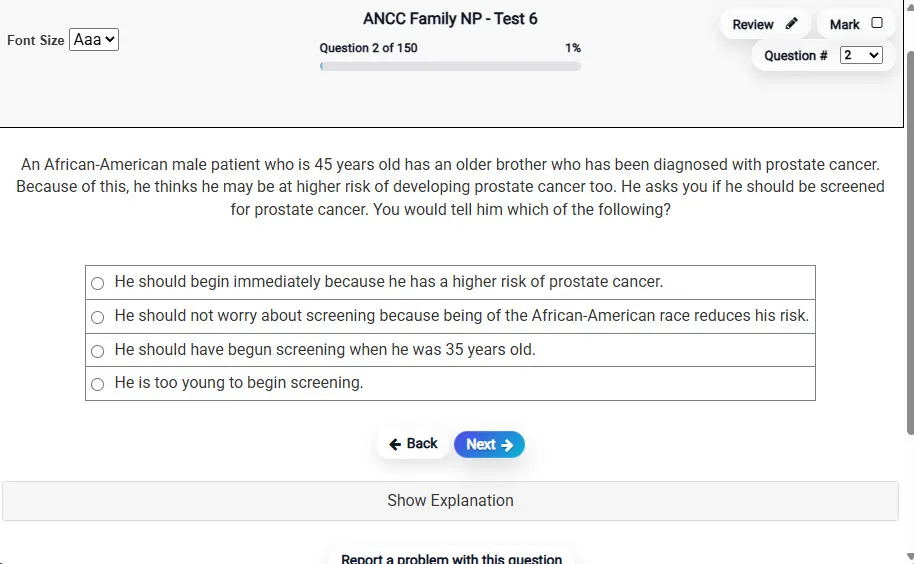
Answering a Question screen – Multiple-choice item view with navigation controls and progress tracker.
Answering a Question Multiple-choice item view with navigation controls and progress tracker.

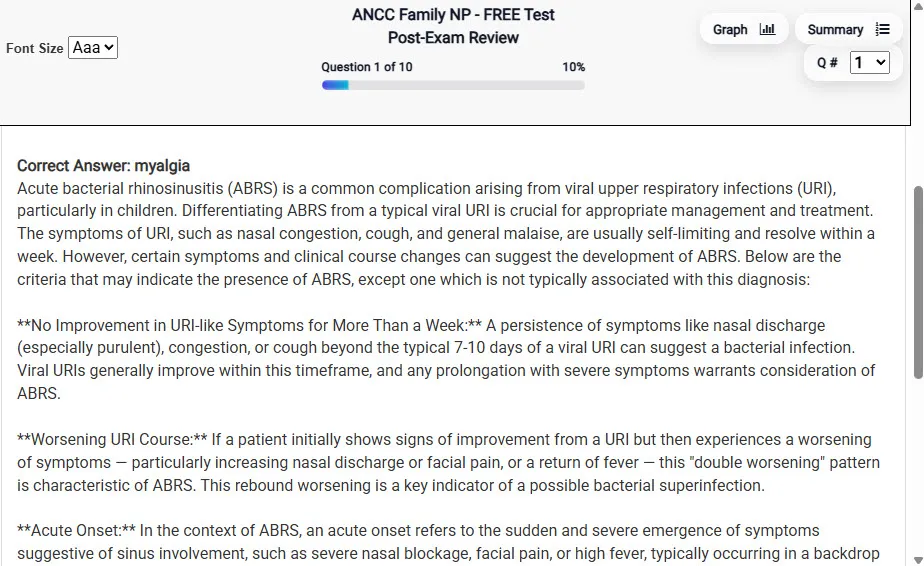
                           Detailed Explanation screen – 
                         Review mode showing chosen answer and rationale and references.
Detailed Explanation Review mode showing chosen answer and rationale and references.

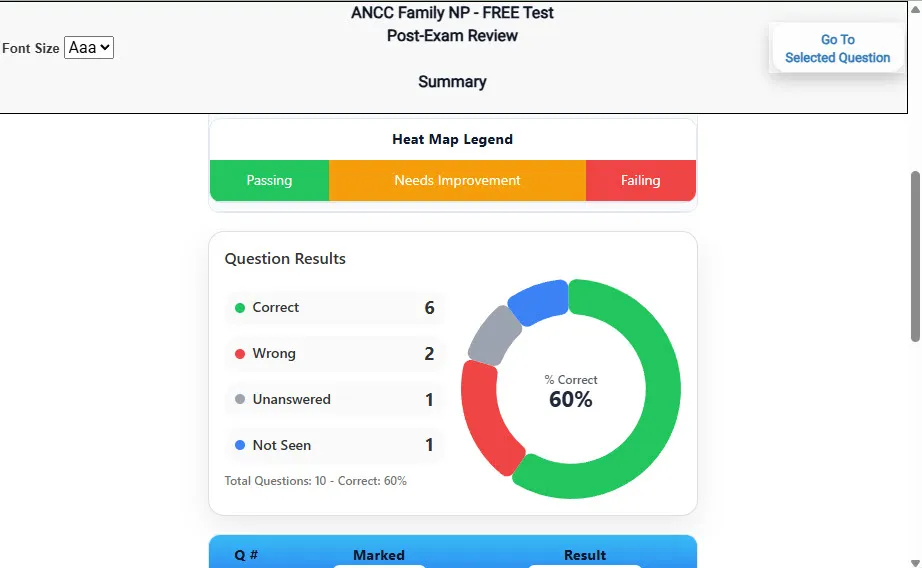
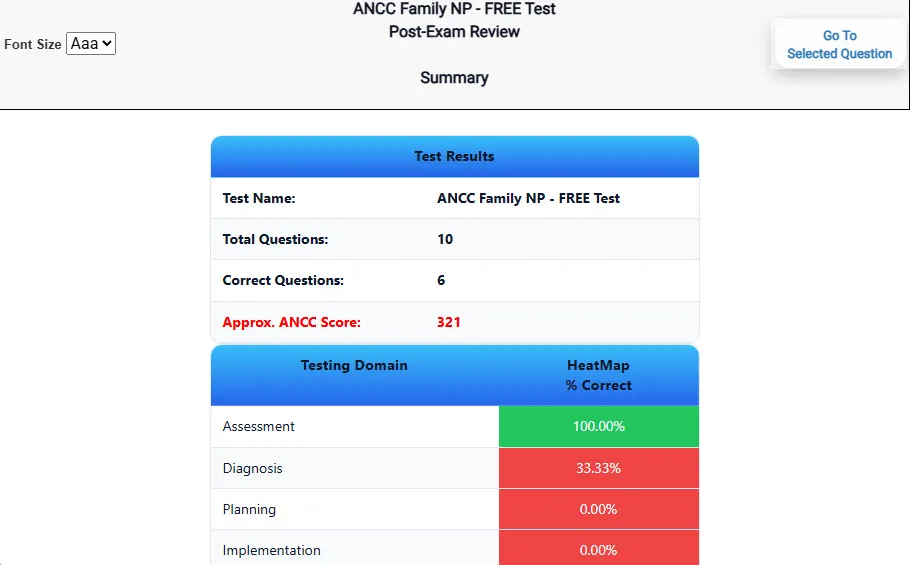
                           Review Summary 1 screen – 
                         Summary with counts for correct/wrong/unanswered and not seen items.
Review Summary 1 Summary with counts for correct/wrong/unanswered and not seen items.

                           Review Summary 2 screen – 
                         Advanced summary with category/domain breakdown and performance insights.
Review Summary 2 Advanced summary with category/domain breakdown and performance insights.

What Each Screen Shows

Answer Question Screen

  • Clean multiple-choice interface with progress bar.
  • Mark for review feature.
  • Matches real test pacing.

Detailed Explanation

  • Correct answer plus rationale.
  • Key concepts and guidelines highlighted.
  • Move between questions to fill knowledge gaps.

Review Summary 1

  • Overall results with total questions and scaled score.
  • Domain heatmap shows strengths and weaknesses.
  • Quick visual feedback on study priorities.

Review Summary 2

  • Chart of correct, wrong, unanswered, not seen.
  • Color-coded results for easy review.
  • Links back to missed items.

Top 10 Reasons to Use Exam Edge for your TX PACT Chemistry Grades 7-12 Exam Prep

  1. Focused on the TX PACT Chemistry Grades 7-12 Exam

    Our practice tests are built specifically for the TX PACT Chemistry exam — every question mirrors the real topics, format, and difficulty so you're studying exactly what matters.

  2. Real Exam Simulation

    We match the per-question time limits and pressure of the actual TX PACT exam, so test day feels familiar and stress-free.

  3. 15 Full Practice Tests & 1,500 Unique Questions

    You'll have more than enough material to master every TX PACT Chemistry concept — no repeats, no fluff.

  4. Lower Cost Than a Retake

    Ordering 5 practice exams costs less than retaking the TX PACT Chemistry Grades 7-12 exam after a failure. One low fee could save you both time and money.

  5. Flexible Testing

    Need to step away mid-exam? Pick up right where you left off — with your remaining time intact.

  6. Instant Scoring & Feedback

    See your raw score and an estimated TX PACT Chemistry Grades 7-12 score immediately after finishing each practice test.

  7. Detailed Explanations for Every Question

    Review correct and incorrect answers with clear, step-by-step explanations so you truly understand each topic.

  8. Trusted & Accredited

    We're fully accredited by the Better Business Bureau and uphold the highest standards of trust and transparency.

  9. Web-Based & Always Available

    No software to install. Access your TX PACT Chemistry practice exams 24/7 from any computer or mobile device.

  10. Expert Support When You Need It

    Need extra help? Our specialized tutors are highly qualified and ready to support your TX PACT exam prep.


Pass the TX PACT Chemistry Grades 7-12 Exam with Realistic Practice Tests from Exam Edge

Preparing for your upcoming TX PACT Chemistry Grades 7-12 (740) Certification Exam can feel overwhelming — but the right practice makes all the difference. Exam Edge gives you the tools, structure, and confidence to pass on your first try. Our online practice exams are built to match the real TX PACT Chemistry exam in content, format, and difficulty.

  • 📝 15 TX PACT Chemistry Grades 7-12 Practice Tests: Access 15 full-length exams with 100 questions each, covering every major TX PACT Chemistry Grades 7-12 topic in depth.
  • Instant Online Access: Start practicing right away — no software, no waiting.
  • 🧠 Step-by-Step Explanations: Understand the reasoning behind every correct answer so you can master TX PACT Chemistry exam concepts.
  • 🔄 Retake Each Exam Up to 4 Times: Build knowledge through repetition and track your improvement over time.
  • 🌐 Web-Based & Available 24/7: Study anywhere, anytime, on any device.
  • 🧘 Boost Your Test-Day Confidence: Familiarity with the TX PACT format reduces anxiety and helps you perform under pressure.

These TX PACT Chemistry Grades 7-12 practice exams are designed to simulate the real testing experience by matching question types, timing, and difficulty level. This approach helps you get comfortable not just with the exam content, but also with the testing environment, so you walk into your exam day focused and confident.


Exam Edge TEXES Reviews


Exam edge really prepared me for my exam. I passed!!! Thank you so much!

Mary, Houston, TX

The practice tests allowed me to practice with questions that were of similar content and construction as the real test. I took several practice tests and was able to focus my studying on what I missed. I felt the rigor of the questions matched the real test as well. After taking the real test and r ...
Read More
Lucy, Texes

Just wanted to tell you how helpful your site and tests were. I have taught HS English for 16 years and challenged this test to make myself more marketable. I ended up buying three tests, studying all the answer reasons, and using the info to make notes to study. I passed on the first try. Actually, ...
Read More
Wendy, Texes

Pleased with using Exam Edge. I have learned many other terms and related information using Exam Edge. I started with one examination to ready myself for the state examination and ended up purchasing all 10. Exam Edge also gave me some additional information after purchasing 10 exams.

Barb N, TX

Excellent experience!

Agnes , San Antonio, Texas

Great exam site that helped me pass my tests.

June , Murphy, Texas


TX PACT Chemistry Grades 7-12 Aliases Test Name

Here is a list of alternative names used for this exam.

  • TX PACT Chemistry Grades 7-12
  • TX PACT Chemistry Grades 7-12 test
  • TX PACT Chemistry Grades 7-12 Certification Test
  • TX PACT Chemistry test
  • TEXES
  • TEXES 740
  • 740 test
  • TX PACT Chemistry Grades 7-12 (740)
  • TX PACT Chemistry Grades 7-12 certification