
This is the content of the pop-over!

TX PACT Art (778) Practice Tests & Test Prep by Exam Edge


TX PACT Art Early Childhood-Grade 12  product image
(4.8)
Based on 25 Reviews

  • Real Exam Simulation: Timed questions and matching content build comfort for your TX PACT Art test day.
  • Instant, 24/7 Access: Web-based TX PACT Art Early Childhood-Grade 12 practice exams with no software needed.
  • Clear Explanations: Step-by-step answers and explanations for your TX PACT exam to strengthen understanding.
  • Boosted Confidence: Reduces anxiety and improves test-taking skills to ace your TX PACT Art Early Childhood-Grade 12 (778).

Featured on

TX PACT Art Early Childhood-Grade 12 Online Practice Test Bundles

BEST VALUE
25 practice tests

$218.75

$998.75

SAVE $780

Only $8.75 per test!

  • 100% Pass Guarantee
  • 25 online practice tests
  • 100 questions per test
  • Bonus: 100 Flash Cards + Study Guide
  • Instant access
  • Detailed Explanations
  • Practice tests never expire
  • Timed, untimed, or study guide mode
MOST POPULAR
10 practice tests

$99.50

$399.50

SAVE $300

Only $9.95 per test!

  • 10 online practice tests
  • 100 questions per test
  • Bonus: 100 Flash Cards + Study Guide
  • Instant access
  • Detailed Explanations
  • Practice tests never expire
  • Timed, untimed, or study guide mode
5 practice tests

$69.75

$199.75

SAVE $130

Only $13.95 per test!

  • 5 online practice tests
  • 100 questions per test
  • Bonus: 100 Flash Cards
  • Instant access
  • Detailed Explanations
  • Practice tests never expire
  • Timed, untimed, or study guide mode
1 practice test

$39.95

  • 1 online practice test
  • 100 questions per test
  • Instant access
  • Detailed Explanations
  • Practice tests never expire
  • Timed, untimed, or study guide mode
Quick Select
Tap to choose a bundle

** All Prices are in US Dollars (USD) **


TX PACT Art (778) Resources

Jump to the section you need most.

Understanding the exact breakdown of the TX PACT Art Early Childhood-Grade 12 test will help you know what to expect and how to most effectively prepare. The TX PACT Art Early Childhood-Grade 12 has 125 multiple-choice questions . The exam will be broken down into the sections below:

TX PACT Art Early Childhood-Grade 12 Exam Blueprint
Domain Name % Number of
Questions
Foundations of Art: Elements and Principles 11% 14
Art Media - Tools - Technologies - Techniques Processes 33% 41
Visual Arts in Historical and Cultural Contexts 33% 41
Aesthetics and Art Criticism 12% 15
Connecting the Visual Arts to Other Disciplines 11% 14

TX PACT Art Early Childhood-Grade 12 Study Tips by Domain

  • Elements: line, shape, form, space, color, value, texture—don’t confuse shape (2D) with form (3D), a common test trap in early childhood examples.
  • Principles: balance, contrast, emphasis, movement, pattern, rhythm, proportion/scale, unity/variety—red flag: “symmetrical” is only one type of balance (also asymmetrical and radial).
  • Color relationships (hue, value, intensity; primary/secondary/tertiary; complementary/analogous)—priority rule: complementary pairs create highest contrast, which is often the intended answer when “make it pop” appears.
  • Space cues (positive/negative space, overlap, size change, placement, linear perspective)—common trap: linear perspective is not developmentally typical for young children, so pick simpler depth cues in EC–grade scenarios.
  • Value and light: highlights, midtones, shadows, and gradients—contraindication: adding black to darken is not always best; lowering value can also be achieved by mixing a complement to reduce intensity.
  • Texture and pattern: actual vs implied texture; motif/repetition to build rhythm—red flag: pattern is repeated design, while rhythm is the visual “beat” created by repetition with variation.
  • Select media by matching properties to intent (e.g., transparent watercolor washes vs. opaque acrylic coverage)—red flag: choosing a medium that can’t achieve the required value range or surface durability.
  • Prioritize safety and classroom procedures (PPE, ventilation, labeling, and age-appropriate materials)—common trap: using aerosol fixatives or solvent-based products without adequate ventilation and documented handling rules.
  • Demonstrate correct tool use and maintenance (brush loading/cleaning, blade handling, kiln/heat tool protocols)—threshold cue: dull blades and dirty brushes increase injury risk and degrade craftsmanship.
  • Explain core technique-process links (e.g., additive vs. subtractive sculpture, relief vs. intaglio printmaking, wet-on-wet vs. glazing)—red flag: skipping drying/curing stages that cause cracking, muddy color, or failed transfers.
  • Use digital and photographic tools intentionally (resolution, file formats, color management, and non-destructive editing)—common trap: printing low-resolution images or editing without saving originals, leading to pixelation and lost work.
  • Plan for material limitations and constraints (paper weight, ground/primer choice, clay shrinkage, and adhesive compatibility)—priority rule: test a small sample first to prevent bleeding, warping, delamination, or glaze crawling.
  • Place artworks in accurate time, place, and purpose (ritual, propaganda, devotion, commerce) and cite at least one contextual clue; red flag: describing “style” without linking it to function or patronage.
  • Compare across cultures by analyzing materials, symbols, and audience rather than ranking “advanced” vs “primitive”; common trap: value judgments that ignore cultural worldview and historical conditions.
  • Identify how geography and available resources shape art (e.g., stone, clay, fiber, pigments) and the resulting forms; cue: when materials change, expect changes in scale, durability, and technique.
  • Connect major movements and periods to social/political change (industrialization, revolution, colonization, civil rights) and predict likely themes; priority rule: tie at least one visual characteristic to a specific historical force.
  • Address Texas and broader U.S. visual traditions (Indigenous, Spanish/Mexican, African American, immigrant communities) with culturally responsive language; red flag: treating a culture as monolithic or using stereotypes as “context.”
  • Evaluate issues of cultural exchange, appropriation, and representation using evidence of source, consent, and power dynamics; contraindication: borrowing sacred imagery or motifs without acknowledging origin and meaning.
  • Use a consistent critique framework (e.g., description → analysis → interpretation → judgment) and anchor every claim in observable evidence; red flag: jumping to “I like it” or a value judgment before describing what is seen.
  • Differentiate formal criticism (elements/principles) from contextual criticism (artist intent, audience, culture, time) and state which lens you are using; common trap: mixing lenses without naming them, leading to unsupported conclusions.
  • Apply aesthetic theories (e.g., imitation/representation, expression, formalism, instrumentalism) to explain why a work is considered art; priority rule: match the theory to the work’s dominant purpose rather than forcing one theory on all artworks.
  • Use precise visual arts vocabulary (line quality, value contrast, compositional balance, texture) to justify interpretations; red flag: relying on vague terms like “nice” or “cool” without specifying what causes that effect.
  • Teach and assess critique with developmentally appropriate prompts (PK–12) while maintaining evidence-based reasoning; common trap: asking young students to infer complex intent without first building observation skills.
  • Maintain ethical and culturally responsive critique practices by separating critique of the artwork from critique of the artist or culture; contraindication: stereotypes or assumptions about a culture used as “context” without credible support.
  • Plan integrated lessons that keep a clear art objective (elements/principles or process) while connecting to another subject; common trap: letting the non-art standard become the real focus and art becomes mere decoration.
  • Use developmentally appropriate integration—PK–2 relies on concrete materials, short steps, and explicit vocabulary, while secondary can handle abstraction and research; red flag: tasks that require reading/writing demands beyond students’ level without supports.
  • Connect to ELA through visual literacy (describe, interpret, justify with evidence from the artwork) and structured critique writing; priority rule: require students to cite specific visual features rather than opinions (“I like it”).
  • Connect to math/science with measurable targets (symmetry, proportion, scale, pattern, data-based color studies, material testing); common trap: math craft activities with no explicit observation/measurement or reflection on results.
  • Connect to social studies by linking artworks to time, place, and civic/cultural meanings while avoiding stereotypes; red flag: using cultural symbols without context, attribution, or discussion of respectful use.
  • Connect to technology and CTE by choosing tools that match the concept (digital imaging, animation, design thinking, safe studio practices) and documenting process; contraindication: introducing new tech without teaching file management, copyright/Creative Commons, or safety procedures.


Built to Fit Into Your Busy Life

Everything you need to prepare with confidence—without wasting a minute.

Three Study Modes

Timed, No Time Limit, or Explanation mode.

Actionable Analytics

Heatmaps and scaled scores highlight weak areas.

High-Yield Rationales

Concise explanations emphasize key concepts.

Realistic Interface

Matches the feel of the actual exam environment.

Accessible by Design

Clean layout reduces cognitive load.

Anytime, Anywhere

Web-based access 24/7 on any device.
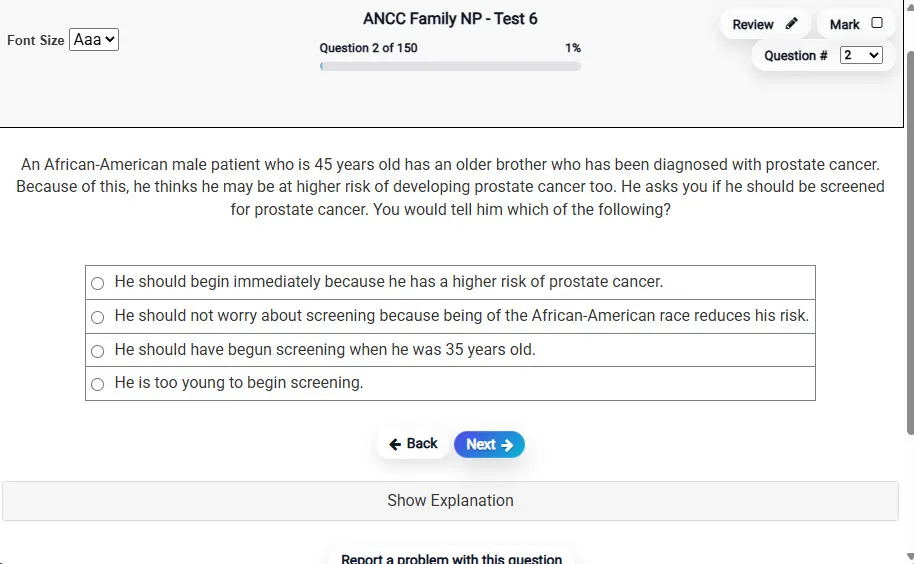
Answering a Question screen – Multiple-choice item view with navigation controls and progress tracker.
Answering a Question Multiple-choice item view with navigation controls and progress tracker.

                           Detailed Explanation screen – 
                         Review mode showing chosen answer and rationale and references.
Detailed Explanation Review mode showing chosen answer and rationale and references.

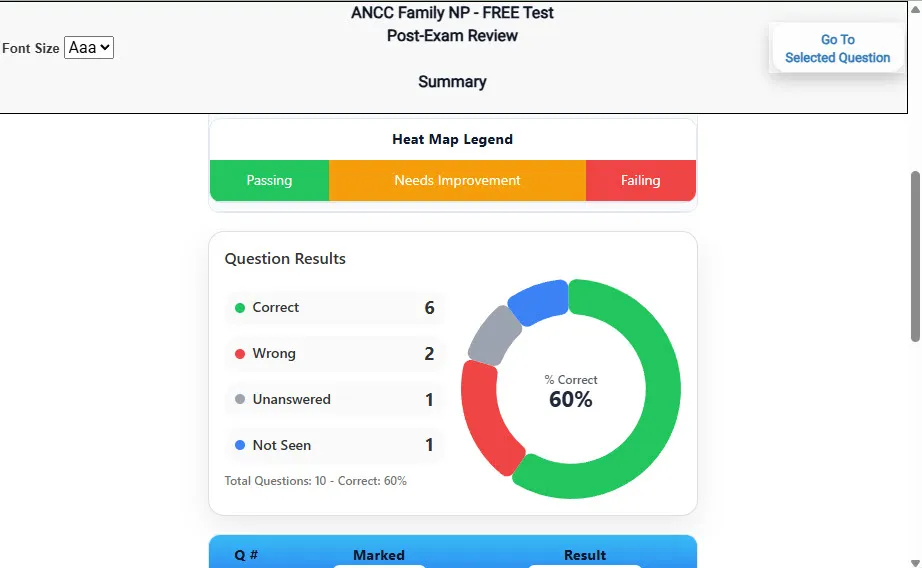
                           Review Summary 1 screen – 
                         Summary with counts for correct/wrong/unanswered and not seen items.
Review Summary 1 Summary with counts for correct/wrong/unanswered and not seen items.

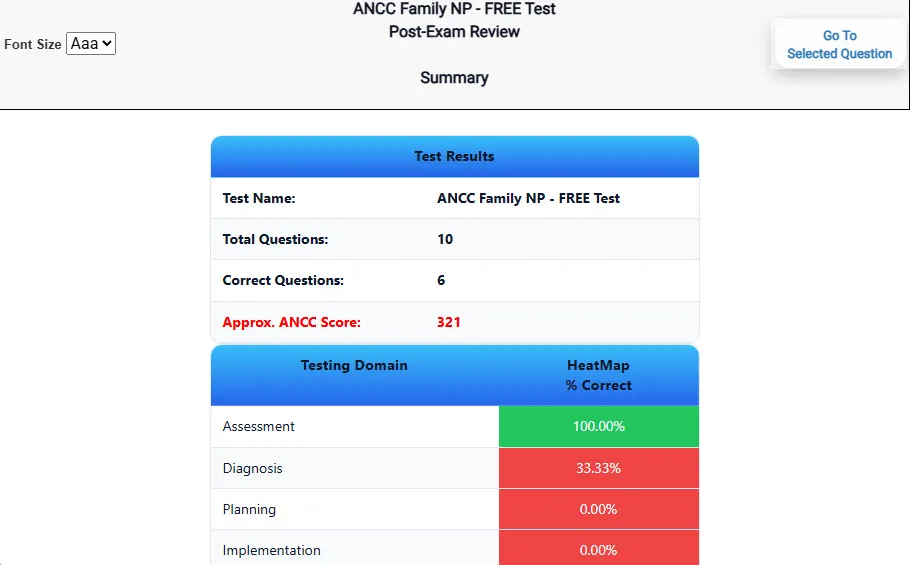
                           Review Summary 2 screen – 
                         Advanced summary with category/domain breakdown and performance insights.
Review Summary 2 Advanced summary with category/domain breakdown and performance insights.

What Each Screen Shows

Answer Question Screen

  • Clean multiple-choice interface with progress bar.
  • Mark for review feature.
  • Matches real test pacing.

Detailed Explanation

  • Correct answer plus rationale.
  • Key concepts and guidelines highlighted.
  • Move between questions to fill knowledge gaps.

Review Summary 1

  • Overall results with total questions and scaled score.
  • Domain heatmap shows strengths and weaknesses.
  • Quick visual feedback on study priorities.

Review Summary 2

  • Chart of correct, wrong, unanswered, not seen.
  • Color-coded results for easy review.
  • Links back to missed items.

Top 10 Reasons to Use Exam Edge for your TX PACT Art Early Childhood-Grade 12 Exam Prep

  1. Focused on the TX PACT Art Early Childhood-Grade 12 Exam

    Our practice tests are built specifically for the TX PACT Art exam — every question mirrors the real topics, format, and difficulty so you're studying exactly what matters.

  2. Real Exam Simulation

    We match the per-question time limits and pressure of the actual TX PACT exam, so test day feels familiar and stress-free.

  3. 25 Full Practice Tests & 2,500 Unique Questions

    You'll have more than enough material to master every TX PACT Art concept — no repeats, no fluff.

  4. Lower Cost Than a Retake

    Ordering 5 practice exams costs less than retaking the TX PACT Art Early Childhood-Grade 12 exam after a failure. One low fee could save you both time and money.

  5. Flexible Testing

    Need to step away mid-exam? Pick up right where you left off — with your remaining time intact.

  6. Instant Scoring & Feedback

    See your raw score and an estimated TX PACT Art Early Childhood-Grade 12 score immediately after finishing each practice test.

  7. Detailed Explanations for Every Question

    Review correct and incorrect answers with clear, step-by-step explanations so you truly understand each topic.

  8. Trusted & Accredited

    We're fully accredited by the Better Business Bureau and uphold the highest standards of trust and transparency.

  9. Web-Based & Always Available

    No software to install. Access your TX PACT Art practice exams 24/7 from any computer or mobile device.

  10. Expert Support When You Need It

    Need extra help? Our specialized tutors are highly qualified and ready to support your TX PACT exam prep.


Pass the TX PACT Art Early Childhood-Grade 12 Exam with Realistic Practice Tests from Exam Edge

Preparing for your upcoming TX PACT Art Early Childhood-Grade 12 (778) Certification Exam can feel overwhelming — but the right practice makes all the difference. Exam Edge gives you the tools, structure, and confidence to pass on your first try. Our online practice exams are built to match the real TX PACT Art exam in content, format, and difficulty.

  • 📝 25 TX PACT Art Early Childhood-Grade 12 Practice Tests: Access 25 full-length exams with 100 questions each, covering every major TX PACT Art Early Childhood-Grade 12 topic in depth.
  • Instant Online Access: Start practicing right away — no software, no waiting.
  • 🧠 Step-by-Step Explanations: Understand the reasoning behind every correct answer so you can master TX PACT Art exam concepts.
  • 🔄 Retake Each Exam Up to 4 Times: Build knowledge through repetition and track your improvement over time.
  • 🌐 Web-Based & Available 24/7: Study anywhere, anytime, on any device.
  • 🧘 Boost Your Test-Day Confidence: Familiarity with the TX PACT format reduces anxiety and helps you perform under pressure.

These TX PACT Art Early Childhood-Grade 12 practice exams are designed to simulate the real testing experience by matching question types, timing, and difficulty level. This approach helps you get comfortable not just with the exam content, but also with the testing environment, so you walk into your exam day focused and confident.


Exam Edge TEXES Reviews


Just wanted to tell you how helpful your site and tests were. I have taught HS English for 16 years and challenged this test to make myself more marketable. I ended up buying three tests, studying all the answer reasons, and using the info to make notes to study. I passed on the first try. Actually, ...
Read More
Wendy, Texes

The practice tests allowed me to practice with questions that were of similar content and construction as the real test. I took several practice tests and was able to focus my studying on what I missed. I felt the rigor of the questions matched the real test as well. After taking the real test and r ...
Read More
Lucy, Texes

Exam edge really prepared me for my exam. I passed!!! Thank you so much!

Mary, Houston, TX

Pleased with using Exam Edge. I have learned many other terms and related information using Exam Edge. I started with one examination to ready myself for the state examination and ended up purchasing all 10. Exam Edge also gave me some additional information after purchasing 10 exams.

Barb N, TX

Excellent experience!

Agnes , San Antonio, Texas

Great exam site that helped me pass my tests.

June , Murphy, Texas


TX PACT Art Early Childhood-Grade 12 Aliases Test Name

Here is a list of alternative names used for this exam.

  • TX PACT Art Early Childhood-Grade 12
  • TX PACT Art Early Childhood-Grade 12 test
  • TX PACT Art Early Childhood-Grade 12 Certification Test
  • TX PACT Art test
  • TEXES
  • TEXES 778
  • 778 test
  • TX PACT Art Early Childhood-Grade 12 (778)
  • TX PACT Art Early Childhood-Grade 12 certification