This is the content of the pop-over!

ORELA Spanish (401) Practice Tests & Test Prep by Exam Edge


ORELA Spanish  product image
(5.0)
Based on 40 Reviews

  • Real Exam Simulation: Timed questions and matching content build comfort for your ORELA Spanish test day.
  • Instant, 24/7 Access: Web-based ORELA Spanish practice exams with no software needed.
  • Clear Explanations: Step-by-step answers and explanations for your ORELA exam to strengthen understanding.
  • Boosted Confidence: Reduces anxiety and improves test-taking skills to ace your ORELA Spanish (401).

Featured on

ORELA Spanish Online Practice Test Bundles

BEST VALUE
10 practice tests

$99.50

$399.50

SAVE $300

Only $9.95 per test!

  • 100% Pass Guarantee
  • 10 online practice tests
  • 100 questions per test
  • Bonus: 100 Flash Cards + Study Guide
  • Instant access
  • Detailed Explanations
  • Practice tests never expire
  • Timed, untimed, or study guide mode
5 practice tests

$69.75

$199.75

SAVE $130

Only $13.95 per test!

  • 5 online practice tests
  • 100 questions per test
  • Bonus: 100 Flash Cards + Study Guide
  • Instant access
  • Detailed Explanations
  • Practice tests never expire
  • Timed, untimed, or study guide mode
1 practice test

$39.95

  • 1 online practice test
  • 100 questions per test
  • Instant access
  • Detailed Explanations
  • Practice tests never expire
  • Timed, untimed, or study guide mode
Quick Select
Tap to choose a bundle

** All Prices are in US Dollars (USD) **


ORELA Spanish (401) Resources

Jump to the section you need most.

Understanding the exact breakdown of the ORELA Spanish test will help you know what to expect and how to most effectively prepare. The ORELA Spanish has multiple-choice questions . The exam will be broken down into the sections below:

ORELA Spanish Exam Blueprint
Domain Name % Number of
Questions
Interpretive Listening 15% 15
Interpretive Reading 15% 15
Language Structures 13% 13
Cultural Understanding 15% 15
Presentational Writing 20% 20
Presentational Speaking 22% 22

ORELA Spanish Study Tips by Domain

  • Identify the speaker’s main idea and purpose first; red flag: choosing an answer that matches only a catchy detail rather than the overall intent.
  • Use discourse markers (pues, sin embargo, por lo tanto, en resumen) to track transitions; common trap: missing a shift and sticking with the opening viewpoint.
  • Listen for who is doing what to whom via pronouns and object markers (le/les, lo/la/los/las, se); red flag: confusing indirect vs. direct objects and swapping roles.
  • Confirm time and sequence through verb tenses and aspect (preterite vs. imperfect, present perfect); common trap: mapping events in the wrong order based on familiar keywords.
  • Infer meaning of unfamiliar words from context, tone, and examples; priority rule: don’t overcommit to a single unknown term if the surrounding message is clear.
  • Distinguish literal meaning from implied attitude (irony, courtesy formulas, hedging like “quizás”); red flag: taking politeness or sarcasm as a factual claim.
  • Identify the text type and purpose quickly (e.g., anuncio, editorial, carta, reseña) and let that guide what details matter; red flag: treating all passages like narrative stories.
  • Infer meaning of unfamiliar words from context clues (cognates, prefixes/suffixes, contrast markers) before guessing; common trap: relying on false cognates (e.g., “embarazada” is not “embarrassed”).
  • Track reference words and agreement (pronouns, demonstratives, relative clauses) to keep who/what is being discussed straight; red flag: losing the antecedent of “lo/la/les” or “se” in dense paragraphs.
  • Distinguish main idea from supporting details by watching discourse markers (por lo tanto, sin embargo, además); common trap: choosing an answer that is a true detail but not the author’s point.
  • Read for tone and stance using evaluative language and modality (quizás, es probable, es imprescindible) to interpret attitude; red flag: missing irony or understatement in opinion pieces.
  • Handle informational texts by extracting specific data (numbers, dates, conditions) and matching them precisely to the question; priority rule: verify units/negatives (no, nunca, apenas) because one missed negation flips the meaning.
  • Demonstrate control of Spanish verb systems (ser/estar, por/para, preterite vs. imperfect) and choose forms that match meaning and context—red flag: defaulting to one form when a change alters the message (e.g., estaba vs. estuvo).
  • Use correct mood (indicative, subjunctive, imperative) triggered by common structures (desire, doubt, emotion, impersonal expressions)—common trap: forgetting the subjunctive after “para que”, “antes de que”, or “a menos que”.
  • Apply pronoun usage accurately (direct/indirect, reflexive, relative, se constructions) with proper placement and agreement—priority rule: double-object pronouns require “se” before “lo/la/los/las” (e.g., se lo di).
  • Maintain noun/adjective agreement and article usage, including gender/number, apocopation, and contractions (al/del)—red flag: mixing gender with common exceptions (el agua fría; la mano derecha).
  • Handle complex syntax (subordination, word order, negation, connectors) to create clear relationships between ideas—common trap: using English-like word order after negation or placing adjectives where meaning changes (un gran hombre vs. un hombre grande).
  • Show lexical precision with appropriate register, collocations, and idioms while avoiding false cognates—red flag: translating directly (asistir = attend, not assist; “realizar” = carry out, not realize).
  • Differentiate products, practices, and perspectives across the Spanish-speaking world; common trap: treating “Spanish culture” as one monolith.
  • Use appropriate registers (tú/usted, forms of address, greetings/leave-takings) aligned to context; red flag: mixing informal address with formal titles in the same interaction.
  • Know high-frequency cultural patterns (meal times, school norms, business hours, personal space) and how they vary by region; priority rule: justify with context rather than stereotypes.
  • Recognize major celebrations and civic/religious traditions (e.g., Día de los Muertos, Semana Santa, Independence Days) and what they signify; common trap: confusing similarly named holidays across countries.
  • Identify regional language and identity markers (vos/vosotros, indigenous influence, Afro-Latin heritage) as cultural signals; red flag: labeling a variety as “incorrect” instead of “regional.”
  • Connect historical and contemporary issues (migration, colonial legacy, social class, politics) to cultural viewpoints; threshold: avoid absolutist claims (“all/always”) and support interpretations with specific evidence.
  • Write for a clear audience and purpose (e.g., formal email, narrative, opinion) and keep the register consistent; red flag: switching between tú and usted within the same piece.
  • Organize with an explicit thesis/topic sentence and logical connectors (por lo tanto, sin embargo, además); common trap: listing ideas without paragraphing or transitions.
  • Demonstrate control of time frames with accurate verb tenses and mood; priority rule: use subjunctive after emotion/necessity/doubt triggers (es importante que, me alegra que) and avoid indicative in those clauses.
  • Maintain agreement and reference accuracy (gender/number, pronouns, articles); red flag: mismatches like “la problema” or “los gente” and unclear antecedents for lo/la/los/las.
  • Use varied, precise vocabulary and idiomatic phrasing while avoiding direct English calques; common trap: translating “to apply for” as aplicar para instead of solicitar/pedir.
  • Revise for mechanics—accent marks (tú/tu, sí/si), punctuation, and spelling of high-frequency words; threshold cue: errors that change meaning or impede comprehension cost more than minor style issues.
  • Open with a clear thesis and roadmap in Spanish (e.g., “Primero…, luego…, por último…”); red flag: launching into details without stating the main point early.
  • Organize with logical connectors (sin embargo, por lo tanto, además) and consistent verb tenses; common trap: overusing “y” or shifting time frames mid-idea.
  • Prioritize comprehensibility over complexity by controlling speed and enunciating key content words; red flag: racing and dropping endings (e.g., -s, -n) that changes meaning.
  • Use register appropriately (tú/usted, formal openings/closings) and maintain it throughout; common trap: mixing “usted” with informal commands or slang in the same response.
  • Support points with at least one specific example or brief anecdote tied to the prompt; red flag: vague claims (e.g., “es importante”) without evidence.
  • Demonstrate self-repair strategically (rephrase once and continue) rather than stopping to apologize; priority rule: if you miss a word, paraphrase instead of long pauses or English fillers.


Built to Fit Into Your Busy Life

Everything you need to prepare with confidence—without wasting a minute.

Three Study Modes

Timed, No Time Limit, or Explanation mode.

Actionable Analytics

Heatmaps and scaled scores highlight weak areas.

High-Yield Rationales

Concise explanations emphasize key concepts.

Realistic Interface

Matches the feel of the actual exam environment.

Accessible by Design

Clean layout reduces cognitive load.

Anytime, Anywhere

Web-based access 24/7 on any device.
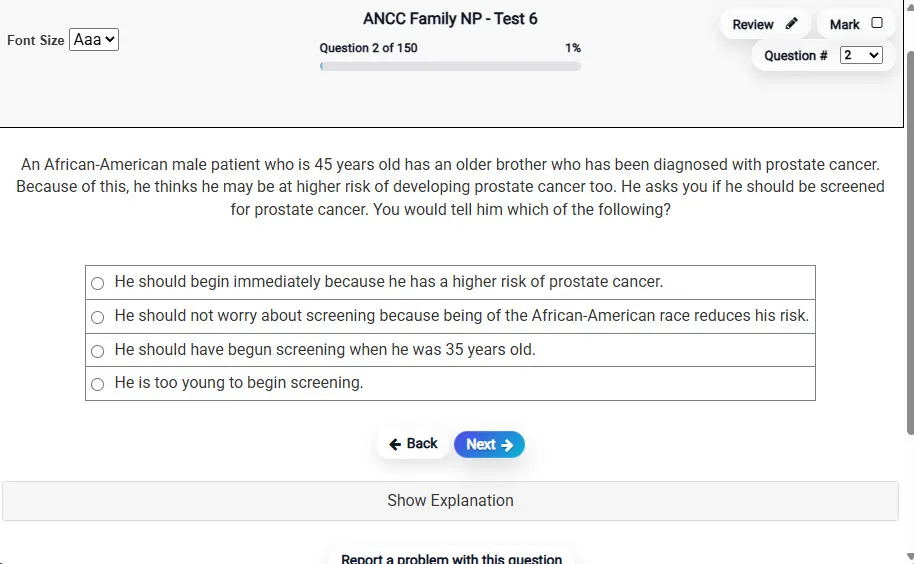
Answering a Question screen – Multiple-choice item view with navigation controls and progress tracker.
Answering a Question Multiple-choice item view with navigation controls and progress tracker.

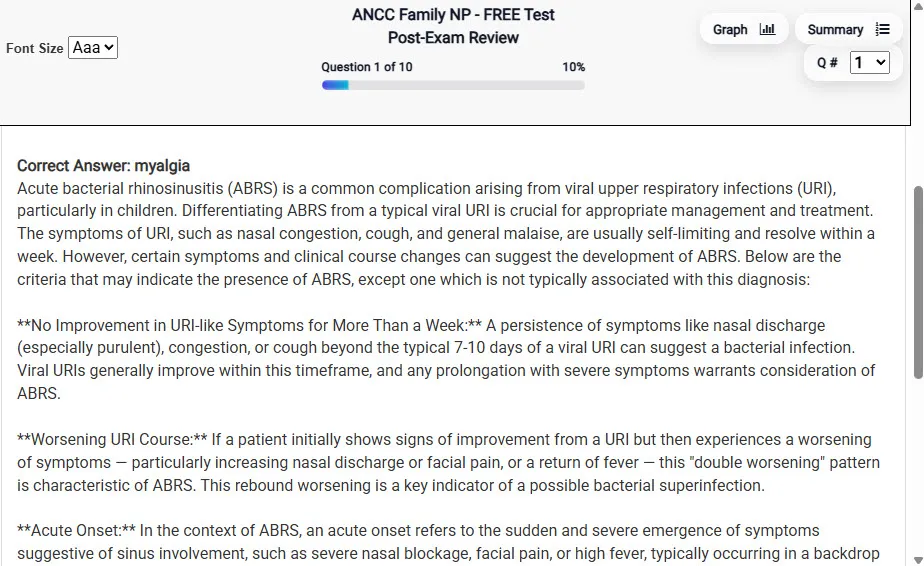
                           Detailed Explanation screen – 
                         Review mode showing chosen answer and rationale and references.
Detailed Explanation Review mode showing chosen answer and rationale and references.

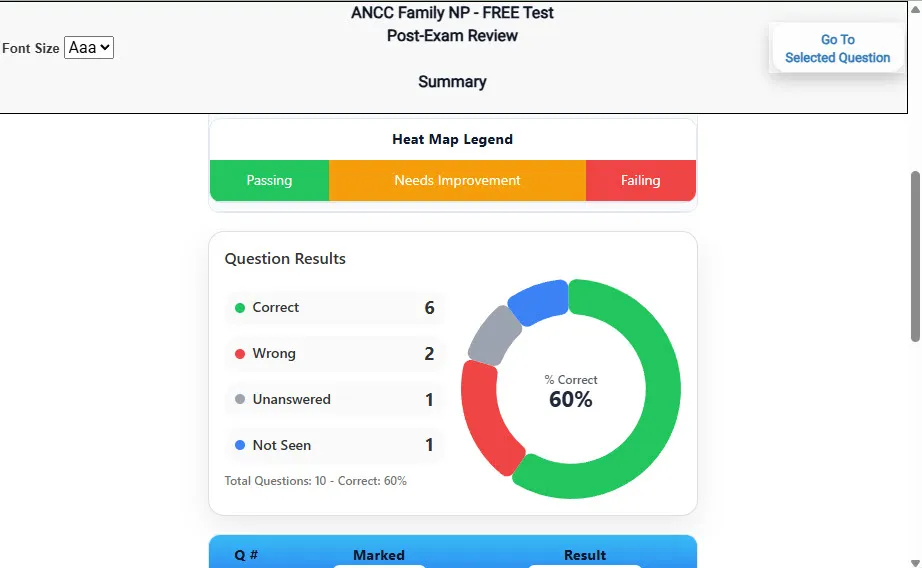
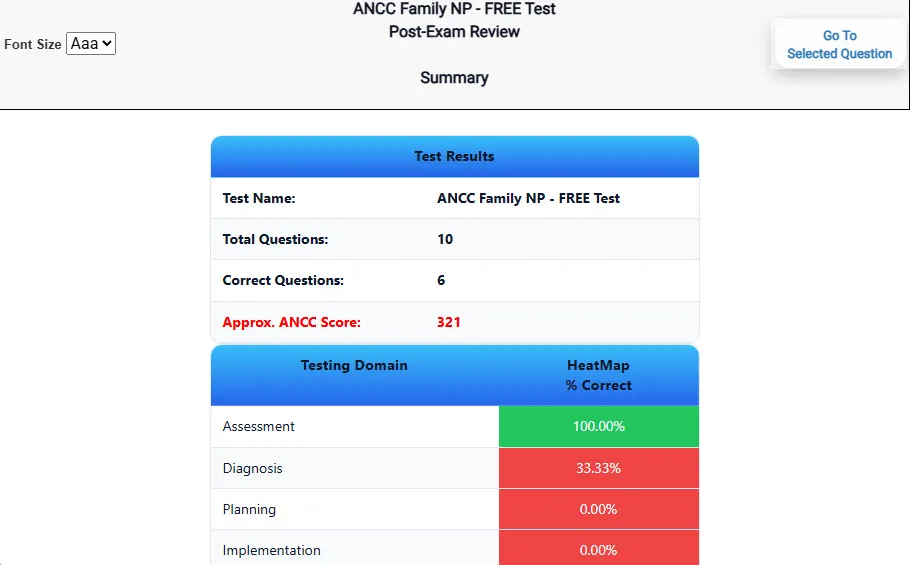
                           Review Summary 1 screen – 
                         Summary with counts for correct/wrong/unanswered and not seen items.
Review Summary 1 Summary with counts for correct/wrong/unanswered and not seen items.

                           Review Summary 2 screen – 
                         Advanced summary with category/domain breakdown and performance insights.
Review Summary 2 Advanced summary with category/domain breakdown and performance insights.

What Each Screen Shows

Answer Question Screen

  • Clean multiple-choice interface with progress bar.
  • Mark for review feature.
  • Matches real test pacing.

Detailed Explanation

  • Correct answer plus rationale.
  • Key concepts and guidelines highlighted.
  • Move between questions to fill knowledge gaps.

Review Summary 1

  • Overall results with total questions and scaled score.
  • Domain heatmap shows strengths and weaknesses.
  • Quick visual feedback on study priorities.

Review Summary 2

  • Chart of correct, wrong, unanswered, not seen.
  • Color-coded results for easy review.
  • Links back to missed items.

Top 10 Reasons to Use Exam Edge for your ORELA Spanish Exam Prep

  1. Focused on the ORELA Spanish Exam

    Our practice tests are built specifically for the ORELA Spanish exam — every question mirrors the real topics, format, and difficulty so you're studying exactly what matters.

  2. Real Exam Simulation

    We match the per-question time limits and pressure of the actual ORELA exam, so test day feels familiar and stress-free.

  3. 10 Full Practice Tests & 1,000 Unique Questions

    You'll have more than enough material to master every ORELA Spanish concept — no repeats, no fluff.

  4. Lower Cost Than a Retake

    Ordering 5 practice exams costs less than retaking the ORELA Spanish exam after a failure. One low fee could save you both time and money.

  5. Flexible Testing

    Need to step away mid-exam? Pick up right where you left off — with your remaining time intact.

  6. Instant Scoring & Feedback

    See your raw score and an estimated ORELA Spanish score immediately after finishing each practice test.

  7. Detailed Explanations for Every Question

    Review correct and incorrect answers with clear, step-by-step explanations so you truly understand each topic.

  8. Trusted & Accredited

    We're fully accredited by the Better Business Bureau and uphold the highest standards of trust and transparency.

  9. Web-Based & Always Available

    No software to install. Access your ORELA Spanish practice exams 24/7 from any computer or mobile device.

  10. Expert Support When You Need It

    Need extra help? Our specialized tutors are highly qualified and ready to support your ORELA exam prep.


Pass the ORELA Spanish Exam with Realistic Practice Tests from Exam Edge

Preparing for your upcoming ORELA Spanish (401) Certification Exam can feel overwhelming — but the right practice makes all the difference. Exam Edge gives you the tools, structure, and confidence to pass on your first try. Our online practice exams are built to match the real ORELA Spanish exam in content, format, and difficulty.

  • 📝 10 ORELA Spanish Practice Tests: Access 10 full-length exams with 100 questions each, covering every major ORELA Spanish topic in depth.
  • Instant Online Access: Start practicing right away — no software, no waiting.
  • 🧠 Step-by-Step Explanations: Understand the reasoning behind every correct answer so you can master ORELA Spanish exam concepts.
  • 🔄 Retake Each Exam Up to 4 Times: Build knowledge through repetition and track your improvement over time.
  • 🌐 Web-Based & Available 24/7: Study anywhere, anytime, on any device.
  • 🧘 Boost Your Test-Day Confidence: Familiarity with the ORELA format reduces anxiety and helps you perform under pressure.

These ORELA Spanish practice exams are designed to simulate the real testing experience by matching question types, timing, and difficulty level. This approach helps you get comfortable not just with the exam content, but also with the testing environment, so you walk into your exam day focused and confident.

Exam Edge ORELA Reviews


ORELA Spanish Aliases Test Name

Here is a list of alternative names used for this exam.

  • ORELA Spanish
  • ORELA Spanish test
  • ORELA Spanish Certification Test
  • ORELA
  • ORELA 401
  • 401 test
  • ORELA Spanish (401)
  • Spanish certification