This is the content of the pop-over!

ORELA General Science (002) Practice Tests & Test Prep by Exam Edge


ORELA General Science   product image
(5.0)
Based on 37 Reviews

  • Real Exam Simulation: Timed questions and matching content build comfort for your ORELA General Science test day.
  • Instant, 24/7 Access: Web-based ORELA General Science practice exams with no software needed.
  • Clear Explanations: Step-by-step answers and explanations for your ORELA exam to strengthen understanding.
  • Boosted Confidence: Reduces anxiety and improves test-taking skills to ace your ORELA General Science (002).

Featured on

ORELA General Science Online Practice Test Bundles

BEST VALUE
5 practice tests

$69.75

$199.75

SAVE $130

Only $13.95 per test!

  • 100% Pass Guarantee
  • 5 online practice tests
  • 100 questions per test
  • Bonus: 100 Flash Cards + Study Guide
  • Instant access
  • Detailed Explanations
  • Practice tests never expire
  • Timed, untimed, or study guide mode
1 practice test

$39.95

  • 1 online practice test
  • 100 questions per test
  • Instant access
  • Detailed Explanations
  • Practice tests never expire
  • Timed, untimed, or study guide mode
Quick Select
Tap to choose a bundle

** All Prices are in US Dollars (USD) **


ORELA General Science (002) Resources

Jump to the section you need most.

Understanding the exact breakdown of the ORELA General Science test will help you know what to expect and how to most effectively prepare. The ORELA General Science has multiple-choice questions . The exam will be broken down into the sections below:

ORELA General Science Exam Blueprint
Domain Name % Number of
Questions
Nature of Science 19% 19
Physical Science 37% 37
Life Science 25% 25
Earth and Space Science 19% 19

ORELA General Science Study Tips by Domain

  • Distinguish observation, inference, hypothesis, theory, and law; red flag: treating a scientific “theory” as a mere guess rather than a well-supported explanatory framework.
  • Identify controlled variables, independent/dependent variables, and valid control groups; common trap: changing more than one factor and then claiming causation from the results.
  • Evaluate measurement quality using accuracy vs. precision and significant figures; priority rule: never report more precision than your instrument allows (don’t overstate decimals).
  • Interpret data displays (tables, graphs) for trends and anomalies; red flag: concluding a relationship from a graph with truncated axes or ignoring outliers without justification.
  • Apply core experimental design ideas like replication, random sampling/assignment, and minimizing bias; common trap: confusing a larger sample size with the elimination of systematic error.
  • Understand how scientific knowledge changes through peer review, reproducibility, and revision with new evidence; priority rule: extraordinary claims require stronger evidence and independent confirmation.
  • Differentiate physical vs. chemical changes by evidence (e.g., new substances, gas formation, persistent color change)—red flag: phase changes and dissolving are physical even when they seem dramatic.
  • Apply Newton’s laws and free-body diagrams consistently—common trap: confusing mass with weight (use W = mg) and forgetting that net force, not individual forces, sets acceleration.
  • Use conservation principles (energy, momentum, charge) to check answers—priority rule: if an isolated system is stated or implied, totals must remain constant despite transformations.
  • Work fluently with waves: v = fλ and the electromagnetic spectrum—red flag: changing medium changes wave speed and wavelength, but frequency stays fixed at the source.
  • Analyze circuits with Ohm’s law and series/parallel rules—common trap: in series current is the same and voltages add; in parallel voltage is the same and currents add.
  • Interpret the periodic table to predict bonding and properties—priority cue: valence electrons drive reactivity, and electronegativity differences signal ionic vs. covalent character (watch alkali metals/halogens as high-reactivity extremes).
  • Differentiate levels of biological organization (cell → tissue → organ → system) and use structure–function links; red flag: describing an organelle’s role with only a vague “makes energy” statement instead of specifying mitochondria/ATP.
  • Connect photosynthesis and cellular respiration (matter cycles, energy flows) using balanced equations; common trap: claiming plants “don’t respire” or that energy is recycled rather than transformed.
  • Apply heredity principles (meiosis, segregation, independent assortment) to predict outcomes with Punnett squares; priority rule: verify genotype vs phenotype and watch the red flag of mixing up homozygous/heterozygous.
  • Explain evolution via natural selection using variation, heritability, and differential reproductive success; common trap: teleological language (“organisms evolve because they need to”) instead of selection acting on existing variation.
  • Analyze ecosystems with trophic levels and cycling of carbon/nitrogen/water; threshold cue: only ~10% of energy transfers between trophic levels, so red flag answers that show increasing energy up the food chain.
  • Describe homeostasis and feedback loops (e.g., thermoregulation, glucose control) and how disruptions cause disease; contraindication cue: positive feedback is rare and destabilizing, so don’t label routine regulation as positive feedback.
  • Use relative dating correctly: superposition, original horizontality, cross-cutting relationships, and index fossils; red flag—assuming radiometric ages can be read directly from stratigraphic order without considering unconformities.
  • Plate tectonics evidence must align (seafloor spreading, magnetic striping, earthquake/focus patterns, and matching fossils/rock belts); common trap—mixing up transform boundaries (shear) with convergent boundaries (subduction, volcanism).
  • Interpret weather maps by linking pressure gradients to wind and fronts to air-mass movement; priority rule—tighter isobars mean stronger winds, not necessarily precipitation.
  • Climate vs. weather: climate is long-term patterns driven by latitude, altitude, ocean currents, and greenhouse gases; red flag—using a single extreme event as proof of climate trend.
  • Explain seasons with Earth’s axial tilt and changing solar angle/day length; common trap—claiming seasons are caused by Earth being closer to the Sun (distance plays a minor role).
  • Apply gravity and orbital relationships: Kepler’s laws, tides, and phases depend on geometry; contraindication—confusing lunar phases (Sun–Earth–Moon angles) with eclipses (alignment plus orbital plane crossing).


Built to Fit Into Your Busy Life

Everything you need to prepare with confidence—without wasting a minute.

Three Study Modes

Timed, No Time Limit, or Explanation mode.

Actionable Analytics

Heatmaps and scaled scores highlight weak areas.

High-Yield Rationales

Concise explanations emphasize key concepts.

Realistic Interface

Matches the feel of the actual exam environment.

Accessible by Design

Clean layout reduces cognitive load.

Anytime, Anywhere

Web-based access 24/7 on any device.
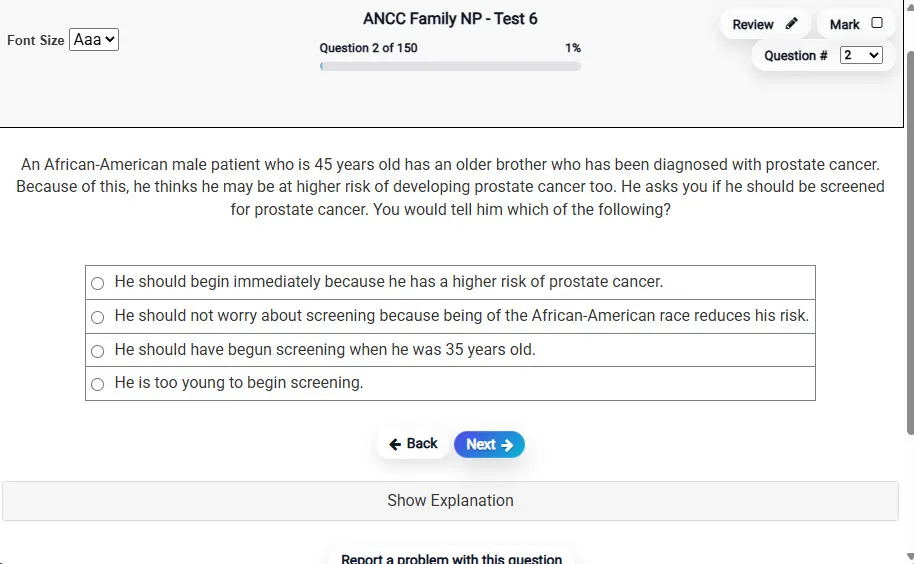
Answering a Question screen – Multiple-choice item view with navigation controls and progress tracker.
Answering a Question Multiple-choice item view with navigation controls and progress tracker.

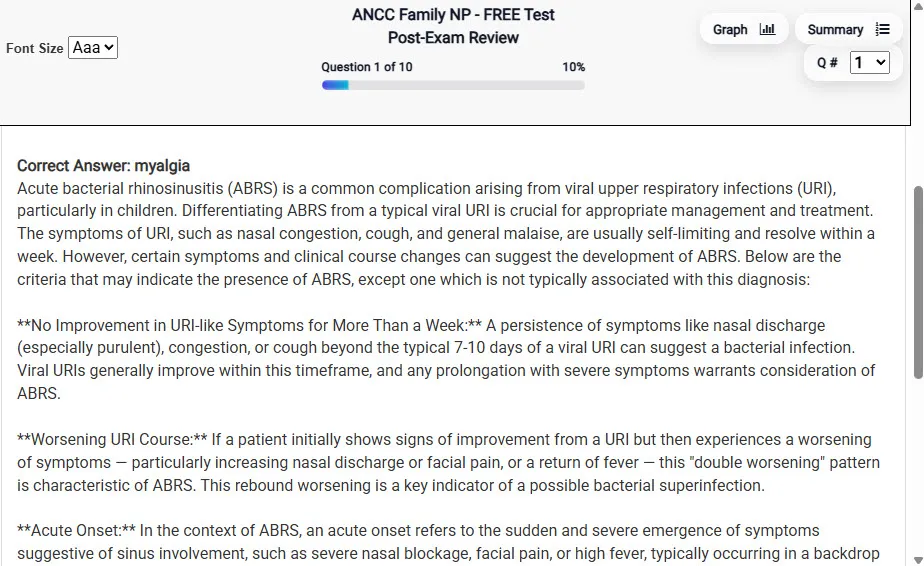
                           Detailed Explanation screen – 
                         Review mode showing chosen answer and rationale and references.
Detailed Explanation Review mode showing chosen answer and rationale and references.

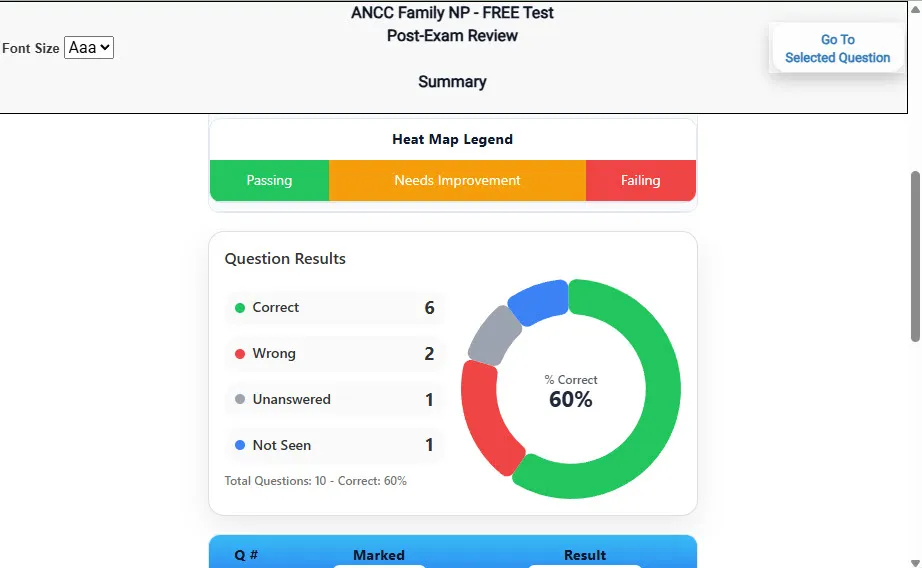
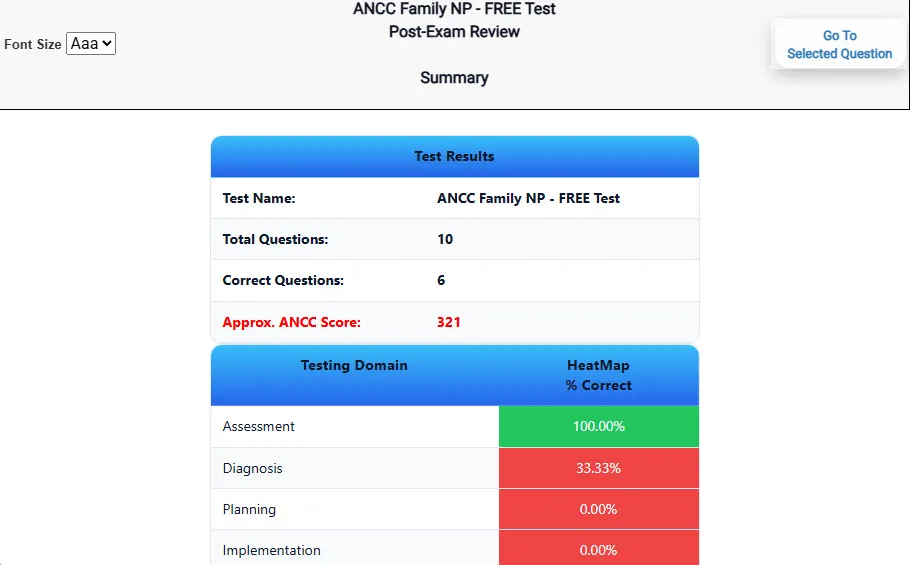
                           Review Summary 1 screen – 
                         Summary with counts for correct/wrong/unanswered and not seen items.
Review Summary 1 Summary with counts for correct/wrong/unanswered and not seen items.

                           Review Summary 2 screen – 
                         Advanced summary with category/domain breakdown and performance insights.
Review Summary 2 Advanced summary with category/domain breakdown and performance insights.

What Each Screen Shows

Answer Question Screen

  • Clean multiple-choice interface with progress bar.
  • Mark for review feature.
  • Matches real test pacing.

Detailed Explanation

  • Correct answer plus rationale.
  • Key concepts and guidelines highlighted.
  • Move between questions to fill knowledge gaps.

Review Summary 1

  • Overall results with total questions and scaled score.
  • Domain heatmap shows strengths and weaknesses.
  • Quick visual feedback on study priorities.

Review Summary 2

  • Chart of correct, wrong, unanswered, not seen.
  • Color-coded results for easy review.
  • Links back to missed items.

Top 10 Reasons to Use Exam Edge for your ORELA General Science Exam Prep

  1. Focused on the ORELA General Science Exam

    Our practice tests are built specifically for the ORELA General Science exam — every question mirrors the real topics, format, and difficulty so you're studying exactly what matters.

  2. Real Exam Simulation

    We match the per-question time limits and pressure of the actual ORELA exam, so test day feels familiar and stress-free.

  3. 5 Full Practice Tests & 500 Unique Questions

    You'll have more than enough material to master every ORELA General Science concept — no repeats, no fluff.

  4. Lower Cost Than a Retake

    Ordering 5 practice exams costs less than retaking the ORELA General Science exam after a failure. One low fee could save you both time and money.

  5. Flexible Testing

    Need to step away mid-exam? Pick up right where you left off — with your remaining time intact.

  6. Instant Scoring & Feedback

    See your raw score and an estimated ORELA General Science score immediately after finishing each practice test.

  7. Detailed Explanations for Every Question

    Review correct and incorrect answers with clear, step-by-step explanations so you truly understand each topic.

  8. Trusted & Accredited

    We're fully accredited by the Better Business Bureau and uphold the highest standards of trust and transparency.

  9. Web-Based & Always Available

    No software to install. Access your ORELA General Science practice exams 24/7 from any computer or mobile device.

  10. Expert Support When You Need It

    Need extra help? Our specialized tutors are highly qualified and ready to support your ORELA exam prep.


Pass the ORELA General Science Exam with Realistic Practice Tests from Exam Edge

Preparing for your upcoming ORELA General Science (002) Certification Exam can feel overwhelming — but the right practice makes all the difference. Exam Edge gives you the tools, structure, and confidence to pass on your first try. Our online practice exams are built to match the real ORELA General Science exam in content, format, and difficulty.

  • 📝 5 ORELA General Science Practice Tests: Access 5 full-length exams with 100 questions each, covering every major ORELA General Science topic in depth.
  • Instant Online Access: Start practicing right away — no software, no waiting.
  • 🧠 Step-by-Step Explanations: Understand the reasoning behind every correct answer so you can master ORELA General Science exam concepts.
  • 🔄 Retake Each Exam Up to 4 Times: Build knowledge through repetition and track your improvement over time.
  • 🌐 Web-Based & Available 24/7: Study anywhere, anytime, on any device.
  • 🧘 Boost Your Test-Day Confidence: Familiarity with the ORELA format reduces anxiety and helps you perform under pressure.

These ORELA General Science practice exams are designed to simulate the real testing experience by matching question types, timing, and difficulty level. This approach helps you get comfortable not just with the exam content, but also with the testing environment, so you walk into your exam day focused and confident.


Exam Edge ORELA Reviews


ORELA General Science Aliases Test Name

Here is a list of alternative names used for this exam.

  • ORELA General Science
  • ORELA General Science test
  • ORELA General Science Certification Test
  • ORELA
  • ORELA 002
  • 002 test
  • ORELA General Science (002)
  • General Science certification