This is the content of the pop-over!

ORELA Reading (001) Practice Tests & Test Prep by Exam Edge


ORELA Reading - Essential Academic Skills  product image
(5.0)
Based on 32 Reviews

  • Real Exam Simulation: Timed questions and matching content build comfort for your ORELA Reading test day.
  • Instant, 24/7 Access: Web-based ORELA Reading - Essential Academic Skills practice exams with no software needed.
  • Clear Explanations: Step-by-step answers and explanations for your ORELA exam to strengthen understanding.
  • Boosted Confidence: Reduces anxiety and improves test-taking skills to ace your ORELA Reading - Essential Academic Skills (001).

Featured on

ORELA Reading - Essential Academic Skills Online Practice Test Bundles

BEST VALUE
10 practice tests

$99.50

$399.50

SAVE $300

Only $9.95 per test!

  • 100% Pass Guarantee
  • 10 online practice tests
  • 45 questions per test
  • Bonus: Study Guide
  • Instant access
  • Detailed Explanations
  • Practice tests never expire
  • Timed, untimed, or study guide mode
5 practice tests

$69.75

$199.75

SAVE $130

Only $13.95 per test!

  • 5 online practice tests
  • 45 questions per test
  • Bonus: Study Guide
  • Instant access
  • Detailed Explanations
  • Practice tests never expire
  • Timed, untimed, or study guide mode
1 practice test

$39.95

  • 1 online practice test
  • 45 questions per test
  • Instant access
  • Detailed Explanations
  • Practice tests never expire
  • Timed, untimed, or study guide mode
Quick Select
Tap to choose a bundle

** All Prices are in US Dollars (USD) **


ORELA Reading (001) Resources

Jump to the section you need most.

Understanding the exact breakdown of the ORELA Reading - Essential Academic Skills test will help you know what to expect and how to most effectively prepare. The ORELA Reading - Essential Academic Skills has multiple-choice questions . The exam will be broken down into the sections below:

ORELA Reading - Essential Academic Skills Exam Blueprint
Domain Name
Understand the meaning of words and phrases.  
Understand the main idea and supporting details in written material.  
Understand a writer's purpose and audience - point of view intended meaning.  
Use critical reasoning skills to evaluate written material.  
Understand the organization of information in written and graphic forms.  

ORELA Reading - Essential Academic Skills Study Tips by Domain

  • Use context clues (contrast, cause/effect, example, restatement) to infer meaning; red flag: choosing a familiar definition that doesn’t fit the sentence logic.
  • Track connotation and tone (positive/negative/neutral) as well as denotation; common trap: missing that a word is sarcastic, ironic, or emotionally loaded.
  • Break unfamiliar words into roots, prefixes, and suffixes (e.g., “anti-”, “-logy”) to narrow meaning; priority rule: verify with context before committing.
  • Interpret figurative language and idioms in plain meaning, not literally; red flag: reading metaphors or common phrases word-for-word.
  • Use sentence structure to identify the role of a word (part of speech) and its function; common trap: treating a noun use like the verb form (or vice versa) and shifting meaning.
  • Resolve pronoun or reference words (this, that, which, they) to the correct antecedent to clarify meaning; red flag: multiple possible antecedents—choose the one that best matches number and idea.
  • Identify the passage’s main idea by restating what the entire text is mostly about in one sentence; red flag: choosing a detail that appears only in one paragraph.
  • Distinguish topic from main idea—the topic is the subject, while the main idea is the author’s key point about it; common trap: picking a broad topic phrase as the answer.
  • Use paragraph topic sentences and concluding sentences as clues, but verify with the rest of the paragraph; priority rule: if evidence in multiple sentences doesn’t support it, it’s not the main idea.
  • Match supporting details to the correct claim by asking “What does this sentence prove or explain?”; red flag: examples and anecdotes often support a point but are rarely the point.
  • Separate major from minor details by checking whether removing the detail would weaken the author’s argument or explanation; common trap: selecting statistics or vivid facts that are memorable but nonessential.
  • For implied main ideas, synthesize repeated points and the overall direction of the passage rather than hunting for a single sentence; contraindication: don’t infer beyond what the provided details reasonably support.
  • Identify the author’s primary purpose (to inform, persuade, analyze, entertain) and verify it with specific textual evidence; red flag: choosing a purpose based on topic alone rather than what the author is trying to do.
  • Determine the intended audience by noting assumptions, jargon, and level of explanation; common trap: picking “general audience” when the passage targets a specialized group (e.g., policymakers, parents, professionals).
  • Pinpoint point of view (first/third person; participant vs observer) and how it shapes credibility and access to information; cue: limited POV often means the narrator cannot confirm other characters’ motives or events.
  • Distinguish tone and stance (supportive, skeptical, ironic, urgent) from mere subject matter; red flag: confusing a serious topic with a serious tone when diction suggests humor or sarcasm.
  • Infer intended meaning when wording is figurative or nuanced by using context and contrast; common trap: interpreting idioms and irony literally despite surrounding cues that signal the opposite.
  • Match each detail to the author’s goal by asking “Why include this?”; priority rule: on ORELA-style items, the best answer explains how a specific choice (example, statistic, anecdote) advances purpose for that audience.
  • Differentiate fact, opinion, and inference—red flag: statements with loaded adjectives or broad claims presented as if they were verified facts.
  • Evaluate evidence quality (relevance, sufficiency, credibility); common trap: accepting a vivid example or anecdote as proof of a general conclusion.
  • Identify assumptions and missing information; priority rule: ask “What must be true for this argument to hold?” and note any unstated premises.
  • Check for logical fallacies (e.g., false cause, hasty generalization, straw man); red flag: conclusions that jump beyond the data or ignore alternative explanations.
  • Assess bias and rhetorical techniques (appeals to emotion/authority, framing); common trap: equating an authoritative tone or credentials with a sound argument.
  • Judge whether conclusions follow from the text and are appropriately qualified; red flag: absolute language (“always,” “never”) without strong, comprehensive support.
  • Identify the text structure first (e.g., cause–effect, compare–contrast, chronology, problem–solution) and use it to predict what information should appear next; red flag: choosing a detail that fits the topic but not the structure.
  • Use headings, subheadings, and section labels to map hierarchy (main sections vs. subpoints) and locate where a specific idea belongs; common trap: treating an example in a sidebar or box as a main point.
  • Track organizational signals (“however,” “for example,” “in contrast,” “as a result”) to determine relationships between sentences; priority rule: let transition words override mere proximity.
  • Interpret graphics (tables, charts, maps, diagrams) by reading titles, keys/legends, axes, units, and captions before drawing conclusions; red flag: missing a unit change (percent vs. raw numbers) or axis scale.
  • Connect visuals to the passage by identifying what claim the graphic supports, qualifies, or illustrates; common trap: selecting an inference that is true generally but not supported by the specific data shown.
  • Follow multi-step directions or procedures by noting sequence markers and conditions (“if,” “unless,” “after”); contraindication: applying a later step early or ignoring an exception clause.


Built to Fit Into Your Busy Life

Everything you need to prepare with confidence—without wasting a minute.

Three Study Modes

Timed, No Time Limit, or Explanation mode.

Actionable Analytics

Heatmaps and scaled scores highlight weak areas.

High-Yield Rationales

Concise explanations emphasize key concepts.

Realistic Interface

Matches the feel of the actual exam environment.

Accessible by Design

Clean layout reduces cognitive load.

Anytime, Anywhere

Web-based access 24/7 on any device.
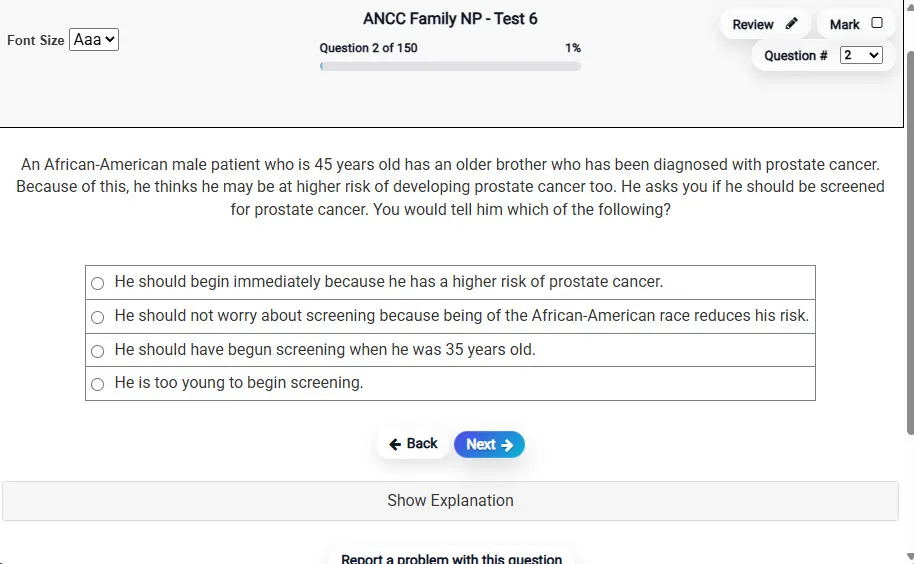
Answering a Question screen – Multiple-choice item view with navigation controls and progress tracker.
Answering a Question Multiple-choice item view with navigation controls and progress tracker.

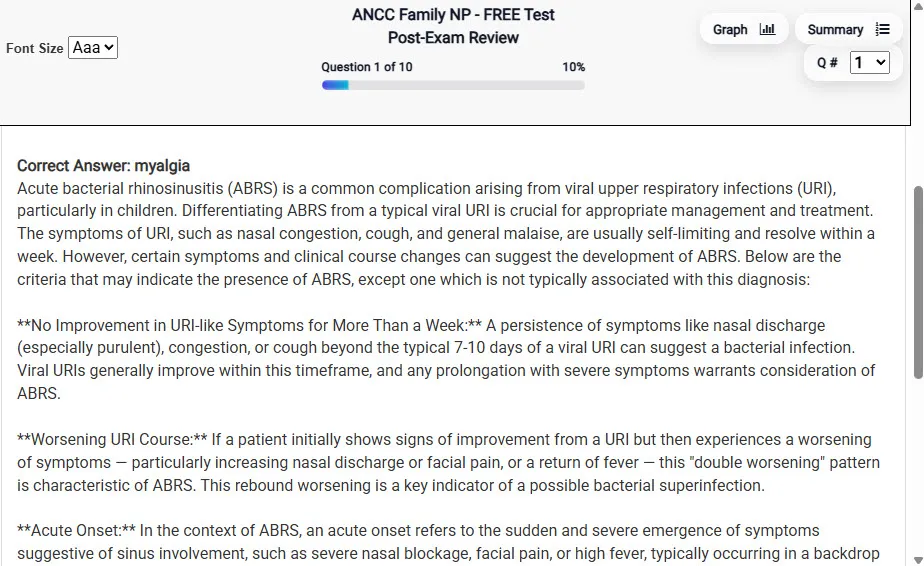
                           Detailed Explanation screen – 
                         Review mode showing chosen answer and rationale and references.
Detailed Explanation Review mode showing chosen answer and rationale and references.

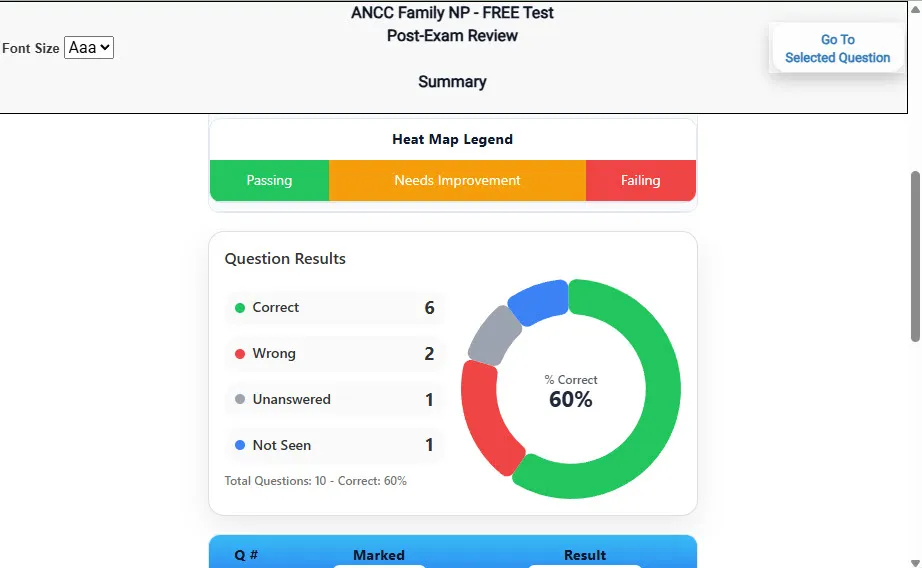
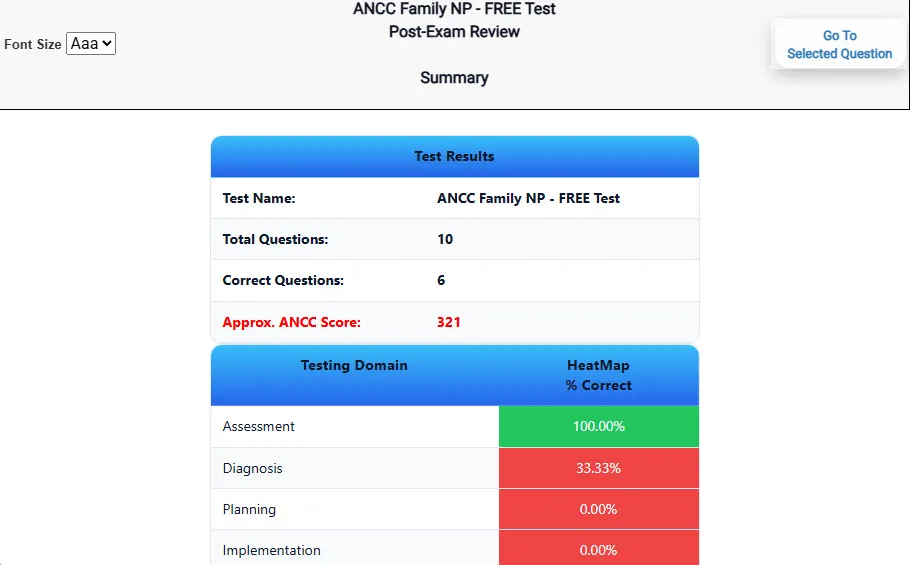
                           Review Summary 1 screen – 
                         Summary with counts for correct/wrong/unanswered and not seen items.
Review Summary 1 Summary with counts for correct/wrong/unanswered and not seen items.

                           Review Summary 2 screen – 
                         Advanced summary with category/domain breakdown and performance insights.
Review Summary 2 Advanced summary with category/domain breakdown and performance insights.

What Each Screen Shows

Answer Question Screen

  • Clean multiple-choice interface with progress bar.
  • Mark for review feature.
  • Matches real test pacing.

Detailed Explanation

  • Correct answer plus rationale.
  • Key concepts and guidelines highlighted.
  • Move between questions to fill knowledge gaps.

Review Summary 1

  • Overall results with total questions and scaled score.
  • Domain heatmap shows strengths and weaknesses.
  • Quick visual feedback on study priorities.

Review Summary 2

  • Chart of correct, wrong, unanswered, not seen.
  • Color-coded results for easy review.
  • Links back to missed items.

Top 10 Reasons to Use Exam Edge for your ORELA Reading - Essential Academic Skills Exam Prep

  1. Focused on the ORELA Reading - Essential Academic Skills Exam

    Our practice tests are built specifically for the ORELA Reading exam — every question mirrors the real topics, format, and difficulty so you're studying exactly what matters.

  2. Real Exam Simulation

    We match the per-question time limits and pressure of the actual ORELA exam, so test day feels familiar and stress-free.

  3. 10 Full Practice Tests & 450 Unique Questions

    You'll have more than enough material to master every ORELA Reading concept — no repeats, no fluff.

  4. Lower Cost Than a Retake

    Ordering 5 practice exams costs less than retaking the ORELA Reading - Essential Academic Skills exam after a failure. One low fee could save you both time and money.

  5. Flexible Testing

    Need to step away mid-exam? Pick up right where you left off — with your remaining time intact.

  6. Instant Scoring & Feedback

    See your raw score and an estimated ORELA Reading - Essential Academic Skills score immediately after finishing each practice test.

  7. Detailed Explanations for Every Question

    Review correct and incorrect answers with clear, step-by-step explanations so you truly understand each topic.

  8. Trusted & Accredited

    We're fully accredited by the Better Business Bureau and uphold the highest standards of trust and transparency.

  9. Web-Based & Always Available

    No software to install. Access your ORELA Reading practice exams 24/7 from any computer or mobile device.

  10. Expert Support When You Need It

    Need extra help? Our specialized tutors are highly qualified and ready to support your ORELA exam prep.


Pass the ORELA Reading - Essential Academic Skills Exam with Realistic Practice Tests from Exam Edge

Preparing for your upcoming ORELA Reading - Essential Academic Skills (001) Certification Exam can feel overwhelming — but the right practice makes all the difference. Exam Edge gives you the tools, structure, and confidence to pass on your first try. Our online practice exams are built to match the real ORELA Reading exam in content, format, and difficulty.

  • 📝 10 ORELA Reading - Essential Academic Skills Practice Tests: Access 10 full-length exams with 45 questions each, covering every major ORELA Reading - Essential Academic Skills topic in depth.
  • Instant Online Access: Start practicing right away — no software, no waiting.
  • 🧠 Step-by-Step Explanations: Understand the reasoning behind every correct answer so you can master ORELA Reading exam concepts.
  • 🔄 Retake Each Exam Up to 4 Times: Build knowledge through repetition and track your improvement over time.
  • 🌐 Web-Based & Available 24/7: Study anywhere, anytime, on any device.
  • 🧘 Boost Your Test-Day Confidence: Familiarity with the ORELA format reduces anxiety and helps you perform under pressure.

These ORELA Reading - Essential Academic Skills practice exams are designed to simulate the real testing experience by matching question types, timing, and difficulty level. This approach helps you get comfortable not just with the exam content, but also with the testing environment, so you walk into your exam day focused and confident.

Exam Edge ORELA Reviews


ORELA Reading - Essential Academic Skills Aliases Test Name

Here is a list of alternative names used for this exam.

  • ORELA Reading - Essential Academic Skills
  • ORELA Reading - Essential Academic Skills test
  • ORELA Reading - Essential Academic Skills Certification Test
  • ORELA Reading test
  • ORELA
  • ORELA 001
  • 001 test
  • ORELA Reading - Essential Academic Skills (001)
  • Reading - Essential Academic Skills certification