This is the content of the pop-over!

ORELA Multiple Subjects Practice Tests & Test Prep by Exam Edge


ORELA Multiple Subjects   product image
(5.0)
Based on 32 Reviews

  • Real Exam Simulation: Timed questions and matching content build comfort for your ORELA Multiple Subjects test day.
  • Instant, 24/7 Access: Web-based ORELA Multiple Subjects practice exams with no software needed.
  • Clear Explanations: Step-by-step answers and explanations for your ORELA exam to strengthen understanding.
  • Boosted Confidence: Reduces anxiety and improves test-taking skills to ace your ORELA Multiple Subjects .

Featured on

ORELA Multiple Subjects Online Practice Test Bundles

BEST VALUE
20 practice tests

$174.00

$799.00

SAVE $625

Only $8.70 per test!

  • 100% Pass Guarantee
  • 20 online practice tests
  • 100 questions per test
  • Bonus: 100 Flash Cards + Study Guide
  • Instant access
  • Detailed Explanations
  • Practice tests never expire
  • Timed, untimed, or study guide mode
MOST POPULAR
10 practice tests

$99.50

$399.50

SAVE $300

Only $9.95 per test!

  • 10 online practice tests
  • 100 questions per test
  • Bonus: 100 Flash Cards + Study Guide
  • Instant access
  • Detailed Explanations
  • Practice tests never expire
  • Timed, untimed, or study guide mode
5 practice tests

$69.75

$199.75

SAVE $130

Only $13.95 per test!

  • 5 online practice tests
  • 100 questions per test
  • Bonus: 100 Flash Cards
  • Instant access
  • Detailed Explanations
  • Practice tests never expire
  • Timed, untimed, or study guide mode
1 practice test

$39.95

  • 1 online practice test
  • 100 questions per test
  • Instant access
  • Detailed Explanations
  • Practice tests never expire
  • Timed, untimed, or study guide mode
Quick Select
Tap to choose a bundle

** All Prices are in US Dollars (USD) **


ORELA Multiple Subjects () Resources

Jump to the section you need most.

Understanding the exact breakdown of the ORELA Multiple Subjects test will help you know what to expect and how to most effectively prepare. The ORELA Multiple Subjects has multiple-choice questions . The exam will be broken down into the sections below:

ORELA Multiple Subjects Exam Blueprint
Domain Name
Language Arts  
Social Science  
The Arts  
Reading Instruction  
Mathematics  
Science  
Health and Physical Education  

ORELA Multiple Subjects Study Tips by Domain

  • Plan writing with clear purpose and audience; a common trap is drifting tone or point of view mid-piece, so verify consistency before revising.
  • Use the writing process (prewrite, draft, revise, edit, publish) and separate revising from editing—red flag: fixing commas while the thesis or organization is still unclear.
  • Teach grammar and usage in context (sentence combining, mentor texts) rather than isolated drills; priority rule: correct recurring errors that most affect meaning first (e.g., fragments, run-ons).
  • Develop academic vocabulary and word analysis (roots, affixes, context clues); caution: avoid relying on dictionary definitions when the word’s meaning shifts by context.
  • Analyze literature elements (theme, character, conflict, structure, figurative language) with text evidence; common trap: confusing theme with topic—theme states an idea about the topic.
  • Apply speaking/listening standards (discussion norms, presentation structure, evaluating claims and evidence); red flag: treating opinions as arguments without warrants or credible sources.
  • Distinguish core civics concepts (federalism, separation of powers, checks and balances) and apply them to scenarios; red flag: confusing delegated vs. reserved powers in Constitution questions.
  • Read maps and data displays (scale, legend, latitude/longitude, thematic maps) to infer patterns; common trap: mixing up correlation on a map with causation in an explanation.
  • Use chronology and periodization to connect causes, key turning points, and effects across U.S. and world history; priority rule: anchor claims with a time marker (century, decade, era) when sources are ambiguous.
  • Evaluate primary vs. secondary sources for perspective, bias, and purpose; red flag: treating a firsthand account as automatically accurate without corroboration.
  • Apply basic economics (scarcity, opportunity cost, incentives, supply/demand, public goods) to classroom scenarios; common trap: calling any government involvement a “public good” (it must be nonexcludable and nonrival).
  • Address culture and diversity (identity, migration, institutions, inequality) using evidence and respectful language; contraindication: overgeneralizing from a single group’s experience to all communities.
  • Distinguish the elements of art (line, shape, form, color, value, texture, space) from the principles of design (balance, contrast, emphasis, movement, pattern, proportion, unity)—common trap: using them interchangeably on selected-response items.
  • For music, know key notation basics (staff, clefs, note/rest values, time signatures) and be able to map rhythm to counts; red flag: confusing 3/4 with 6/8 (simple triple vs compound duple) when identifying meter.
  • In theatre, separate blocking, stage directions, and technical roles (lighting, sound, props, costumes) from acting choices; priority rule: “upstage/downstage” is actor-relative to the audience, not the script’s left/right.
  • In dance, identify locomotor vs non-locomotor movements and the elements (body, energy, space, time); common trap: mixing up levels (high/middle/low) with pathways (straight/curved/zigzag).
  • Use arts vocabulary to interpret and critique works (describe → analyze → interpret → evaluate) with evidence; red flag: jumping to personal preference without citing observable features (e.g., color harmony, motif, dynamics).
  • Connect arts to culture and history (function, patronage, audience, traditions) without stereotyping; contraindication: attributing a style to a culture broadly when the question cues a specific region, period, or purpose.
  • Use assessment data to match instruction to need (e.g., phonological awareness, phonics, fluency, vocabulary, comprehension); red flag: treating a low comprehension score as only a “vocabulary problem” without checking decoding and fluency first.
  • In K–2, prioritize systematic, explicit phonics with cumulative review and decodable text; common trap: using leveled texts too early so students “guess” from pictures instead of mapping sounds to letters.
  • For phonemic awareness, focus on oral segmentation/blending and manipulation before print; contraindication: spending excessive time on letter names when the student cannot segment or blend sounds.
  • Build fluency through modeled reading, repeated reading, and feedback on accuracy/prosody; practical cue: if accuracy is below about 90–95% in connected text, address decoding/word recognition before pushing speed.
  • Teach vocabulary via student-friendly definitions, multiple exposures, and morphology (prefixes/roots/suffixes); red flag: relying on dictionary copying or single-context “word of the week” with no application.
  • Teach comprehension with explicit strategies (predict, question, clarify, summarize) plus text structure (story grammar, cause/effect, compare/contrast); common trap: asking only recall questions instead of requiring evidence-based responses (“Where in the text?”).
  • Use place value and properties of operations to estimate and check reasonableness; red flag: an exact-looking answer that contradicts a quick estimate (e.g., 49×21 should be near 1,000, not 10,000).
  • Fractions/decimals/percents must convert fluently in real contexts; common trap: treating percent change additively (e.g., a 20% decrease then 20% increase does not return to the original).
  • For ratios and proportional relationships, verify with unit rate or cross products; priority rule: don’t assume proportionality from a table unless the ratio is constant.
  • In algebra, define variables clearly and keep equality balanced; red flag: moving terms across an equals sign without changing signs or distributing incorrectly (especially with negatives).
  • In geometry and measurement, track units and squared/cubed units; common trap: mixing perimeter vs. area or forgetting that scaling a figure by k multiplies area by k2.
  • For data, statistics, and probability, match the measure to the situation; red flag: using mean when an outlier skews data or assuming events are independent without justification.
  • Plan investigations with clear variables and controls—red flag: changing more than one factor at a time makes results uninterpretable.
  • Choose appropriate measurement tools and units (SI) and report with correct precision—common trap: recording more significant figures than the instrument supports.
  • Interpret graphs, tables, and models by distinguishing observation from inference—priority rule: claims must be supported by the displayed data, not assumptions.
  • Connect matter and energy concepts (e.g., conservation, phase change, basic chemical vs. physical change)—red flag: confusing mass loss in an open system with mass not being conserved.
  • Apply life science principles (cells, heredity, evolution, ecosystems) with cause-and-effect reasoning—common trap: treating “survival of the fittest” as “strongest” rather than best adapted to the environment.
  • Use Earth/space systems ideas (weather vs. climate, plate tectonics, seasons, lunar phases) accurately—red flag: explaining seasons by Earth’s distance from the Sun instead of axial tilt.
  • Use health promotion priorities that match school practice (nutrition, sleep, mental health, injury prevention) — red flag: recommending fad diets/supplements or medical claims beyond a teacher’s scope.
  • Know communicable disease basics (routes of transmission, hygiene, vaccination concepts) and classroom prevention — common trap: confusing airborne vs. bloodborne precautions or treating all body fluids as equal risk.
  • Apply safety and risk management in PE (proper warm-up, equipment checks, space awareness, hydration breaks) — priority rule: stop activity immediately for suspected concussion, heat illness, or breathing distress.
  • Teach fitness components (cardiorespiratory endurance, muscular strength/endurance, flexibility, body composition) with age-appropriate goals — red flag: using one-size-fits-all norms or public weigh-ins that violate student privacy.
  • Design inclusive instruction and modifications for diverse learners (developmental differences, disabilities, language needs) — common trap: equating “fair” with identical tasks rather than equitable access and safety.
  • Assess skill and health knowledge with clear criteria (rubrics, observation checklists, self-monitoring logs) — red flag: grading primarily on athletic ability, speed, or body type instead of growth, participation, and standards-based performance.


Built to Fit Into Your Busy Life

Everything you need to prepare with confidence—without wasting a minute.

Three Study Modes

Timed, No Time Limit, or Explanation mode.

Actionable Analytics

Heatmaps and scaled scores highlight weak areas.

High-Yield Rationales

Concise explanations emphasize key concepts.

Realistic Interface

Matches the feel of the actual exam environment.

Accessible by Design

Clean layout reduces cognitive load.

Anytime, Anywhere

Web-based access 24/7 on any device.
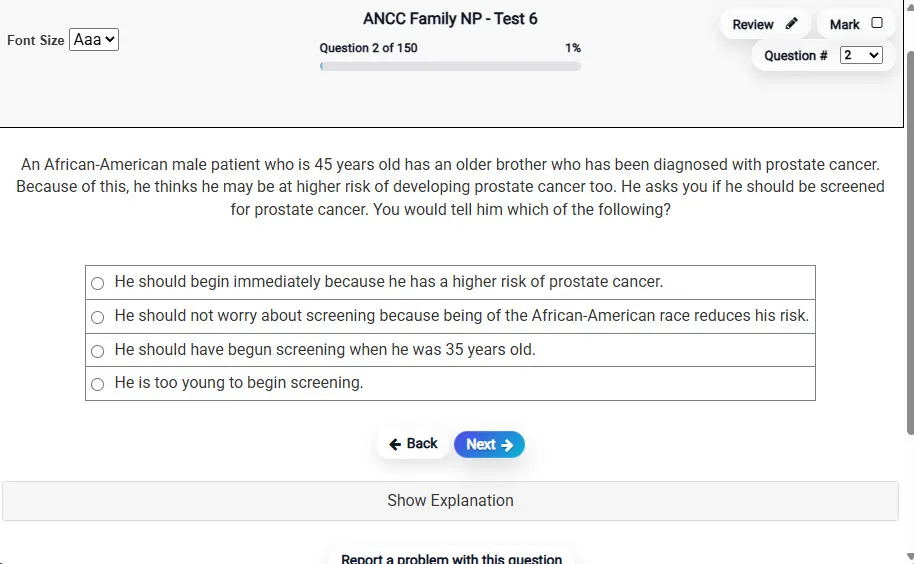
Answering a Question screen – Multiple-choice item view with navigation controls and progress tracker.
Answering a Question Multiple-choice item view with navigation controls and progress tracker.

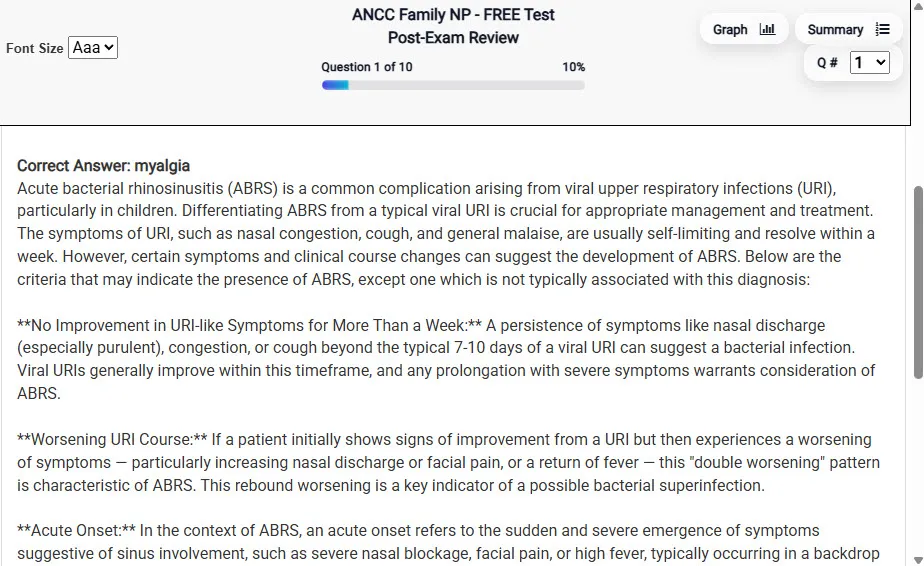
                           Detailed Explanation screen – 
                         Review mode showing chosen answer and rationale and references.
Detailed Explanation Review mode showing chosen answer and rationale and references.

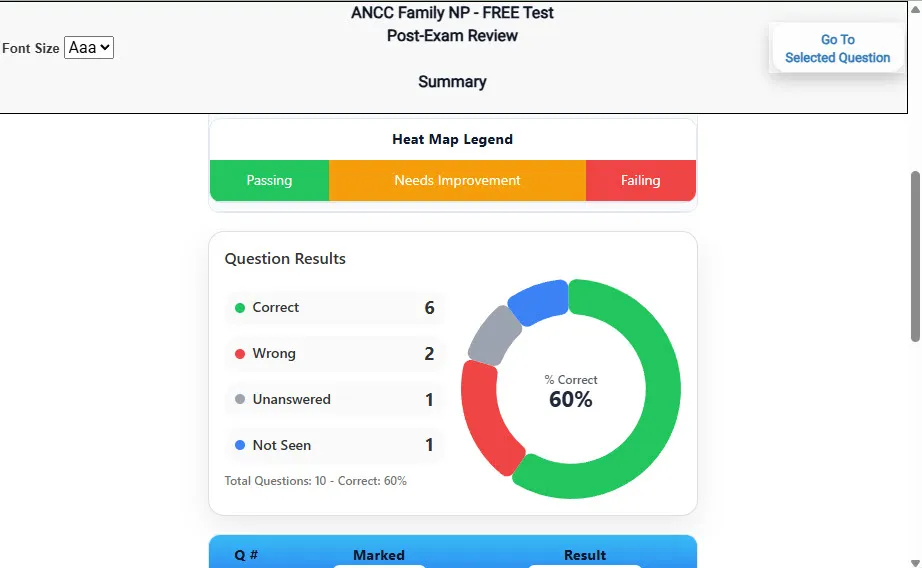
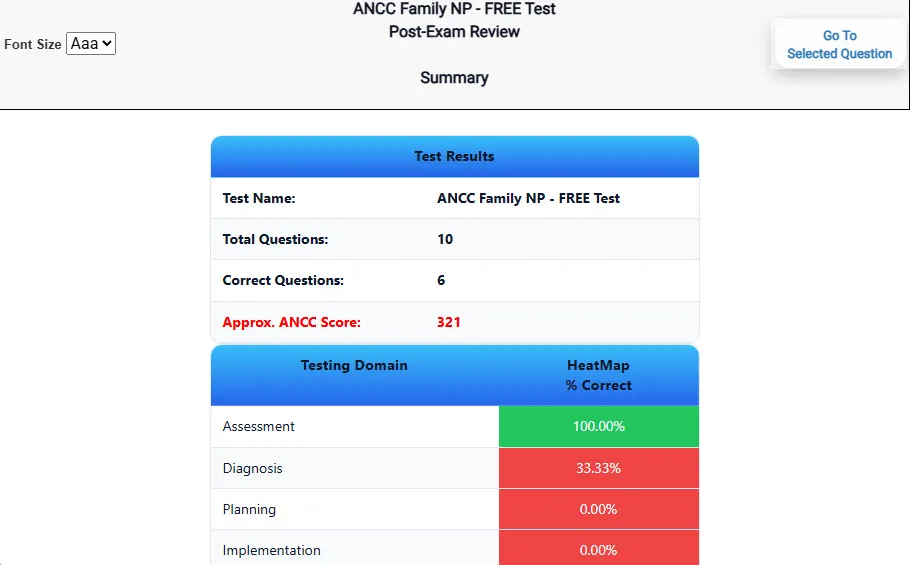
                           Review Summary 1 screen – 
                         Summary with counts for correct/wrong/unanswered and not seen items.
Review Summary 1 Summary with counts for correct/wrong/unanswered and not seen items.

                           Review Summary 2 screen – 
                         Advanced summary with category/domain breakdown and performance insights.
Review Summary 2 Advanced summary with category/domain breakdown and performance insights.

What Each Screen Shows

Answer Question Screen

  • Clean multiple-choice interface with progress bar.
  • Mark for review feature.
  • Matches real test pacing.

Detailed Explanation

  • Correct answer plus rationale.
  • Key concepts and guidelines highlighted.
  • Move between questions to fill knowledge gaps.

Review Summary 1

  • Overall results with total questions and scaled score.
  • Domain heatmap shows strengths and weaknesses.
  • Quick visual feedback on study priorities.

Review Summary 2

  • Chart of correct, wrong, unanswered, not seen.
  • Color-coded results for easy review.
  • Links back to missed items.

Top 10 Reasons to Use Exam Edge for your ORELA Multiple Subjects Exam Prep

  1. Focused on the ORELA Multiple Subjects Exam

    Our practice tests are built specifically for the ORELA Multiple Subjects exam — every question mirrors the real topics, format, and difficulty so you're studying exactly what matters.

  2. Real Exam Simulation

    We match the per-question time limits and pressure of the actual ORELA exam, so test day feels familiar and stress-free.

  3. 20 Full Practice Tests & 2,000 Unique Questions

    You'll have more than enough material to master every ORELA Multiple Subjects concept — no repeats, no fluff.

  4. Lower Cost Than a Retake

    Ordering 5 practice exams costs less than retaking the ORELA Multiple Subjects exam after a failure. One low fee could save you both time and money.

  5. Flexible Testing

    Need to step away mid-exam? Pick up right where you left off — with your remaining time intact.

  6. Instant Scoring & Feedback

    See your raw score and an estimated ORELA Multiple Subjects score immediately after finishing each practice test.

  7. Detailed Explanations for Every Question

    Review correct and incorrect answers with clear, step-by-step explanations so you truly understand each topic.

  8. Trusted & Accredited

    We're fully accredited by the Better Business Bureau and uphold the highest standards of trust and transparency.

  9. Web-Based & Always Available

    No software to install. Access your ORELA Multiple Subjects practice exams 24/7 from any computer or mobile device.

  10. Expert Support When You Need It

    Need extra help? Our specialized tutors are highly qualified and ready to support your ORELA exam prep.


Pass the ORELA Multiple Subjects Exam with Realistic Practice Tests from Exam Edge

Preparing for your upcoming ORELA Multiple Subjects () Certification Exam can feel overwhelming — but the right practice makes all the difference. Exam Edge gives you the tools, structure, and confidence to pass on your first try. Our online practice exams are built to match the real ORELA Multiple Subjects exam in content, format, and difficulty.

  • 📝 20 ORELA Multiple Subjects Practice Tests: Access 20 full-length exams with 100 questions each, covering every major ORELA Multiple Subjects topic in depth.
  • Instant Online Access: Start practicing right away — no software, no waiting.
  • 🧠 Step-by-Step Explanations: Understand the reasoning behind every correct answer so you can master ORELA Multiple Subjects exam concepts.
  • 🔄 Retake Each Exam Up to 4 Times: Build knowledge through repetition and track your improvement over time.
  • 🌐 Web-Based & Available 24/7: Study anywhere, anytime, on any device.
  • 🧘 Boost Your Test-Day Confidence: Familiarity with the ORELA format reduces anxiety and helps you perform under pressure.

These ORELA Multiple Subjects practice exams are designed to simulate the real testing experience by matching question types, timing, and difficulty level. This approach helps you get comfortable not just with the exam content, but also with the testing environment, so you walk into your exam day focused and confident.

Exam Edge ORELA Reviews


ORELA Multiple Subjects Aliases Test Name

Here is a list of alternative names used for this exam.

  • ORELA Multiple Subjects
  • ORELA Multiple Subjects test
  • ORELA Multiple Subjects Certification Test
  • ORELA
  • ORELA
  • test
  • ORELA Multiple Subjects ()
  • Multiple Subjects certification