This is the content of the pop-over!

ORELA Middle Grades General Science (204) Practice Tests & Test Prep by Exam Edge


ORELA Middle Grades General Science  product image
(5.0)
Based on 22 Reviews

  • Real Exam Simulation: Timed questions and matching content build comfort for your ORELA Middle Grades General Science test day.
  • Instant, 24/7 Access: Web-based ORELA Middle Grades General Science practice exams with no software needed.
  • Clear Explanations: Step-by-step answers and explanations for your ORELA exam to strengthen understanding.
  • Boosted Confidence: Reduces anxiety and improves test-taking skills to ace your ORELA Middle Grades General Science (204).

Featured on

ORELA Middle Grades General Science Online Practice Test Bundles

BEST VALUE
5 practice tests

$69.75

$199.75

SAVE $130

Only $13.95 per test!

  • 100% Pass Guarantee
  • 5 online practice tests
  • 100 questions per test
  • Bonus: 100 Flash Cards + Study Guide
  • Instant access
  • Detailed Explanations
  • Practice tests never expire
  • Timed, untimed, or study guide mode
1 practice test

$39.95

  • 1 online practice test
  • 100 questions per test
  • Instant access
  • Detailed Explanations
  • Practice tests never expire
  • Timed, untimed, or study guide mode
Quick Select
Tap to choose a bundle

** All Prices are in US Dollars (USD) **


ORELA Middle Grades General Science (204) Resources

Jump to the section you need most.

Understanding the exact breakdown of the ORELA Middle Grades General Science test will help you know what to expect and how to most effectively prepare. The ORELA Middle Grades General Science has multiple-choice questions . The exam will be broken down into the sections below:

ORELA Middle Grades General Science Exam Blueprint
Domain Name % Number of
Questions
Nature of Science 19% 19
Physical Science 31% 31
Life Science 25% 25
Earth and Space Science 25% 25

ORELA Middle Grades General Science Study Tips by Domain

  • Differentiate observation, inference, hypothesis, theory, and law; red flag: treating a scientific theory as a mere “guess” or as something that becomes a law when “proven.”
  • Identify variables and controls in experimental design (independent, dependent, constants) and use a control group when feasible; common trap: changing more than one variable and still claiming cause-and-effect.
  • Evaluate data quality using accuracy vs. precision, measurement error, and significant figures; cue: if repeated trials cluster tightly but miss the accepted value, it’s precise but not accurate.
  • Distinguish correlation from causation and recognize confounding variables; priority rule: claims of causation require a plausible mechanism and controlled evidence, not just a trend line.
  • Use scientific reasoning to interpret graphs and tables (slope as rate, intercept meaning, outliers) and choose appropriate graph types; red flag: using a line graph for categorical data or ignoring an outlier without justification.
  • Understand peer review, replication, and ethical conduct (honest reporting, avoiding bias, proper treatment of subjects); cue: a single dramatic study without replication is weak evidence on ORELA-style items.
  • Use dimensional analysis and unit conversions (SI) to check every step; red flag: answers with mismatched units (e.g., mixing N and kg or m/s and km/h) indicate setup errors.
  • Apply Newton’s laws with clear free-body diagrams and sign conventions; common trap: including action–reaction forces on the same object or forgetting friction/opposing forces.
  • Relate energy, work, and power (including gravitational/elastic potential) and identify when energy is conserved; priority rule: if nonconservative forces (friction, drag) are present, mechanical energy is not conserved unless accounted for.
  • Analyze momentum and impulse in collisions and explosions; threshold cue: total momentum is conserved only in an isolated system (watch for external forces like friction or tension from a wall).
  • Use wave relationships (v = fλ), the electromagnetic spectrum, and sound/light behavior; common trap: assuming frequency changes when a wave enters a new medium (it’s wavelength/speed that change).
  • Explain electric circuits (Ohm’s law, series vs. parallel) and magnetism/induction conceptually and quantitatively; red flag: in parallel circuits, voltage is the same across branches (not current), and adding branches lowers total resistance.
  • Trace matter and energy through ecosystems: energy flows one way (10% rule) while matter cycles (carbon, nitrogen, water) — red flag if an answer implies energy “recycles.”
  • Differentiate photosynthesis vs. cellular respiration and where they occur (chloroplasts vs. mitochondria) — common trap: claiming plants only photosynthesize or that respiration happens only in animals.
  • Connect genetics to traits using meiosis, segregation, independent assortment, and Punnett squares — priority rule: distinguish genotype vs. phenotype; red flag when heterozygous and homozygous are swapped.
  • Explain evolution by natural selection (variation, heritability, differential survival/reproduction) and interpret evidence (fossils, homologous structures, DNA) — common trap: “organisms evolve because they need to.”
  • Relate structure and function across levels (cells → tissues → organs → systems) including homeostasis with negative feedback — red flag if positive feedback is treated as the main stabilizing mechanism.
  • Describe population dynamics and human impacts (carrying capacity, limiting factors, invasive species, habitat loss) — priority cue: density-dependent vs. density-independent factors are often tested; avoid treating all limits as the same.
  • Know how Earth’s layers are inferred from seismic waves—P-waves pass through solids and liquids while S-waves do not travel through liquids (red flag: claiming S-waves can pass through the outer core).
  • Connect plate boundaries to landforms and hazards: convergent → trenches/volcanic arcs, divergent → rift valleys/mid-ocean ridges, transform → shallow earthquakes (common trap: pairing transform boundaries with volcano chains).
  • Track the rock cycle processes and energy sources—heat drives metamorphism/melting and gravity drives erosion/sedimentation (priority rule: identify the process, not just the rock type).
  • Use the law of superposition, cross-cutting relationships, and index fossils for relative dating; radiometric half-life supports absolute ages (red flag: thinking carbon-14 is appropriate for dating most rocks).
  • Explain weather vs. climate and what controls each—latitude, altitude, proximity to water, ocean currents, and topography (common trap: using a single storm or cold week to disprove long-term climate trends).
  • Describe Sun–Earth–Moon geometry: seasons come from Earth’s axial tilt, moon phases from viewing angle, and eclipses require near-perfect alignment (red flag: attributing seasons to Earth being closer to the Sun).


Built to Fit Into Your Busy Life

Everything you need to prepare with confidence—without wasting a minute.

Three Study Modes

Timed, No Time Limit, or Explanation mode.

Actionable Analytics

Heatmaps and scaled scores highlight weak areas.

High-Yield Rationales

Concise explanations emphasize key concepts.

Realistic Interface

Matches the feel of the actual exam environment.

Accessible by Design

Clean layout reduces cognitive load.

Anytime, Anywhere

Web-based access 24/7 on any device.
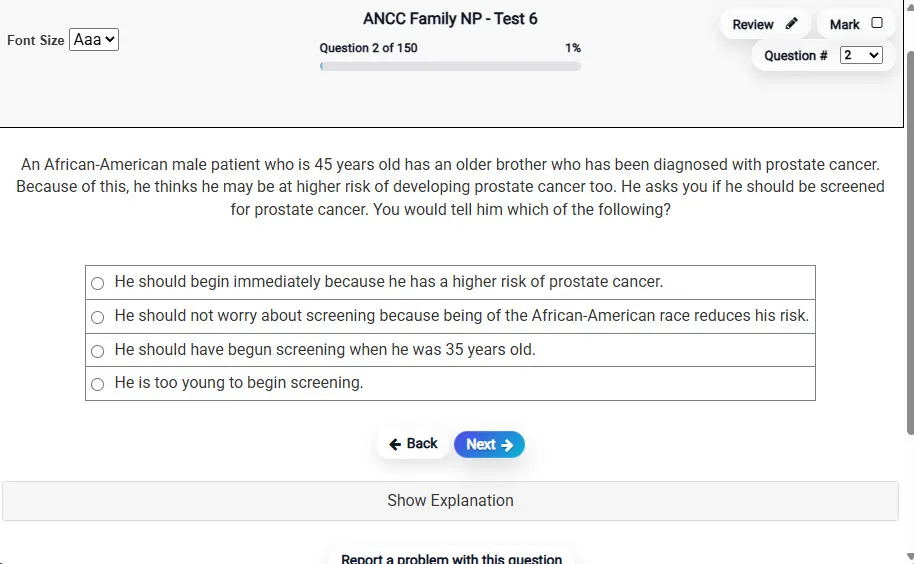
Answering a Question screen – Multiple-choice item view with navigation controls and progress tracker.
Answering a Question Multiple-choice item view with navigation controls and progress tracker.

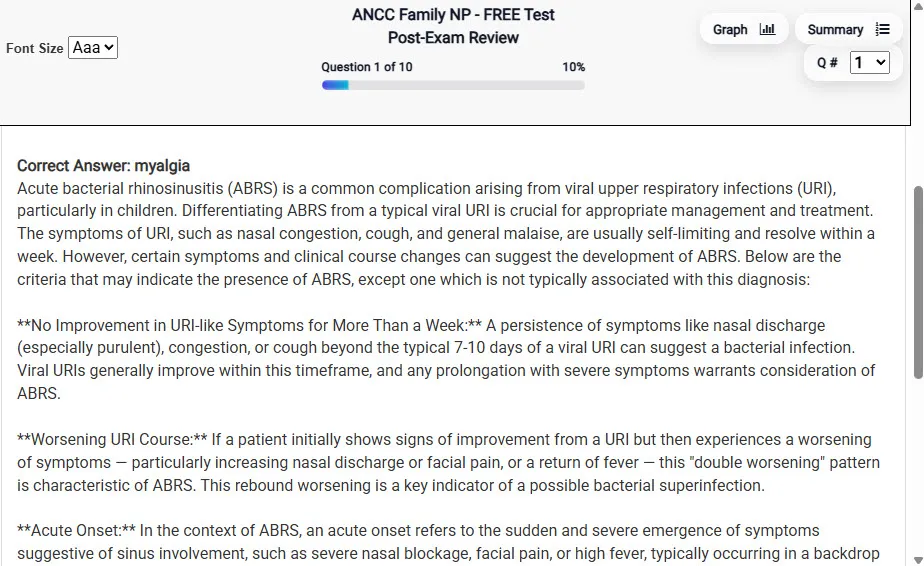
                           Detailed Explanation screen – 
                         Review mode showing chosen answer and rationale and references.
Detailed Explanation Review mode showing chosen answer and rationale and references.

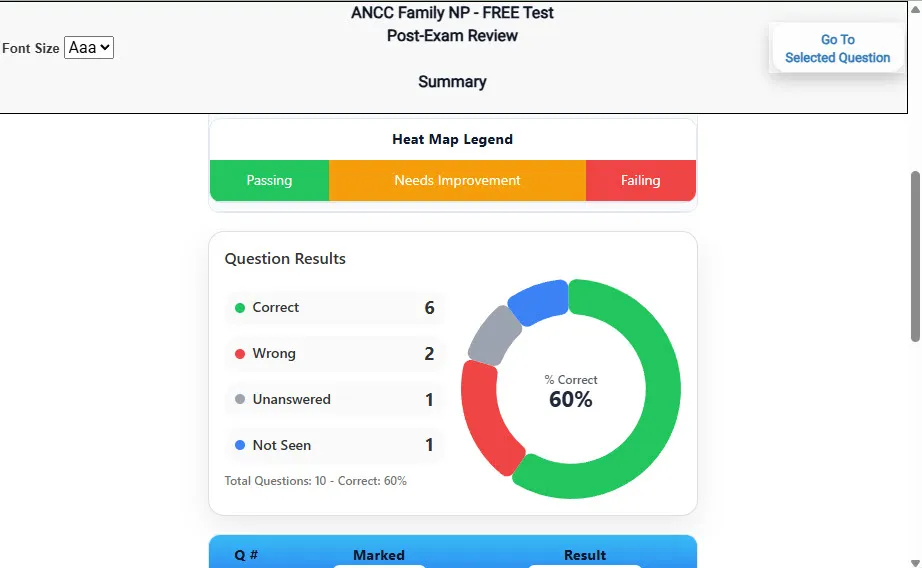
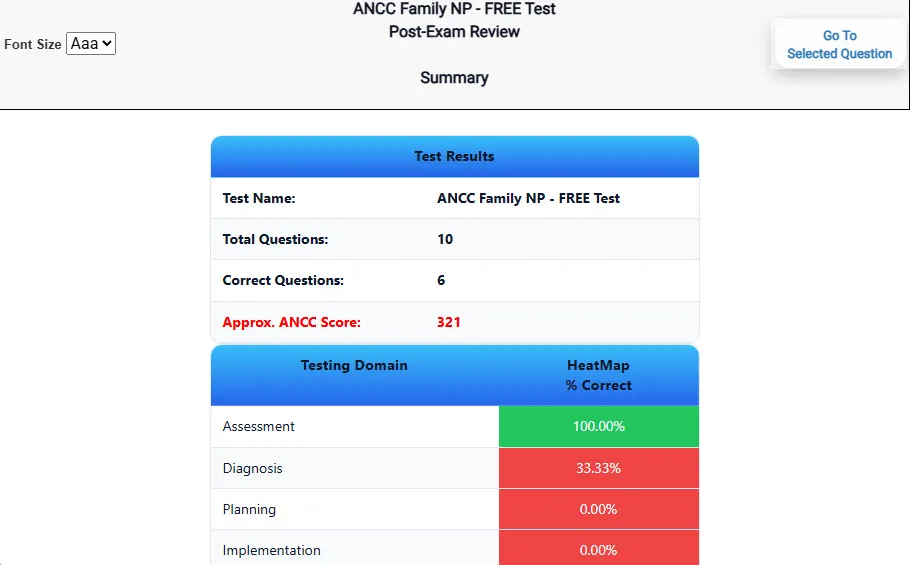
                           Review Summary 1 screen – 
                         Summary with counts for correct/wrong/unanswered and not seen items.
Review Summary 1 Summary with counts for correct/wrong/unanswered and not seen items.

                           Review Summary 2 screen – 
                         Advanced summary with category/domain breakdown and performance insights.
Review Summary 2 Advanced summary with category/domain breakdown and performance insights.

What Each Screen Shows

Answer Question Screen

  • Clean multiple-choice interface with progress bar.
  • Mark for review feature.
  • Matches real test pacing.

Detailed Explanation

  • Correct answer plus rationale.
  • Key concepts and guidelines highlighted.
  • Move between questions to fill knowledge gaps.

Review Summary 1

  • Overall results with total questions and scaled score.
  • Domain heatmap shows strengths and weaknesses.
  • Quick visual feedback on study priorities.

Review Summary 2

  • Chart of correct, wrong, unanswered, not seen.
  • Color-coded results for easy review.
  • Links back to missed items.

Top 10 Reasons to Use Exam Edge for your ORELA Middle Grades General Science Exam Prep

  1. Focused on the ORELA Middle Grades General Science Exam

    Our practice tests are built specifically for the ORELA Middle Grades General Science exam — every question mirrors the real topics, format, and difficulty so you're studying exactly what matters.

  2. Real Exam Simulation

    We match the per-question time limits and pressure of the actual ORELA exam, so test day feels familiar and stress-free.

  3. 5 Full Practice Tests & 500 Unique Questions

    You'll have more than enough material to master every ORELA Middle Grades General Science concept — no repeats, no fluff.

  4. Lower Cost Than a Retake

    Ordering 5 practice exams costs less than retaking the ORELA Middle Grades General Science exam after a failure. One low fee could save you both time and money.

  5. Flexible Testing

    Need to step away mid-exam? Pick up right where you left off — with your remaining time intact.

  6. Instant Scoring & Feedback

    See your raw score and an estimated ORELA Middle Grades General Science score immediately after finishing each practice test.

  7. Detailed Explanations for Every Question

    Review correct and incorrect answers with clear, step-by-step explanations so you truly understand each topic.

  8. Trusted & Accredited

    We're fully accredited by the Better Business Bureau and uphold the highest standards of trust and transparency.

  9. Web-Based & Always Available

    No software to install. Access your ORELA Middle Grades General Science practice exams 24/7 from any computer or mobile device.

  10. Expert Support When You Need It

    Need extra help? Our specialized tutors are highly qualified and ready to support your ORELA exam prep.


Pass the ORELA Middle Grades General Science Exam with Realistic Practice Tests from Exam Edge

Preparing for your upcoming ORELA Middle Grades General Science (204) Certification Exam can feel overwhelming — but the right practice makes all the difference. Exam Edge gives you the tools, structure, and confidence to pass on your first try. Our online practice exams are built to match the real ORELA Middle Grades General Science exam in content, format, and difficulty.

  • 📝 5 ORELA Middle Grades General Science Practice Tests: Access 5 full-length exams with 100 questions each, covering every major ORELA Middle Grades General Science topic in depth.
  • Instant Online Access: Start practicing right away — no software, no waiting.
  • 🧠 Step-by-Step Explanations: Understand the reasoning behind every correct answer so you can master ORELA Middle Grades General Science exam concepts.
  • 🔄 Retake Each Exam Up to 4 Times: Build knowledge through repetition and track your improvement over time.
  • 🌐 Web-Based & Available 24/7: Study anywhere, anytime, on any device.
  • 🧘 Boost Your Test-Day Confidence: Familiarity with the ORELA format reduces anxiety and helps you perform under pressure.

These ORELA Middle Grades General Science practice exams are designed to simulate the real testing experience by matching question types, timing, and difficulty level. This approach helps you get comfortable not just with the exam content, but also with the testing environment, so you walk into your exam day focused and confident.


Exam Edge ORELA Reviews


ORELA Middle Grades General Science Aliases Test Name

Here is a list of alternative names used for this exam.

  • ORELA Middle Grades General Science
  • ORELA Middle Grades General Science test
  • ORELA Middle Grades General Science Certification Test
  • ORELA
  • ORELA 204
  • 204 test
  • ORELA Middle Grades General Science (204)
  • Middle Grades General Science certification