This is the content of the pop-over!

ORELA Math (003) Practice Tests & Test Prep by Exam Edge


ORELA Math - Essential Academic Skills  product image
(5.0)
Based on 29 Reviews

  • Real Exam Simulation: Timed questions and matching content build comfort for your ORELA Math test day.
  • Instant, 24/7 Access: Web-based ORELA Math - Essential Academic Skills practice exams with no software needed.
  • Clear Explanations: Step-by-step answers and explanations for your ORELA exam to strengthen understanding.
  • Boosted Confidence: Reduces anxiety and improves test-taking skills to ace your ORELA Math - Essential Academic Skills (003).

Featured on

ORELA Math - Essential Academic Skills Online Practice Test Bundles

BEST VALUE
20 practice tests

$174.00

$799.00

SAVE $625

Only $8.70 per test!

  • 100% Pass Guarantee
  • 20 online practice tests
  • 45 questions per test
  • Bonus: 100 Flash Cards + Study Guide
  • Instant access
  • Detailed Explanations
  • Practice tests never expire
  • Timed, untimed, or study guide mode
MOST POPULAR
10 practice tests

$99.50

$399.50

SAVE $300

Only $9.95 per test!

  • 10 online practice tests
  • 45 questions per test
  • Bonus: 100 Flash Cards + Study Guide
  • Instant access
  • Detailed Explanations
  • Practice tests never expire
  • Timed, untimed, or study guide mode
5 practice tests

$69.75

$199.75

SAVE $130

Only $13.95 per test!

  • 5 online practice tests
  • 45 questions per test
  • Bonus: 100 Flash Cards
  • Instant access
  • Detailed Explanations
  • Practice tests never expire
  • Timed, untimed, or study guide mode
1 practice test

$39.95

  • 1 online practice test
  • 45 questions per test
  • Instant access
  • Detailed Explanations
  • Practice tests never expire
  • Timed, untimed, or study guide mode
Quick Select
Tap to choose a bundle

** All Prices are in US Dollars (USD) **


ORELA Math (003) Resources

Jump to the section you need most.

Understanding the exact breakdown of the ORELA Math - Essential Academic Skills test will help you know what to expect and how to most effectively prepare. The ORELA Math - Essential Academic Skills has multiple-choice questions . The exam will be broken down into the sections below:

ORELA Math - Essential Academic Skills Exam Blueprint
Domain Name
Understand number properties and number operations  
Understand fundamental principles of algebra  
Understand measurement principles and geometry concepts  
Understand probability and statistics  
Understand problem solving - reasoning mathematical communication  

ORELA Math - Essential Academic Skills Study Tips by Domain

  • Distinguish rational vs. irrational numbers and classify numbers within the real number system; red flag: assuming a nonrepeating decimal must be rational without proof.
  • Apply properties of operations (commutative, associative, distributive, identities, inverses) to rewrite expressions efficiently; common trap: distributing incorrectly across subtraction or forgetting to distribute a negative.
  • Use order of operations with integers, fractions, and exponents (including parentheses and absolute value); priority rule: evaluate exponents and absolute value before multiplication/division and addition/subtraction.
  • Compute with fractions, decimals, and percents and convert among forms; red flag: adding/subtracting fractions without a common denominator or moving the decimal the wrong direction when converting percent to decimal.
  • Work with ratios, rates, and proportional relationships (unit rate, scaling, percent increase/decrease); common trap: swapping part-to-whole with part-to-part or using the wrong base for percent change.
  • Apply exponent rules and roots in numeric contexts (negative exponents, scientific notation); threshold cue: a negative exponent means take the reciprocal, and (-a)2 differs from -a2.
  • Manipulate expressions using the distributive property and combining like terms; red flag: losing a negative when distributing across parentheses (e.g., −3(x − 2)).
  • Solve linear equations and inequalities, including those with fractions; common trap: when multiplying/dividing an inequality by a negative, you must reverse the inequality sign.
  • Work with functions (notation, evaluation, domain/range, and interpreting graphs); priority rule: check for denominators equal to 0 and even roots of negative numbers when stating the domain.
  • Apply slope and intercept concepts in coordinate geometry (slope formula, point-slope, slope-intercept); red flag: confusing slope with y-intercept or swapping x- and y-differences inconsistently.
  • Factor and expand polynomials (GCF, difference of squares, trinomials); common trap: trying to factor a sum of squares (it’s not factorable over the reals).
  • Simplify and solve problems with exponents, radicals, and rational expressions; threshold rule: when squaring both sides or clearing radicals, always check for extraneous solutions in the original equation.
  • Convert within and between metric and U.S. customary units using dimensional analysis; red flag: mixing linear and squared/cubed units (e.g., ft vs ft2) breaks area/volume conversions.
  • Apply perimeter, area, surface area, and volume formulas for common figures (triangles, circles, prisms, cylinders); common trap: forgetting that diameter = 2r or using perimeter formulas when the question asks for area.
  • Use the Pythagorean Theorem and distance formula in coordinate geometry; priority rule: check whether a triangle is right before using a2+b2=c2.
  • Work with angle relationships (vertical, complementary, supplementary) and parallel lines cut by a transversal; red flag: assuming angles are equal without citing a relationship (corresponding/alternate interior).
  • Analyze similarity and congruence (scale factors, side ratios, ASA/SAS/SSS); common trap: scaling area/volume linearly instead of by the square/cube of the scale factor.
  • Compute slope, midpoint, and interpret geometric transformations on the coordinate plane; contraindication: in reflections/rotations, changing shape size indicates an error because rigid motions preserve distance and angle.
  • Distinguish theoretical vs. experimental probability and use the correct model; red flag: treating a small sample’s relative frequency as the true probability without noting variability.
  • Apply complement and conditional probability correctly (e.g., P(A′)=1−P(A), P(A|B)=P(A∩B)/P(B)); common trap: forgetting to divide by P(B) or using P(B|A) by accident.
  • Use counting methods (multiplication principle, permutations, combinations) aligned to whether order matters; red flag: using nCr when the arrangement/order changes the outcome.
  • Interpret measures of center and spread (mean/median/mode, range, IQR, standard deviation) in context; priority rule: choose median and IQR for skewed data or when outliers are present.
  • Read and compare data displays (histograms, box plots, scatterplots) using shape, center, spread, and outliers; common trap: claiming causation from correlation in a scatterplot.
  • Understand sampling, bias, and margin of error in surveys/experiments; red flag: a convenience or self-selected sample — even with a large n — does not justify generalizing to the full population.
  • Translate word problems into a clear plan (define variables, note givens/unknowns) before computing—red flag: starting calculations without stating what the answer represents or its units.
  • Check reasonableness using estimation or bounds (e.g., compare to nearby benchmarks)—common trap: an exact but implausible result due to a misplaced decimal or wrong scale.
  • Use correct mathematical language and notation (e.g., distinguish “if” vs “if and only if,” and “subset” vs “element of”)—priority rule: ambiguous notation can make an otherwise correct solution unacceptable.
  • Justify steps with properties or definitions (commutative, distributive, inverse operations, definition of slope, etc.)—red flag: “because I did the same thing to both sides” without stating which property permits the move.
  • Interpret graphs, tables, and formulas in context (identify independent/dependent variables and what intercepts/parameters mean)—common trap: mixing up axes or reporting an intercept as a rate.
  • Verify solutions by substituting back, checking constraints (domain, nonzero denominators, extraneous roots), and labeling final answers clearly—contraindication: accepting a solution that violates the original conditions.


Built to Fit Into Your Busy Life

Everything you need to prepare with confidence—without wasting a minute.

Three Study Modes

Timed, No Time Limit, or Explanation mode.

Actionable Analytics

Heatmaps and scaled scores highlight weak areas.

High-Yield Rationales

Concise explanations emphasize key concepts.

Realistic Interface

Matches the feel of the actual exam environment.

Accessible by Design

Clean layout reduces cognitive load.

Anytime, Anywhere

Web-based access 24/7 on any device.
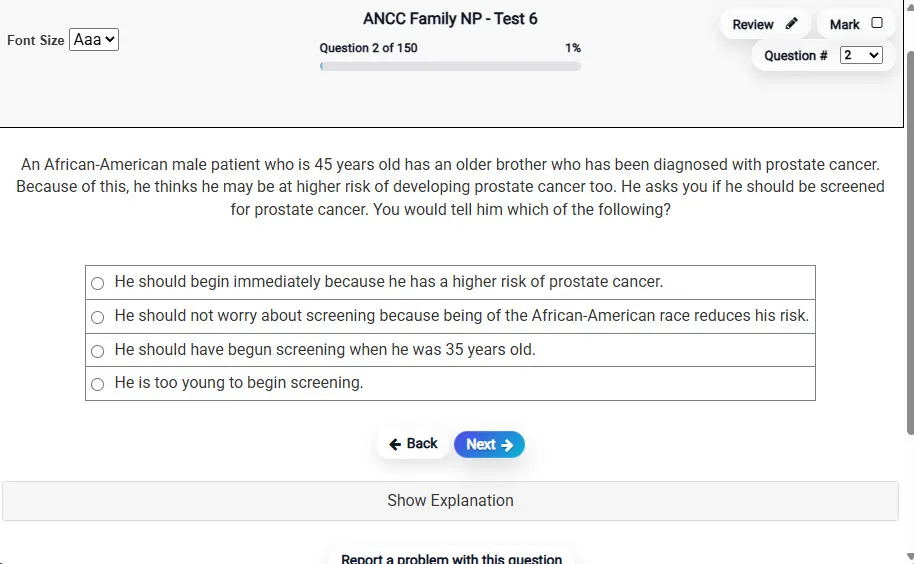
Answering a Question screen – Multiple-choice item view with navigation controls and progress tracker.
Answering a Question Multiple-choice item view with navigation controls and progress tracker.

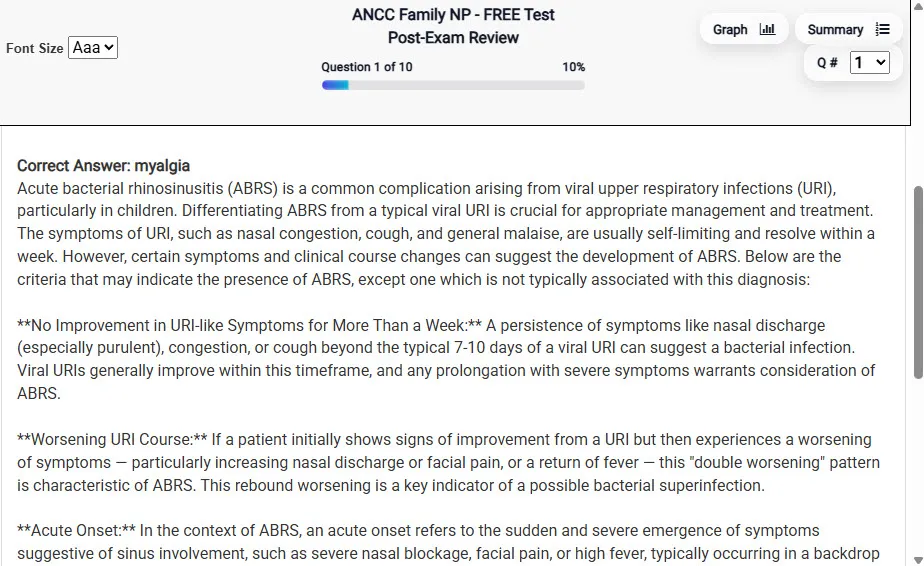
                           Detailed Explanation screen – 
                         Review mode showing chosen answer and rationale and references.
Detailed Explanation Review mode showing chosen answer and rationale and references.

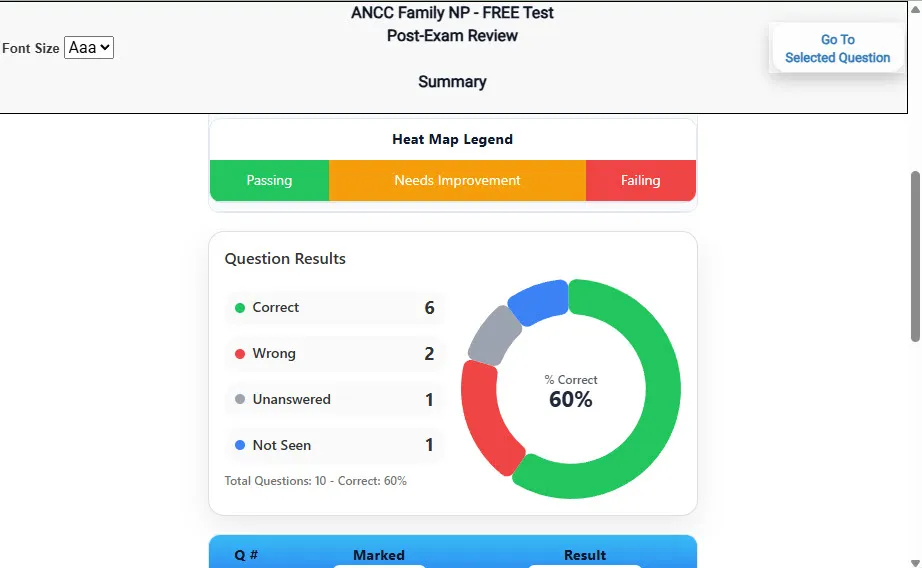
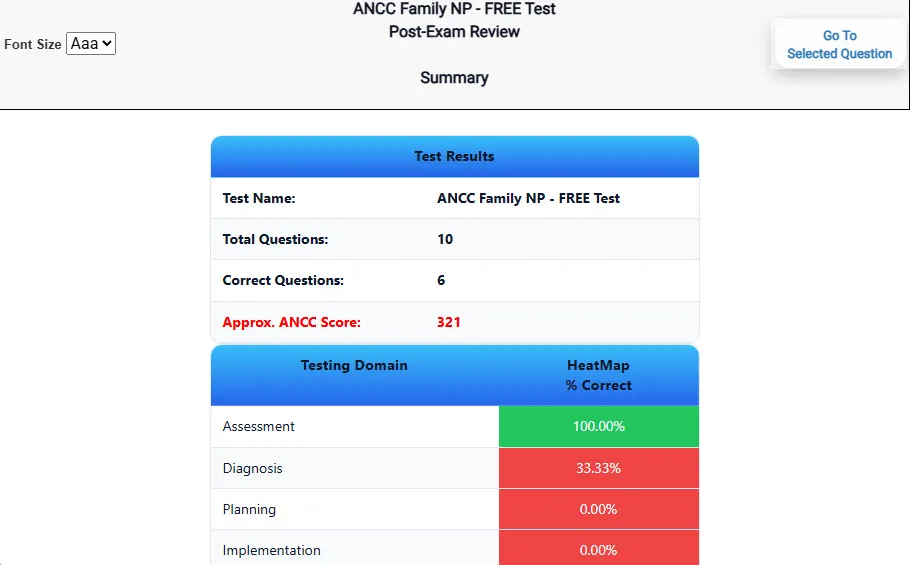
                           Review Summary 1 screen – 
                         Summary with counts for correct/wrong/unanswered and not seen items.
Review Summary 1 Summary with counts for correct/wrong/unanswered and not seen items.

                           Review Summary 2 screen – 
                         Advanced summary with category/domain breakdown and performance insights.
Review Summary 2 Advanced summary with category/domain breakdown and performance insights.

What Each Screen Shows

Answer Question Screen

  • Clean multiple-choice interface with progress bar.
  • Mark for review feature.
  • Matches real test pacing.

Detailed Explanation

  • Correct answer plus rationale.
  • Key concepts and guidelines highlighted.
  • Move between questions to fill knowledge gaps.

Review Summary 1

  • Overall results with total questions and scaled score.
  • Domain heatmap shows strengths and weaknesses.
  • Quick visual feedback on study priorities.

Review Summary 2

  • Chart of correct, wrong, unanswered, not seen.
  • Color-coded results for easy review.
  • Links back to missed items.

Top 10 Reasons to Use Exam Edge for your ORELA Math - Essential Academic Skills Exam Prep

  1. Focused on the ORELA Math - Essential Academic Skills Exam

    Our practice tests are built specifically for the ORELA Math exam — every question mirrors the real topics, format, and difficulty so you're studying exactly what matters.

  2. Real Exam Simulation

    We match the per-question time limits and pressure of the actual ORELA exam, so test day feels familiar and stress-free.

  3. 20 Full Practice Tests & 900 Unique Questions

    You'll have more than enough material to master every ORELA Math concept — no repeats, no fluff.

  4. Lower Cost Than a Retake

    Ordering 5 practice exams costs less than retaking the ORELA Math - Essential Academic Skills exam after a failure. One low fee could save you both time and money.

  5. Flexible Testing

    Need to step away mid-exam? Pick up right where you left off — with your remaining time intact.

  6. Instant Scoring & Feedback

    See your raw score and an estimated ORELA Math - Essential Academic Skills score immediately after finishing each practice test.

  7. Detailed Explanations for Every Question

    Review correct and incorrect answers with clear, step-by-step explanations so you truly understand each topic.

  8. Trusted & Accredited

    We're fully accredited by the Better Business Bureau and uphold the highest standards of trust and transparency.

  9. Web-Based & Always Available

    No software to install. Access your ORELA Math practice exams 24/7 from any computer or mobile device.

  10. Expert Support When You Need It

    Need extra help? Our specialized tutors are highly qualified and ready to support your ORELA exam prep.


Pass the ORELA Math - Essential Academic Skills Exam with Realistic Practice Tests from Exam Edge

Preparing for your upcoming ORELA Math - Essential Academic Skills (003) Certification Exam can feel overwhelming — but the right practice makes all the difference. Exam Edge gives you the tools, structure, and confidence to pass on your first try. Our online practice exams are built to match the real ORELA Math exam in content, format, and difficulty.

  • 📝 20 ORELA Math - Essential Academic Skills Practice Tests: Access 20 full-length exams with 45 questions each, covering every major ORELA Math - Essential Academic Skills topic in depth.
  • Instant Online Access: Start practicing right away — no software, no waiting.
  • 🧠 Step-by-Step Explanations: Understand the reasoning behind every correct answer so you can master ORELA Math exam concepts.
  • 🔄 Retake Each Exam Up to 4 Times: Build knowledge through repetition and track your improvement over time.
  • 🌐 Web-Based & Available 24/7: Study anywhere, anytime, on any device.
  • 🧘 Boost Your Test-Day Confidence: Familiarity with the ORELA format reduces anxiety and helps you perform under pressure.

These ORELA Math - Essential Academic Skills practice exams are designed to simulate the real testing experience by matching question types, timing, and difficulty level. This approach helps you get comfortable not just with the exam content, but also with the testing environment, so you walk into your exam day focused and confident.

Exam Edge ORELA Reviews


ORELA Math - Essential Academic Skills Aliases Test Name

Here is a list of alternative names used for this exam.

  • ORELA Math - Essential Academic Skills
  • ORELA Math - Essential Academic Skills test
  • ORELA Math - Essential Academic Skills Certification Test
  • ORELA Math test
  • ORELA
  • ORELA 003
  • 003 test
  • ORELA Math - Essential Academic Skills (003)
  • Math - Essential Academic Skills certification