This is the content of the pop-over!

ORELA English Language Arts (301) Practice Tests & Test Prep by Exam Edge


ORELA English Language Arts  product image
(5.0)
Based on 28 Reviews

  • Real Exam Simulation: Timed questions and matching content build comfort for your ORELA English Language Arts test day.
  • Instant, 24/7 Access: Web-based ORELA English Language Arts practice exams with no software needed.
  • Clear Explanations: Step-by-step answers and explanations for your ORELA exam to strengthen understanding.
  • Boosted Confidence: Reduces anxiety and improves test-taking skills to ace your ORELA English Language Arts (301).

Featured on

ORELA English Language Arts Online Practice Test Bundles

BEST VALUE
15 practice tests

$149.25

$599.25

SAVE $450

Only $9.95 per test!

  • 100% Pass Guarantee
  • 15 online practice tests
  • 150 questions per test
  • Bonus: 100 Flash Cards + Study Guide
  • Instant access
  • Detailed Explanations
  • Practice tests never expire
  • Timed, untimed, or study guide mode
MOST POPULAR
10 practice tests

$99.50

$399.50

SAVE $300

Only $9.95 per test!

  • 10 online practice tests
  • 150 questions per test
  • Bonus: 100 Flash Cards + Study Guide
  • Instant access
  • Detailed Explanations
  • Practice tests never expire
  • Timed, untimed, or study guide mode
5 practice tests

$69.75

$199.75

SAVE $130

Only $13.95 per test!

  • 5 online practice tests
  • 150 questions per test
  • Bonus: 100 Flash Cards
  • Instant access
  • Detailed Explanations
  • Practice tests never expire
  • Timed, untimed, or study guide mode
1 practice test

$39.95

  • 1 online practice test
  • 150 questions per test
  • Instant access
  • Detailed Explanations
  • Practice tests never expire
  • Timed, untimed, or study guide mode
Quick Select
Tap to choose a bundle

** All Prices are in US Dollars (USD) **


ORELA English Language Arts (301) Resources

Jump to the section you need most.

Understanding the exact breakdown of the ORELA English Language Arts test will help you know what to expect and how to most effectively prepare. The ORELA English Language Arts has 150 multiple-choice questions . The exam will be broken down into the sections below:

ORELA English Language Arts Exam Blueprint
Domain Name % Number of
Questions
Vocabulary - Reading Comprehension Reading Various Text Forms 23% 35
Analyzing and Interpreting Literature 23% 35
English Language Conventions - Composition -
Writing Process Research
19% 29
Modes of Writing 23% 35
Oral and Visual Communication 12% 18

ORELA English Language Arts Study Tips by Domain

  • Use context clues (definition, restatement, example, contrast) to infer word meaning; red flag: choosing a familiar meaning when the sentence signals a different sense (denotation vs. connotation).
  • Analyze morphology (prefix/root/suffix) and etymology to unlock academic vocabulary; common trap: assuming a prefix always keeps the same meaning across words (e.g., “in-” as negation vs. “in-” meaning “in/into”).
  • Determine central idea/theme and trace how key details develop it across a text; priority rule: if a detail doesn’t support the central claim, it’s likely a distractor.
  • Make inferences supported by explicit evidence (quote or paraphrase) rather than opinion; red flag: answers that sound plausible but have no textual anchor.
  • Compare and evaluate multiple text forms (e.g., informational article, argument, drama, poetry) for purpose, structure, and tone; common trap: applying the same criteria to all genres (e.g., treating poetic imagery like literal evidence).
  • Interpret author’s choices in structure and features (headings, graphics, footnotes, charts) and how they shape meaning; threshold cue: verify whether a question asks for “most supported” vs. “best inference” before selecting.
  • Use close reading to connect specific textual evidence (diction, imagery, syntax) to an interpretive claim; red flag: answers that summarize plot without analysis.
  • Track how literary elements (characterization, setting, conflict) develop theme across the whole text; common trap: treating theme as a single-word topic (e.g., “love”) rather than a statement.
  • Analyze point of view and reliability (first-person limits, omniscience, bias) and how it shapes meaning; cue: watch for shifts in perspective or withheld information.
  • Interpret figurative language and symbolism in context, distinguishing connotation from denotation; contraindication: assuming every symbol has one fixed, universal meaning.
  • Examine structure (plot arc, pacing, chronology, foreshadowing, juxtaposition) and its effect on reader response; priority rule: tie structural choices to purpose, not just identify them.
  • Situate a text within literary/historical context (genre conventions, period ideas) without reducing it to biography; red flag: attributing intent or meaning solely to the author’s life.
  • Apply standard grammar and usage (agreement, pronoun case/reference, modifier placement) and treat nonstandard dialect as a revision choice for audience/purpose—red flag: “their” with a singular antecedent when formal Standard English is expected.
  • Punctuate for clarity (comma splices, run-ons, semicolons/colons, quotation integration) and prioritize meaning over “rule memorization”—common trap: using a comma where a semicolon or period is required between two independent clauses.
  • Maintain sentence variety and coherence through effective subordination/coordination and parallel structure—priority rule: items in a series must match grammatical form (e.g., all -ing or all infinitives).
  • Organize composition with a defensible thesis, purposeful paragraphs, and transitions that signal logical relationships—red flag: topic sentences that repeat the prompt but don’t make a claim you can support.
  • Use the writing process strategically (prewrite, draft, revise, edit, proofread) and separate global revision (focus/organization) from local editing (grammar/mechanics)—common trap: proofreading first and never fixing weak evidence or unclear reasoning.
  • Conduct research with credible, relevant sources; integrate quotes/paraphrases with attribution and consistent citation style (e.g., MLA) and avoid plagiarism—threshold: any borrowed idea or distinctive phrasing needs a citation, even when paraphrased.
  • Match mode to purpose and audience: argument persuades with claims and reasons, informative/explanatory teaches with clear categories, narrative creates meaning through story elements—red flag: switching purposes mid-essay without signaling.
  • Argument writing must state a defensible thesis, use logically ordered reasons, and address counterclaims—common trap: listing opinions without evidence or ignoring opposing viewpoints entirely.
  • Informative/explanatory writing should define terms, use concrete examples, and maintain an objective tone—priority rule: avoid slipping into persuasion (loaded language, calls to action) unless the task explicitly asks for it.
  • Narrative writing needs a clear arc (setup, conflict, resolution) and purposeful details (setting, character, dialogue, pacing)—red flag: summary-only narration with no scene, tension, or reflection.
  • Compare/contrast and analysis essays should use a consistent organizing structure (block or point-by-point) with parallel criteria—common trap: uneven comparisons (more detail for one side) that undermine coherence.
  • In any mode, coherence depends on transitions, topic sentences, and mode-appropriate evidence (textual citations for analysis, data/examples for informative, sensory detail for narrative)—red flag: paragraphs that do not support the central controlling idea.
  • Differentiate purposes and structures of speeches (informative, persuasive, ceremonial) and match them to audience and occasion—red flag: a generic thesis that doesn’t signal the speech’s purpose.
  • Apply rhetorical appeals and reasoning (ethos/pathos/logos; claims, evidence, warrants) and identify fallacies—common trap: treating an emotional anecdote as sufficient proof for a broad claim.
  • Use effective delivery techniques (pacing, articulation, emphasis, eye contact, posture) aligned to message—priority rule: if clarity suffers, slow down before adding volume.
  • Plan and evaluate listening and discussion behaviors (active listening, turn-taking, questioning, summarizing) for collaborative tasks—red flag: responding before paraphrasing the speaker’s main point.
  • Analyze how visual/media elements shape meaning (image selection, layout, color, sound, editing, captions) and assess credibility/bias—common trap: assuming high production value equals reliable content.
  • Adapt multimodal presentations to context (time limits, technology, accessibility, citation of sources) and anticipate constraints—threshold cue: if a slide can’t be read in ~5 seconds, it’s too dense.


Built to Fit Into Your Busy Life

Everything you need to prepare with confidence—without wasting a minute.

Three Study Modes

Timed, No Time Limit, or Explanation mode.

Actionable Analytics

Heatmaps and scaled scores highlight weak areas.

High-Yield Rationales

Concise explanations emphasize key concepts.

Realistic Interface

Matches the feel of the actual exam environment.

Accessible by Design

Clean layout reduces cognitive load.

Anytime, Anywhere

Web-based access 24/7 on any device.
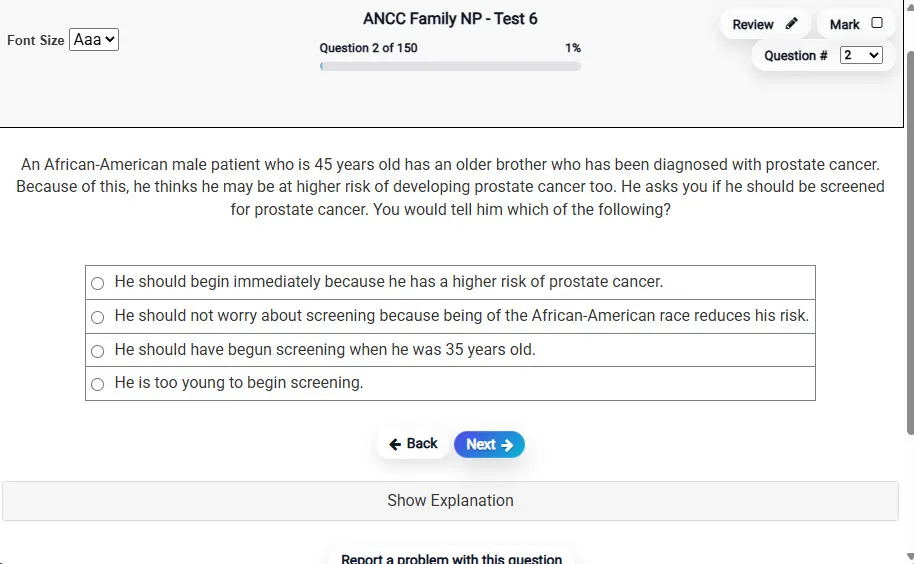
Answering a Question screen – Multiple-choice item view with navigation controls and progress tracker.
Answering a Question Multiple-choice item view with navigation controls and progress tracker.

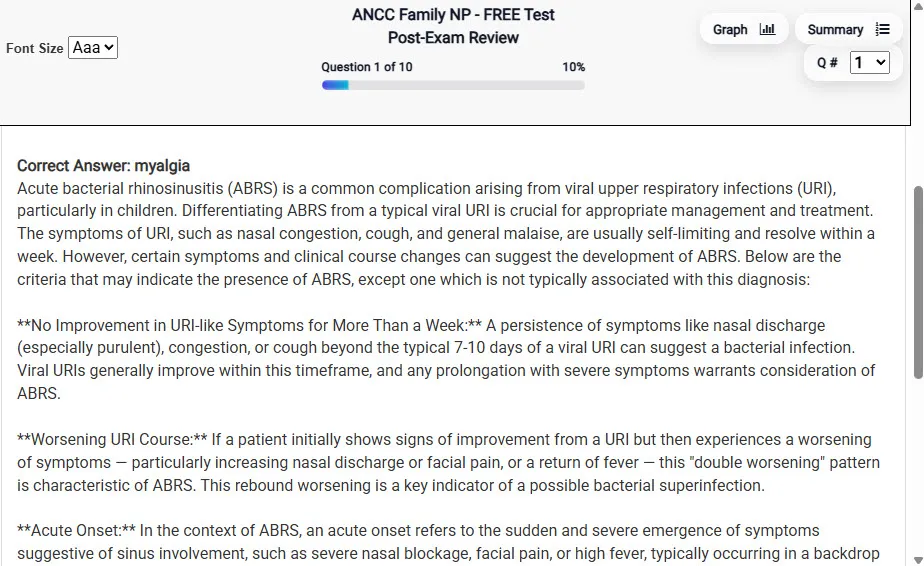
                           Detailed Explanation screen – 
                         Review mode showing chosen answer and rationale and references.
Detailed Explanation Review mode showing chosen answer and rationale and references.

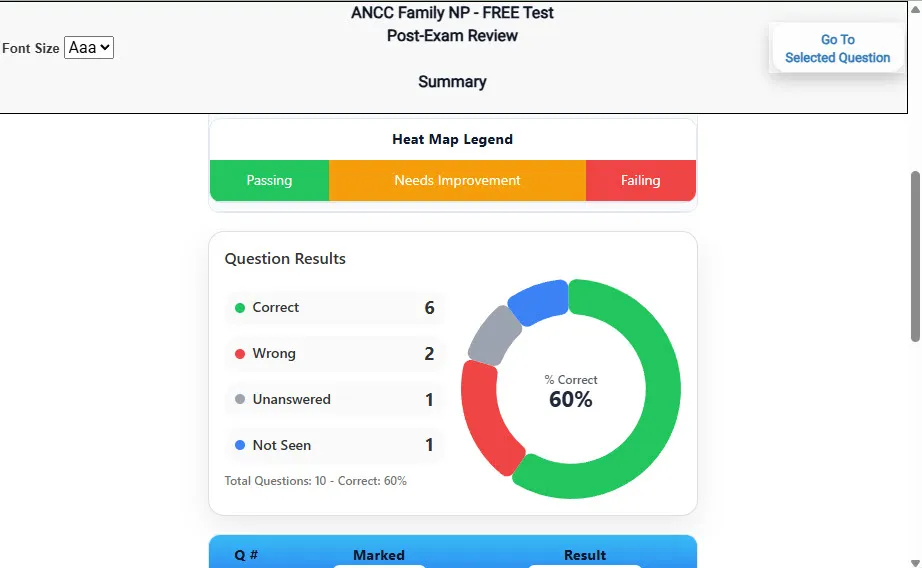
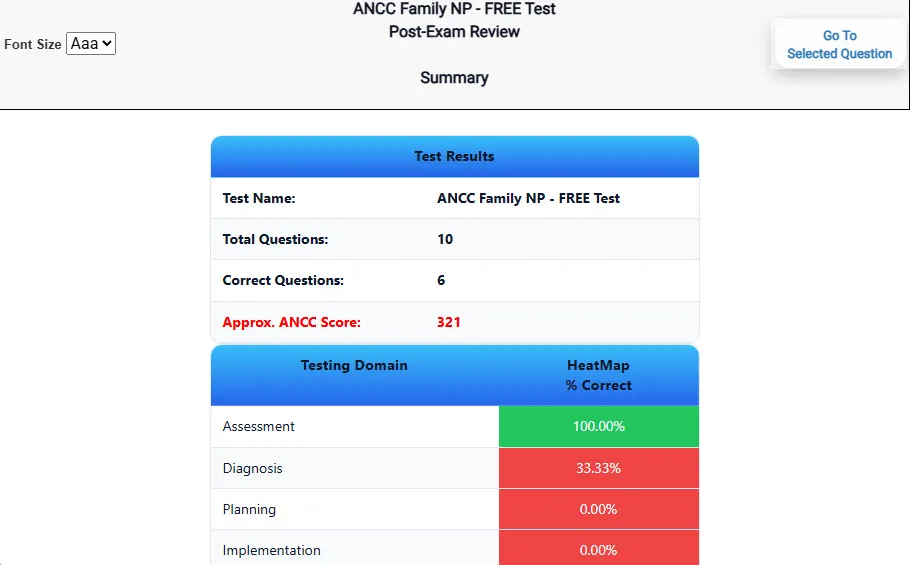
                           Review Summary 1 screen – 
                         Summary with counts for correct/wrong/unanswered and not seen items.
Review Summary 1 Summary with counts for correct/wrong/unanswered and not seen items.

                           Review Summary 2 screen – 
                         Advanced summary with category/domain breakdown and performance insights.
Review Summary 2 Advanced summary with category/domain breakdown and performance insights.

What Each Screen Shows

Answer Question Screen

  • Clean multiple-choice interface with progress bar.
  • Mark for review feature.
  • Matches real test pacing.

Detailed Explanation

  • Correct answer plus rationale.
  • Key concepts and guidelines highlighted.
  • Move between questions to fill knowledge gaps.

Review Summary 1

  • Overall results with total questions and scaled score.
  • Domain heatmap shows strengths and weaknesses.
  • Quick visual feedback on study priorities.

Review Summary 2

  • Chart of correct, wrong, unanswered, not seen.
  • Color-coded results for easy review.
  • Links back to missed items.

Top 10 Reasons to Use Exam Edge for your ORELA English Language Arts Exam Prep

  1. Focused on the ORELA English Language Arts Exam

    Our practice tests are built specifically for the ORELA English Language Arts exam — every question mirrors the real topics, format, and difficulty so you're studying exactly what matters.

  2. Real Exam Simulation

    We match the per-question time limits and pressure of the actual ORELA exam, so test day feels familiar and stress-free.

  3. 15 Full Practice Tests & 2,250 Unique Questions

    You'll have more than enough material to master every ORELA English Language Arts concept — no repeats, no fluff.

  4. Lower Cost Than a Retake

    Ordering 5 practice exams costs less than retaking the ORELA English Language Arts exam after a failure. One low fee could save you both time and money.

  5. Flexible Testing

    Need to step away mid-exam? Pick up right where you left off — with your remaining time intact.

  6. Instant Scoring & Feedback

    See your raw score and an estimated ORELA English Language Arts score immediately after finishing each practice test.

  7. Detailed Explanations for Every Question

    Review correct and incorrect answers with clear, step-by-step explanations so you truly understand each topic.

  8. Trusted & Accredited

    We're fully accredited by the Better Business Bureau and uphold the highest standards of trust and transparency.

  9. Web-Based & Always Available

    No software to install. Access your ORELA English Language Arts practice exams 24/7 from any computer or mobile device.

  10. Expert Support When You Need It

    Need extra help? Our specialized tutors are highly qualified and ready to support your ORELA exam prep.


Pass the ORELA English Language Arts Exam with Realistic Practice Tests from Exam Edge

Preparing for your upcoming ORELA English Language Arts (301) Certification Exam can feel overwhelming — but the right practice makes all the difference. Exam Edge gives you the tools, structure, and confidence to pass on your first try. Our online practice exams are built to match the real ORELA English Language Arts exam in content, format, and difficulty.

  • 📝 15 ORELA English Language Arts Practice Tests: Access 15 full-length exams with 150 questions each, covering every major ORELA English Language Arts topic in depth.
  • Instant Online Access: Start practicing right away — no software, no waiting.
  • 🧠 Step-by-Step Explanations: Understand the reasoning behind every correct answer so you can master ORELA English Language Arts exam concepts.
  • 🔄 Retake Each Exam Up to 4 Times: Build knowledge through repetition and track your improvement over time.
  • 🌐 Web-Based & Available 24/7: Study anywhere, anytime, on any device.
  • 🧘 Boost Your Test-Day Confidence: Familiarity with the ORELA format reduces anxiety and helps you perform under pressure.

These ORELA English Language Arts practice exams are designed to simulate the real testing experience by matching question types, timing, and difficulty level. This approach helps you get comfortable not just with the exam content, but also with the testing environment, so you walk into your exam day focused and confident.


Exam Edge ORELA Reviews


ORELA English Language Arts Aliases Test Name

Here is a list of alternative names used for this exam.

  • ORELA English Language Arts
  • ORELA English Language Arts test
  • ORELA English Language Arts Certification Test
  • ORELA
  • ORELA 301
  • 301 test
  • ORELA English Language Arts (301)
  • English Language Arts certification