This is the content of the pop-over!

ORELA Early Childhood Education (101) Practice Tests & Test Prep by Exam Edge


ORELA Early Childhood Education  product image
(5.0)
Based on 28 Reviews

  • Real Exam Simulation: Timed questions and matching content build comfort for your ORELA Early Childhood Education test day.
  • Instant, 24/7 Access: Web-based ORELA Early Childhood Education practice exams with no software needed.
  • Clear Explanations: Step-by-step answers and explanations for your ORELA exam to strengthen understanding.
  • Boosted Confidence: Reduces anxiety and improves test-taking skills to ace your ORELA Early Childhood Education (101).

Featured on

ORELA Early Childhood Education Online Practice Test Bundles

BEST VALUE
10 practice tests

$99.50

$399.50

SAVE $300

Only $9.95 per test!

  • 100% Pass Guarantee
  • 10 online practice tests
  • 100 questions per test
  • Bonus: 100 Flash Cards + Study Guide
  • Instant access
  • Detailed Explanations
  • Practice tests never expire
  • Timed, untimed, or study guide mode
5 practice tests

$69.75

$199.75

SAVE $130

Only $13.95 per test!

  • 5 online practice tests
  • 100 questions per test
  • Bonus: 100 Flash Cards + Study Guide
  • Instant access
  • Detailed Explanations
  • Practice tests never expire
  • Timed, untimed, or study guide mode
1 practice test

$39.95

  • 1 online practice test
  • 100 questions per test
  • Instant access
  • Detailed Explanations
  • Practice tests never expire
  • Timed, untimed, or study guide mode
Quick Select
Tap to choose a bundle

** All Prices are in US Dollars (USD) **


ORELA Early Childhood Education (101) Resources

Jump to the section you need most.

Understanding the exact breakdown of the ORELA Early Childhood Education test will help you know what to expect and how to most effectively prepare. The ORELA Early Childhood Education has multiple-choice questions . The exam will be broken down into the sections below:

ORELA Early Childhood Education Exam Blueprint
Domain Name % Number of
Questions
Child Development and Learning 21% 21
Language and Literacy Development 29% 29
Learning Across the Curriculum 36% 36
Professional Relationships and Responsibilities 14% 14

ORELA Early Childhood Education Study Tips by Domain

  • Use developmental milestones as a guide, not a checklist—red flag: labeling a child as “behind” based on one skill without considering variation, context, and multiple observations.
  • Prioritize health, safety, and basic needs (sleep, nutrition, secure attachment) as foundations for learning—common trap: interpreting persistent dysregulation as willful behavior instead of unmet needs or stress.
  • Match expectations and activities to the child’s developmental level and temperament—priority rule: adjust the task (materials, time, support) before blaming motivation or compliance.
  • Support social-emotional development with explicit routines, modeling, and positive guidance—red flag: relying on exclusionary discipline (e.g., repeated time-out) without teaching replacement behaviors.
  • Recognize that play is a primary mode of learning in early childhood—common trap: replacing active, hands-on play with extended seatwork that exceeds typical attention spans.
  • Use ongoing, culturally responsive observation and documentation to plan next steps—red flag: making high-stakes decisions from a single test or a one-day snapshot.
  • Track language milestones and refer when patterns persist (e.g., no babbling by ~12 months or no two-word phrases by ~24 months)—red flag: repeated concerns across settings without progress despite targeted support.
  • Build oral language daily with interactive read-alouds, open-ended questions, and wait time—common trap: asking only yes/no or recall questions that limit vocabulary growth.
  • Strengthen phonological awareness with brief play (rhyming, syllable clapping, initial-sound games) before formal phonics—priority rule: keep tasks auditory and developmentally appropriate, not worksheet-driven.
  • Teach print concepts (front/back, directionality, word boundaries) using big books, labels, and shared writing—red flag: correcting every letter formation instead of focusing on message and meaning.
  • Support emergent writing through drawing-to-writing, name writing, and dictation with adult modeling—common trap: expecting conventional spelling too early rather than valuing invented spelling as a stage.
  • Provide equitable access for dual language learners and children with disabilities using visuals, gestures, home-language connections, and targeted interventions—contraindication: delaying literacy exposure while waiting for “full English” proficiency.
  • Plan integrated units that connect science, social studies, arts, and math to a central theme with clear learning targets; red flag: “cute crafts” that don’t assess any specific skill or concept.
  • Use play-based learning centers with intentional teacher roles (modeling, prompting, observing) tied to standards; common trap: treating centers as free time without documented objectives or progress notes.
  • Differentiate instruction using UDL supports (visuals, manipulatives, movement, choice) while keeping the same essential goal; priority rule: accommodations change access, not the expectation for learning.
  • Build early math through daily routines (counting, comparing, sorting, patterning, measurement talk) using concrete materials first; red flag: relying on worksheets before children show understanding with manipulatives.
  • Promote inquiry in science and social studies with predict–test–observe–explain cycles and real-world tools; common trap: doing “demonstrations” where children only watch and never investigate or record.
  • Use ongoing assessment (anecdotal records, checklists, work samples, performance tasks) to adjust instruction; threshold cue: if you can’t name what evidence will show mastery, the activity is not assessment-ready.
  • Maintain confidentiality and follow mandated reporter requirements—red flag: discussing a child’s records or behavior with non-authorized staff or other families, even informally.
  • Use clear, respectful two-way communication with families and honor cultural/linguistic differences—common trap: assuming nonparticipation equals disinterest rather than addressing access barriers (translation, schedules).
  • Collaborate with colleagues and specialists (e.g., IEP/IFSP teams) using role clarity and shared goals—priority rule: implement agreed accommodations consistently across routines, not only during “special” activities.
  • Apply professional ethics and boundaries in all interactions—red flag: accepting gifts or engaging in social media contact that could be perceived as favoritism or a conflict of interest.
  • Use observation and documentation responsibly to inform instruction and referrals—common trap: labeling a child based on a single incident instead of collecting objective, dated evidence across settings.
  • Ensure health, safety, and legal compliance in daily practice—priority rule: if a procedure conflicts with policy (supervision ratios, allergy plans, emergency protocols), follow policy and document immediately.


Built to Fit Into Your Busy Life

Everything you need to prepare with confidence—without wasting a minute.

Three Study Modes

Timed, No Time Limit, or Explanation mode.

Actionable Analytics

Heatmaps and scaled scores highlight weak areas.

High-Yield Rationales

Concise explanations emphasize key concepts.

Realistic Interface

Matches the feel of the actual exam environment.

Accessible by Design

Clean layout reduces cognitive load.

Anytime, Anywhere

Web-based access 24/7 on any device.
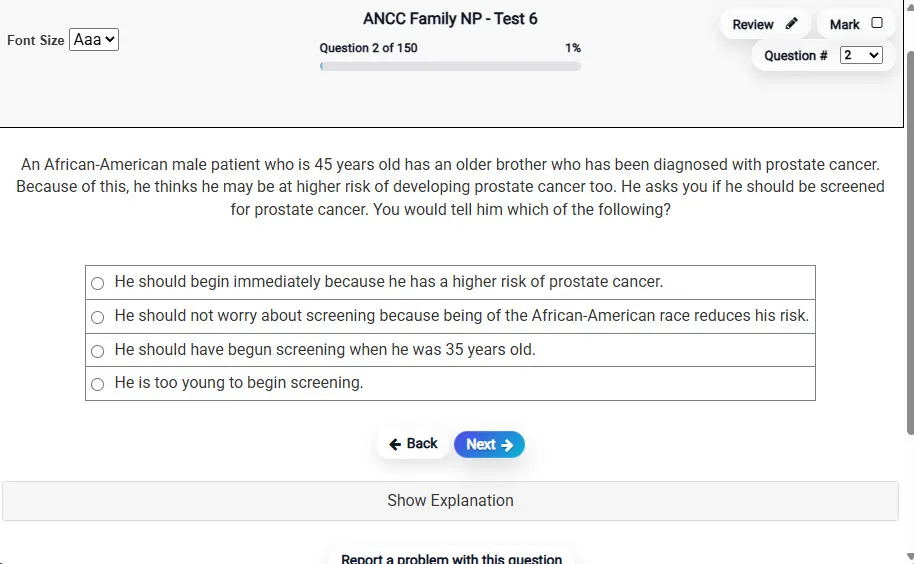
Answering a Question screen – Multiple-choice item view with navigation controls and progress tracker.
Answering a Question Multiple-choice item view with navigation controls and progress tracker.

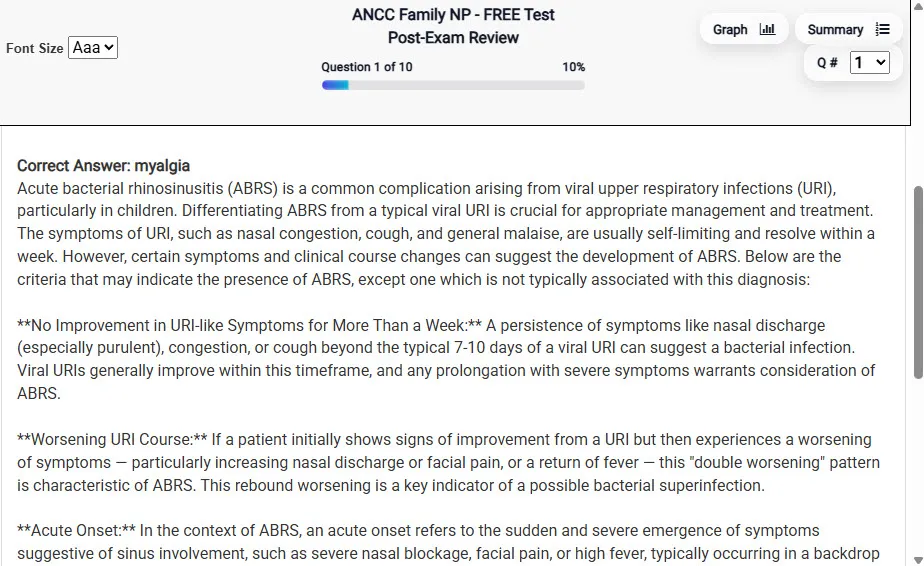
                           Detailed Explanation screen – 
                         Review mode showing chosen answer and rationale and references.
Detailed Explanation Review mode showing chosen answer and rationale and references.

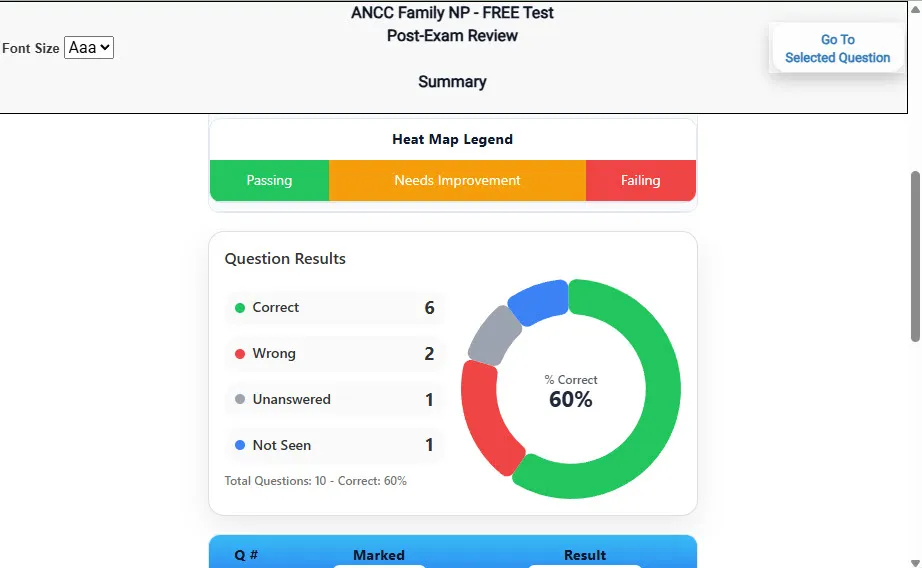
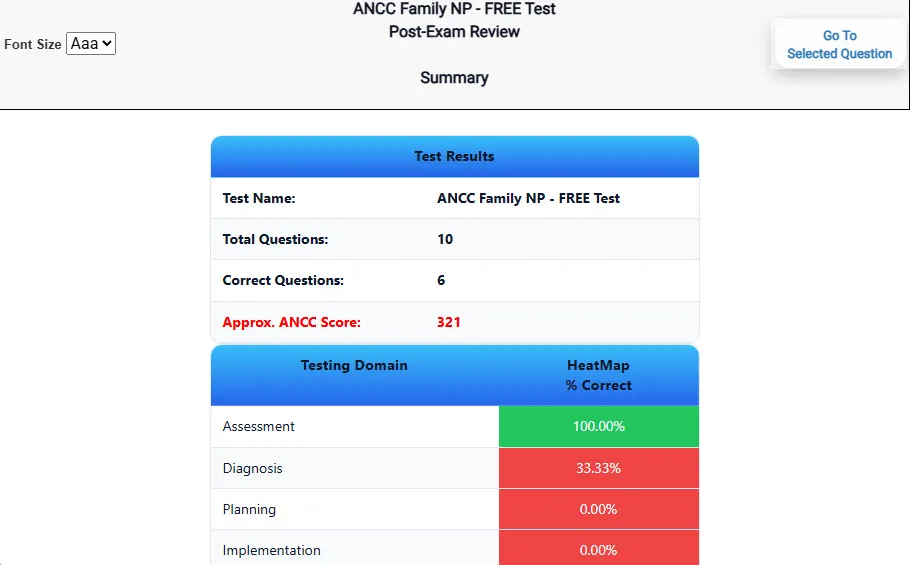
                           Review Summary 1 screen – 
                         Summary with counts for correct/wrong/unanswered and not seen items.
Review Summary 1 Summary with counts for correct/wrong/unanswered and not seen items.

                           Review Summary 2 screen – 
                         Advanced summary with category/domain breakdown and performance insights.
Review Summary 2 Advanced summary with category/domain breakdown and performance insights.

What Each Screen Shows

Answer Question Screen

  • Clean multiple-choice interface with progress bar.
  • Mark for review feature.
  • Matches real test pacing.

Detailed Explanation

  • Correct answer plus rationale.
  • Key concepts and guidelines highlighted.
  • Move between questions to fill knowledge gaps.

Review Summary 1

  • Overall results with total questions and scaled score.
  • Domain heatmap shows strengths and weaknesses.
  • Quick visual feedback on study priorities.

Review Summary 2

  • Chart of correct, wrong, unanswered, not seen.
  • Color-coded results for easy review.
  • Links back to missed items.

Top 10 Reasons to Use Exam Edge for your ORELA Early Childhood Education Exam Prep

  1. Focused on the ORELA Early Childhood Education Exam

    Our practice tests are built specifically for the ORELA Early Childhood Education exam — every question mirrors the real topics, format, and difficulty so you're studying exactly what matters.

  2. Real Exam Simulation

    We match the per-question time limits and pressure of the actual ORELA exam, so test day feels familiar and stress-free.

  3. 10 Full Practice Tests & 1,000 Unique Questions

    You'll have more than enough material to master every ORELA Early Childhood Education concept — no repeats, no fluff.

  4. Lower Cost Than a Retake

    Ordering 5 practice exams costs less than retaking the ORELA Early Childhood Education exam after a failure. One low fee could save you both time and money.

  5. Flexible Testing

    Need to step away mid-exam? Pick up right where you left off — with your remaining time intact.

  6. Instant Scoring & Feedback

    See your raw score and an estimated ORELA Early Childhood Education score immediately after finishing each practice test.

  7. Detailed Explanations for Every Question

    Review correct and incorrect answers with clear, step-by-step explanations so you truly understand each topic.

  8. Trusted & Accredited

    We're fully accredited by the Better Business Bureau and uphold the highest standards of trust and transparency.

  9. Web-Based & Always Available

    No software to install. Access your ORELA Early Childhood Education practice exams 24/7 from any computer or mobile device.

  10. Expert Support When You Need It

    Need extra help? Our specialized tutors are highly qualified and ready to support your ORELA exam prep.


Pass the ORELA Early Childhood Education Exam with Realistic Practice Tests from Exam Edge

Preparing for your upcoming ORELA Early Childhood Education (101) Certification Exam can feel overwhelming — but the right practice makes all the difference. Exam Edge gives you the tools, structure, and confidence to pass on your first try. Our online practice exams are built to match the real ORELA Early Childhood Education exam in content, format, and difficulty.

  • 📝 10 ORELA Early Childhood Education Practice Tests: Access 10 full-length exams with 100 questions each, covering every major ORELA Early Childhood Education topic in depth.
  • Instant Online Access: Start practicing right away — no software, no waiting.
  • 🧠 Step-by-Step Explanations: Understand the reasoning behind every correct answer so you can master ORELA Early Childhood Education exam concepts.
  • 🔄 Retake Each Exam Up to 4 Times: Build knowledge through repetition and track your improvement over time.
  • 🌐 Web-Based & Available 24/7: Study anywhere, anytime, on any device.
  • 🧘 Boost Your Test-Day Confidence: Familiarity with the ORELA format reduces anxiety and helps you perform under pressure.

These ORELA Early Childhood Education practice exams are designed to simulate the real testing experience by matching question types, timing, and difficulty level. This approach helps you get comfortable not just with the exam content, but also with the testing environment, so you walk into your exam day focused and confident.


Exam Edge ORELA Reviews


ORELA Early Childhood Education Aliases Test Name

Here is a list of alternative names used for this exam.

  • ORELA Early Childhood Education
  • ORELA Early Childhood Education test
  • ORELA Early Childhood Education Certification Test
  • ORELA
  • ORELA 101
  • 101 test
  • ORELA Early Childhood Education (101)
  • Early Childhood Education certification