This is the content of the pop-over!

ORELA Chemistry (306) Practice Tests & Test Prep by Exam Edge


ORELA Chemistry   product image
(5.0)
Based on 28 Reviews

  • Real Exam Simulation: Timed questions and matching content build comfort for your ORELA Chemistry test day.
  • Instant, 24/7 Access: Web-based ORELA Chemistry practice exams with no software needed.
  • Clear Explanations: Step-by-step answers and explanations for your ORELA exam to strengthen understanding.
  • Boosted Confidence: Reduces anxiety and improves test-taking skills to ace your ORELA Chemistry (306).

Featured on

ORELA Chemistry Online Practice Test Bundles

BEST VALUE
15 practice tests

$149.25

$599.25

SAVE $450

Only $9.95 per test!

  • 100% Pass Guarantee
  • 15 online practice tests
  • 125 questions per test
  • Bonus: 100 Flash Cards + Study Guide
  • Instant access
  • Detailed Explanations
  • Practice tests never expire
  • Timed, untimed, or study guide mode
MOST POPULAR
10 practice tests

$99.50

$399.50

SAVE $300

Only $9.95 per test!

  • 10 online practice tests
  • 125 questions per test
  • Bonus: 100 Flash Cards + Study Guide
  • Instant access
  • Detailed Explanations
  • Practice tests never expire
  • Timed, untimed, or study guide mode
5 practice tests

$69.75

$199.75

SAVE $130

Only $13.95 per test!

  • 5 online practice tests
  • 125 questions per test
  • Bonus: 100 Flash Cards
  • Instant access
  • Detailed Explanations
  • Practice tests never expire
  • Timed, untimed, or study guide mode
1 practice test

$39.95

  • 1 online practice test
  • 125 questions per test
  • Instant access
  • Detailed Explanations
  • Practice tests never expire
  • Timed, untimed, or study guide mode
Quick Select
Tap to choose a bundle

** All Prices are in US Dollars (USD) **


ORELA Chemistry (306) Resources

Jump to the section you need most.

Understanding the exact breakdown of the ORELA Chemistry test will help you know what to expect and how to most effectively prepare. The ORELA Chemistry has 150 multiple-choice questions . The exam will be broken down into the sections below:

ORELA Chemistry Exam Blueprint
Domain Name % Number of
Questions
Nature of Science 18% 27
Matter and Atomic Structure 18% 27
Energy and Chemical Bonding 23% 35
Chemical Reactions 23% 35
Stoichiometry and Solutions 18% 27

ORELA Chemistry Study Tips by Domain

  • Differentiate observation from inference and keep claims tied to evidence; red flag: treating a hypothesis as a proven theory because it “explains” a result.
  • Use the scientific method iteratively (question → testable hypothesis → controlled experiment → analysis → revision); common trap: changing multiple variables at once so you can’t attribute cause.
  • Identify independent, dependent, and controlled variables and include an appropriate control group; priority rule: controls and constants must match the experimental group except for the independent variable.
  • Evaluate data quality using precision vs. accuracy and significant figures; red flag: reporting more digits than your measurement tool supports (false precision).
  • Interpret graphs and tables by checking units, scale, and uncertainty before drawing conclusions; common trap: inferring causation from correlation or from a truncated axis.
  • Apply lab safety and ethics (PPE, SDS interpretation, proper waste disposal, honest reporting); contraindication: mixing unknowns or disposing of chemicals down the drain without confirming permissible procedures.
  • Distinguish subatomic particles by charge and location: protons (+) and neutrons (0) in the nucleus, electrons (−) in orbitals—red flag: using atomic number for neutrons instead of protons.
  • Use nuclide notation to connect atomic number, mass number, and isotopes; calculate neutrons as A − Z—common trap: confusing average atomic mass (periodic table) with mass number (integer for one isotope).
  • Apply electron configurations and orbital filling (Aufbau, Pauli, Hund) to predict valence electrons and periodic trends—priority rule: do not pair electrons in a set of degenerate orbitals until each has one.
  • Relate periodic trends (atomic radius, ionization energy, electron affinity, electronegativity) to effective nuclear charge and shielding—red flag: claiming ionization energy increases down a group without noting increased shielding.
  • Differentiate ions from atoms and connect charge to electron gain/loss; for main-group ions, use noble-gas configurations as a quick check—common trap: changing the number of protons when forming ions.
  • Identify atom vs. molecule vs. ion vs. compound and interpret chemical symbols and formulas accurately—contraindication: do not treat subscripts as coefficients (e.g., H2O is not 2HO).
  • Use Coulomb’s law trends to compare lattice energy and ionic bond strength—red flag: forgetting that smaller ionic radii and higher charges increase attraction dramatically.
  • Apply VSEPR and electron-domain counting (bonding pairs + lone pairs) to predict molecular shape—common trap: treating double bonds as two domains instead of one.
  • Determine polarity by combining bond dipoles with geometry—priority rule: symmetrical shapes (e.g., CO2, BF3, CCl4) can be nonpolar even with polar bonds.
  • Rank bond energies and lengths by bond order—contraindication: do not assume all multiple bonds are longer; higher bond order generally means shorter, stronger bonds (triple > double > single).
  • Connect intermolecular forces to macroscopic properties (bp/mp, viscosity, solubility)—red flag: hydrogen bonding requires H directly bonded to N, O, or F (not just any H near an electronegative atom).
  • Use thermochemistry relationships (q = mcΔT, ΔH signs, bond energy estimates) to classify endothermic vs exothermic processes—common trap: mixing system vs surroundings sign conventions (system absorbs heat → ΔH > 0).
  • Balance equations by conserving atoms and net charge; red flag: changing subscripts (formula units) instead of using coefficients.
  • Classify reaction types (synthesis, decomposition, single/double replacement, combustion) and predict products; common trap: ignoring diatomic elements (H2, N2, O2, F2, Cl2, Br2, I2).
  • Use oxidation numbers to identify redox and track electron transfer; priority rule: the element whose oxidation number increases is oxidized and is the reducing agent (often mislabeled).
  • Apply activity series and solubility rules to predict whether a reaction occurs and what precipitates form; red flag: writing a precipitate for nitrates or alkali metal salts (typically always soluble).
  • Write complete and net ionic equations correctly; common trap: failing to split strong electrolytes (aqueous strong acids, strong bases, soluble salts) while incorrectly splitting weak acids/bases.
  • Recognize driving forces in aqueous reactions (formation of precipitate, gas, or weak electrolyte like H2O); threshold cue: in acid–carbonate reactions, CO2(g) + H2O formation indicates completion.
  • Balance the chemical equation first, then use mole ratios for any mass–mass or volume–volume conversion; red flag: using unbalanced coefficients gives the wrong limiting reactant.
  • Identify the limiting reagent by converting all reactants to moles of the same product and taking the smallest yield; common trap: stopping after comparing reactant moles without applying the stoichiometric ratio.
  • Percent yield = (actual/theoretical)×100 and percent composition comes from molar mass fractions; cue: if percent yield >100%, suspect wet product, impurities, or measurement/calculation error.
  • For solutions, M = mol/L and dilution uses M1V1 = M2V2; priority rule: always convert mL to L before computing moles from molarity.
  • For ionic solutions, write complete and net ionic equations and cancel spectators; red flag: leaving strong electrolytes (e.g., soluble salts, strong acids/bases) undissociated in the net ionic equation.
  • Apply solubility rules and Ksp with Q vs. K to predict precipitation; common trap: forgetting to include stoichiometric exponents in Q (e.g., for CaF2, Q = [Ca2+][F]2).


Built to Fit Into Your Busy Life

Everything you need to prepare with confidence—without wasting a minute.

Three Study Modes

Timed, No Time Limit, or Explanation mode.

Actionable Analytics

Heatmaps and scaled scores highlight weak areas.

High-Yield Rationales

Concise explanations emphasize key concepts.

Realistic Interface

Matches the feel of the actual exam environment.

Accessible by Design

Clean layout reduces cognitive load.

Anytime, Anywhere

Web-based access 24/7 on any device.
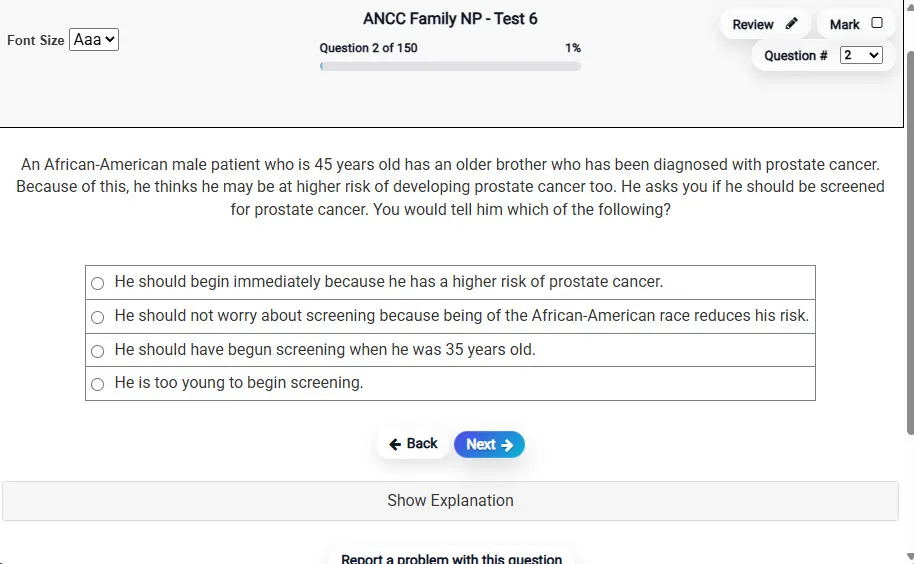
Answering a Question screen – Multiple-choice item view with navigation controls and progress tracker.
Answering a Question Multiple-choice item view with navigation controls and progress tracker.

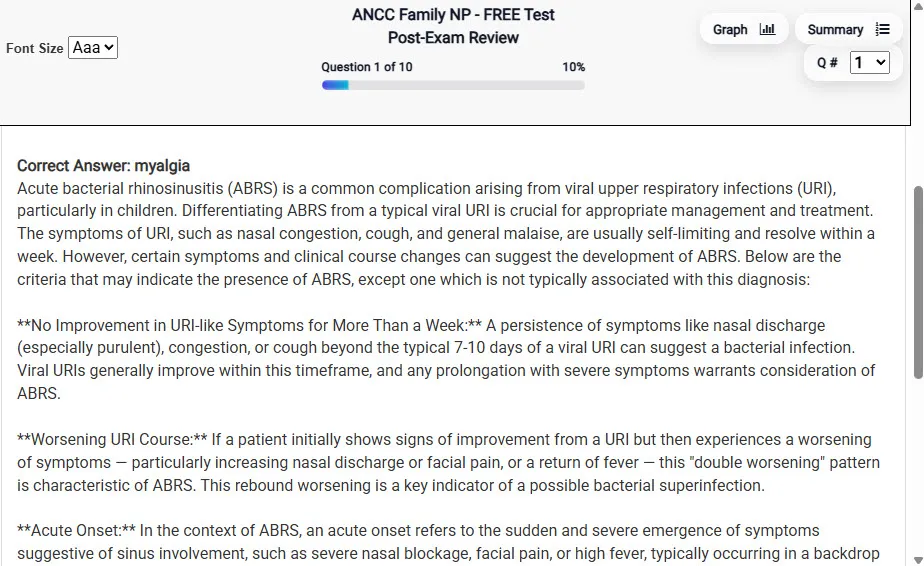
                           Detailed Explanation screen – 
                         Review mode showing chosen answer and rationale and references.
Detailed Explanation Review mode showing chosen answer and rationale and references.

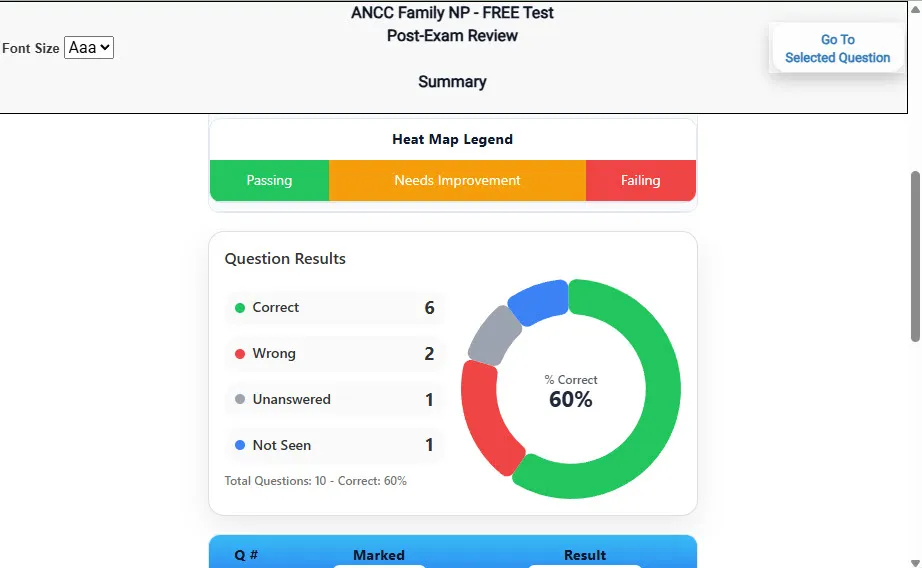
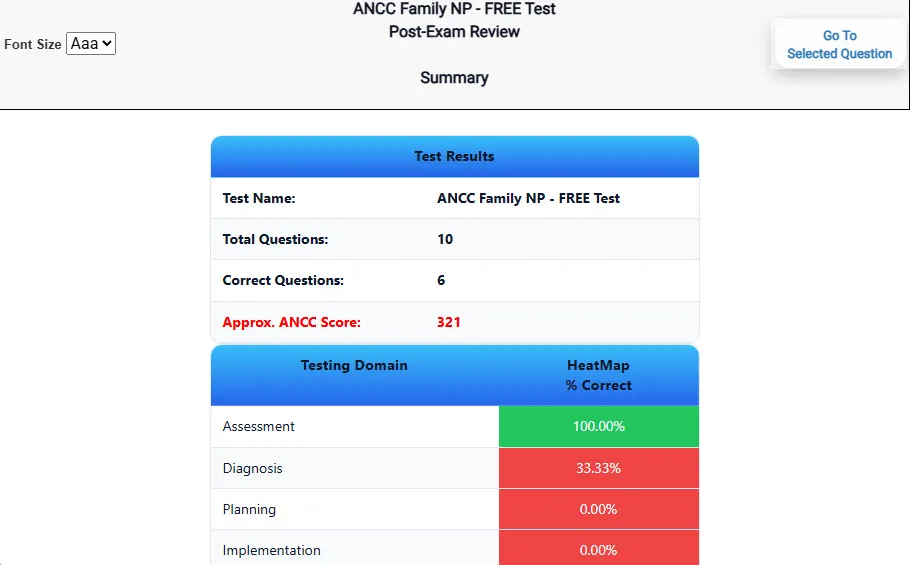
                           Review Summary 1 screen – 
                         Summary with counts for correct/wrong/unanswered and not seen items.
Review Summary 1 Summary with counts for correct/wrong/unanswered and not seen items.

                           Review Summary 2 screen – 
                         Advanced summary with category/domain breakdown and performance insights.
Review Summary 2 Advanced summary with category/domain breakdown and performance insights.

What Each Screen Shows

Answer Question Screen

  • Clean multiple-choice interface with progress bar.
  • Mark for review feature.
  • Matches real test pacing.

Detailed Explanation

  • Correct answer plus rationale.
  • Key concepts and guidelines highlighted.
  • Move between questions to fill knowledge gaps.

Review Summary 1

  • Overall results with total questions and scaled score.
  • Domain heatmap shows strengths and weaknesses.
  • Quick visual feedback on study priorities.

Review Summary 2

  • Chart of correct, wrong, unanswered, not seen.
  • Color-coded results for easy review.
  • Links back to missed items.

Top 10 Reasons to Use Exam Edge for your ORELA Chemistry Exam Prep

  1. Focused on the ORELA Chemistry Exam

    Our practice tests are built specifically for the ORELA Chemistry exam — every question mirrors the real topics, format, and difficulty so you're studying exactly what matters.

  2. Real Exam Simulation

    We match the per-question time limits and pressure of the actual ORELA exam, so test day feels familiar and stress-free.

  3. 15 Full Practice Tests & 1,875 Unique Questions

    You'll have more than enough material to master every ORELA Chemistry concept — no repeats, no fluff.

  4. Lower Cost Than a Retake

    Ordering 5 practice exams costs less than retaking the ORELA Chemistry exam after a failure. One low fee could save you both time and money.

  5. Flexible Testing

    Need to step away mid-exam? Pick up right where you left off — with your remaining time intact.

  6. Instant Scoring & Feedback

    See your raw score and an estimated ORELA Chemistry score immediately after finishing each practice test.

  7. Detailed Explanations for Every Question

    Review correct and incorrect answers with clear, step-by-step explanations so you truly understand each topic.

  8. Trusted & Accredited

    We're fully accredited by the Better Business Bureau and uphold the highest standards of trust and transparency.

  9. Web-Based & Always Available

    No software to install. Access your ORELA Chemistry practice exams 24/7 from any computer or mobile device.

  10. Expert Support When You Need It

    Need extra help? Our specialized tutors are highly qualified and ready to support your ORELA exam prep.


Pass the ORELA Chemistry Exam with Realistic Practice Tests from Exam Edge

Preparing for your upcoming ORELA Chemistry (306) Certification Exam can feel overwhelming — but the right practice makes all the difference. Exam Edge gives you the tools, structure, and confidence to pass on your first try. Our online practice exams are built to match the real ORELA Chemistry exam in content, format, and difficulty.

  • 📝 15 ORELA Chemistry Practice Tests: Access 15 full-length exams with 125 questions each, covering every major ORELA Chemistry topic in depth.
  • Instant Online Access: Start practicing right away — no software, no waiting.
  • 🧠 Step-by-Step Explanations: Understand the reasoning behind every correct answer so you can master ORELA Chemistry exam concepts.
  • 🔄 Retake Each Exam Up to 4 Times: Build knowledge through repetition and track your improvement over time.
  • 🌐 Web-Based & Available 24/7: Study anywhere, anytime, on any device.
  • 🧘 Boost Your Test-Day Confidence: Familiarity with the ORELA format reduces anxiety and helps you perform under pressure.

These ORELA Chemistry practice exams are designed to simulate the real testing experience by matching question types, timing, and difficulty level. This approach helps you get comfortable not just with the exam content, but also with the testing environment, so you walk into your exam day focused and confident.


Exam Edge ORELA Reviews


ORELA Chemistry Aliases Test Name

Here is a list of alternative names used for this exam.

  • ORELA Chemistry
  • ORELA Chemistry test
  • ORELA Chemistry Certification Test
  • ORELA
  • ORELA 306
  • 306 test
  • ORELA Chemistry (306)
  • Chemistry certification