This is the content of the pop-over!

OAE Elementary Education (018/019) Practice Tests & Test Prep by Exam Edge


OAE Elementary Education  product image
(5.0)
Based on 34 Reviews

  • Real Exam Simulation: Timed questions and matching content build comfort for your OAE Elementary Education test day.
  • Instant, 24/7 Access: Web-based OAE Elementary Education practice exams with no software needed.
  • Clear Explanations: Step-by-step answers and explanations for your OAE exam to strengthen understanding.
  • Boosted Confidence: Reduces anxiety and improves test-taking skills to ace your OAE Elementary Education (018/019).

Featured on

OAE Elementary Education Online Practice Test Bundles

BEST VALUE
10 practice tests

$99.50

$399.50

SAVE $300

Only $9.95 per test!

  • 100% Pass Guarantee
  • 10 online practice tests
  • 150 questions per test
  • Bonus: 100 Flash Cards + Study Guide
  • Instant access
  • Detailed Explanations
  • Practice tests never expire
  • Timed, untimed, or study guide mode
5 practice tests

$69.75

$199.75

SAVE $130

Only $13.95 per test!

  • 5 online practice tests
  • 150 questions per test
  • Bonus: 100 Flash Cards + Study Guide
  • Instant access
  • Detailed Explanations
  • Practice tests never expire
  • Timed, untimed, or study guide mode
1 practice test

$39.95

  • 1 online practice test
  • 150 questions per test
  • Instant access
  • Detailed Explanations
  • Practice tests never expire
  • Timed, untimed, or study guide mode
Quick Select
Tap to choose a bundle

** All Prices are in US Dollars (USD) **


OAE Elementary Education (018/019) Resources

Jump to the section you need most.

Understanding the exact breakdown of the OAE Elementary Education test will help you know what to expect and how to most effectively prepare. The OAE Elementary Education has 150 multiple-choice questions . The exam will be broken down into the sections below:

OAE Elementary Education Exam Blueprint
Domain Name % Number of
Questions
Elementary Education Subtest I  
     Reading and English Language Arts 62% 47
     Social Studies 38% 29
Elementary Education Subtest II  
     Mathematics 50% 38
     Science 38% 29
     The Arts - Health Fitness 12% 9

OAE Elementary Education Study Tips by Domain

  • Plan developmentally appropriate instruction by aligning objectives, materials, and assessments to standards and learner needs; red flag: activities that are engaging but don’t measure the stated objective.
  • Use formative assessment (e.g., exit tickets, quick checks) to adjust instruction in real time; common trap: waiting for a unit test before reteaching misconceptions.
  • Differentiate with targeted scaffolds (sentence frames, manipulatives, chunking) while maintaining grade-level expectations; priority rule: accommodations change access, not the learning target.
  • Apply principles of classroom management (clear routines, explicit expectations, positive reinforcement) to maximize instructional time; red flag: addressing behavior without teaching the procedure you expect.
  • Support diverse learners (IEP/504, multilingual learners, gifted) using data and documented plans; contraindication: implementing an IEP accommodation inconsistently or only during testing.
  • Meet legal/ethical responsibilities (confidentiality, mandated reporting, equitable practice) in everyday decisions; common trap: discussing student information with unauthorized staff or in public spaces.
  • Teach foundational skills systematically (phonological/phonemic awareness → phonics → fluency) and use decoding/encoding evidence to target instruction; red flag: relying on pictures/context cues as the primary word-reading strategy.
  • Build vocabulary with explicit instruction in morphemes (prefixes, roots, suffixes) and multiple exposures in varied contexts; common trap: treating memorization of weekly word lists as equivalent to transferable word knowledge.
  • Strengthen comprehension by aligning strategies to text type (story elements for narrative; main idea, structure, and evidence for informational) and require text-based answers; priority rule: claims must be supported with specific details from the passage.
  • Use formative assessment data (running records, miscue analysis, comprehension checks) to match readers to appropriately challenging texts; red flag: equating reading level with overall reading ability without considering accuracy, rate, and comprehension.
  • Teach the writing process (plan–draft–revise–edit–publish) with clear purpose, audience, and genre expectations; common trap: grading primarily for mechanics when the prompt assesses organization and development.
  • Integrate language conventions (grammar, usage, capitalization, punctuation) through authentic editing and sentence combining; contraindication: correcting every error in early drafts instead of prioritizing one or two high-impact patterns for reteaching.
  • Emphasize map and globe skills (scale, legends, latitude/longitude, and compass rose) and have students use them to answer location questions—red flag: confusing relative location (near/far) with absolute location (coordinates).
  • Teach civics through the U.S. Constitution’s structure (separation of powers, checks and balances, federalism) and connect to classroom examples—common trap: mixing up powers of state vs. federal government.
  • Cover core economic ideas (scarcity, opportunity cost, incentives, supply/demand) using simple scenarios—priority rule: always identify the trade-off when a choice is made.
  • In history, distinguish primary vs. secondary sources and evaluate purpose, audience, and bias—red flag: treating a source as “true” without corroboration.
  • Use timelines and chronology to compare events and cause/effect across eras (including Ohio and U.S. history)—common trap: assuming events that are close on a timeline are causally related.
  • In geography and culture, address how humans adapt to and modify environments (settlement, resources, migration) and the impacts—contraindication: oversimplifying culture to a single trait instead of multiple influences.
  • Know the Ohio Learning Standards progression for grades K–5 across ELA, math, science, and social studies—common trap: choosing an activity that is developmentally inappropriate for the grade band.
  • Differentiate instruction using data (screeners, formative checks, IEP/504 goals) and select the next instructional step—red flag: reteaching the same way after data show the misconception persists.
  • Apply assessment literacy: match purpose to tool (diagnostic vs. formative vs. summative) and use results to adjust instruction—priority rule: formative data should drive immediate feedback and regrouping.
  • Use effective literacy practices (phonological awareness/phonics/fluency/vocabulary/comprehension) and academic language supports—common trap: overrelying on context clues instead of explicit word analysis for struggling readers.
  • Manage classroom environment: establish routines, reinforce expectations, and respond to behavior with least intrusive supports first—red flag: escalating consequences without teaching the expected behavior.
  • Follow legal/ethical responsibilities (confidentiality, mandatory reporting, equitable access, IEP implementation) in school scenarios—contraindication: sharing student information beyond legitimate educational interest.
  • Prioritize conceptual understanding of place value and operations (e.g., regrouping, meaning of remainder)—red flag: treating multi-digit procedures as “steps” without explaining what each step represents.
  • Interpret fractions as numbers on a number line and as equal parts of a whole or set—common trap: adding/subtracting fractions by adding denominators or failing to use common denominators.
  • Use ratio, rate, and percent models (double number lines, tape diagrams) and justify reasonableness of results—priority rule: always check whether the answer should be greater/less than 100% (or the original amount).
  • Solve word problems with multiple representations (equations, tables, graphs) and label units throughout—red flag: dropping units leads to incorrect conversions or mismatched quantities.
  • Apply measurement and geometry with attention to attributes and formulas (area vs. perimeter, volume, angle measures)—common trap: using the right formula but the wrong dimension (e.g., perimeter formula for area).
  • Analyze data displays (bar graphs, line plots, dot plots) and describe center/variability appropriately—contraindication: claiming causation from a graph that shows only association or a trend.
  • Plan investigations that change only one variable at a time and include a fair comparison group; red flag: students claiming a “cause” without controlling variables or having repeatable data.
  • Emphasize measurement and data integrity (SI units, tools, multiple trials, and clear tables/graphs); common trap: mixing units or choosing the wrong instrument (e.g., using a ruler to estimate volume instead of a graduated cylinder).
  • Apply physical science ideas to everyday phenomena (forces, motion, energy transfer, simple circuits, properties of matter); priority rule: energy is transferred or transformed—not “used up.”
  • Connect Earth/space patterns (day/night, seasons, Moon phases, weather vs. climate, rock cycle) to models and observations; red flag: explaining seasons by Earth being closer to the Sun rather than Earth’s axial tilt.
  • Address life science across levels (cells → organisms → populations → ecosystems) including heredity and adaptations; common trap: confusing adaptation with individual choice or short-term change within a lifetime.
  • Use OAE-style classroom scenarios to select safe, developmentally appropriate lab practices and materials; contraindication: any activity that risks ingestion/inhalation or unmanaged electricity/heat without explicit safety procedures and supervision.
  • Use Ohio’s K–5 benchmarks mindset: emphasize skill progression (e.g., locomotor → manipulative → combinations) and flag lessons that skip prerequisite movement patterns as a common trap.
  • Health education focuses on decision-making and prevention—teach refusal skills and identifying trusted adults; red flag: memorizing facts without applying them to scenarios (peer pressure, media influence).
  • For fitness, distinguish health-related components (cardiorespiratory endurance, muscular strength/endurance, flexibility, body composition) from skill-related; common trap: calling BMI a “fitness test score” without noting limitations and privacy concerns.
  • In the arts, connect process and vocabulary (rhythm, texture, form, elements/principles) to student work; priority rule: assessment should include criteria-based rubrics, not just effort or neatness.
  • Safety and inclusion are tested often—use contraindications (asthma action plans, allergies, concussion protocols) and adaptive strategies; red flag: activities that require elimination games or unsafe equipment spacing.
  • Integrate cross-curricular goals appropriately (arts integration, health literacy) but keep standards-driven outcomes; common trap: “craft projects” that don’t teach an art concept or PE lessons that are active but lack skill instruction.


Built to Fit Into Your Busy Life

Everything you need to prepare with confidence—without wasting a minute.

Three Study Modes

Timed, No Time Limit, or Explanation mode.

Actionable Analytics

Heatmaps and scaled scores highlight weak areas.

High-Yield Rationales

Concise explanations emphasize key concepts.

Realistic Interface

Matches the feel of the actual exam environment.

Accessible by Design

Clean layout reduces cognitive load.

Anytime, Anywhere

Web-based access 24/7 on any device.
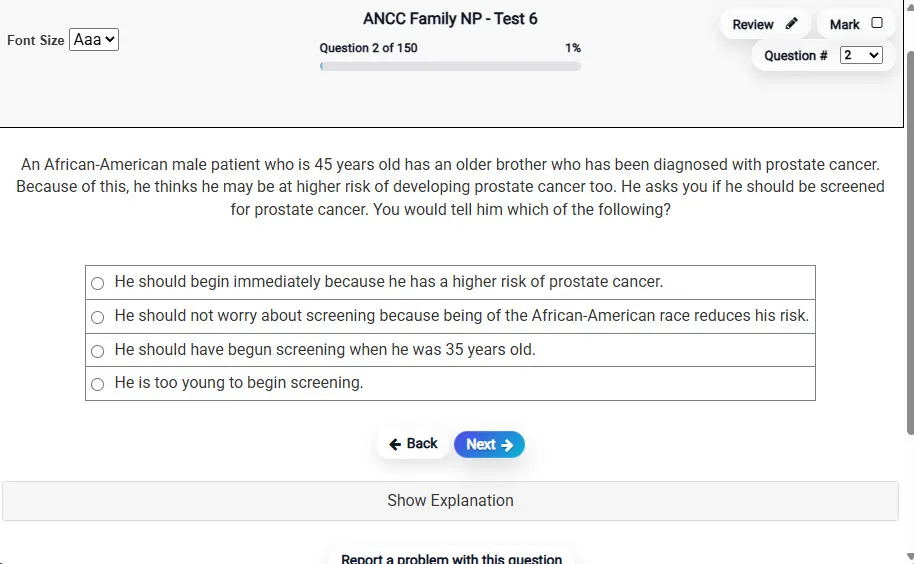
Answering a Question screen – Multiple-choice item view with navigation controls and progress tracker.
Answering a Question Multiple-choice item view with navigation controls and progress tracker.

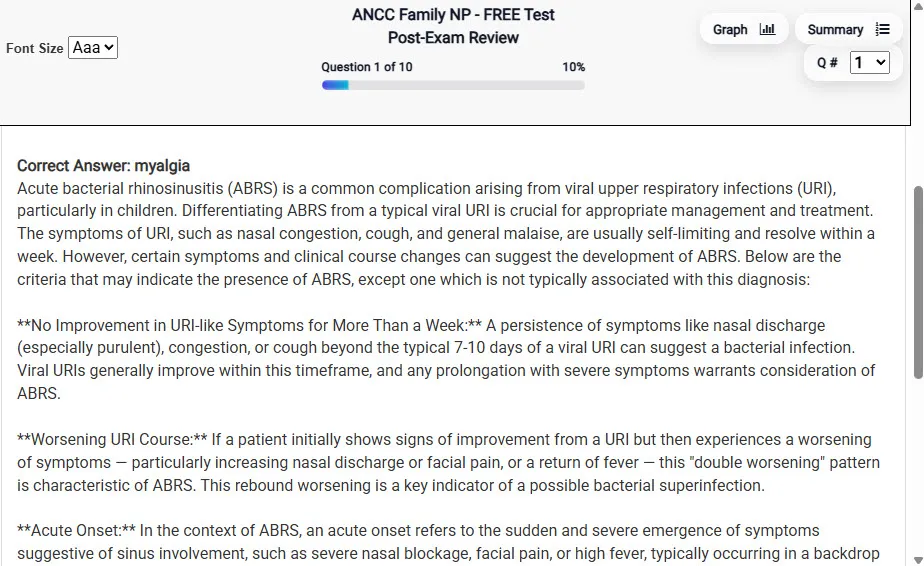
                           Detailed Explanation screen – 
                         Review mode showing chosen answer and rationale and references.
Detailed Explanation Review mode showing chosen answer and rationale and references.

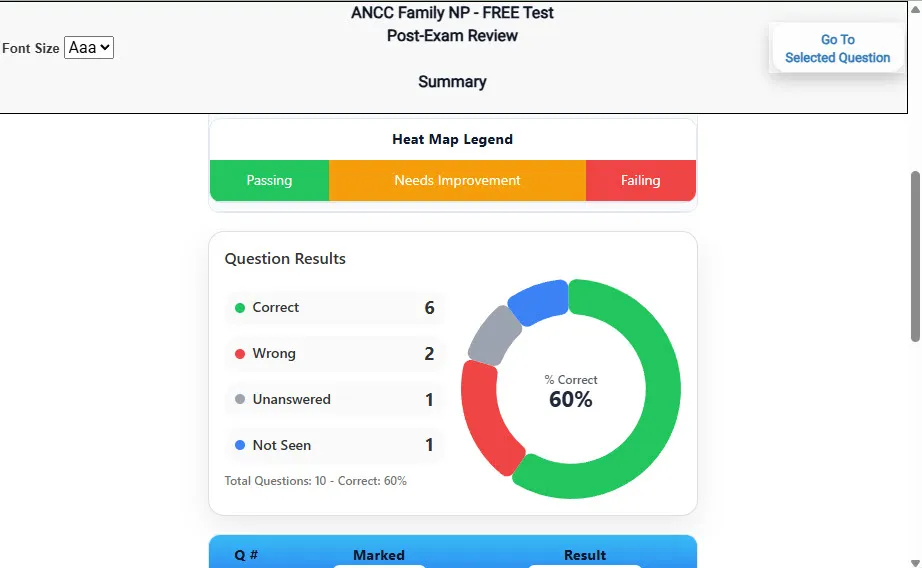
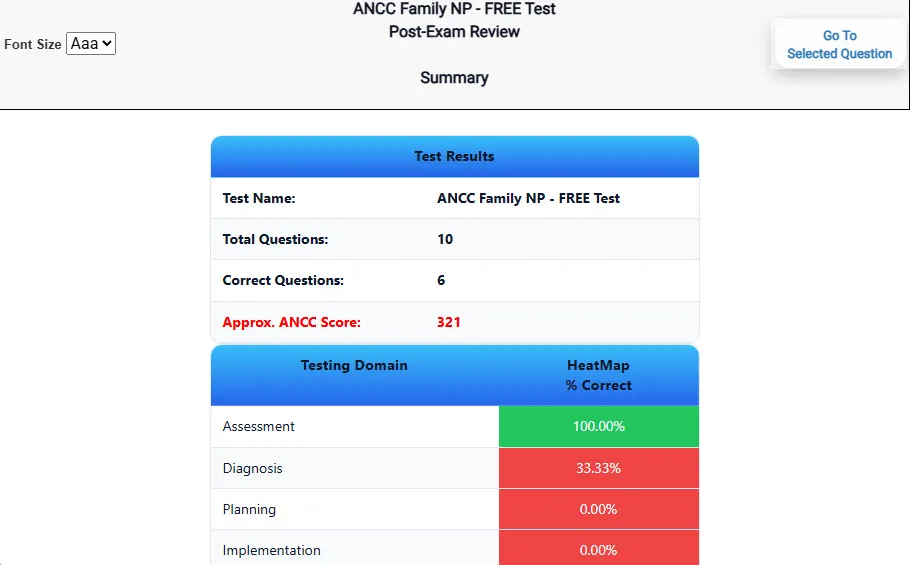
                           Review Summary 1 screen – 
                         Summary with counts for correct/wrong/unanswered and not seen items.
Review Summary 1 Summary with counts for correct/wrong/unanswered and not seen items.

                           Review Summary 2 screen – 
                         Advanced summary with category/domain breakdown and performance insights.
Review Summary 2 Advanced summary with category/domain breakdown and performance insights.

What Each Screen Shows

Answer Question Screen

  • Clean multiple-choice interface with progress bar.
  • Mark for review feature.
  • Matches real test pacing.

Detailed Explanation

  • Correct answer plus rationale.
  • Key concepts and guidelines highlighted.
  • Move between questions to fill knowledge gaps.

Review Summary 1

  • Overall results with total questions and scaled score.
  • Domain heatmap shows strengths and weaknesses.
  • Quick visual feedback on study priorities.

Review Summary 2

  • Chart of correct, wrong, unanswered, not seen.
  • Color-coded results for easy review.
  • Links back to missed items.

Top 10 Reasons to Use Exam Edge for your OAE Elementary Education Exam Prep

  1. Focused on the OAE Elementary Education Exam

    Our practice tests are built specifically for the OAE Elementary Education exam — every question mirrors the real topics, format, and difficulty so you're studying exactly what matters.

  2. Real Exam Simulation

    We match the per-question time limits and pressure of the actual OAE exam, so test day feels familiar and stress-free.

  3. 10 Full Practice Tests & 1,500 Unique Questions

    You'll have more than enough material to master every OAE Elementary Education concept — no repeats, no fluff.

  4. Lower Cost Than a Retake

    Ordering 5 practice exams costs less than retaking the OAE Elementary Education exam after a failure. One low fee could save you both time and money.

  5. Flexible Testing

    Need to step away mid-exam? Pick up right where you left off — with your remaining time intact.

  6. Instant Scoring & Feedback

    See your raw score and an estimated OAE Elementary Education score immediately after finishing each practice test.

  7. Detailed Explanations for Every Question

    Review correct and incorrect answers with clear, step-by-step explanations so you truly understand each topic.

  8. Trusted & Accredited

    We're fully accredited by the Better Business Bureau and uphold the highest standards of trust and transparency.

  9. Web-Based & Always Available

    No software to install. Access your OAE Elementary Education practice exams 24/7 from any computer or mobile device.

  10. Expert Support When You Need It

    Need extra help? Our specialized tutors are highly qualified and ready to support your OAE exam prep.


Pass the OAE Elementary Education Exam with Realistic Practice Tests from Exam Edge

Preparing for your upcoming OAE Elementary Education (018/019) Certification Exam can feel overwhelming — but the right practice makes all the difference. Exam Edge gives you the tools, structure, and confidence to pass on your first try. Our online practice exams are built to match the real OAE Elementary Education exam in content, format, and difficulty.

  • 📝 10 OAE Elementary Education Practice Tests: Access 10 full-length exams with 150 questions each, covering every major OAE Elementary Education topic in depth.
  • Instant Online Access: Start practicing right away — no software, no waiting.
  • 🧠 Step-by-Step Explanations: Understand the reasoning behind every correct answer so you can master OAE Elementary Education exam concepts.
  • 🔄 Retake Each Exam Up to 4 Times: Build knowledge through repetition and track your improvement over time.
  • 🌐 Web-Based & Available 24/7: Study anywhere, anytime, on any device.
  • 🧘 Boost Your Test-Day Confidence: Familiarity with the OAE format reduces anxiety and helps you perform under pressure.

These OAE Elementary Education practice exams are designed to simulate the real testing experience by matching question types, timing, and difficulty level. This approach helps you get comfortable not just with the exam content, but also with the testing environment, so you walk into your exam day focused and confident.


Exam Edge OAE Reviews


Great program to study from. Audio and images REALLY boosted my understanding of subjects.

Cherish , NEWARK, OH

Today, I took my test and passed with confidence. I took it the first time and failed, but after purchasing this study guide, I was provided with resources that allowed me to take the test and get through it without being nervous. A lot of the questions that were provided in this study guide were si ...
Read More
Stephanie , Ohio

Studied a practice test everyday, and passed my test!

Gracyn, Clinton, Ohio


OAE Elementary Education Aliases Test Name

Here is a list of alternative names used for this exam.

  • OAE Elementary Education
  • OAE Elementary Education test
  • OAE Elementary Education Certification Test
  • OAE
  • OAE 018/019
  • 018/019 test
  • OAE Elementary Education (018/019)
  • Elementary Education certification