This is the content of the pop-over!

OAE Earth and Space Science (014) Practice Tests & Test Prep by Exam Edge


OAE Earth and Space Science  product image
(5.0)
Based on 29 Reviews

  • Real Exam Simulation: Timed questions and matching content build comfort for your OAE Earth and Space Science test day.
  • Instant, 24/7 Access: Web-based OAE Earth and Space Science practice exams with no software needed.
  • Clear Explanations: Step-by-step answers and explanations for your OAE exam to strengthen understanding.
  • Boosted Confidence: Reduces anxiety and improves test-taking skills to ace your OAE Earth and Space Science (014).

Featured on

OAE Earth and Space Science Online Practice Test Bundles

BEST VALUE
15 practice tests

$149.25

$599.25

SAVE $450

Only $9.95 per test!

  • 100% Pass Guarantee
  • 15 online practice tests
  • 100 questions per test
  • Bonus: 100 Flash Cards + Study Guide
  • Instant access
  • Detailed Explanations
  • Practice tests never expire
  • Timed, untimed, or study guide mode
MOST POPULAR
10 practice tests

$99.50

$399.50

SAVE $300

Only $9.95 per test!

  • 10 online practice tests
  • 100 questions per test
  • Bonus: 100 Flash Cards + Study Guide
  • Instant access
  • Detailed Explanations
  • Practice tests never expire
  • Timed, untimed, or study guide mode
5 practice tests

$69.75

$199.75

SAVE $130

Only $13.95 per test!

  • 5 online practice tests
  • 100 questions per test
  • Bonus: 100 Flash Cards
  • Instant access
  • Detailed Explanations
  • Practice tests never expire
  • Timed, untimed, or study guide mode
1 practice test

$39.95

  • 1 online practice test
  • 100 questions per test
  • Instant access
  • Detailed Explanations
  • Practice tests never expire
  • Timed, untimed, or study guide mode
Quick Select
Tap to choose a bundle

** All Prices are in US Dollars (USD) **


OAE Earth and Space Science (014) Resources

Jump to the section you need most.

Understanding the exact breakdown of the OAE Earth and Space Science test will help you know what to expect and how to most effectively prepare. The OAE Earth and Space Science has 150 multiple-choice questions . The exam will be broken down into the sections below:

OAE Earth and Space Science Exam Blueprint
Domain Name % Number of
Questions
Nature of Science 18% 27
Geology 25% 38
Oceanography and Freshwater Systems 19% 29
The Atmosphere - Weather Climate 19% 29
Astronomy 19% 29

OAE Earth and Space Science Study Tips by Domain

  • Differentiate observation vs. inference vs. hypothesis vs. theory vs. law; red flag: treating a “theory” as a guess rather than a well-supported explanatory framework.
  • Identify controlled variables, independent/dependent variables, and appropriate controls; common trap: changing more than one variable at a time and still claiming causation.
  • Evaluate data quality using precision, accuracy, and uncertainty/error bars; priority rule: conclusions must match the measurement limits (don’t overclaim beyond significant figures).
  • Assess experimental design and bias (sampling bias, confirmation bias, instrument calibration); red flag: a nonrandom or too-small sample used to generalize to a whole population.
  • Interpret graphs, models, and correlations correctly; common trap: assuming correlation implies causation without a plausible mechanism and supporting evidence.
  • Understand scientific argumentation and peer review (replication, falsifiability, revision with new evidence); priority rule: extraordinary claims require strong, reproducible evidence—single studies are not definitive.
  • Apply relative dating (superposition, cross-cutting, inclusions) to sequence events; red flag: an intrusion or fault is always younger than the rocks it cuts.
  • Use radiometric dating by matching parent–daughter ratios and half-life logic; common trap: confusing half-life with absolute age or assuming a constant daughter starting amount when not stated.
  • Identify plate-boundary features (subduction arcs, rift valleys, transform faults) from maps and seismic/volcanic patterns; priority rule: deep-focus earthquakes indicate subduction, not transform motion.
  • Distinguish rock types by formation process and texture (igneous cooling rate, sedimentary layering/fossils, metamorphic foliation); red flag: foliation indicates directed pressure, not just heat.
  • Infer stress and deformation from structures (folds, normal/reverse/strike-slip faults) and relate them to tectonic settings; common trap: mixing up hanging wall movement on normal vs. reverse faults.
  • Evaluate surficial processes and hazards (weathering, mass wasting, rivers, glaciers) using slope, saturation, and energy; contraindication: saturated, steep slopes with recent disturbance are high landslide risk even without heavy rain.
  • Differentiate salinity and density drivers of stratification and circulation—red flag: assuming warmer water is always less dense; in seawater, higher salinity can outweigh temperature.
  • Apply Coriolis effects on surface currents and Ekman transport (net flow ~90° to wind in NH)—common trap: drawing the same deflection direction in both hemispheres.
  • Explain tides using the Earth–Moon system (two bulges; spring vs. neap tides)—priority rule: alignments (new/full moon) produce spring tides, not the Moon’s distance alone.
  • Link upwelling/downwelling to wind patterns and productivity—red flag: expecting highest surface nutrients in strongly stratified waters; nutrient replenishment typically requires mixing or upwelling.
  • Use watershed and stream concepts (drainage basins, discharge, baseflow vs. runoff)—common trap: confusing velocity with discharge; discharge = area × velocity.
  • Assess freshwater quality indicators (DO, BOD, turbidity, pH, nitrates/phosphates) and eutrophication—contraindication: low DO with high BOD signals organic pollution and potential fish kills.
  • Distinguish weather from climate: weather is short-term conditions, climate is long-term patterns (typically ≥30 years)—red flag: calling a single storm or cold week “proof” of climate change.
  • Apply pressure-gradient, Coriolis, and friction to wind: surface winds cross isobars toward lower pressure, while upper-level winds are closer to geostrophic—common trap: assuming Coriolis changes wind speed rather than direction.
  • Use stability and lifting mechanisms (fronts, orographic lift, convergence, convection) to predict clouds and precipitation—priority rule: rising air cools adiabatically, so saturation/condensation occurs when temperature reaches the dew point.
  • Interpret fronts and air masses on weather maps: cold fronts typically bring narrow bands of intense precipitation and a temperature drop, warm fronts bring widespread stratiform clouds—red flag: mixing up the direction the front moves with the direction the wind blows.
  • Relate humidity measures: relative humidity depends on temperature, while dew point is a more direct indicator of moisture content—common trap: claiming relative humidity must rise when more water vapor is added even if temperature also increases.
  • Connect global circulation and ocean–atmosphere patterns to climate: Hadley/Ferrel/Polar cells, jet streams, and ENSO shift storm tracks and precipitation—threshold cue: El Niño/La Niña typically require sustained equatorial Pacific SST anomalies (about ±0.5 °C) over multiple months.
  • Use Kepler’s laws to relate orbital period, distance, and speed—red flag: mixing up perihelion vs. aphelion (objects move fastest at perihelion).
  • Apply H–R diagram logic (color/temperature vs. luminosity) to infer stellar size and life stage—common trap: assuming brighter always means hotter (giants can be cool but luminous).
  • Know how parallax measures distance and why it fails for very distant stars—priority rule: larger parallax angle means closer star; tiny angles are measurement-limited.
  • Distinguish electromagnetic spectrum observations (radio, IR, visible, UV, X-ray) by what they reveal—red flag: claiming ground-based telescopes can observe most UV/X-rays (atmosphere blocks them).
  • Explain phases of the Moon and eclipses using Sun–Earth–Moon geometry—common trap: attributing Moon phases to Earth’s shadow (that’s eclipses only).
  • Relate redshift to recessional velocity and expanding-universe evidence—threshold cue: larger redshift generally indicates greater distance/velocity, but don’t apply Hubble’s law to nearby bound systems like the Milky Way.


Built to Fit Into Your Busy Life

Everything you need to prepare with confidence—without wasting a minute.

Three Study Modes

Timed, No Time Limit, or Explanation mode.

Actionable Analytics

Heatmaps and scaled scores highlight weak areas.

High-Yield Rationales

Concise explanations emphasize key concepts.

Realistic Interface

Matches the feel of the actual exam environment.

Accessible by Design

Clean layout reduces cognitive load.

Anytime, Anywhere

Web-based access 24/7 on any device.
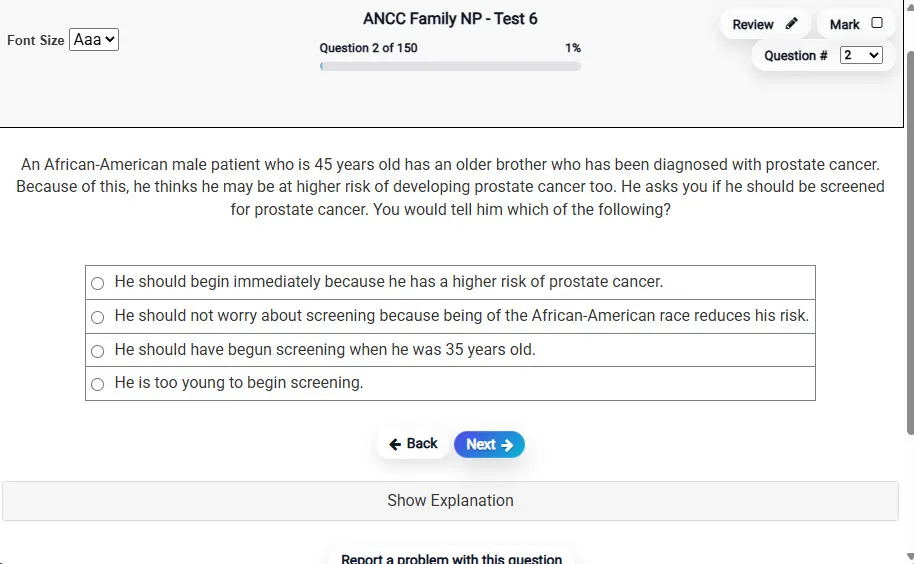
Answering a Question screen – Multiple-choice item view with navigation controls and progress tracker.
Answering a Question Multiple-choice item view with navigation controls and progress tracker.

                           Detailed Explanation screen – 
                         Review mode showing chosen answer and rationale and references.
Detailed Explanation Review mode showing chosen answer and rationale and references.

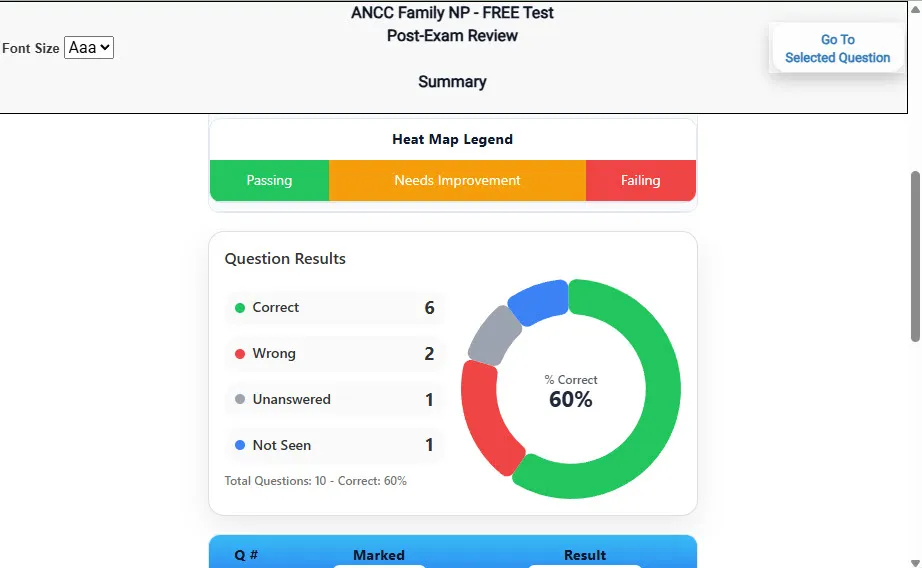
                           Review Summary 1 screen – 
                         Summary with counts for correct/wrong/unanswered and not seen items.
Review Summary 1 Summary with counts for correct/wrong/unanswered and not seen items.

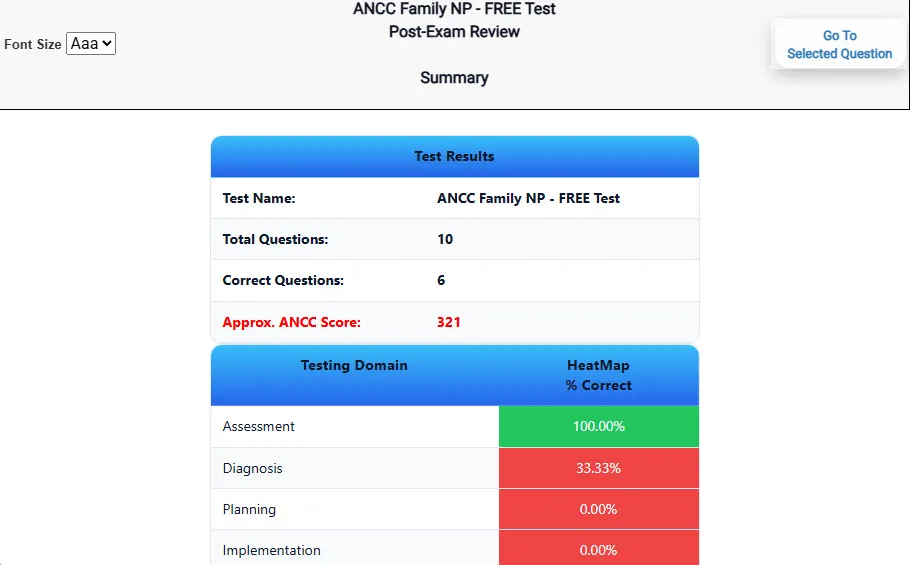
                           Review Summary 2 screen – 
                         Advanced summary with category/domain breakdown and performance insights.
Review Summary 2 Advanced summary with category/domain breakdown and performance insights.

What Each Screen Shows

Answer Question Screen

  • Clean multiple-choice interface with progress bar.
  • Mark for review feature.
  • Matches real test pacing.

Detailed Explanation

  • Correct answer plus rationale.
  • Key concepts and guidelines highlighted.
  • Move between questions to fill knowledge gaps.

Review Summary 1

  • Overall results with total questions and scaled score.
  • Domain heatmap shows strengths and weaknesses.
  • Quick visual feedback on study priorities.

Review Summary 2

  • Chart of correct, wrong, unanswered, not seen.
  • Color-coded results for easy review.
  • Links back to missed items.

Top 10 Reasons to Use Exam Edge for your OAE Earth and Space Science Exam Prep

  1. Focused on the OAE Earth and Space Science Exam

    Our practice tests are built specifically for the OAE Earth and Space Science exam — every question mirrors the real topics, format, and difficulty so you're studying exactly what matters.

  2. Real Exam Simulation

    We match the per-question time limits and pressure of the actual OAE exam, so test day feels familiar and stress-free.

  3. 15 Full Practice Tests & 1,500 Unique Questions

    You'll have more than enough material to master every OAE Earth and Space Science concept — no repeats, no fluff.

  4. Lower Cost Than a Retake

    Ordering 5 practice exams costs less than retaking the OAE Earth and Space Science exam after a failure. One low fee could save you both time and money.

  5. Flexible Testing

    Need to step away mid-exam? Pick up right where you left off — with your remaining time intact.

  6. Instant Scoring & Feedback

    See your raw score and an estimated OAE Earth and Space Science score immediately after finishing each practice test.

  7. Detailed Explanations for Every Question

    Review correct and incorrect answers with clear, step-by-step explanations so you truly understand each topic.

  8. Trusted & Accredited

    We're fully accredited by the Better Business Bureau and uphold the highest standards of trust and transparency.

  9. Web-Based & Always Available

    No software to install. Access your OAE Earth and Space Science practice exams 24/7 from any computer or mobile device.

  10. Expert Support When You Need It

    Need extra help? Our specialized tutors are highly qualified and ready to support your OAE exam prep.


Pass the OAE Earth and Space Science Exam with Realistic Practice Tests from Exam Edge

Preparing for your upcoming OAE Earth and Space Science (014) Certification Exam can feel overwhelming — but the right practice makes all the difference. Exam Edge gives you the tools, structure, and confidence to pass on your first try. Our online practice exams are built to match the real OAE Earth and Space Science exam in content, format, and difficulty.

  • 📝 15 OAE Earth and Space Science Practice Tests: Access 15 full-length exams with 100 questions each, covering every major OAE Earth and Space Science topic in depth.
  • Instant Online Access: Start practicing right away — no software, no waiting.
  • 🧠 Step-by-Step Explanations: Understand the reasoning behind every correct answer so you can master OAE Earth and Space Science exam concepts.
  • 🔄 Retake Each Exam Up to 4 Times: Build knowledge through repetition and track your improvement over time.
  • 🌐 Web-Based & Available 24/7: Study anywhere, anytime, on any device.
  • 🧘 Boost Your Test-Day Confidence: Familiarity with the OAE format reduces anxiety and helps you perform under pressure.

These OAE Earth and Space Science practice exams are designed to simulate the real testing experience by matching question types, timing, and difficulty level. This approach helps you get comfortable not just with the exam content, but also with the testing environment, so you walk into your exam day focused and confident.


Exam Edge OAE Reviews


Today, I took my test and passed with confidence. I took it the first time and failed, but after purchasing this study guide, I was provided with resources that allowed me to take the test and get through it without being nervous. A lot of the questions that were provided in this study guide were si ...
Read More
Stephanie , Ohio

Studied a practice test everyday, and passed my test!

Gracyn, Clinton, Ohio

Great program to study from. Audio and images REALLY boosted my understanding of subjects.

Cherish , NEWARK, OH


OAE Earth and Space Science Aliases Test Name

Here is a list of alternative names used for this exam.

  • OAE Earth and Space Science
  • OAE Earth and Space Science test
  • OAE Earth and Space Science Certification Test
  • OAE
  • OAE 014
  • 014 test
  • OAE Earth and Space Science (014)
  • Earth and Space Science certification