This is the content of the pop-over!

OAE Chemistry (009) Practice Tests & Test Prep by Exam Edge


OAE Chemistry  product image
(5.0)
Based on 22 Reviews

  • Real Exam Simulation: Timed questions and matching content build comfort for your OAE Chemistry test day.
  • Instant, 24/7 Access: Web-based OAE Chemistry practice exams with no software needed.
  • Clear Explanations: Step-by-step answers and explanations for your OAE exam to strengthen understanding.
  • Boosted Confidence: Reduces anxiety and improves test-taking skills to ace your OAE Chemistry (009).

Featured on

OAE Chemistry Online Practice Test Bundles

BEST VALUE
15 practice tests

$149.25

$599.25

SAVE $450

Only $9.95 per test!

  • 100% Pass Guarantee
  • 15 online practice tests
  • 125 questions per test
  • Bonus: 100 Flash Cards + Study Guide
  • Instant access
  • Detailed Explanations
  • Practice tests never expire
  • Timed, untimed, or study guide mode
MOST POPULAR
10 practice tests

$99.50

$399.50

SAVE $300

Only $9.95 per test!

  • 10 online practice tests
  • 125 questions per test
  • Bonus: 100 Flash Cards + Study Guide
  • Instant access
  • Detailed Explanations
  • Practice tests never expire
  • Timed, untimed, or study guide mode
5 practice tests

$69.75

$199.75

SAVE $130

Only $13.95 per test!

  • 5 online practice tests
  • 125 questions per test
  • Bonus: 100 Flash Cards
  • Instant access
  • Detailed Explanations
  • Practice tests never expire
  • Timed, untimed, or study guide mode
1 practice test

$39.95

  • 1 online practice test
  • 125 questions per test
  • Instant access
  • Detailed Explanations
  • Practice tests never expire
  • Timed, untimed, or study guide mode
Quick Select
Tap to choose a bundle

** All Prices are in US Dollars (USD) **


OAE Chemistry (009) Resources

Jump to the section you need most.

Understanding the exact breakdown of the OAE Chemistry test will help you know what to expect and how to most effectively prepare. The OAE Chemistry has 150 multiple-choice questions . The exam will be broken down into the sections below:

OAE Chemistry Exam Blueprint
Domain Name % Number of
Questions
Nature of Science 18% 27
Matter and Atomic Structure 18% 27
Energy and Chemical Bonding 23% 35
Chemical Reactions 23% 35
Stoichiometry and Solutions 18% 27

OAE Chemistry Study Tips by Domain

  • Distinguish observation vs. inference and hypothesis vs. theory vs. law—common trap: calling a well-supported theory (e.g., atomic theory) a “guess” because it isn’t a law.
  • Evaluate experimental design by identifying independent/dependent variables and controlled constants—red flag: changing more than one factor at a time makes causal claims invalid.
  • Use proper data treatment (significant figures, uncertainty, and error types)—priority rule: don’t report more precision than your least precise measurement supports.
  • Interpret graphs/tables with units and scales and check for linear vs. nonlinear trends—common trap: concluding proportionality from a straight-looking plot that has a truncated axis.
  • Assess validity and reliability through replication, sample size, and peer review—red flag: a single trial or anecdotal result is insufficient for a strong scientific claim.
  • Apply chemistry safety, ethics, and responsible conduct (SDS, PPE, waste disposal, data integrity)—contraindication: never mix unknown chemicals or dispose of reactive/metal wastes down the drain.
  • Use the periodic table to predict common ion charges and trends (atomic radius, ionization energy, electronegativity); red flag: mixing up size trends—radius increases down a group but decreases across a period.
  • Relate isotope notation to nuclear composition (A = p + n; Z = p) and compute average atomic mass from percent abundance; common trap: using mass number instead of isotopic mass in the weighted average.
  • Write electron configurations (including noble-gas shorthand) and identify valence electrons for main-group elements; priority rule: apply Aufbau, Pauli, and Hund—don’t pair electrons in degenerate orbitals before single occupancy.
  • Connect spectral lines and photon energy to electronic transitions using E = hν and c = λν; red flag: longer wavelength means lower energy (inverse relationship).
  • Distinguish among atomic models (Dalton, Thomson, Rutherford, Bohr, quantum mechanical) and what evidence supports each; common trap: attributing fixed circular orbits to the quantum model rather than orbitals (probability distributions).
  • Use the mole concept with atomic/molar masses and Avogadro’s number to convert between atoms, moles, and mass; threshold cue: always label units—errors often come from skipping unit cancellation in multi-step conversions.
  • Use periodic trends (electronegativity, atomic radius, ionization energy) to predict bond type and polarity; red flag: treating ionic compounds as discrete molecules instead of extended lattices.
  • Apply Lewis structures, formal charge, and resonance to evaluate plausible bonding/structure; common trap: violating the octet rule without checking allowed exceptions (e.g., B, expanded octets for period 3+).
  • Relate molecular geometry (VSEPR) and hybridization to polarity and intermolecular forces; priority rule: strong H-bonding requires H directly bonded to N, O, or F—not merely present in the formula.
  • Compare intermolecular forces (London, dipole-dipole, H-bonding, ion-dipole) to explain boiling/melting points and solubility; red flag: assuming higher molar mass always means higher boiling point regardless of polarity/IMFs.
  • Use thermochemical concepts (bond energies, Hess’s law, enthalpy signs) to connect bonding changes to energy flow; common trap: reversing sign conventions for exothermic vs. endothermic processes.
  • Connect phase changes and heating curves to particle-level energy (kinetic vs. potential) and bonding/IMFs; threshold cue: during a phase change, temperature stays constant while energy goes into overcoming attractions.
  • Classify reactions quickly (synthesis, decomposition, single/double replacement, combustion) by tracking which species change partners; red flag: calling any acid + base a “replacement” instead of neutralization (salt + water).
  • Balance equations by conserving atoms and net charge, especially for ionic equations; common trap: leaving spectator ions in the net ionic equation or mismatching charge in redox half-reactions.
  • Predict products using activity series and solubility rules; priority rule: a reaction is driven when a precipitate, gas, or weak electrolyte (e.g., H2O) forms—if none form, expect “no reaction.”
  • Identify oxidation numbers and oxidizing/reducing agents in redox processes; red flag: confusing the species oxidized (loses e, oxidation number increases) with the oxidizing agent (gets reduced).
  • Apply equilibrium qualitatively with Le Châtelier’s principle; contraindication: adding a catalyst does not shift equilibrium—it only speeds reaching it.
  • Use reaction-rate factors (concentration, temperature, surface area, catalysts) and interpret simple rate laws; common trap: assuming a higher coefficient in the balanced equation automatically means a higher reaction order.
  • Balance the equation first, then use molar ratios for stoichiometry; red flag: doing mass-to-mass conversions without converting to moles.
  • Identify the limiting reagent by comparing moles available per stoichiometric coefficient; common trap: picking the reactant with the smaller mass instead of the smaller “reaction extent.”
  • Compute theoretical yield from the limiting reagent and percent yield = (actual/theoretical)×100%; OAE-style trap: using grams in the ratio rather than moles.
  • For solutions, use M = mol/L and track dilution with M1V1 = M2V2; red flag: mixing mL and L without unit conversion.
  • For titrations, use balanced-equation mole ratios to relate analyte and titrant at equivalence; priority rule: equivalence means stoichiometric consumption, not necessarily pH 7.
  • Handle solubility with Ksp, Q, and the common-ion effect; contraindication: assuming a precipitate forms without checking whether Q > Ksp.


Built to Fit Into Your Busy Life

Everything you need to prepare with confidence—without wasting a minute.

Three Study Modes

Timed, No Time Limit, or Explanation mode.

Actionable Analytics

Heatmaps and scaled scores highlight weak areas.

High-Yield Rationales

Concise explanations emphasize key concepts.

Realistic Interface

Matches the feel of the actual exam environment.

Accessible by Design

Clean layout reduces cognitive load.

Anytime, Anywhere

Web-based access 24/7 on any device.
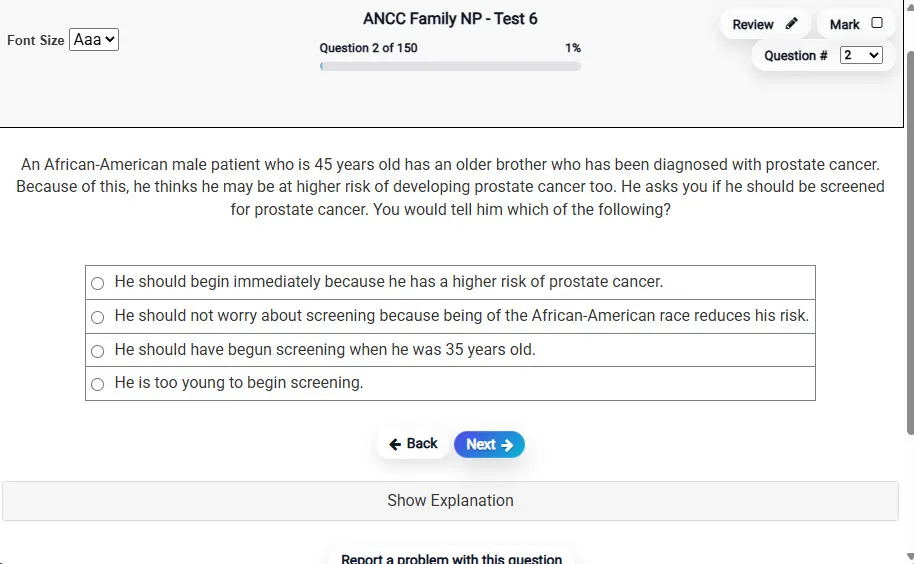
Answering a Question screen – Multiple-choice item view with navigation controls and progress tracker.
Answering a Question Multiple-choice item view with navigation controls and progress tracker.

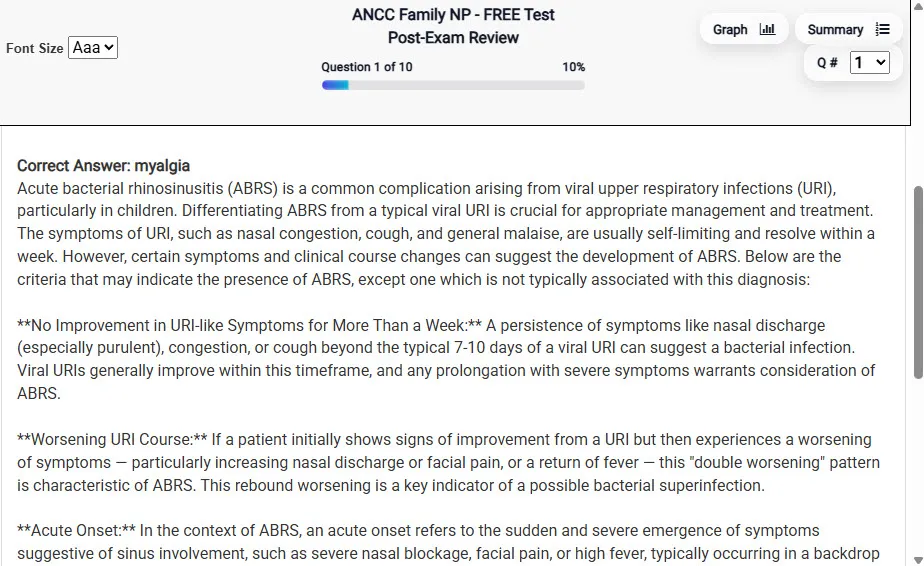
                           Detailed Explanation screen – 
                         Review mode showing chosen answer and rationale and references.
Detailed Explanation Review mode showing chosen answer and rationale and references.

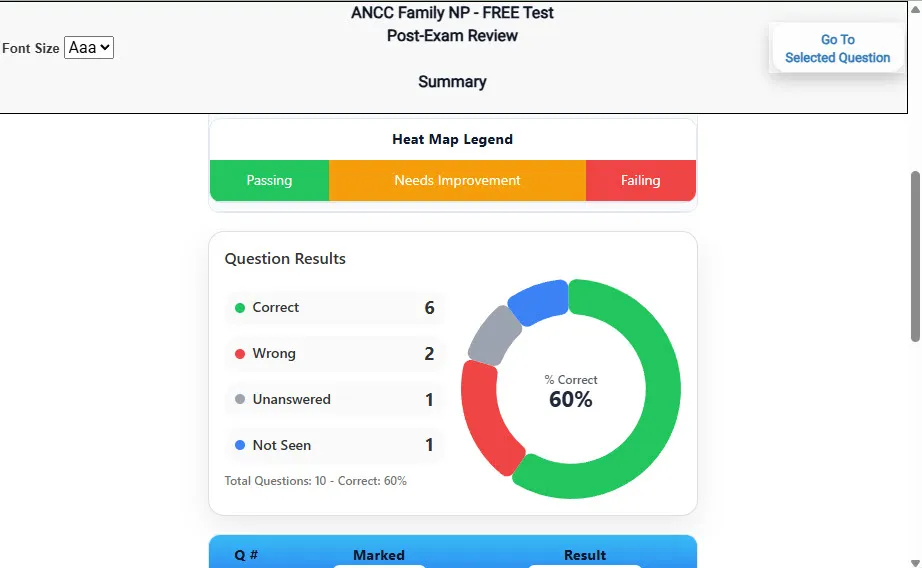
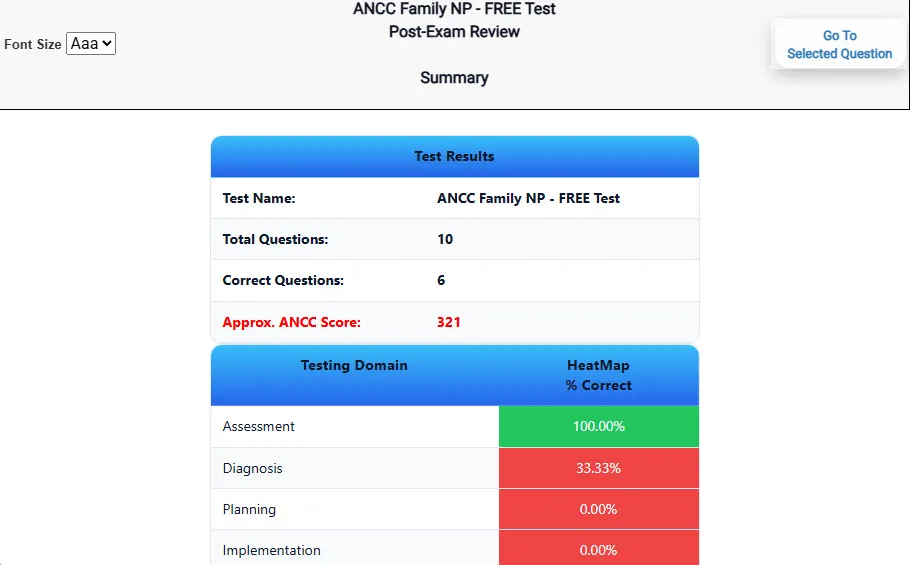
                           Review Summary 1 screen – 
                         Summary with counts for correct/wrong/unanswered and not seen items.
Review Summary 1 Summary with counts for correct/wrong/unanswered and not seen items.

                           Review Summary 2 screen – 
                         Advanced summary with category/domain breakdown and performance insights.
Review Summary 2 Advanced summary with category/domain breakdown and performance insights.

What Each Screen Shows

Answer Question Screen

  • Clean multiple-choice interface with progress bar.
  • Mark for review feature.
  • Matches real test pacing.

Detailed Explanation

  • Correct answer plus rationale.
  • Key concepts and guidelines highlighted.
  • Move between questions to fill knowledge gaps.

Review Summary 1

  • Overall results with total questions and scaled score.
  • Domain heatmap shows strengths and weaknesses.
  • Quick visual feedback on study priorities.

Review Summary 2

  • Chart of correct, wrong, unanswered, not seen.
  • Color-coded results for easy review.
  • Links back to missed items.

Top 10 Reasons to Use Exam Edge for your OAE Chemistry Exam Prep

  1. Focused on the OAE Chemistry Exam

    Our practice tests are built specifically for the OAE Chemistry exam — every question mirrors the real topics, format, and difficulty so you're studying exactly what matters.

  2. Real Exam Simulation

    We match the per-question time limits and pressure of the actual OAE exam, so test day feels familiar and stress-free.

  3. 15 Full Practice Tests & 1,875 Unique Questions

    You'll have more than enough material to master every OAE Chemistry concept — no repeats, no fluff.

  4. Lower Cost Than a Retake

    Ordering 5 practice exams costs less than retaking the OAE Chemistry exam after a failure. One low fee could save you both time and money.

  5. Flexible Testing

    Need to step away mid-exam? Pick up right where you left off — with your remaining time intact.

  6. Instant Scoring & Feedback

    See your raw score and an estimated OAE Chemistry score immediately after finishing each practice test.

  7. Detailed Explanations for Every Question

    Review correct and incorrect answers with clear, step-by-step explanations so you truly understand each topic.

  8. Trusted & Accredited

    We're fully accredited by the Better Business Bureau and uphold the highest standards of trust and transparency.

  9. Web-Based & Always Available

    No software to install. Access your OAE Chemistry practice exams 24/7 from any computer or mobile device.

  10. Expert Support When You Need It

    Need extra help? Our specialized tutors are highly qualified and ready to support your OAE exam prep.


Pass the OAE Chemistry Exam with Realistic Practice Tests from Exam Edge

Preparing for your upcoming OAE Chemistry (009) Certification Exam can feel overwhelming — but the right practice makes all the difference. Exam Edge gives you the tools, structure, and confidence to pass on your first try. Our online practice exams are built to match the real OAE Chemistry exam in content, format, and difficulty.

  • 📝 15 OAE Chemistry Practice Tests: Access 15 full-length exams with 125 questions each, covering every major OAE Chemistry topic in depth.
  • Instant Online Access: Start practicing right away — no software, no waiting.
  • 🧠 Step-by-Step Explanations: Understand the reasoning behind every correct answer so you can master OAE Chemistry exam concepts.
  • 🔄 Retake Each Exam Up to 4 Times: Build knowledge through repetition and track your improvement over time.
  • 🌐 Web-Based & Available 24/7: Study anywhere, anytime, on any device.
  • 🧘 Boost Your Test-Day Confidence: Familiarity with the OAE format reduces anxiety and helps you perform under pressure.

These OAE Chemistry practice exams are designed to simulate the real testing experience by matching question types, timing, and difficulty level. This approach helps you get comfortable not just with the exam content, but also with the testing environment, so you walk into your exam day focused and confident.


Exam Edge OAE Reviews


Today, I took my test and passed with confidence. I took it the first time and failed, but after purchasing this study guide, I was provided with resources that allowed me to take the test and get through it without being nervous. A lot of the questions that were provided in this study guide were si ...
Read More
Stephanie , Ohio

Studied a practice test everyday, and passed my test!

Gracyn, Clinton, Ohio

Great program to study from. Audio and images REALLY boosted my understanding of subjects.

Cherish , NEWARK, OH


OAE Chemistry Aliases Test Name

Here is a list of alternative names used for this exam.

  • OAE Chemistry
  • OAE Chemistry test
  • OAE Chemistry Certification Test
  • OAE
  • OAE 009
  • 009 test
  • OAE Chemistry (009)
  • Chemistry certification