This is the content of the pop-over!

EAS (201) Practice Tests & Test Prep by Exam Edge


NYSTCE EAS Educating all Students  product image
(4.6)
Based on 22 Reviews

  • Real Exam Simulation: Timed questions and matching content build comfort for your NYSTCE EAS test day.
  • Instant, 24/7 Access: Web-based NYSTCE EAS Educating all Students practice exams with no software needed.
  • Clear Explanations: Step-by-step answers and explanations for your NYSTCE exam to strengthen understanding.
  • Boosted Confidence: Reduces anxiety and improves test-taking skills to ace your NYSTCE EAS Educating all Students (201).

Featured on

NYSTCE EAS Educating all Students Online Practice Test Bundles

BEST VALUE
15 practice tests

$149.25

$599.25

SAVE $450

Only $9.95 per test!

  • 100% Pass Guarantee
  • 15 online practice tests
  • 40 questions + 3 essays per test
  • Bonus: Study Guide
  • Instant access
  • Detailed Explanations
  • Practice tests never expire
  • Timed, untimed, or study guide mode
MOST POPULAR
10 practice tests

$99.50

$399.50

SAVE $300

Only $9.95 per test!

  • 10 online practice tests
  • 40 questions + 3 essays per test
  • Bonus: Study Guide
  • Instant access
  • Detailed Explanations
  • Practice tests never expire
  • Timed, untimed, or study guide mode
5 practice tests

$69.75

$199.75

SAVE $130

Only $13.95 per test!

  • 5 online practice tests
  • 40 questions + 3 essays per test
  • Instant access
  • Detailed Explanations
  • Practice tests never expire
  • Timed, untimed, or study guide mode
1 practice test

$39.95

  • 1 online practice test
  • 40 questions + 3 essays per test
  • Instant access
  • Detailed Explanations
  • Practice tests never expire
  • Timed, untimed, or study guide mode
Quick Select
Tap to choose a bundle

** All Prices are in US Dollars (USD) **


NYSTCE EAS (201) Resources

Jump to the section you need most.

Understanding the exact breakdown of the NYSTCE EAS Educating all Students test will help you know what to expect and how to most effectively prepare. The NYSTCE EAS Educating all Students has 40 multiple-choice questions and 3 essay questions. The exam will be broken down into the sections below:

NYSTCE EAS Educating all Students Exam Blueprint
Domain Name % Number of
Questions
Diverse Student Populations 28% 11
English Language Learners 28% 11
Students with Disabilities and Other Special Learning Needs 28% 11
Teacher Responsibilities 8% 3
School-Home Relationships 8% 3

NYSTCE EAS Educating all Students Study Tips by Domain

  • Use an asset-based lens (funds of knowledge) when planning instruction; red flag: labeling culturally influenced communication styles as “noncompliance” instead of differing norms.
  • Differentiate by readiness, interest, and learning profile while keeping grade-level goals constant; common trap: watering down rigor for certain groups rather than scaffolding access.
  • Apply culturally responsive teaching (materials, examples, and discussion norms that reflect students’ identities); cue: if only one culture appears in texts/problems, representation is likely insufficient.
  • Prevent bias in discipline and participation by using objective behavior descriptions and consistent routines; red flag: relying on subjective terms like “defiant” without observable evidence.
  • Create inclusive classroom structures (flexible grouping, multiple ways to demonstrate learning); priority rule: vary grouping intentionally—avoid tracking that repeatedly places the same students in low-level groups.
  • Use equitable assessment practices (clear criteria, multiple measures, and accommodations as needed); common trap: confusing cultural background with lack of ability when performance changes by context or task type.
  • Identify an English Language Learner (ELL) as a student entitled to language-access supports; red flag: treating ELL status as a disability or using it as the sole explanation for academic difficulty.
  • Differentiate BICS vs. CALP when setting expectations; common trap: assuming conversational fluency means the student can handle grade-level academic language without scaffolds.
  • Plan instruction using sheltered strategies (e.g., visuals, modeling, sentence frames) tied to content objectives and language objectives; priority rule: keep the task cognitively rigorous while reducing linguistic load.
  • Use formative assessment that separates language proficiency from content knowledge; red flag: grading only grammar/spelling on a content assessment when the standard targets understanding of the concept.
  • Provide testing and classroom accommodations appropriately (e.g., extended time, bilingual glossary where permitted); contraindication: lowering standards or changing the construct being assessed in ways that invalidate the measure.
  • Collaborate with ESL/ENL staff and communicate with families in a language they understand; common trap: relying on students as interpreters for placement, progress, or high-stakes information.
  • Differentiate IEPs (special education, legally binding) from Section 504 Plans (access accommodations)—red flag: providing only informal classroom supports when a documented plan requires specific services.
  • Apply LRE and inclusion first: start with general education supports and services before proposing a more restrictive setting—common trap: assuming a separate class is best solely due to low academic performance.
  • Use Universal Design for Learning (UDL), accommodations, and modifications correctly—priority rule: accommodations change how students access/express learning; modifications change what is taught/assessed and can affect grading/credits.
  • For behavior concerns, rely on data-based interventions (e.g., FBA → BIP) and teach replacement skills—red flag: repeated punitive consequences without identifying function or documenting progress monitoring.
  • Protect confidentiality and follow mandated procedures—common trap: discussing a student’s disability/IEP details with staff who lack a legitimate educational interest or with other parents/students.
  • Implement assistive technology and related services as written and monitor effectiveness—contraindication: removing or limiting AT because it seems like a “crutch” rather than collecting data and reconvening the team if changes are needed.
  • Follow mandated reporter duties and district policy: report suspected abuse/neglect immediately to the designated authority—do not investigate or wait for “proof” (common trap).
  • Maintain confidentiality under FERPA: share student records only with staff who have a legitimate educational interest—avoid discussing students in hallways, emails to personal accounts, or social media (red flag).
  • Use professional judgment with equity: apply classroom rules consistently and document behavior/academic concerns with objective, time-stamped facts—avoid subjective labels like “lazy” or “defiant” (common trap).
  • Implement required plans with fidelity (e.g., IEP/504, safety plans): accommodations are not optional or “only for tests”—failure to provide them is a compliance issue (priority rule).
  • Ensure student safety and supervision: actively monitor transitions, labs, and high-risk activities—do not leave students unattended or ignore known hazards (red flag).
  • Communicate and collaborate professionally: escalate concerns through the proper chain of command and keep families informed using approved channels—avoid adversarial language or undocumented verbal agreements (common trap).
  • Establish proactive, two-way communication routines (e.g., weekly updates and a documented outreach log); red flag: contacting families only for discipline or failing grades.
  • Ensure communications are accessible (plain language, translated/interpreted as needed, multiple modalities); common trap: sending English-only notices and assuming nonresponse means disinterest.
  • Use culturally responsive, strengths-based conferencing that starts with student assets and shared goals; priority rule: describe observable behaviors and data rather than labels or assumptions.
  • Maintain confidentiality and follow FERPA-aligned practices when sharing student information; red flag: discussing a student’s performance with other parents, volunteers, or in public spaces.
  • Handle conflict with de-escalation and problem-solving steps (listen, restate, propose options, agree on next actions, follow up in writing); common trap: becoming defensive or making promises outside your authority.
  • Increase family engagement by removing participation barriers (flexible meeting times, childcare info, virtual options) and inviting meaningful input; threshold cue: if a family cannot attend, offer an alternate format within a reasonable timeframe rather than marking them “noncompliant.”


Built to Fit Into Your Busy Life

Everything you need to prepare with confidence—without wasting a minute.

Three Study Modes

Timed, No Time Limit, or Explanation mode.

Actionable Analytics

Heatmaps and scaled scores highlight weak areas.

High-Yield Rationales

Concise explanations emphasize key concepts.

Realistic Interface

Matches the feel of the actual exam environment.

Accessible by Design

Clean layout reduces cognitive load.

Anytime, Anywhere

Web-based access 24/7 on any device.
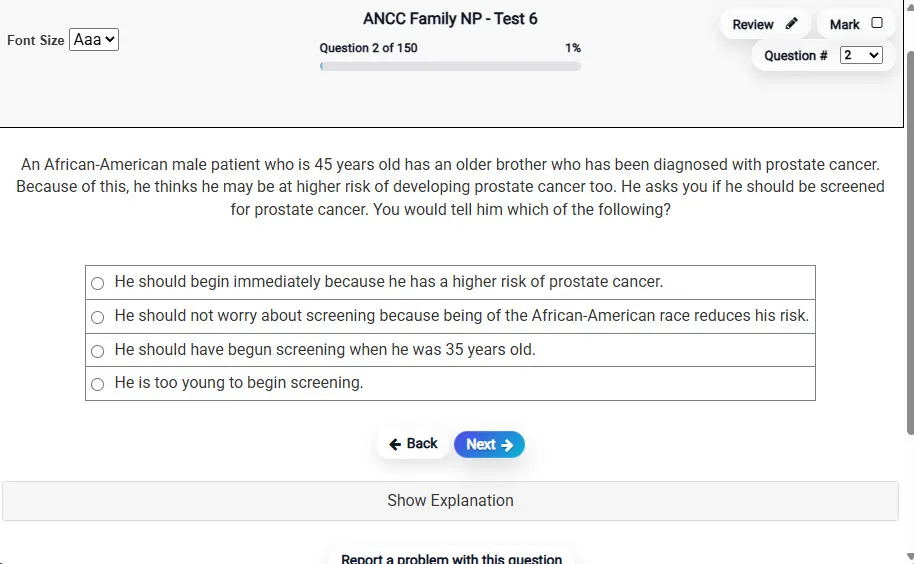
Answering a Question screen – Multiple-choice item view with navigation controls and progress tracker.
Answering a Question Multiple-choice item view with navigation controls and progress tracker.

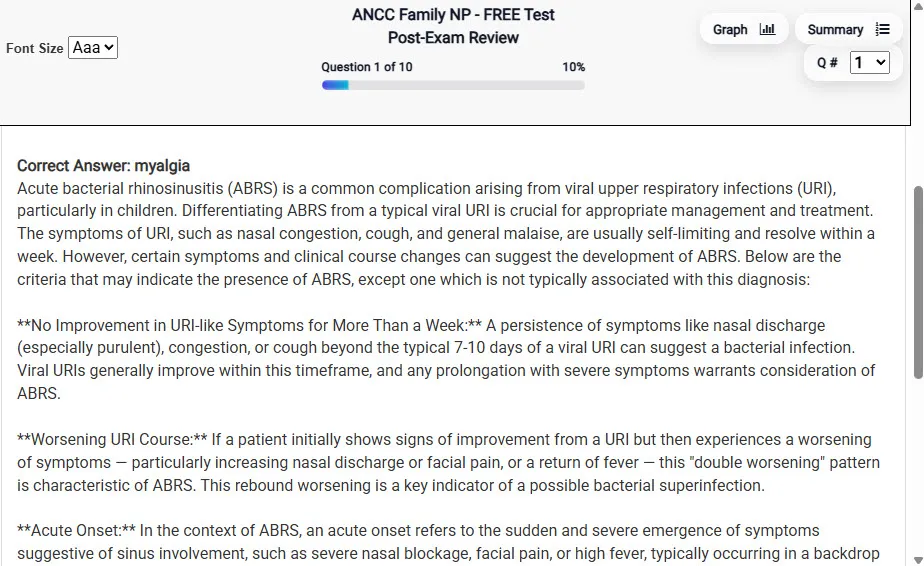
                           Detailed Explanation screen – 
                         Review mode showing chosen answer and rationale and references.
Detailed Explanation Review mode showing chosen answer and rationale and references.

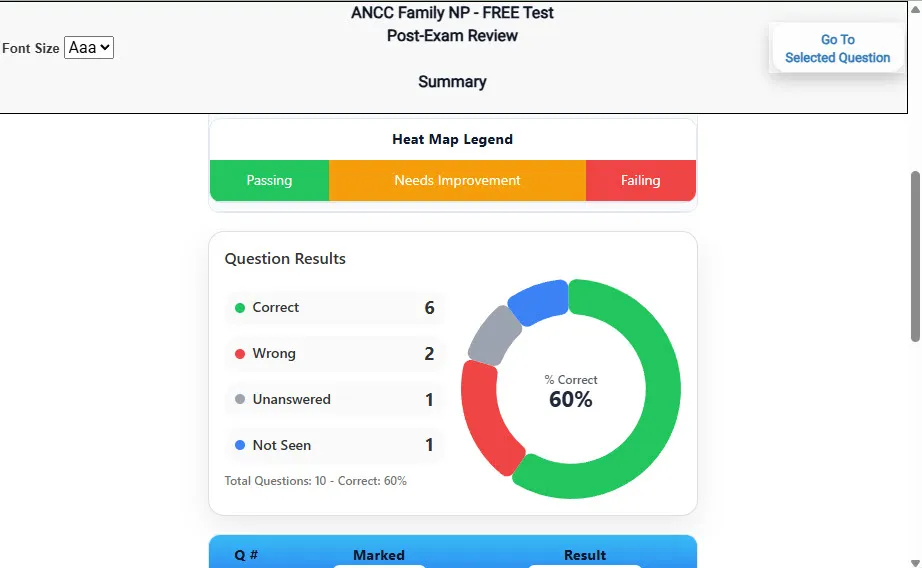
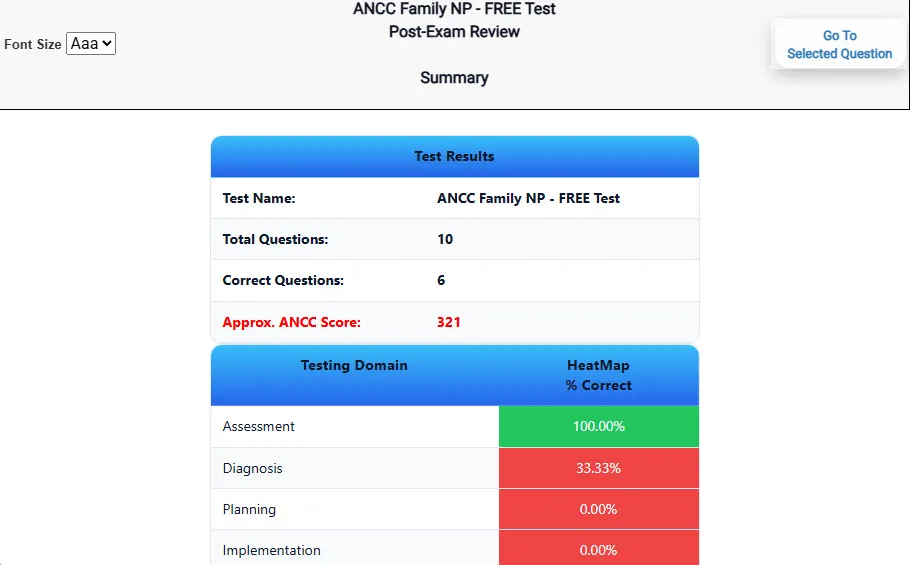
                           Review Summary 1 screen – 
                         Summary with counts for correct/wrong/unanswered and not seen items.
Review Summary 1 Summary with counts for correct/wrong/unanswered and not seen items.

                           Review Summary 2 screen – 
                         Advanced summary with category/domain breakdown and performance insights.
Review Summary 2 Advanced summary with category/domain breakdown and performance insights.

What Each Screen Shows

Answer Question Screen

  • Clean multiple-choice interface with progress bar.
  • Mark for review feature.
  • Matches real test pacing.

Detailed Explanation

  • Correct answer plus rationale.
  • Key concepts and guidelines highlighted.
  • Move between questions to fill knowledge gaps.

Review Summary 1

  • Overall results with total questions and scaled score.
  • Domain heatmap shows strengths and weaknesses.
  • Quick visual feedback on study priorities.

Review Summary 2

  • Chart of correct, wrong, unanswered, not seen.
  • Color-coded results for easy review.
  • Links back to missed items.

Top 10 Reasons to Use Exam Edge for your NYSTCE EAS Educating all Students Exam Prep

  1. Focused on the NYSTCE EAS Educating all Students Exam

    Our practice tests are built specifically for the NYSTCE EAS exam — every question mirrors the real topics, format, and difficulty so you're studying exactly what matters.

  2. Real Exam Simulation

    We match the per-question time limits and pressure of the actual NYSTCE exam, so test day feels familiar and stress-free.

  3. 15 Full Practice Tests & 645 Unique Questions

    You'll have more than enough material to master every NYSTCE EAS concept — no repeats, no fluff.

  4. Lower Cost Than a Retake

    Ordering 5 practice exams costs less than retaking the NYSTCE EAS Educating all Students exam after a failure. One low fee could save you both time and money.

  5. Flexible Testing

    Need to step away mid-exam? Pick up right where you left off — with your remaining time intact.

  6. Instant Scoring & Feedback

    See your raw score and an estimated NYSTCE EAS Educating all Students score immediately after finishing each practice test.

  7. Detailed Explanations for Every Question

    Review correct and incorrect answers with clear, step-by-step explanations so you truly understand each topic.

  8. Trusted & Accredited

    We're fully accredited by the Better Business Bureau and uphold the highest standards of trust and transparency.

  9. Web-Based & Always Available

    No software to install. Access your NYSTCE EAS practice exams 24/7 from any computer or mobile device.

  10. Expert Support When You Need It

    Need extra help? Our specialized tutors are highly qualified and ready to support your NYSTCE exam prep.


Pass the NYSTCE EAS Educating all Students Exam with Realistic Practice Tests from Exam Edge

Preparing for your upcoming NYSTCE EAS Educating all Students (201) Certification Exam can feel overwhelming — but the right practice makes all the difference. Exam Edge gives you the tools, structure, and confidence to pass on your first try. Our online practice exams are built to match the real NYSTCE EAS exam in content, format, and difficulty.

  • 📝 15 NYSTCE EAS Educating all Students Practice Tests: Access 15 full-length exams with 43 questions each, covering every major NYSTCE EAS Educating all Students topic in depth.
  • Instant Online Access: Start practicing right away — no software, no waiting.
  • 🧠 Step-by-Step Explanations: Understand the reasoning behind every correct answer so you can master NYSTCE EAS exam concepts.
  • 🔄 Retake Each Exam Up to 4 Times: Build knowledge through repetition and track your improvement over time.
  • 🌐 Web-Based & Available 24/7: Study anywhere, anytime, on any device.
  • 🧘 Boost Your Test-Day Confidence: Familiarity with the NYSTCE format reduces anxiety and helps you perform under pressure.

These NYSTCE EAS Educating all Students practice exams are designed to simulate the real testing experience by matching question types, timing, and difficulty level. This approach helps you get comfortable not just with the exam content, but also with the testing environment, so you walk into your exam day focused and confident.

Exam Edge NYSTCE Reviews


The experience was very practical and I did well.

Trina , Silver Spring , MD

Very easy to navigate.

Collene , Silver Spring , MD

Not a user friendly experience

Amelia , Rochester, New York

Didn't really reflect the questions that were on the test for the most part. Also, they totally got the format of the constructed response question wrong, which never changes. Overall OK if you have nothing else, but definitely not worth the price they charge in my opinion.

Randy , Queens, New York

It was a good test run. Now I know what to expect and what I need to study.

Timothy , Eden, New York

Exam Edge was terrific. Even better than I hoped. Just completing and reviewing the tests are a great learning experience. I can't wait to take the certification test. Tom S.

Thomas , Port Washington, NY


NYSTCE EAS Educating all Students Aliases Test Name

Here is a list of alternative names used for this exam.

  • NYSTCE EAS Educating all Students
  • NYSTCE EAS Educating all Students test
  • NYSTCE EAS Educating all Students Certification Test
  • NYSTCE EAS test
  • NYSTCE
  • NYSTCE 201
  • 201 test
  • NYSTCE EAS Educating all Students (201)
  • EAS Educating all Students certification