This is the content of the pop-over!

Lightning Deal Alert – 12% Off Ends at Midnight!

Strike while the savings are hot! Use promo code FlashSale at checkout for 12% off any Exam Edge test or bundle. Hurry—the clock is ticking!

NETA PT (NETA-PT) Practice Tests & Test Prep by Exam Edge


NETA Personal Trainer   product image
(5.0)
Based on 40 Reviews

  • Real Exam Simulation: Timed questions and matching content build comfort for your NETA PT test day.
  • Instant, 24/7 Access: Web-based NETA Personal Trainer practice exams with no software needed.
  • Clear Explanations: Step-by-step answers and explanations for your NETA exam to strengthen understanding.
  • Boosted Confidence: Reduces anxiety and improves test-taking skills to ace your NETA Personal Trainer (NETA-PT).

Featured on

NETA Personal Trainer Online Practice Test Bundles

BEST VALUE
5 practice tests

$69.75

$199.75

SAVE $130

Only $13.95 per test!

  • 100% Pass Guarantee
  • 5 online practice tests
  • 100 questions per test
  • Bonus: 100 Flash Cards + Study Guide
  • Instant access
  • Detailed Explanations
  • Practice tests never expire
  • Timed, untimed, or study guide mode
1 practice test

$39.95

  • 1 online practice test
  • 100 questions per test
  • Instant access
  • Detailed Explanations
  • Practice tests never expire
  • Timed, untimed, or study guide mode
Quick Select
Tap to choose a bundle

** All Prices are in US Dollars (USD) **


NETA PT (NETA-PT) Resources

Jump to the section you need most.

Understanding the exact breakdown of the NETA Personal Trainer test will help you know what to expect and how to most effectively prepare. The NETA Personal Trainer has 120 multiple-choice questions . The exam will be broken down into the sections below:

NETA Personal Trainer Exam Blueprint
Domain Name
Exercise Science (Anatomy - Exercise Physiology - Kinesiology - Biomechanics)  
Health & Fitness Assessments  
Exercise Programming for Healthy Adults  
Principles of Nutrition & Weight Management  
Dynamics of Communication & Behavioral Change  

NETA Personal Trainer Study Tips by Domain

  • Muscle actions drive coaching cues: concentric shortens, eccentric lengthens (often where DOMS is greatest), and isometric holds; red flag—uncontrolled eccentrics or breath-holding during heavy efforts increases injury/risk.
  • Joint structure and common movement faults matter: scapular upward rotation supports overhead pressing, while excessive anterior shoulder glide is a trap; priority rule—fix thoracic mobility/scapular control before loading overhead.
  • Energy systems align with interval design: ATP-PC dominates ~0–10 seconds, glycolytic ~10 seconds–2 minutes, oxidative >2 minutes; common trap—prescribing long rest for “conditioning” intervals that are actually glycolytic.
  • Cardiorespiratory physiology essentials: HR rises with intensity, stroke volume plateaus in many clients, and VO2 reflects oxygen use; red flag—dizziness, chest pain, or unusual shortness of breath warrants stopping and following emergency procedures.
  • Biomechanics for safe loading: keep external load close to the axis to reduce torque, and maintain a neutral spine in hip-hinge patterns; common trap—knees collapsing inward (dynamic valgus) during squats/lunges signals poor hip control and needs regression.
  • Stretch-shortening cycle and flexibility: plyometrics rely on rapid eccentric-to-concentric coupling; contraindication—avoid high-impact plyos when a client lacks basic landing mechanics or has joint pain during deceleration.
  • Screen every client with PAR-Q+ and a focused health-history interview; red flag: chest pain, unexplained syncope, or uncontrolled hypertension means stop and refer for medical clearance.
  • Measure resting vitals correctly (BP, HR, RR) after 5 minutes seated and use proper cuff size; trap: an undersized cuff can falsely elevate BP and skew risk classification.
  • Use validated body composition methods (skinfolds, BIA) with standardized pre-test conditions; red flag: recent exercise, alcohol, or dehydration can make BIA results meaningless.
  • Select cardiorespiratory tests that match risk and experience (submax for higher-risk/novice, max only when appropriate) and terminate with ACSM-style stop criteria; priority rule: abnormal symptoms beat “finishing the test.”
  • Assess movement and muscular fitness with safe progressions (e.g., squat pattern, push-up, plank) and document compensations; common trap: loading a client with knee valgus or lumbar extension before correcting technique.
  • Establish baseline flexibility and posture measures you can repeat consistently, then re-test on a set schedule; cue: change programs only when trends are consistent across 2+ assessments, not a single outlier day.
  • Start every plan with a clear goal and a baseline from assessments, then prioritize movement quality before load; red flag: progressing intensity when form breaks or pain appears.
  • Apply FITT-VP with conservative progressions (e.g., increase only one variable at a time by about 5%–10%); common trap: adding weight and volume in the same week and triggering overuse.
  • Program resistance training with balanced push/pull and lower/upper patterns plus core stability; priority rule: include rest days and avoid training the same muscle group hard on consecutive days for most beginners.
  • Use cardio modalities and intensities that match the client’s status (talk test/RPE are practical tools); red flag: clients who can’t speak more than a few words at a time are likely above an appropriate steady-state zone.
  • Warm-up should be specific and progressive (mobility → activation → rehearsal sets), and cool-down should downshift intensity; common trap: skipping the warm-up before heavy or high-impact work.
  • Build in recovery and autoregulation (sleep, soreness, performance trends) and adjust sessions accordingly; red flag: persistent DOMS, declining performance, or elevated resting heart rate suggests the plan is too aggressive.
  • Estimate energy needs with a baseline (e.g., Mifflin-St Jeor) and adjust by activity, then target a modest 250–500 kcal/day deficit for fat loss; red flag: rapid losses (>1% body weight/week) often signal muscle loss or poor adherence.
  • Prioritize protein to support lean mass during weight loss (roughly 1.6–2.2 g/kg/day as tolerated) and distribute across meals; common trap: relying on post-workout shakes while total daily protein remains low.
  • Manage carbohydrates around training to support performance (more on higher-volume days, less on rest days) while keeping total calories aligned; red flag: very-low-carb plans paired with high-intensity training often drive fatigue and dropout.
  • Use dietary fat to meet health needs (generally ~20–35% of calories) and limit trans fats; common trap: cutting fats too low and seeing hunger, hormone-related issues, or reduced dietary adherence.
  • Teach weight-management behaviors—portion control, fiber and water first, and consistent meal patterns—before advanced strategies; priority rule: focus on sustainable weekly averages, not single “perfect” days.
  • Know scope and referrals: provide general education (e.g., MyPlate-style guidance) but refer to an RD/RDN for medical nutrition therapy; red flag: client has diabetes, kidney disease, eating-disorder history, pregnancy, or is using weight-loss meds/supplements with adverse effects.
  • Use motivational interviewing (OARS) to elicit change talk and set autonomy-supportive goals; red flag: righting reflex — giving unsolicited advice increases resistance.
  • Apply SMART goals plus action planning (when/where/how) and include a coping plan; common trap: vague goals like “work out more” with no schedule or barriers addressed.
  • Match strategies to stage of change (precontemplation through maintenance); priority rule: don’t push high-effort prescriptions when the client is ambivalent — focus first on awareness and small wins.
  • Use consistent, objective language and reflective listening to build rapport and reduce defensiveness; red flag: judgmental phrasing (e.g., “lazy”, “bad diet”) that triggers dropout.
  • Build self-efficacy with mastery experiences, scaled challenges, and positive, specific feedback; common trap: programming too hard too soon — early failure undermines adherence.
  • Address adherence with simple monitoring (RPE, step count, workout log) and periodic re-contracting of goals; red flag: missed sessions without follow-up — treat as a problem-solving cue, not a compliance issue.


Built to Fit Into Your Busy Life

Everything you need to prepare with confidence—without wasting a minute.

Three Study Modes

Timed, No Time Limit, or Explanation mode.

Actionable Analytics

Heatmaps and scaled scores highlight weak areas.

High-Yield Rationales

Concise explanations emphasize key concepts.

Realistic Interface

Matches the feel of the actual exam environment.

Accessible by Design

Clean layout reduces cognitive load.

Anytime, Anywhere

Web-based access 24/7 on any device.
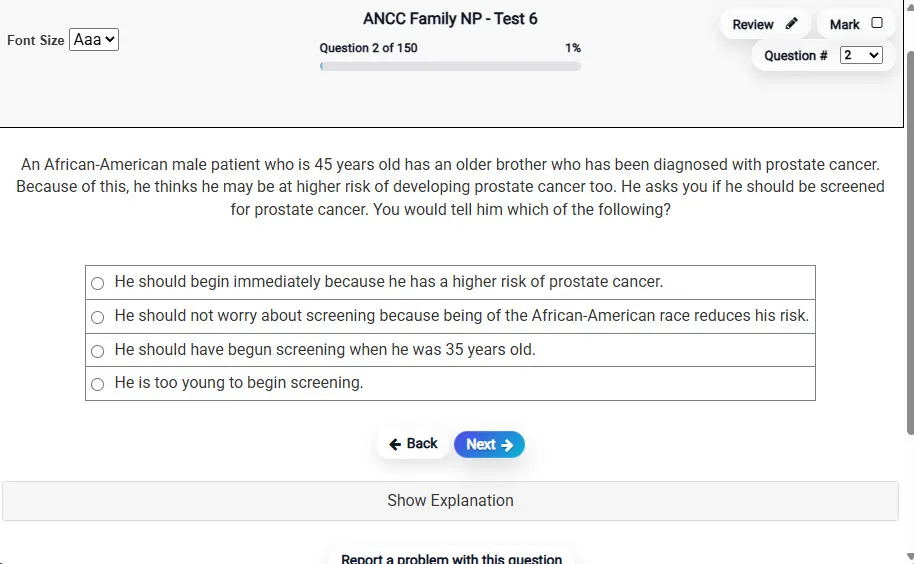
Answering a Question screen – Multiple-choice item view with navigation controls and progress tracker.
Answering a Question Multiple-choice item view with navigation controls and progress tracker.

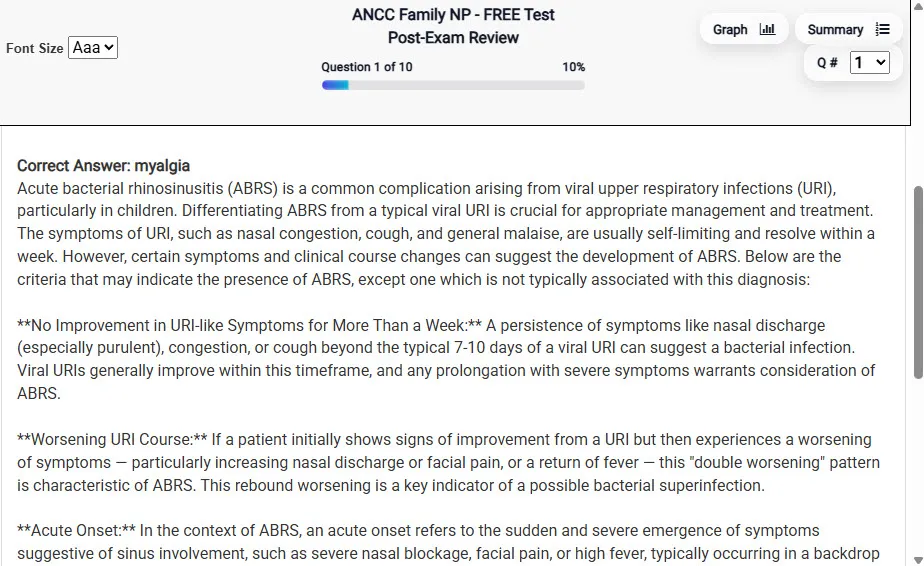
                           Detailed Explanation screen – 
                         Review mode showing chosen answer and rationale and references.
Detailed Explanation Review mode showing chosen answer and rationale and references.

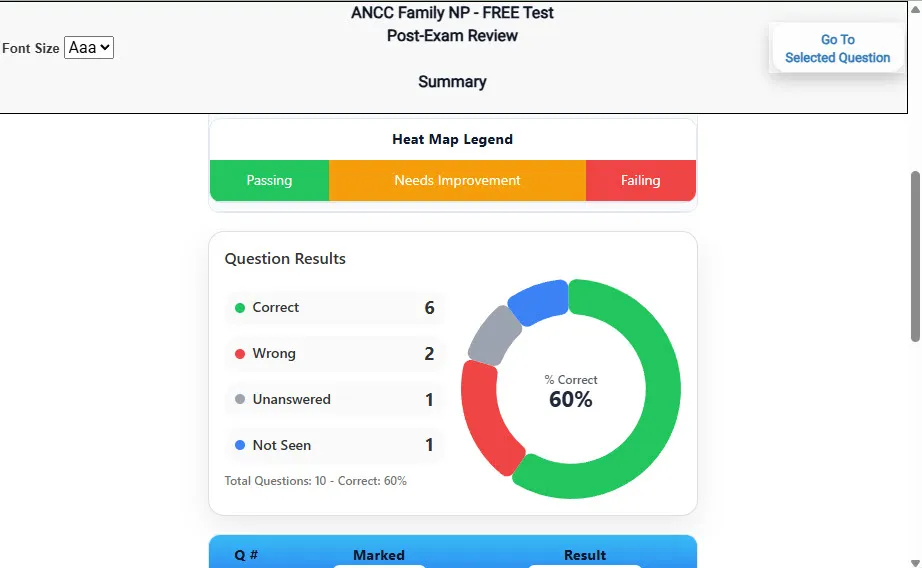
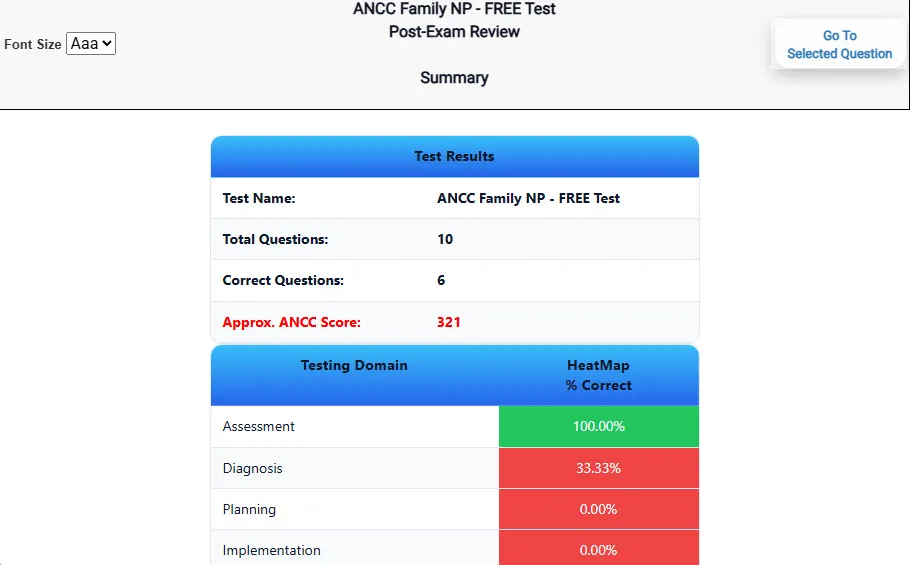
                           Review Summary 1 screen – 
                         Summary with counts for correct/wrong/unanswered and not seen items.
Review Summary 1 Summary with counts for correct/wrong/unanswered and not seen items.

                           Review Summary 2 screen – 
                         Advanced summary with category/domain breakdown and performance insights.
Review Summary 2 Advanced summary with category/domain breakdown and performance insights.

What Each Screen Shows

Answer Question Screen

  • Clean multiple-choice interface with progress bar.
  • Mark for review feature.
  • Matches real test pacing.

Detailed Explanation

  • Correct answer plus rationale.
  • Key concepts and guidelines highlighted.
  • Move between questions to fill knowledge gaps.

Review Summary 1

  • Overall results with total questions and scaled score.
  • Domain heatmap shows strengths and weaknesses.
  • Quick visual feedback on study priorities.

Review Summary 2

  • Chart of correct, wrong, unanswered, not seen.
  • Color-coded results for easy review.
  • Links back to missed items.

Top 10 Reasons to Use Exam Edge for your NETA Personal Trainer Exam Prep

  1. Focused on the NETA Personal Trainer Exam

    Our practice tests are built specifically for the NETA PT exam — every question mirrors the real topics, format, and difficulty so you're studying exactly what matters.

  2. Real Exam Simulation

    We match the per-question time limits and pressure of the actual NETA exam, so test day feels familiar and stress-free.

  3. 5 Full Practice Tests & 500 Unique Questions

    You'll have more than enough material to master every NETA PT concept — no repeats, no fluff.

  4. Lower Cost Than a Retake

    Ordering 5 practice exams costs less than retaking the NETA Personal Trainer exam after a failure. One low fee could save you both time and money.

  5. Flexible Testing

    Need to step away mid-exam? Pick up right where you left off — with your remaining time intact.

  6. Instant Scoring & Feedback

    See your raw score and an estimated NETA Personal Trainer score immediately after finishing each practice test.

  7. Detailed Explanations for Every Question

    Review correct and incorrect answers with clear, step-by-step explanations so you truly understand each topic.

  8. Trusted & Accredited

    We're fully accredited by the Better Business Bureau and uphold the highest standards of trust and transparency.

  9. Web-Based & Always Available

    No software to install. Access your NETA PT practice exams 24/7 from any computer or mobile device.

  10. Expert Support When You Need It

    Need extra help? Our specialized tutors are highly qualified and ready to support your NETA exam prep.


Pass the NETA Personal Trainer Exam with Realistic Practice Tests from Exam Edge

Preparing for your upcoming NETA Personal Trainer (NETA-PT) Certification Exam can feel overwhelming — but the right practice makes all the difference. Exam Edge gives you the tools, structure, and confidence to pass on your first try. Our online practice exams are built to match the real NETA PT exam in content, format, and difficulty.

  • 📝 5 NETA Personal Trainer Practice Tests: Access 5 full-length exams with 100 questions each, covering every major NETA Personal Trainer topic in depth.
  • Instant Online Access: Start practicing right away — no software, no waiting.
  • 🧠 Step-by-Step Explanations: Understand the reasoning behind every correct answer so you can master NETA PT exam concepts.
  • 🔄 Retake Each Exam Up to 4 Times: Build knowledge through repetition and track your improvement over time.
  • 🌐 Web-Based & Available 24/7: Study anywhere, anytime, on any device.
  • 🧘 Boost Your Test-Day Confidence: Familiarity with the NETA format reduces anxiety and helps you perform under pressure.

These NETA Personal Trainer practice exams are designed to simulate the real testing experience by matching question types, timing, and difficulty level. This approach helps you get comfortable not just with the exam content, but also with the testing environment, so you walk into your exam day focused and confident.


Exam Edge NETA Reviews


NETA Personal Trainer Aliases Test Name

Here is a list of alternative names used for this exam.

  • NETA Personal Trainer
  • NETA Personal Trainer test
  • NETA Personal Trainer Certification Test
  • NETA PT test
  • NETA
  • NETA NETA-PT
  • NETA-PT test
  • NETA Personal Trainer (NETA-PT)
  • Personal Trainer certification