This is the content of the pop-over!

NNAAP NC Nurse Aide Practice Tests & Test Prep by Exam Edge


NNAAP North Carolina Nurse Aide product image
(4.9)
Based on 34 Reviews

  • Real Exam Simulation: Timed questions and matching content build comfort for your NNAAP NC Nurse Aide test day.
  • Instant, 24/7 Access: Web-based NNAAP North Carolina Nurse Aide practice exams with no software needed.
  • Clear Explanations: Step-by-step answers and explanations for your NNAAP exam to strengthen understanding.
  • Boosted Confidence: Reduces anxiety and improves test-taking skills to ace your NNAAP North Carolina Nurse Aide .

Featured on

NNAAP North Carolina Nurse Aide Online Practice Test Bundles

BEST VALUE
20 practice tests

$174.00

$799.00

SAVE $625

Only $8.70 per test!

  • 100% Pass Guarantee
  • 20 online practice tests
  • 70 questions per test
  • Bonus: 100 Flash Cards + Study Guide
  • Instant access
  • Detailed Explanations
  • Practice tests never expire
  • Timed, untimed, or study guide mode
MOST POPULAR
10 practice tests

$99.50

$399.50

SAVE $300

Only $9.95 per test!

  • 10 online practice tests
  • 70 questions per test
  • Bonus: 100 Flash Cards + Study Guide
  • Instant access
  • Detailed Explanations
  • Practice tests never expire
  • Timed, untimed, or study guide mode
5 practice tests

$69.75

$199.75

SAVE $130

Only $13.95 per test!

  • 5 online practice tests
  • 70 questions per test
  • Bonus: 100 Flash Cards
  • Instant access
  • Detailed Explanations
  • Practice tests never expire
  • Timed, untimed, or study guide mode
1 practice test

$39.95

  • 1 online practice test
  • 70 questions per test
  • Instant access
  • Detailed Explanations
  • Practice tests never expire
  • Timed, untimed, or study guide mode
Quick Select
Tap to choose a bundle

** All Prices are in US Dollars (USD) **


NNAAP NC Nurse Aide () Resources

Jump to the section you need most.

Understanding the exact breakdown of the NNAAP North Carolina Nurse Aide test will help you know what to expect and how to most effectively prepare. The NNAAP North Carolina Nurse Aide has 70 multiple-choice questions . The exam will be broken down into the sections below:

NNAAP North Carolina Nurse Aide Exam Blueprint
Domain Name % Number of
Questions
Physical Care Skills - Activities of Daily Living 14% 10
Physical Care Skills - Basic Nursing Skills 39% 27
Physical Care Skills - Restorative Skills 8% 6
Psychosocial Care Skills - Emotional and Mental Health Needs 11% 8
Psychosocial Care Skills - Spiritual and Cultural Needs 2% 1
Role of the NA - Communication 8% 6
Role of the NA - Client Rights 7% 5
Role of the NA - Legal and Ethical Behavior 3% 2
Role of the NA - Member of the Health Care Team 8% 6

NNAAP North Carolina Nurse Aide Study Tips by Domain

  • Promote independence with ADLs by offering choices and setting up supplies, then assist only as needed; red flag: doing everything for the client when they can safely do part of the task.
  • For bathing and perineal care, wash clean-to-dirty and front-to-back, changing washcloth areas as you move; common trap: reusing the same cloth on the perineum after the rectal area.
  • During oral care, position upright and use a moist swab for clients who cannot safely handle toothpaste/water; contraindication: giving fluids to a client with dysphagia or who is NPO.
  • When feeding, verify diet consistency and encourage small bites with slow pacing; priority rule: stop and report coughing, choking, wet voice, or pocketing food (aspiration risk).
  • For dressing and grooming, use the affected side first when dressing and last when undressing; common trap: pulling on a weak arm or causing shoulder injury during sleeve placement.
  • With toileting, provide privacy and safety (call light, non-skid footwear, proper positioning) and measure/record output when ordered; red flag: leaving a high fall-risk client unattended in the bathroom.
  • Hand hygiene is required before and after every resident contact and after glove removal; red flag: touching bedrails/curtains then providing care without re-cleaning hands.
  • Use standard precautions for all residents and transmission-based precautions when posted; common trap: assuming a resident is “not infectious” because they look well.
  • Measure vital signs accurately and report immediately per facility parameters (e.g., new fever, very low/high pulse, low O2 if assigned); priority rule: report a sudden change from the resident’s baseline even if within “normal” ranges.
  • Prevent aspiration during feeding by sitting the resident upright (typically 90°) and offering small bites/sips; contraindication: feeding when the resident is coughing/choking, pocketing food, or too drowsy—stop and notify the nurse.
  • Provide perineal care front-to-back for females and retract foreskin only if uncircumcised then replace it after cleaning; red flag: leaving the foreskin retracted (risk of swelling/paraphimosis).
  • Maintain safety with transfers and ambulation using gait belt when indicated and locking wheels before moving; common trap: pulling on the resident’s arms/shoulders or transferring without non-skid footwear.
  • Promote independence by cueing the resident to do as much of the task as possible (e.g., hand them the comb, place supplies within reach) — red flag: doing the whole task “to be faster” is a common restorative-skill fail.
  • Encourage safe mobility and transfer techniques (e.g., proper footwear, clear path, use gait belt if ordered) — priority rule: stop immediately if the resident reports dizziness, chest pain, or new shortness of breath.
  • Support range-of-motion exercises as directed (active first when able, then assist) — contraindication: do not force movement or exercise a painful, swollen, or newly injured joint; report changes.
  • Use correct positioning and turning schedules to maintain function and prevent contractures — common trap: leaving a resident in poor alignment (e.g., plantar flexion without foot support) increases breakdown and loss of mobility.
  • Apply ordered assistive devices (walkers, canes, splints) correctly and consistently — red flag: improper height/fit or missing non-skid tips can cause falls and should be reported before ambulation.
  • Reinforce toileting programs and bladder/bowel retraining plans per care plan — priority rule: document/output accurately and report inability to void, new incontinence, or constipation beyond facility threshold.
  • Use calm, simple communication and allow extra response time; red flag: escalating anxiety or anger often means you should reduce stimuli and call the nurse rather than argue.
  • For confused or disoriented clients, reorient with name, place, date, and familiar cues; common trap: “reality orientation” is not effective for severe dementia—use validation and redirection instead.
  • Watch for acute mental status changes (sudden confusion, new agitation, hallucinations) and report immediately; priority rule: treat sudden change as possible delirium/medical issue, not “just behavior.”
  • Support independence and dignity during care by offering choices (two options) and explaining each step; contraindication: do not use threats, infantilizing speech, or “you have to” statements.
  • If a client expresses hopelessness, self-harm thoughts, or talks about wanting to die, stay with the client and notify the nurse at once; red flag: never promise secrecy.
  • Respond therapeutically to emotional distress by listening, acknowledging feelings, and using silence; common trap: giving advice, changing the subject, or offering false reassurance (e.g., “everything will be fine”).
  • Ask and document the resident’s spiritual practices, preferences, and restrictions (e.g., prayer times, clergy visits, dietary rules) and follow the care plan—red flag: assuming preferences based on name, accent, or appearance.
  • Provide privacy and a quiet environment for spiritual rituals when safe, and coordinate visits with chaplain/clergy per facility policy—common trap: interrupting or rushing a ritual because it’s “not care.”
  • Honor cultural food practices within ordered diets and report conflicts to the nurse (e.g., fasting with diabetes, fluid restriction with religious observance)—priority rule: safety and prescribed diet orders override preference until clarified by the nurse/provider.
  • Support modesty and personal space needs (gowning, exposure, touch, and hygiene routines) and offer same-gender caregiver when possible—red flag: insisting on routine care if the resident expresses cultural discomfort; pause and notify the nurse.
  • Use interpreters or approved communication tools for language barriers; do not rely on minor children or other residents to translate sensitive information—common trap: using family as the only interpreter and missing consent or symptom details.
  • Respond respectfully to spiritual distress (fear, guilt, end-of-life concerns) by listening and reporting to the nurse/chaplain rather than giving personal advice—contraindication: debating beliefs or promising outcomes (“You’ll be fine”).
  • Use clear, respectful introductions and verify preferred name/pronouns before care; red flag: calling a resident by a nickname they didn’t choose or discussing them as if they aren’t present.
  • Practice active listening (sit at eye level, allow time to respond, reflect back key points); common trap: interrupting or finishing sentences, especially with aphasia or dementia.
  • Give directions one step at a time and check understanding with teach-back; priority rule: if the client can’t repeat the plan, stop and re-explain rather than proceeding.
  • Report and document objectively using exact observations and quotes (e.g., “Client said, ‘I feel dizzy’”); red flag: charting conclusions like “confused” without specific behaviors.
  • Use SBAR or your facility’s chain-of-command to communicate changes promptly; threshold: new chest pain, trouble breathing, acute confusion, or a fall requires immediate reporting, not “watching it.”
  • Maintain privacy in communication—speak quietly, use private areas, and share only on a need-to-know basis; common trap: hallway/elevator talk or texting client details, which can breach confidentiality.
  • Verify client identity with facility-approved identifiers before care (e.g., name and DOB)—red flag: relying on room number or another client’s confirmation.
  • Protect privacy and confidentiality at all times by closing doors/curtains and limiting information to those who need to know—trap: discussing client details in hallways, elevators, or on social media.
  • Obtain consent before touching, moving, or providing care and honor the right to refuse—priority rule: stop and report if a client says “no” or appears fearful/resistant.
  • Promote autonomy by offering choices (clothing, bathing time, meal options) within the care plan—red flag: rushing and making decisions for the client because it’s “faster.”
  • Maintain safety and dignity during personal care (cover exposed areas, explain steps) and use least restrictive measures—contraindication: using restraints or side rails as punishment or convenience.
  • Recognize and report suspected abuse, neglect, or misappropriation immediately per facility policy—threshold: unexplained bruises, sudden fearfulness, or missing belongings warrants prompt reporting without investigating yourself.
  • Follow the chain of command: report changes to the nurse promptly and only take assignments you’re trained and authorized to do—red flag is being asked to do sterile procedures or give medications.
  • Use clear, timely communication such as SBAR-style reporting (situation, background, assessment, recommendation) when notifying the nurse—common trap is giving vague statements like “she’s not acting right” without specific observations and times.
  • Chart only what you did and what you observed (objective, measurable data) and report immediately if you made an error—never chart for someone else or before care is provided.
  • Coordinate care to support the plan of care (e.g., schedule toileting, ambulation, and meals) and communicate barriers—priority rule is safety first if the client becomes dizzy, short of breath, or unsteady during activity.
  • Maintain professional boundaries and teamwork: accept feedback, avoid arguing in front of clients, and escalate conflicts appropriately—red flag is gossiping about staff or clients, which can violate policy and confidentiality.
  • Use infection control and standard precautions consistently across team interactions (hand hygiene before/after every client contact, proper PPE) and remind others respectfully—common trap is skipping hand hygiene after glove removal.


Built to Fit Into Your Busy Life

Everything you need to prepare with confidence—without wasting a minute.

Three Study Modes

Timed, No Time Limit, or Explanation mode.

Actionable Analytics

Heatmaps and scaled scores highlight weak areas.

High-Yield Rationales

Concise explanations emphasize key concepts.

Realistic Interface

Matches the feel of the actual exam environment.

Accessible by Design

Clean layout reduces cognitive load.

Anytime, Anywhere

Web-based access 24/7 on any device.
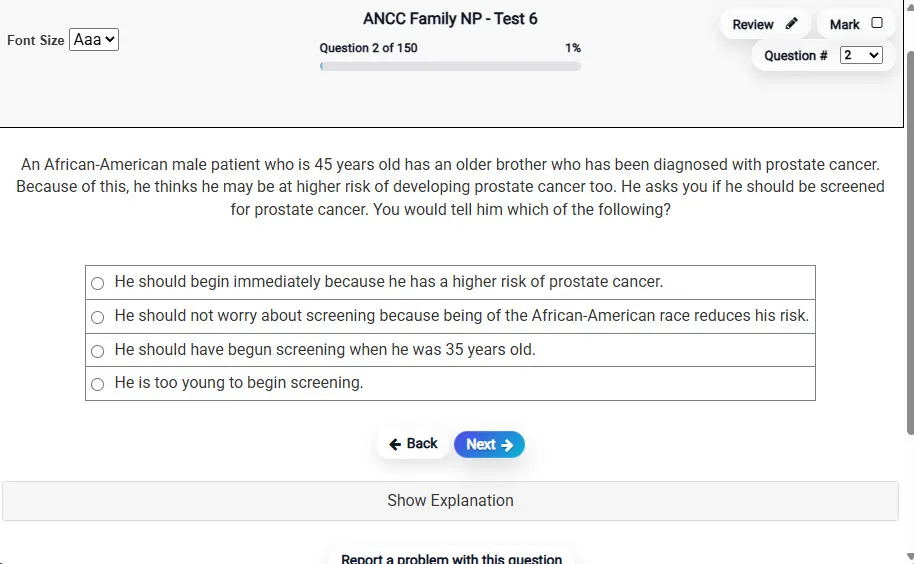
Answering a Question screen – Multiple-choice item view with navigation controls and progress tracker.
Answering a Question Multiple-choice item view with navigation controls and progress tracker.

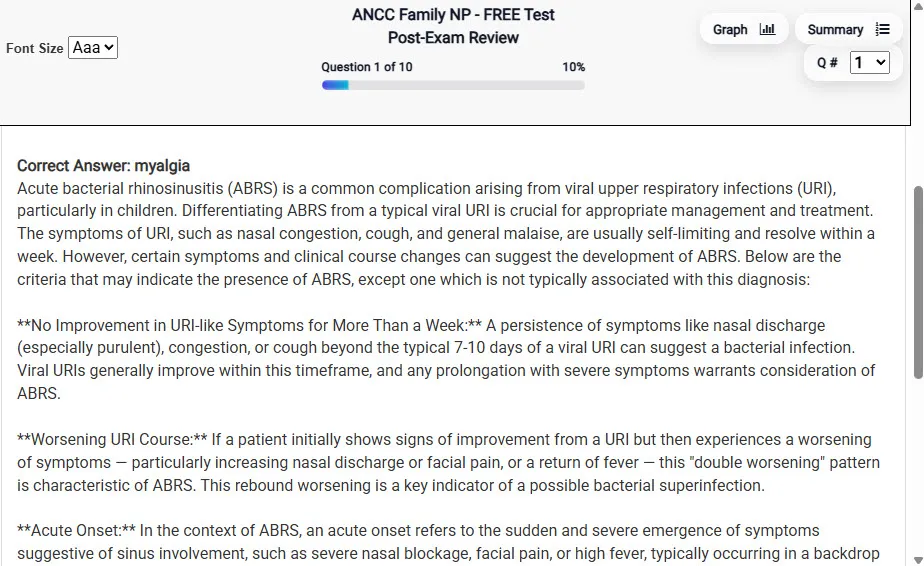
                           Detailed Explanation screen – 
                         Review mode showing chosen answer and rationale and references.
Detailed Explanation Review mode showing chosen answer and rationale and references.

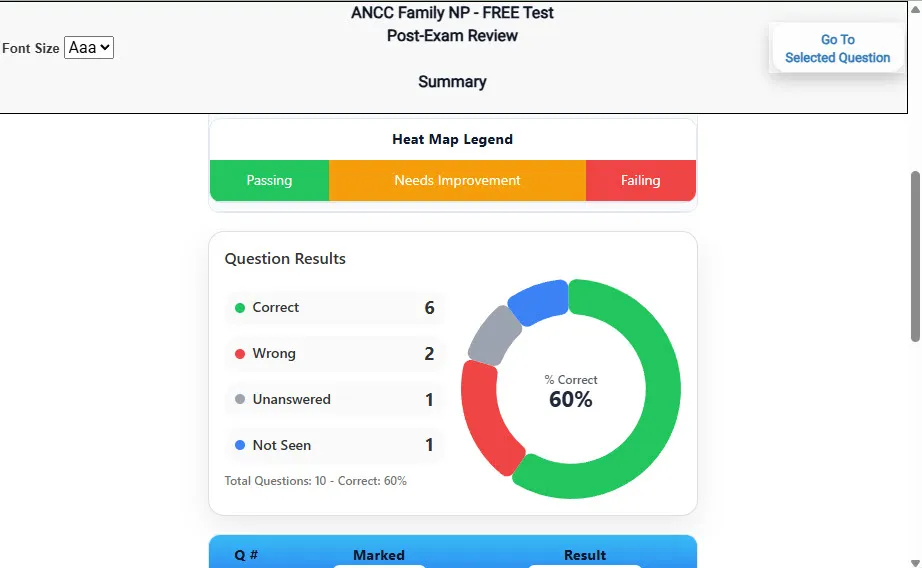
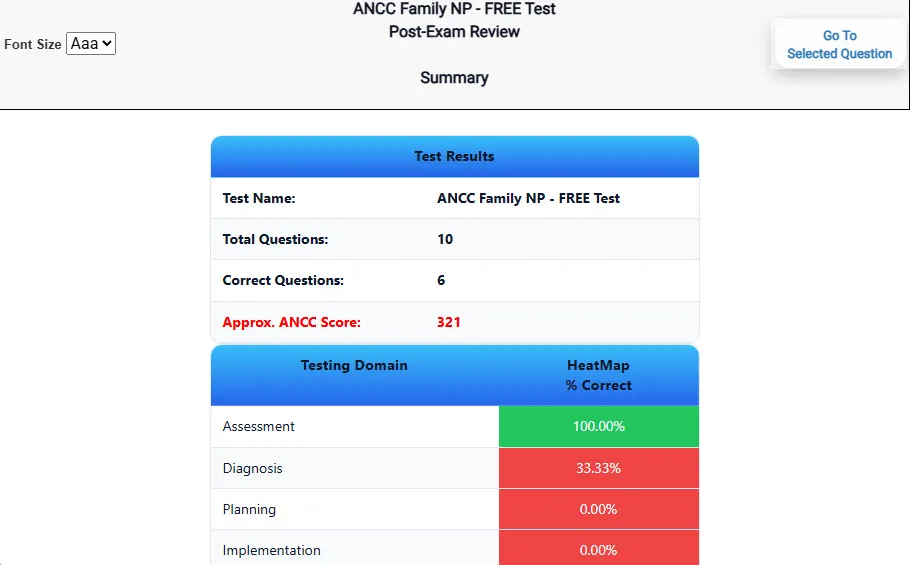
                           Review Summary 1 screen – 
                         Summary with counts for correct/wrong/unanswered and not seen items.
Review Summary 1 Summary with counts for correct/wrong/unanswered and not seen items.

                           Review Summary 2 screen – 
                         Advanced summary with category/domain breakdown and performance insights.
Review Summary 2 Advanced summary with category/domain breakdown and performance insights.

What Each Screen Shows

Answer Question Screen

  • Clean multiple-choice interface with progress bar.
  • Mark for review feature.
  • Matches real test pacing.

Detailed Explanation

  • Correct answer plus rationale.
  • Key concepts and guidelines highlighted.
  • Move between questions to fill knowledge gaps.

Review Summary 1

  • Overall results with total questions and scaled score.
  • Domain heatmap shows strengths and weaknesses.
  • Quick visual feedback on study priorities.

Review Summary 2

  • Chart of correct, wrong, unanswered, not seen.
  • Color-coded results for easy review.
  • Links back to missed items.

Top 10 Reasons to Use Exam Edge for your NNAAP North Carolina Nurse Aide Exam Prep

  1. Focused on the NNAAP North Carolina Nurse Aide Exam

    Our practice tests are built specifically for the NNAAP NC Nurse Aide exam — every question mirrors the real topics, format, and difficulty so you're studying exactly what matters.

  2. Real Exam Simulation

    We match the per-question time limits and pressure of the actual NNAAP exam, so test day feels familiar and stress-free.

  3. 20 Full Practice Tests & 1,400 Unique Questions

    You'll have more than enough material to master every NNAAP NC Nurse Aide concept — no repeats, no fluff.

  4. Lower Cost Than a Retake

    Ordering 5 practice exams costs less than retaking the NNAAP North Carolina Nurse Aide exam after a failure. One low fee could save you both time and money.

  5. Flexible Testing

    Need to step away mid-exam? Pick up right where you left off — with your remaining time intact.

  6. Instant Scoring & Feedback

    See your raw score and an estimated NNAAP North Carolina Nurse Aide score immediately after finishing each practice test.

  7. Detailed Explanations for Every Question

    Review correct and incorrect answers with clear, step-by-step explanations so you truly understand each topic.

  8. Trusted & Accredited

    We're fully accredited by the Better Business Bureau and uphold the highest standards of trust and transparency.

  9. Web-Based & Always Available

    No software to install. Access your NNAAP NC Nurse Aide practice exams 24/7 from any computer or mobile device.

  10. Expert Support When You Need It

    Need extra help? Our specialized tutors are highly qualified and ready to support your NNAAP exam prep.


Pass the NNAAP North Carolina Nurse Aide Exam with Realistic Practice Tests from Exam Edge

Preparing for your upcoming NNAAP North Carolina Nurse Aide () Certification Exam can feel overwhelming — but the right practice makes all the difference. Exam Edge gives you the tools, structure, and confidence to pass on your first try. Our online practice exams are built to match the real NNAAP NC Nurse Aide exam in content, format, and difficulty.

  • 📝 20 NNAAP North Carolina Nurse Aide Practice Tests: Access 20 full-length exams with 70 questions each, covering every major NNAAP North Carolina Nurse Aide topic in depth.
  • Instant Online Access: Start practicing right away — no software, no waiting.
  • 🧠 Step-by-Step Explanations: Understand the reasoning behind every correct answer so you can master NNAAP NC Nurse Aide exam concepts.
  • 🔄 Retake Each Exam Up to 4 Times: Build knowledge through repetition and track your improvement over time.
  • 🌐 Web-Based & Available 24/7: Study anywhere, anytime, on any device.
  • 🧘 Boost Your Test-Day Confidence: Familiarity with the NNAAP format reduces anxiety and helps you perform under pressure.

These NNAAP North Carolina Nurse Aide practice exams are designed to simulate the real testing experience by matching question types, timing, and difficulty level. This approach helps you get comfortable not just with the exam content, but also with the testing environment, so you walk into your exam day focused and confident.


Exam Edge NCSBN Reviews


I recently had to test out of my school with an 850 on the Hesi PN, so I purchased the exams from you guys, about 5 to 7 exams, and passed the exit HesiPn with a 988! First time around! Then I purchased the NclexPN exam tests from you guys and I passed my NCLEX first time around! These tests really ...
Read More
Welsh, NC

Great experience to follow a path for success .

E. , Souderton, Pennsylvania

Thank you so much for this website!!! Not enough nursing students know about Exam Edge!! We're all studying the wrong material .. When I found this site and started studying I just knew that I had finally found what I need to pass my boards !!! I purchased the 30 practice test and I studied and ...
Read More
LaDonna , Michigan

I can't believe this website doesn't have a high following status. I bought 40 practice questions, did 20 practice questions, and took my Hesi exit. I scored 1070. I completed all 40 practice exams and passed my boards for the first time. Exam Edge introduced me to a bunch of topics and boosted my c ...
Read More
Juliet M., Tarpon Springs, Florida


NNAAP North Carolina Nurse Aide Aliases Test Name

Here is a list of alternative names used for this exam.

  • NNAAP North Carolina Nurse Aide
  • NNAAP North Carolina Nurse Aide test
  • NNAAP North Carolina Nurse Aide Certification Test
  • NNAAP NC Nurse Aide test
  • NCSBN
  • NCSBN
  • test
  • NNAAP North Carolina Nurse Aide ()
  • NNAAP North Carolina Nurse Aide certification