This is the content of the pop-over!

Lightning Deal Alert – 12% Off Ends at Midnight!

Strike while the savings are hot! Use promo code FlashSale at checkout for 12% off any Exam Edge test or bundle. Hurry—the clock is ticking!

MTTC Bilingual Education (075) Practice Tests & Test Prep by Exam Edge


MTTC Bilingual Education  product image
(4.5)
Based on 25 Reviews

  • Real Exam Simulation: Timed questions and matching content build comfort for your MTTC Bilingual Education test day.
  • Instant, 24/7 Access: Web-based MTTC Bilingual Education practice exams with no software needed.
  • Clear Explanations: Step-by-step answers and explanations for your MTTC exam to strengthen understanding.
  • Boosted Confidence: Reduces anxiety and improves test-taking skills to ace your MTTC Bilingual Education (125).

Featured on

MTTC Bilingual Education Online Practice Test Bundles

BEST VALUE
10 practice tests

$99.50

$399.50

SAVE $300

Only $9.95 per test!

  • 100% Pass Guarantee
  • 10 online practice tests
  • 100 questions per test
  • Bonus: 100 Flash Cards + Study Guide
  • Instant access
  • Detailed Explanations
  • Practice tests never expire
  • Timed, untimed, or study guide mode
5 practice tests

$69.75

$199.75

SAVE $130

Only $13.95 per test!

  • 5 online practice tests
  • 100 questions per test
  • Bonus: 100 Flash Cards + Study Guide
  • Instant access
  • Detailed Explanations
  • Practice tests never expire
  • Timed, untimed, or study guide mode
1 practice test

$39.95

  • 1 online practice test
  • 100 questions per test
  • Instant access
  • Detailed Explanations
  • Practice tests never expire
  • Timed, untimed, or study guide mode
Quick Select
Tap to choose a bundle

** All Prices are in US Dollars (USD) **


MTTC Bilingual Education (125) Resources

Jump to the section you need most.

Understanding the exact breakdown of the MTTC Bilingual Education test will help you know what to expect and how to most effectively prepare. The MTTC Bilingual Education has 100 multiple-choice questions . The exam will be broken down into the sections below:

MTTC Bilingual Education Exam Blueprint
Domain Name % Number of
Questions
Language - Linguistics Comparisons 15% 15
Culture 15% 15
Second Language Acquisition and Instructional Practices 15% 15
Integration of Standards into Curriculum and Instruction 25% 25
Assessment 15% 15
Professionalism 15% 15

MTTC Bilingual Education Study Tips by Domain

  • Differentiate phonology, morphology, syntax, semantics, and pragmatics across languages; red flag: treating pronunciation issues as “low intelligence” rather than predictable L1 transfer.
  • Compare phoneme inventories and syllable structures (e.g., consonant clusters, vowel length, tones) to anticipate errors; priority rule: explicitly teach contrasts that change meaning and are absent in the student’s L1.
  • Analyze morphological patterns (inflections, derivations, agglutination, gender/number marking) and how they differ by language; common trap: grading errors that stem from different L1 morphosyntactic rules as “careless” mistakes.
  • Contrast syntactic features such as word order, subject omission, question formation, negation, and use of articles; red flag: overcorrecting developmental patterns like missing articles when the L1 lacks an article system.
  • Identify cognates, false cognates, and cross-linguistic semantic range differences; priority rule: teach high-utility true cognates while explicitly warning about common false friends (e.g., “actual” vs. “actual” in Spanish).
  • Compare pragmatics and discourse conventions (politeness, turn-taking, directness, register, storytelling structure); contraindication: interpreting culturally patterned eye contact, silence, or indirect requests as defiance or lack of comprehension.
  • Differentiate cultural values (e.g., individualism/collectivism, time orientation, power distance) from stereotypes; red flag: attributing a student’s behavior to a single “cultural trait” without checking family/community context.
  • Use asset-based cultural frameworks (funds of knowledge, community cultural wealth) to plan instruction; common trap: treating home language/culture as a barrier rather than a resource for learning.
  • Identify how acculturation, bicultural identity, and migration/refugee experiences can affect school participation; priority rule: avoid assuming low engagement equals low ability—consider adjustment stress and prior schooling disruptions.
  • Ensure culturally responsive communication with families (interpreters, plain language, preferred contact methods) while maintaining confidentiality; red flag: using students/siblings as interpreters for sensitive topics.
  • Recognize and mitigate cultural bias in classroom discourse and participation norms; common trap: grading “participation” solely by frequent speaking rather than including culturally varied ways of contributing.
  • Address equity and representation in materials and school practices (inclusive texts, counter-narratives, respectful naming/pronunciation); red flag: “food/festival” activities that tokenize culture without connecting to authentic perspectives and power dynamics.
  • Distinguish BICS vs. CALP and plan for longer academic-language development (often 5–7 years) — red flag: exiting EL services based only on conversational fluency.
  • Use WIDA-like proficiency levels to set language objectives alongside content objectives — common trap: writing only content goals and assuming language will “come along” without explicit supports.
  • Provide comprehensible input (e.g., visuals, modeling, sentence frames) while keeping grade-level rigor — priority rule: scaffold the task, not the standard.
  • Build structured interaction (think-pair-share, information gaps, accountable talk) to increase output and feedback — red flag: ELLs consistently placed in passive listening roles.
  • Leverage students’ L1 strategically (cognates, contrastive analysis, translanguaging routines) — contraindication: banning L1 use, which can reduce access and slow conceptual understanding.
  • Use formative assessment (running records, language samples, rubrics) to separate language need from disability — common trap: referring to special education before documenting appropriate ELD instruction and progress over time.
  • Start with the target standard(s) and write measurable language objectives alongside content objectives; red flag: lessons that list standards but don’t show how students will demonstrate them.
  • Integrate the four language domains (listening, speaking, reading, writing) into content tasks aligned to standards; common trap: focusing only on vocabulary worksheets instead of authentic discourse and texts.
  • Plan explicit language supports (e.g., sentence frames, modeled exemplars, graphic organizers) tied to the standard’s academic language demands; priority rule: remove supports gradually as proficiency increases.
  • Use formative checks aligned to the standard (e.g., quick writes, oral explanations with rubrics) to adjust instruction; red flag: grading language errors when the standard is assessing content understanding.
  • Differentiate access to the same standard by proficiency level without lowering rigor; common trap: giving ELLs simpler, off-grade assignments instead of scaffolding the grade-level task.
  • Ensure assessments and instructional materials are culturally and linguistically appropriate while still matching standards; contraindication: using translated tests or glossaries in ways that change what the standard intends to measure.
  • Differentiate screening, diagnostic, formative, and summative assessments and match each to the decision being made; red flag: using a placement screener (e.g., language proficiency) to assign grades or special education eligibility.
  • Use multiple measures for English learner (EL) decisions (classwork, observation, performance tasks, language proficiency data) rather than a single test score; common trap: over-weighting one standardized reading score when language proficiency is still emerging.
  • Interpret language proficiency results by domain (listening, speaking, reading, writing) and set targeted goals for the lowest domain; priority rule: instructional supports should align to the assessed domain weakness, not a general “low EL level.”
  • Distinguish language difference from disability by reviewing growth over time, first-language (L1) performance, and opportunity to learn; red flag: persistent difficulties in both L1 and L2 across settings despite appropriate instruction may warrant a referral.
  • Ensure accommodations support access without altering the construct being measured (e.g., extended time, separate setting) and document them consistently; contraindication: translating reading-comprehension items may invalidate what the test is intended to measure.
  • Apply assessment ethics and data privacy in reporting and communication with families; common trap: sharing identifiable student results beyond those with legitimate educational interest or making high-stakes decisions without parent-friendly explanation.
  • Follow MTTC-aligned ethics and confidentiality rules — never discuss student records, immigration status, or test items in public or on social media (red flag: sharing screenshots or “real test questions”).
  • Meet legal obligations for ELs and bilingual services (e.g., civil rights/anti-discrimination, appropriate language access) — a common trap is treating language need as a disability or delaying services until a parent requests them.
  • Use interpreter/translator services appropriately — do not use students or siblings as interpreters for sensitive meetings (priority rule: qualified interpreter for IEP/discipline/medical or safety-related topics).
  • Collaborate within a multi-tiered support system by documenting interventions and language-proficiency data — red flag: recommending special education evaluation based primarily on limited English proficiency without multiple data sources.
  • Maintain professional communication with families that is culturally and linguistically responsive — avoid deficit language and ensure notices are understandable in the home language when required (common trap: sending only English-only notices).
  • Engage in continuous professional learning grounded in research and reflective practice — prioritize training on sheltered instruction, bilingual assessment literacy, and bias reduction (threshold cue: if instruction isn’t yielding language-growth evidence, adjust rather than repeating the same approach).


Built to Fit Into Your Busy Life

Everything you need to prepare with confidence—without wasting a minute.

Three Study Modes

Timed, No Time Limit, or Explanation mode.

Actionable Analytics

Heatmaps and scaled scores highlight weak areas.

High-Yield Rationales

Concise explanations emphasize key concepts.

Realistic Interface

Matches the feel of the actual exam environment.

Accessible by Design

Clean layout reduces cognitive load.

Anytime, Anywhere

Web-based access 24/7 on any device.
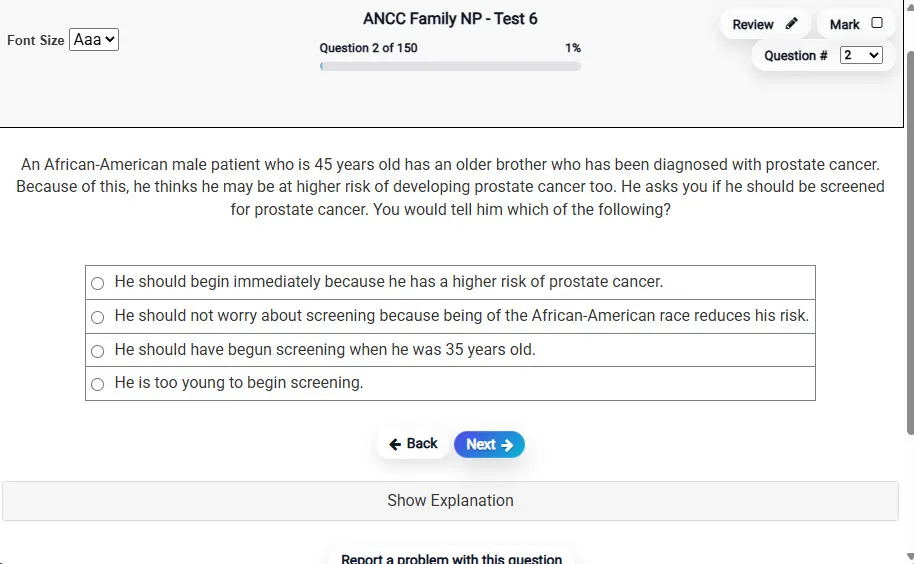
Answering a Question screen – Multiple-choice item view with navigation controls and progress tracker.
Answering a Question Multiple-choice item view with navigation controls and progress tracker.

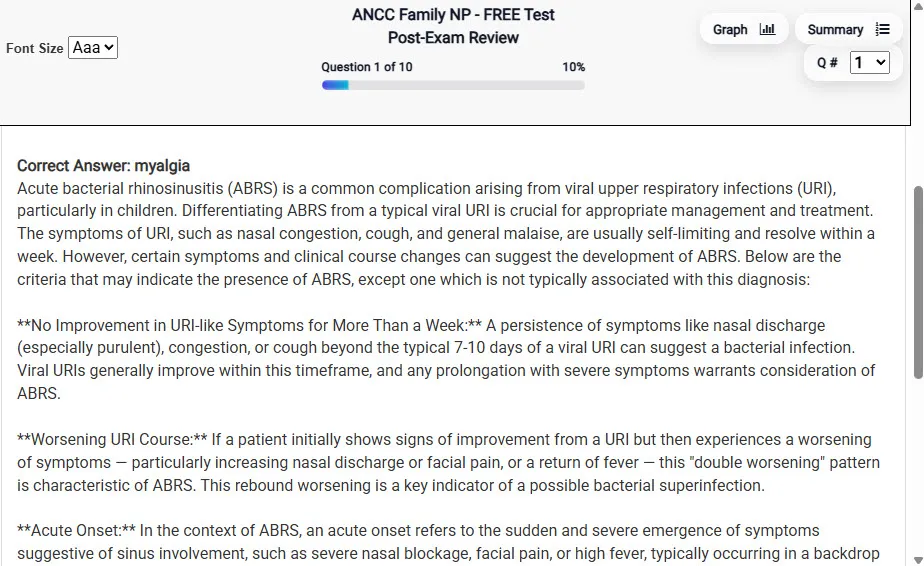
                           Detailed Explanation screen – 
                         Review mode showing chosen answer and rationale and references.
Detailed Explanation Review mode showing chosen answer and rationale and references.

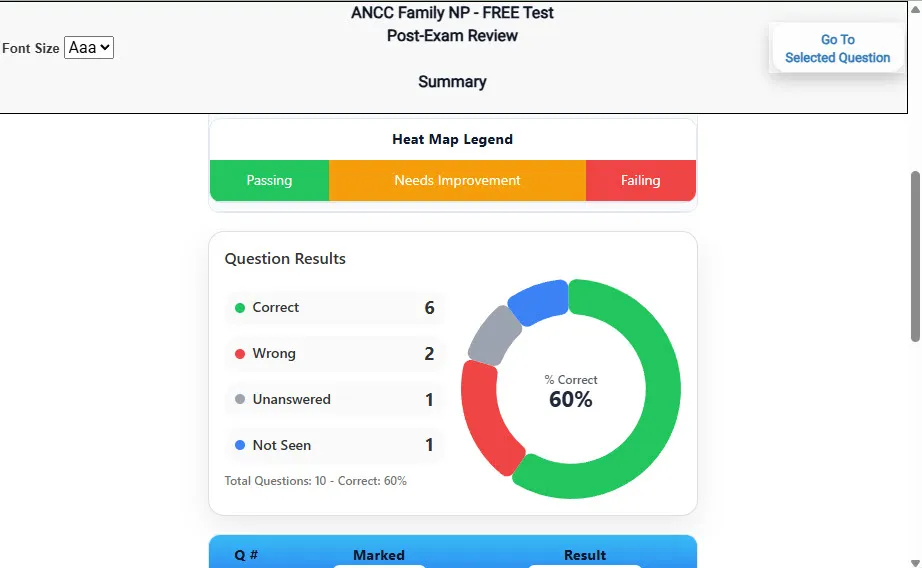
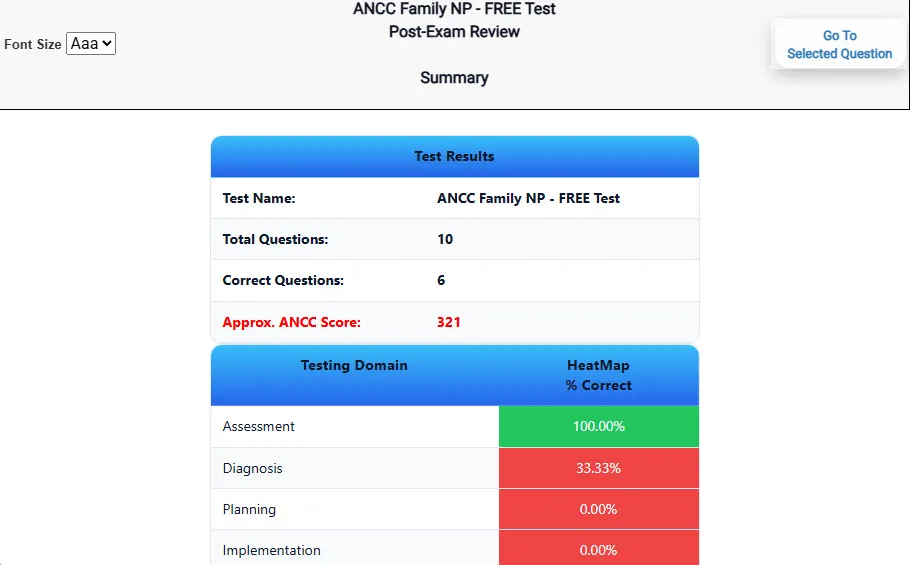
                           Review Summary 1 screen – 
                         Summary with counts for correct/wrong/unanswered and not seen items.
Review Summary 1 Summary with counts for correct/wrong/unanswered and not seen items.

                           Review Summary 2 screen – 
                         Advanced summary with category/domain breakdown and performance insights.
Review Summary 2 Advanced summary with category/domain breakdown and performance insights.

What Each Screen Shows

Answer Question Screen

  • Clean multiple-choice interface with progress bar.
  • Mark for review feature.
  • Matches real test pacing.

Detailed Explanation

  • Correct answer plus rationale.
  • Key concepts and guidelines highlighted.
  • Move between questions to fill knowledge gaps.

Review Summary 1

  • Overall results with total questions and scaled score.
  • Domain heatmap shows strengths and weaknesses.
  • Quick visual feedback on study priorities.

Review Summary 2

  • Chart of correct, wrong, unanswered, not seen.
  • Color-coded results for easy review.
  • Links back to missed items.

Top 10 Reasons to Use Exam Edge for your MTTC Bilingual Education Exam Prep

  1. Focused on the MTTC Bilingual Education Exam

    Our practice tests are built specifically for the MTTC Bilingual Education exam — every question mirrors the real topics, format, and difficulty so you're studying exactly what matters.

  2. Real Exam Simulation

    We match the per-question time limits and pressure of the actual MTTC exam, so test day feels familiar and stress-free.

  3. 10 Full Practice Tests & 1,000 Unique Questions

    You'll have more than enough material to master every MTTC Bilingual Education concept — no repeats, no fluff.

  4. Lower Cost Than a Retake

    Ordering 5 practice exams costs less than retaking the MTTC Bilingual Education exam after a failure. One low fee could save you both time and money.

  5. Flexible Testing

    Need to step away mid-exam? Pick up right where you left off — with your remaining time intact.

  6. Instant Scoring & Feedback

    See your raw score and an estimated MTTC Bilingual Education score immediately after finishing each practice test.

  7. Detailed Explanations for Every Question

    Review correct and incorrect answers with clear, step-by-step explanations so you truly understand each topic.

  8. Trusted & Accredited

    We're fully accredited by the Better Business Bureau and uphold the highest standards of trust and transparency.

  9. Web-Based & Always Available

    No software to install. Access your MTTC Bilingual Education practice exams 24/7 from any computer or mobile device.

  10. Expert Support When You Need It

    Need extra help? Our specialized tutors are highly qualified and ready to support your MTTC exam prep.


Pass the MTTC Bilingual Education Exam with Realistic Practice Tests from Exam Edge

Preparing for your upcoming MTTC Bilingual Education (125) Certification Exam can feel overwhelming — but the right practice makes all the difference. Exam Edge gives you the tools, structure, and confidence to pass on your first try. Our online practice exams are built to match the real MTTC Bilingual Education exam in content, format, and difficulty.

  • 📝 10 MTTC Bilingual Education Practice Tests: Access 10 full-length exams with 100 questions each, covering every major MTTC Bilingual Education topic in depth.
  • Instant Online Access: Start practicing right away — no software, no waiting.
  • 🧠 Step-by-Step Explanations: Understand the reasoning behind every correct answer so you can master MTTC Bilingual Education exam concepts.
  • 🔄 Retake Each Exam Up to 4 Times: Build knowledge through repetition and track your improvement over time.
  • 🌐 Web-Based & Available 24/7: Study anywhere, anytime, on any device.
  • 🧘 Boost Your Test-Day Confidence: Familiarity with the MTTC format reduces anxiety and helps you perform under pressure.

These MTTC Bilingual Education practice exams are designed to simulate the real testing experience by matching question types, timing, and difficulty level. This approach helps you get comfortable not just with the exam content, but also with the testing environment, so you walk into your exam day focused and confident.


Exam Edge MTTC Reviews


The questions weren't even close to what was asked on the MTTC 056 exam. Very disappointed and a waste of my money.

Aimee , Allen Park, Michigan

I recently took the Counselor MTTC 51 test and did not pass it. I honestly did not what I was going to do. I just happened to come across Exam Edge, and purchased the 5 practice tests. It gives you the explanations of the questions you missed. It also mirrors the actual first test I took. Well, I pa ...
Read More
Mike, Michigan

I passed both of my Michigan Teacher Certification exams using Exam Edge. It was very helpful in getting access to relevant questions that prepared me for the test. Some of the topics for the questions were the SAME as my real test, which was awesome. I will recommend this to all my teacher friends.

Catherine , Canton, Michigan

Just wanted to say a quick thank you for providing sample tests for MTTC for Business, Management, Marketing and Technology as my state did not and because of prepping with Exam Edge I passed my first time. Thank you again!!!

Sandra, , UTICA, Michigan

Hello ExamEdge Team, I am a current high school chemistry teacher (2020-21) at UPSM-HS, Detroit, MI. I want to share my MTTC Chemistry exam success experience. I recently gave my MTTC Chemistry exam on 04/02/2021 at 10 am, in Michigan, and I passed my exam on my very first attempt. I purchased 15 pr ...
Read More
Giridhar, India


MTTC Bilingual Education Aliases Test Name

Here is a list of alternative names used for this exam.

  • MTTC Bilingual Education
  • MTTC Bilingual Education test
  • MTTC Bilingual Education Certification Test
  • MTTC
  • MTTC 125
  • 125 test
  • MTTC Bilingual Education (125)
  • Bilingual Education certification