This is the content of the pop-over!

MTTC Basic Skills Reading (096) Practice Tests & Test Prep by Exam Edge


MTTC Basic Skills Reading  product image
(4.9)
Based on 34 Reviews

  • Real Exam Simulation: Timed questions and matching content build comfort for your MTTC Basic Skills Reading test day.
  • Instant, 24/7 Access: Web-based MTTC Basic Skills Reading practice exams with no software needed.
  • Clear Explanations: Step-by-step answers and explanations for your MTTC exam to strengthen understanding.
  • Boosted Confidence: Reduces anxiety and improves test-taking skills to ace your MTTC Basic Skills Reading (096).

Featured on

MTTC Basic Skills Reading Online Practice Test Bundles

BEST VALUE
25 practice tests

$218.75

$998.75

SAVE $780

Only $8.75 per test!

  • 100% Pass Guarantee
  • 25 online practice tests
  • 42 questions per test
  • Bonus: Study Guide
  • Instant access
  • Detailed Explanations
  • Practice tests never expire
  • Timed, untimed, or study guide mode
MOST POPULAR
10 practice tests

$99.50

$399.50

SAVE $300

Only $9.95 per test!

  • 10 online practice tests
  • 42 questions per test
  • Bonus: Study Guide
  • Instant access
  • Detailed Explanations
  • Practice tests never expire
  • Timed, untimed, or study guide mode
5 practice tests

$69.75

$199.75

SAVE $130

Only $13.95 per test!

  • 5 online practice tests
  • 42 questions per test
  • Instant access
  • Detailed Explanations
  • Practice tests never expire
  • Timed, untimed, or study guide mode
1 practice test

$39.95

  • 1 online practice test
  • 42 questions per test
  • Instant access
  • Detailed Explanations
  • Practice tests never expire
  • Timed, untimed, or study guide mode
Quick Select
Tap to choose a bundle

** All Prices are in US Dollars (USD) **


MTTC Basic Skills Reading (096) Resources

Jump to the section you need most.

Understanding the exact breakdown of the MTTC Basic Skills Reading test will help you know what to expect and how to most effectively prepare. The MTTC Basic Skills Reading has multiple-choice questions . The exam will be broken down into the sections below:

MTTC Basic Skills Reading Exam Blueprint
Domain Name
Determine the meaning of words and phrases  
Understand the main idea and supporting details in written material  
Identify a writer's purpose - point of view intended meaning  
Analyze the relationship among ideas in written material  
Use critical reasoning skills to evaluate written material  
Apply study skills to reading assignments.  

MTTC Basic Skills Reading Study Tips by Domain

  • Use context clues (definition, example, contrast, cause/effect) to infer meaning; red flag: choosing an option that merely repeats nearby words without matching the sentence’s logic.
  • Analyze word parts (prefix, root, suffix) to narrow meaning and part of speech; common trap: ignoring a negative prefix (e.g., in-, dis-, non-) that reverses the meaning.
  • Determine the meaning of figurative language (metaphor, simile, idiom) in context; priority rule: select the non-literal meaning that fits the author’s point, not the literal definition.
  • Use sentence structure and grammar to identify what a pronoun, modifier, or phrase refers to; red flag: an answer that could refer to multiple nouns when the passage signals a single clear antecedent.
  • Distinguish connotation from denotation when words have similar dictionary meanings; common trap: missing tone words (e.g., “slender” vs. “scrawny”) that change the intended meaning.
  • For technical or domain-specific terms, rely on how the passage uses the term rather than prior knowledge; red flag: picking a familiar everyday meaning when the surrounding details indicate a specialized sense.
  • Identify the main idea by asking what one sentence could cover every paragraph; red flag: choosing a detail that appears only once as the “main idea.”
  • Distinguish topic from main idea—the topic is the subject, while the main idea is the author’s key claim about it; common trap: selecting a broad topic phrase instead of a complete idea.
  • Use paragraph structure (topic sentence, repeated key terms, concluding sentence) to locate support; priority rule: if a “main idea” answer can’t be backed by multiple details, it’s likely wrong.
  • Separate major from minor details by checking whether the detail explains, proves, or illustrates the main idea; red flag: examples, statistics, or anecdotes presented as if they were the author’s point.
  • Handle implied main ideas by synthesizing repeated points across the passage; common trap: choosing an inference that goes beyond the passage rather than one grounded in stated support.
  • Match supporting details to the correct claim or sub-idea within the passage; threshold check: the best support should be specific and directly relevant, not merely related by the same topic.
  • Identify purpose by matching text features to goals: thesis-driven argument/persuasion, step-by-step directions/inform, vivid imagery/anecdote/entertain—red flag: assuming every passage is persuasive just because it has opinions.
  • Determine point of view by tracking pronouns, level of personal involvement, and stance markers (e.g., “clearly,” “unfortunately”)—common trap: confusing the author’s view with a quoted or summarized opposing view.
  • Infer intended meaning from tone and context (sarcasm, irony, understatement) rather than literal wording—red flag: a statement that seems to contradict surrounding evidence is often ironic, not a factual claim.
  • Distinguish fact from opinion and identify when the writer is trying to influence belief vs. report information—priority rule: evaluative language (best, flawed, alarming) usually signals argument or bias.
  • Use the conclusion and opening to confirm the writer’s central aim (call to action, recommendation, warning, explanation)—common trap: choosing an answer that is too broad when the passage targets a specific audience or outcome.
  • Spot bias by noting what the writer emphasizes or omits and the sources selected (expert quotes vs. anecdotes)—red flag: one-sided evidence and loaded wording typically indicate a strong point of view.
  • Track cause-and-effect chains by asking “What directly leads to what?”; red flag: the passage describes events in sequence but never claims causation.
  • Identify comparison/contrast by marking like/unlike features and the basis of comparison; common trap: choosing an answer about a detail that appears in both items but isn’t the main comparison point.
  • Recognize problem-solution structures by locating the problem statement and the proposed response; priority rule: select the solution that addresses the stated cause, not just the symptom.
  • Follow logic signposts (e.g., “however,” “therefore,” “for example”) to map transitions; red flag: “however” signals a shift or limitation, not simply a new detail.
  • Distinguish generalizations from examples by testing whether the example could be removed without changing the main claim; common trap: mistaking a vivid anecdote for the author’s overall point.
  • Assess how one idea supports, qualifies, or refutes another (evidence, counterexample, concession); threshold cue: if a sentence begins with “although” or “even if,” it usually limits the claim rather than overturning it.
  • Judge the strength of an argument by checking whether the conclusion actually follows from the stated premises; red flag: a persuasive tone or vivid anecdote substituted for evidence.
  • Evaluate evidence quality by preferring relevant, specific, and sufficient support over vague generalities; common trap: treating a single example as proof of a broad claim.
  • Distinguish fact from opinion and interpretation by looking for verifiable statements versus value judgments; cue: words like “clearly” or “obviously” often signal unsupported opinion.
  • Identify assumptions and gaps in logic (e.g., causal leaps, false dilemmas) and test whether alternative explanations fit the facts; red flag: “after X, therefore because of X” reasoning.
  • Assess credibility and bias by noting the source’s expertise, potential conflict of interest, and whether counterevidence is addressed; priority rule: a balanced discussion of opposing views typically increases reliability.
  • Check for internal consistency and alignment between claims, data, and examples; common trap: accepting statistics without confirming what the numbers actually measure (definitions, time frame, or comparison group).
  • Preview strategically before reading: scan headings, first/last paragraphs, and visuals to form 2–3 guiding questions; red flag—diving in without a purpose often leads to missing what the MTTC questions target.
  • Set a time-and-chunk plan (e.g., read in sections and pause to paraphrase); common trap—reading straight through without checkpoints makes it harder to locate evidence fast on test day.
  • Annotate for structure, not decoration: mark thesis/claim, topic sentences, and signal words (“however,” “therefore”); red flag—highlighting entire paragraphs usually signals you’re not distinguishing key ideas.
  • Use an evidence map while reading: note where each major point is supported (paragraph numbers or brief tags); priority rule—when answering, return to the exact line/section rather than relying on memory.
  • Adjust reading rate to text difficulty: slow down at definitions, dense arguments, or conflicting viewpoints; contraindication—skimming sections with qualifiers (“most,” “except,” “only if”) commonly flips the meaning.
  • After reading, self-test with a 1–2 sentence summary and a quick outline of supporting points; common trap—if your summary includes minor examples but not the central claim, you likely misprioritized details.


Built to Fit Into Your Busy Life

Everything you need to prepare with confidence—without wasting a minute.

Three Study Modes

Timed, No Time Limit, or Explanation mode.

Actionable Analytics

Heatmaps and scaled scores highlight weak areas.

High-Yield Rationales

Concise explanations emphasize key concepts.

Realistic Interface

Matches the feel of the actual exam environment.

Accessible by Design

Clean layout reduces cognitive load.

Anytime, Anywhere

Web-based access 24/7 on any device.
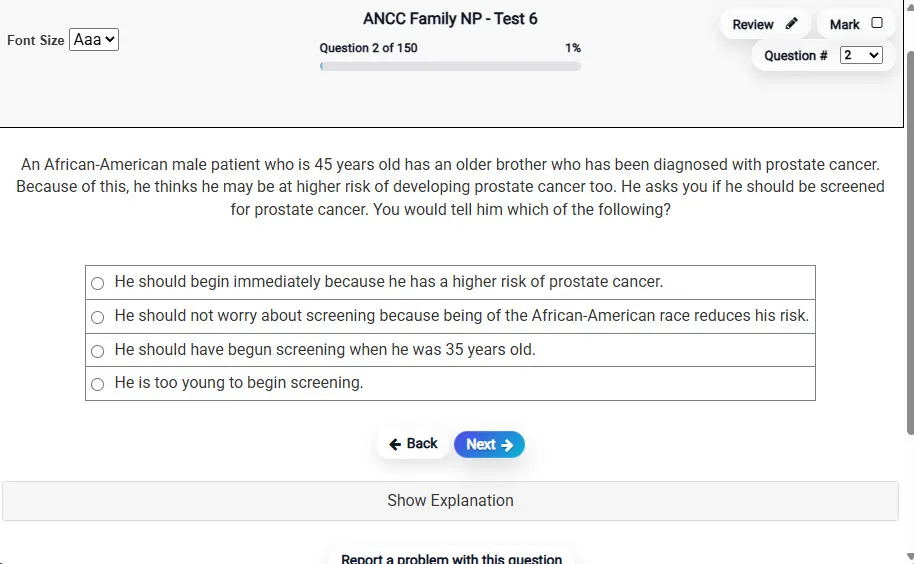
Answering a Question screen – Multiple-choice item view with navigation controls and progress tracker.
Answering a Question Multiple-choice item view with navigation controls and progress tracker.

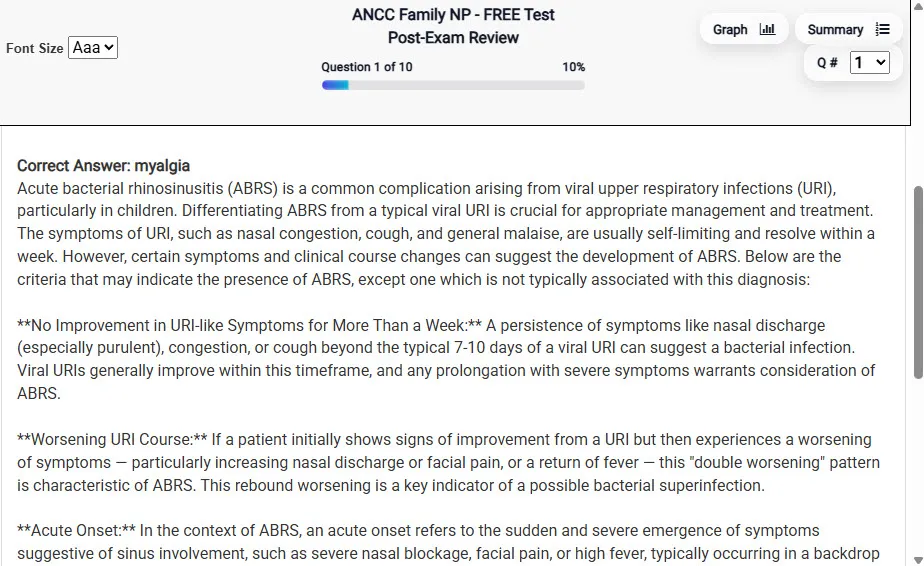
                           Detailed Explanation screen – 
                         Review mode showing chosen answer and rationale and references.
Detailed Explanation Review mode showing chosen answer and rationale and references.

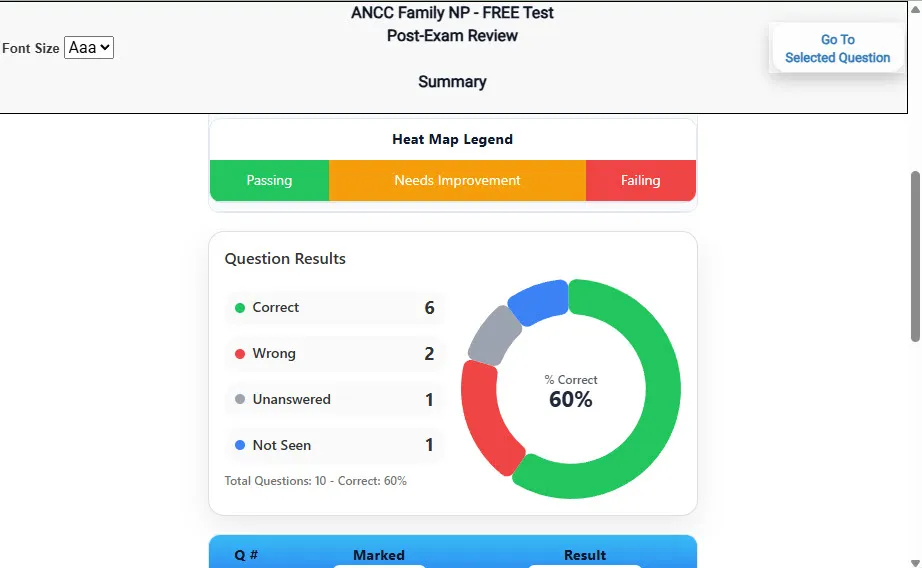
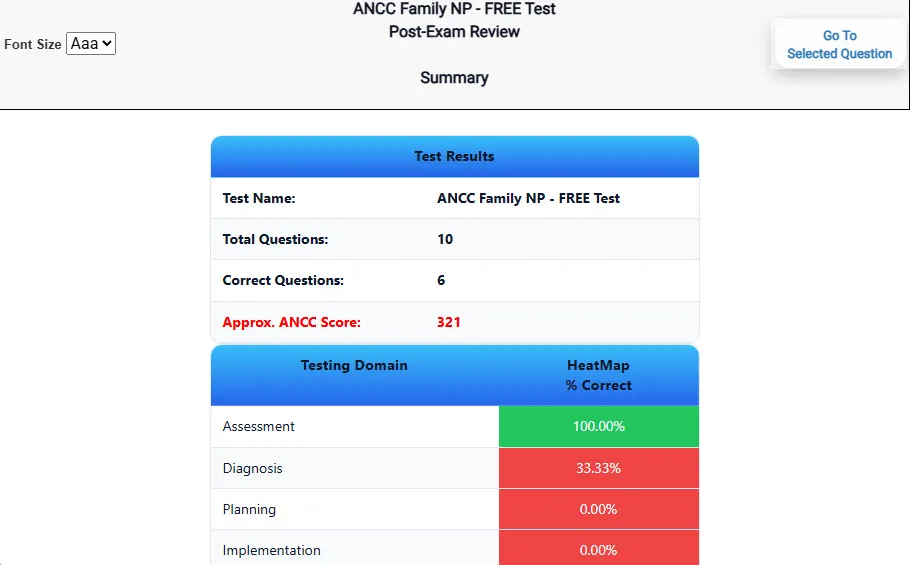
                           Review Summary 1 screen – 
                         Summary with counts for correct/wrong/unanswered and not seen items.
Review Summary 1 Summary with counts for correct/wrong/unanswered and not seen items.

                           Review Summary 2 screen – 
                         Advanced summary with category/domain breakdown and performance insights.
Review Summary 2 Advanced summary with category/domain breakdown and performance insights.

What Each Screen Shows

Answer Question Screen

  • Clean multiple-choice interface with progress bar.
  • Mark for review feature.
  • Matches real test pacing.

Detailed Explanation

  • Correct answer plus rationale.
  • Key concepts and guidelines highlighted.
  • Move between questions to fill knowledge gaps.

Review Summary 1

  • Overall results with total questions and scaled score.
  • Domain heatmap shows strengths and weaknesses.
  • Quick visual feedback on study priorities.

Review Summary 2

  • Chart of correct, wrong, unanswered, not seen.
  • Color-coded results for easy review.
  • Links back to missed items.

Top 10 Reasons to Use Exam Edge for your MTTC Basic Skills Reading Exam Prep

  1. Focused on the MTTC Basic Skills Reading Exam

    Our practice tests are built specifically for the MTTC Basic Skills Reading exam — every question mirrors the real topics, format, and difficulty so you're studying exactly what matters.

  2. Real Exam Simulation

    We match the per-question time limits and pressure of the actual MTTC exam, so test day feels familiar and stress-free.

  3. 25 Full Practice Tests & 1,050 Unique Questions

    You'll have more than enough material to master every MTTC Basic Skills Reading concept — no repeats, no fluff.

  4. Lower Cost Than a Retake

    Ordering 5 practice exams costs less than retaking the MTTC Basic Skills Reading exam after a failure. One low fee could save you both time and money.

  5. Flexible Testing

    Need to step away mid-exam? Pick up right where you left off — with your remaining time intact.

  6. Instant Scoring & Feedback

    See your raw score and an estimated MTTC Basic Skills Reading score immediately after finishing each practice test.

  7. Detailed Explanations for Every Question

    Review correct and incorrect answers with clear, step-by-step explanations so you truly understand each topic.

  8. Trusted & Accredited

    We're fully accredited by the Better Business Bureau and uphold the highest standards of trust and transparency.

  9. Web-Based & Always Available

    No software to install. Access your MTTC Basic Skills Reading practice exams 24/7 from any computer or mobile device.

  10. Expert Support When You Need It

    Need extra help? Our specialized tutors are highly qualified and ready to support your MTTC exam prep.


Pass the MTTC Basic Skills Reading Exam with Realistic Practice Tests from Exam Edge

Preparing for your upcoming MTTC Basic Skills Reading (096) Certification Exam can feel overwhelming — but the right practice makes all the difference. Exam Edge gives you the tools, structure, and confidence to pass on your first try. Our online practice exams are built to match the real MTTC Basic Skills Reading exam in content, format, and difficulty.

  • 📝 25 MTTC Basic Skills Reading Practice Tests: Access 25 full-length exams with 42 questions each, covering every major MTTC Basic Skills Reading topic in depth.
  • Instant Online Access: Start practicing right away — no software, no waiting.
  • 🧠 Step-by-Step Explanations: Understand the reasoning behind every correct answer so you can master MTTC Basic Skills Reading exam concepts.
  • 🔄 Retake Each Exam Up to 4 Times: Build knowledge through repetition and track your improvement over time.
  • 🌐 Web-Based & Available 24/7: Study anywhere, anytime, on any device.
  • 🧘 Boost Your Test-Day Confidence: Familiarity with the MTTC format reduces anxiety and helps you perform under pressure.

These MTTC Basic Skills Reading practice exams are designed to simulate the real testing experience by matching question types, timing, and difficulty level. This approach helps you get comfortable not just with the exam content, but also with the testing environment, so you walk into your exam day focused and confident.

Exam Edge MTTC Reviews


I passed both of my Michigan Teacher Certification exams using Exam Edge. It was very helpful in getting access to relevant questions that prepared me for the test. Some of the topics for the questions were the SAME as my real test, which was awesome. I will recommend this to all my teacher friends.

Catherine , Canton, Michigan

The questions weren't even close to what was asked on the MTTC 056 exam. Very disappointed and a waste of my money.

Aimee , Allen Park, Michigan

I recently took the Counselor MTTC 51 test and did not pass it. I honestly did not what I was going to do. I just happened to come across Exam Edge, and purchased the 5 practice tests. It gives you the explanations of the questions you missed. It also mirrors the actual first test I took. Well, I pa ...
Read More
Mike, Michigan

Hello ExamEdge Team, I am a current high school chemistry teacher (2020-21) at UPSM-HS, Detroit, MI. I want to share my MTTC Chemistry exam success experience. I recently gave my MTTC Chemistry exam on 04/02/2021 at 10 am, in Michigan, and I passed my exam on my very first attempt. I purchased 15 pr ...
Read More
Giridhar, India

Just wanted to say a quick thank you for providing sample tests for MTTC for Business, Management, Marketing and Technology as my state did not and because of prepping with Exam Edge I passed my first time. Thank you again!!!

Sandra, , UTICA, Michigan


MTTC Basic Skills Reading Aliases Test Name

Here is a list of alternative names used for this exam.

  • MTTC Basic Skills Reading
  • MTTC Basic Skills Reading test
  • MTTC Basic Skills Reading Certification Test
  • MTTC
  • MTTC 096
  • 096 test
  • MTTC Basic Skills Reading (096)
  • Basic Skills Reading certification