This is the content of the pop-over!

MCA Biology (016) Practice Tests & Test Prep by Exam Edge


MCA Biology   product image
(4.6)
Based on 20 Reviews

  • Real Exam Simulation: Timed questions and matching content build comfort for your MCA Biology test day.
  • Instant, 24/7 Access: Web-based MCA Biology practice exams with no software needed.
  • Clear Explanations: Step-by-step answers and explanations for your MCA exam to strengthen understanding.
  • Boosted Confidence: Reduces anxiety and improves test-taking skills to ace your MCA Biology (016).

Featured on

MCA Biology Online Practice Test Bundles

BEST VALUE
20 practice tests

$174.00

$799.00

SAVE $625

Only $8.70 per test!

  • 100% Pass Guarantee
  • 20 online practice tests
  • 80 questions per test
  • Bonus: 100 Flash Cards + Study Guide
  • Instant access
  • Detailed Explanations
  • Practice tests never expire
  • Timed, untimed, or study guide mode
MOST POPULAR
10 practice tests

$99.50

$399.50

SAVE $300

Only $9.95 per test!

  • 10 online practice tests
  • 80 questions per test
  • Bonus: 100 Flash Cards + Study Guide
  • Instant access
  • Detailed Explanations
  • Practice tests never expire
  • Timed, untimed, or study guide mode
5 practice tests

$69.75

$199.75

SAVE $130

Only $13.95 per test!

  • 5 online practice tests
  • 80 questions per test
  • Bonus: 100 Flash Cards
  • Instant access
  • Detailed Explanations
  • Practice tests never expire
  • Timed, untimed, or study guide mode
1 practice test

$39.95

  • 1 online practice test
  • 80 questions per test
  • Instant access
  • Detailed Explanations
  • Practice tests never expire
  • Timed, untimed, or study guide mode
Quick Select
Tap to choose a bundle

** All Prices are in US Dollars (USD) **


MCA Biology (016) Resources

Jump to the section you need most.

Understanding the exact breakdown of the MCA Biology test will help you know what to expect and how to most effectively prepare. The MCA Biology has 80 multiple-choice questions . The exam will be broken down into the sections below:

MCA Biology Exam Blueprint
Domain Name % Number of
Questions
Science and Engineering Practices 21% 17
Biochemistry and Cell Biology 14% 11
Genetics and Evolution 29% 23
Biological Unity and Diversity 14% 11
Ecology and Environment 22% 18

MCA Biology Study Tips by Domain

  • When evaluating a study, separate observation from inference and flag any causal claim based only on correlation as a red flag (e.g., no control group or randomization).
  • Design experiments with a clear hypothesis, independent/dependent variables, and appropriate controls; common trap: changing multiple variables at once makes results uninterpretable.
  • Choose the right type of graph for the data (continuous vs. categorical) and include units and labeled axes; red flag: axes that are unlabeled or scales that exaggerate differences.
  • Interpret statistical summaries cautiously—p-values don’t measure effect size; priority rule: check sample size and variability (SD/SE) before trusting a claimed “significant” difference.
  • Use models (conceptual, mathematical, or physical) to make testable predictions and note assumptions; common trap: treating a simplified model as reality outside its valid range.
  • Assess sources for reliability and bias; red flag: conclusions that ignore contradictory data or rely on anecdotal evidence rather than replicated results.
  • Know macromolecules by building block and bond type: amino acids–peptide, monosaccharides–glycosidic, nucleotides–phosphodiester, fatty acids–ester; red flag—mixing up dehydration synthesis vs. hydrolysis when predicting products.
  • Enzyme activity depends on temperature, pH, substrate concentration, and inhibitors; common trap—assuming enzymes change equilibrium rather than just lowering activation energy and speeding both forward/reverse rates.
  • Membrane transport: diffusion/osmosis, facilitated diffusion (no ATP), active transport (ATP or gradients), and bulk transport; priority rule—check solute vs. water movement and tonicity before predicting cell swelling or shrinking.
  • Cell cycle and division: interphase (G1, S, G2), mitosis (PMAT), cytokinesis, and checkpoints; red flag—confusing chromosome number vs. chromatid number after S phase and during anaphase.
  • Cellular respiration vs. photosynthesis: locations and inputs/outputs (glycolysis—cytoplasm; Krebs/ETC—mitochondria; light reactions—thylakoid; Calvin cycle—stroma); common trap—thinking oxygen is produced in the Calvin cycle rather than in light reactions (water splitting).
  • Cell communication and homeostasis: receptors (membrane vs. intracellular), second messengers (e.g., cAMP), and negative feedback loops; red flag—assuming all hormones cross membranes—steroid hormones typically do, peptide hormones typically don’t.
  • Use Punnett squares only after identifying allele relationships (complete dominance, codominance, incomplete dominance) and inheritance pattern (autosomal vs sex-linked)—red flag: assuming dominance tells you frequency in offspring.
  • Link meiosis to variation: crossing over in prophase I and independent assortment in metaphase I create new allele combinations—common trap: attributing mutation to meiosis steps rather than DNA replication errors or mutagens.
  • Interpret pedigrees by checking for skipped generations and sex bias to distinguish autosomal recessive vs X-linked traits—priority rule: if mostly males affected with no father-to-son transmission, suspect X-linked recessive.
  • Apply Hardy–Weinberg only when assumptions hold (large population, random mating, no selection, migration, mutation)—red flag: using p + q = 1 without confirming only two alleles and equilibrium conditions.
  • Connect natural selection to differential reproductive success and changing allele frequencies, not individuals evolving—common trap: confusing adaptation (population-level over generations) with acclimation (individual-level).
  • Distinguish mechanisms of evolution: genetic drift (bottleneck/founder effects), gene flow, mutation, and selection—threshold cue: drift is strongest in small populations and can fix alleles even if they are neutral or harmful.
  • Use taxonomy hierarchy correctly (Domain → Species) and be able to justify a placement with a shared derived trait; red flag: relying on habitat or “looks like” instead of diagnostic characteristics.
  • Distinguish Bacteria vs Archaea vs Eukarya by cell wall/? chemistry and gene expression features; common trap: assuming all prokaryotes have peptidoglycan (Archaea do not).
  • Compare plant vs animal vs fungal life strategies with a concrete trait (cellulose vs chitin, chloroplasts, nutrition mode); priority rule: if chitin cell wall and absorptive heterotrophy, classify as fungi even if it looks plant-like.
  • Identify major body plan features (symmetry, segmentation, coelom, protostome vs deuterostome) and link them to phyla-level classification; red flag: confusing coelomate with presence of a body cavity that is not fully mesoderm-lined.
  • Recognize key vertebrate adaptations (jaws, lungs, amniotic egg, endothermy) and place groups in order of appearance; common trap: thinking amniotic egg is only in birds—it also defines reptiles and mammals.
  • Use dichotomous keys and cladograms to determine identity and relatedness; threshold cue: the most recent common ancestor determines relatedness, not the number of shared traits from convergence.
  • Trace energy flow with the 10% rule in mind and distinguish productivity terms (GPP, NPP) — red flag: confusing biomass pyramids with energy pyramids (energy pyramids are always upright).
  • Interpret population growth models and carrying capacity (K) using real data — common trap: labeling any S-shaped curve as “stable” when overshoot-and-dieback indicates resource depletion.
  • Use species interactions (competition, predation, mutualism, parasitism) to predict community changes — priority rule: identify the limiting interaction before proposing management actions (e.g., removing predators can trigger trophic cascades).
  • Connect biogeochemical cycles (carbon, nitrogen, phosphorus, water) to human impacts — red flag: attributing eutrophication to CO2 instead of excess N/P inputs that drive algal blooms and hypoxia.
  • Analyze abiotic factors and niches (fundamental vs. realized) across biomes — common trap: assuming “tolerance range” means optimal growth (optimum is narrower than tolerance limits).
  • Evaluate environmental change and conservation tools (biodiversity metrics, invasive species, habitat fragmentation) — contraindication: relying solely on species richness when evenness and keystone species loss can collapse ecosystem function.


Built to Fit Into Your Busy Life

Everything you need to prepare with confidence—without wasting a minute.

Three Study Modes

Timed, No Time Limit, or Explanation mode.

Actionable Analytics

Heatmaps and scaled scores highlight weak areas.

High-Yield Rationales

Concise explanations emphasize key concepts.

Realistic Interface

Matches the feel of the actual exam environment.

Accessible by Design

Clean layout reduces cognitive load.

Anytime, Anywhere

Web-based access 24/7 on any device.
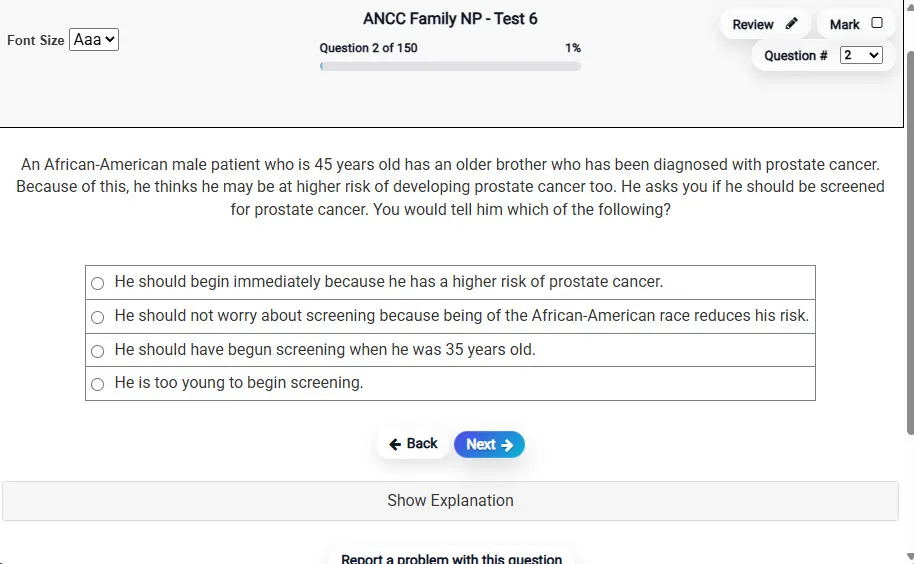
Answering a Question screen – Multiple-choice item view with navigation controls and progress tracker.
Answering a Question Multiple-choice item view with navigation controls and progress tracker.

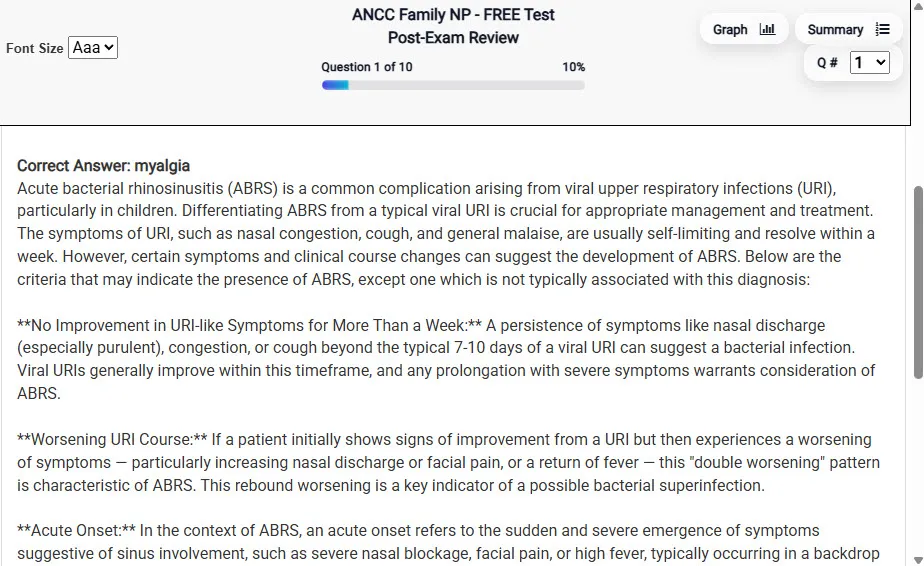
                           Detailed Explanation screen – 
                         Review mode showing chosen answer and rationale and references.
Detailed Explanation Review mode showing chosen answer and rationale and references.

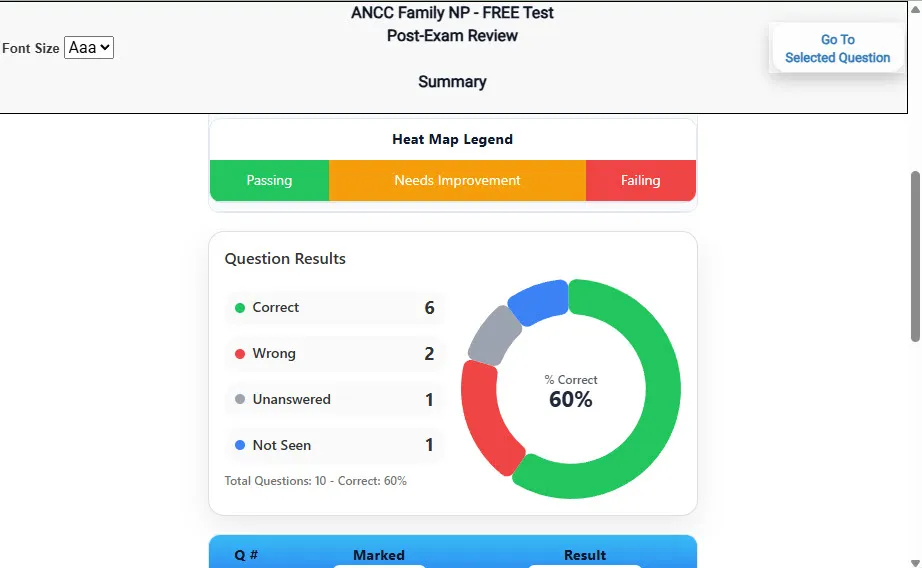
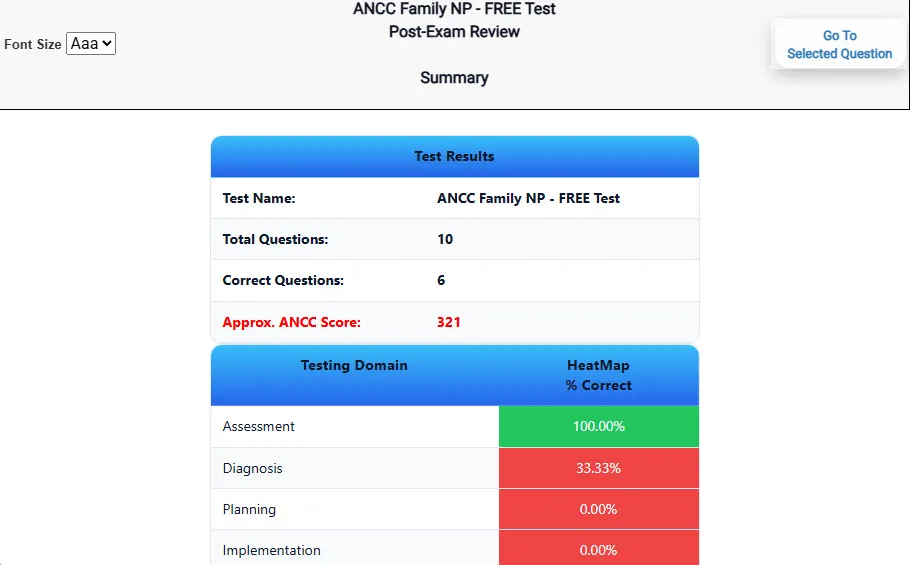
                           Review Summary 1 screen – 
                         Summary with counts for correct/wrong/unanswered and not seen items.
Review Summary 1 Summary with counts for correct/wrong/unanswered and not seen items.

                           Review Summary 2 screen – 
                         Advanced summary with category/domain breakdown and performance insights.
Review Summary 2 Advanced summary with category/domain breakdown and performance insights.

What Each Screen Shows

Answer Question Screen

  • Clean multiple-choice interface with progress bar.
  • Mark for review feature.
  • Matches real test pacing.

Detailed Explanation

  • Correct answer plus rationale.
  • Key concepts and guidelines highlighted.
  • Move between questions to fill knowledge gaps.

Review Summary 1

  • Overall results with total questions and scaled score.
  • Domain heatmap shows strengths and weaknesses.
  • Quick visual feedback on study priorities.

Review Summary 2

  • Chart of correct, wrong, unanswered, not seen.
  • Color-coded results for easy review.
  • Links back to missed items.

Top 10 Reasons to Use Exam Edge for your MCA Biology Exam Prep

  1. Focused on the MCA Biology Exam

    Our practice tests are built specifically for the MCA Biology exam — every question mirrors the real topics, format, and difficulty so you're studying exactly what matters.

  2. Real Exam Simulation

    We match the per-question time limits and pressure of the actual MCA exam, so test day feels familiar and stress-free.

  3. 20 Full Practice Tests & 1,600 Unique Questions

    You'll have more than enough material to master every MCA Biology concept — no repeats, no fluff.

  4. Lower Cost Than a Retake

    Ordering 5 practice exams costs less than retaking the MCA Biology exam after a failure. One low fee could save you both time and money.

  5. Flexible Testing

    Need to step away mid-exam? Pick up right where you left off — with your remaining time intact.

  6. Instant Scoring & Feedback

    See your raw score and an estimated MCA Biology score immediately after finishing each practice test.

  7. Detailed Explanations for Every Question

    Review correct and incorrect answers with clear, step-by-step explanations so you truly understand each topic.

  8. Trusted & Accredited

    We're fully accredited by the Better Business Bureau and uphold the highest standards of trust and transparency.

  9. Web-Based & Always Available

    No software to install. Access your MCA Biology practice exams 24/7 from any computer or mobile device.

  10. Expert Support When You Need It

    Need extra help? Our specialized tutors are highly qualified and ready to support your MCA exam prep.


Pass the MCA Biology Exam with Realistic Practice Tests from Exam Edge

Preparing for your upcoming MCA Biology (016) Certification Exam can feel overwhelming — but the right practice makes all the difference. Exam Edge gives you the tools, structure, and confidence to pass on your first try. Our online practice exams are built to match the real MCA Biology exam in content, format, and difficulty.

  • 📝 20 MCA Biology Practice Tests: Access 20 full-length exams with 80 questions each, covering every major MCA Biology topic in depth.
  • Instant Online Access: Start practicing right away — no software, no waiting.
  • 🧠 Step-by-Step Explanations: Understand the reasoning behind every correct answer so you can master MCA Biology exam concepts.
  • 🔄 Retake Each Exam Up to 4 Times: Build knowledge through repetition and track your improvement over time.
  • 🌐 Web-Based & Available 24/7: Study anywhere, anytime, on any device.
  • 🧘 Boost Your Test-Day Confidence: Familiarity with the MCA format reduces anxiety and helps you perform under pressure.

These MCA Biology practice exams are designed to simulate the real testing experience by matching question types, timing, and difficulty level. This approach helps you get comfortable not just with the exam content, but also with the testing environment, so you walk into your exam day focused and confident.


Exam Edge MCA Reviews


MCA Biology Aliases Test Name

Here is a list of alternative names used for this exam.

  • MCA Biology
  • MCA Biology test
  • MCA Biology Certification Test
  • MCA
  • MCA 016
  • 016 test
  • MCA Biology (016)
  • Biology certification