This is the content of the pop-over!

HESI Pediatric NP Practice Tests & Test Prep by Exam Edge


HESI Pediatric Nurse Practitioner  product image
(4.6)
Based on 34 Reviews

  • Real Exam Simulation: Timed questions and matching content build comfort for your HESI Pediatric NP test day.
  • Instant, 24/7 Access: Web-based HESI Pediatric Nurse Practitioner practice exams with no software needed.
  • Clear Explanations: Step-by-step answers and explanations for your HESI exam to strengthen understanding.
  • Boosted Confidence: Reduces anxiety and improves test-taking skills to ace your HESI Pediatric Nurse Practitioner .

Featured on

HESI Pediatric Nurse Practitioner Online Practice Test Bundles

BEST VALUE
10 practice tests

$99.50

$399.50

SAVE $300

Only $9.95 per test!

  • 100% Pass Guarantee
  • 10 online practice tests
  • 100 questions per test
  • Bonus: 100 Flash Cards + Study Guide
  • Instant access
  • Detailed Explanations
  • Practice tests never expire
  • Timed, untimed, or study guide mode
5 practice tests

$69.75

$199.75

SAVE $130

Only $13.95 per test!

  • 5 online practice tests
  • 100 questions per test
  • Bonus: 100 Flash Cards + Study Guide
  • Instant access
  • Detailed Explanations
  • Practice tests never expire
  • Timed, untimed, or study guide mode
1 practice test

$39.95

  • 1 online practice test
  • 100 questions per test
  • Instant access
  • Detailed Explanations
  • Practice tests never expire
  • Timed, untimed, or study guide mode
Quick Select
Tap to choose a bundle

** All Prices are in US Dollars (USD) **


HESI Pediatric NP () Resources

Jump to the section you need most.

Understanding the exact breakdown of the HESI Pediatric Nurse Practitioner test will help you know what to expect and how to most effectively prepare. The HESI Pediatric Nurse Practitioner has multiple-choice questions . The exam will be broken down into the sections below:

HESI Pediatric Nurse Practitioner Exam Blueprint
Domain Name
Growth and Development Theories - Concepts Findings  
Advanced Practice Nursing  
Assessment - Diagnosis - Outcome Identification  
Clinical Assessment  
Development and growth  

HESI Pediatric Nurse Practitioner Study Tips by Domain

  • Use Piaget to match teaching to thinking level: preoperational (2–7 years) = magical thinking — red flag if you explain procedures with abstract logic and then label the child “noncompliant.”
  • Apply Erikson for psychosocial priorities: toddler autonomy vs shame/doubt — priority rule is offer limited choices (e.g., which arm for BP) to prevent power struggles.
  • Know Kohlberg basics for moral reasoning: school-age often “good/bad” based on rules and approval — common trap is expecting principled reasoning from a 7-year-old.
  • Use Vygotsky to guide skill-building: teach in the zone of proximal development with scaffolding — red flag is giving tasks too hard/too easy and interpreting failure as defiance.
  • Differentiate separation anxiety vs stranger anxiety: separation peaks ~9–18 months — practical cue is have caregivers leave briefly and return consistently rather than “sneaking out.”
  • Use play as a developmental finding: toddlers = parallel play, preschoolers = associative, school-age = cooperative — red flag if a school-age child persistently can’t engage in cooperative play, warranting further developmental screening.
  • Prioritize pediatric prevention at every visit (immunizations, anticipatory guidance, safe sleep, car seat safety)—red flag if the chief complaint visit ends without updating vaccine status or providing age-appropriate safety counseling.
  • Use weight-based prescribing in kg and document the calculation—common trap: dosing from pounds or failing to cap doses (e.g., acetaminophen/ibuprofen) leading to toxicity risk.
  • Know when to treat vs. refer/escalate: any infant <28 days with fever, toxic appearance, or poor perfusion needs urgent ED evaluation—do not “watch and wait” in this group.
  • Apply antibiotic stewardship: avoid antibiotics for viral URIs/bronchiolitis and use narrow-spectrum first-line when indicated (e.g., amoxicillin for uncomplicated AOM)—red flag is prescribing broad-spectrum without a clear indication.
  • Protect confidentiality while involving caregivers: offer private time for adolescents and follow minor-consent rules—common trap is disclosing sexual health or substance-use information to parents without permission when not legally required.
  • Document scope-of-practice essentials (history/PE, differential, rationale, follow-up, return precautions)—priority rule: always include “worsening, breathing difficulty, dehydration, or persistent fever” return instructions to reduce missed deterioration.
  • Prioritize pediatric triage with ABCs and age-specific vital signs; red flag: any infant <3 months with rectal temp ≥38.0°C (100.4°F) needs urgent evaluation.
  • Use a structured head-to-toe plus focused history (prenatal/birth, immunizations, exposures); common trap: relying on axillary temps or underestimating caregiver report of lethargy or poor feeding.
  • Formulate nursing/clinical diagnoses by clustering objective cues (e.g., retractions, grunting, SpO2 trends); red flag: silent chest or altered mental status signals impending respiratory failure.
  • Differentiate dehydration severity with weight change, mucous membranes, tears, cap refill, and urine output; priority rule: decreased perfusion (cap refill >2 seconds, tachycardia) warrants rapid fluid resuscitation.
  • Set measurable outcomes tied to time and function (e.g., pain ≤3/10 within 30 minutes, SpO2 ≥94% on room air in 2 hours); common trap: writing vague outcomes like “improved” without a metric.
  • Reassess after interventions and update diagnosis/outcomes based on response; red flag: failure to trend serial exams (neuro checks, I&O, respiratory effort) can miss rapid pediatric deterioration.
  • Use age-appropriate vital-sign norms and trends—a single “normal” value is a trap if the child’s baseline and trajectory suggest deterioration.
  • For respiratory assessment, prioritize work of breathing (retractions, grunting, nasal flaring) over pulse oximetry alone—a normal SpO2 can mask impending fatigue.
  • Assess hydration with multiple cues (mucous membranes, tears, cap refill, urine output, weight change)—red flag: delayed cap refill with tachycardia suggests hypovolemia even if BP is normal.
  • In infants, evaluate mental status and perfusion early (tone, feeding, consolability, color)—common trap: attributing lethargy or poor feeding to “viral illness” without ruling out sepsis.
  • Perform a focused pain assessment using validated tools (FLACC, FACES, numeric) and reassess after intervention—priority rule: escalating pain with guarding or rebound is a red flag for acute abdomen.
  • When examining ears/throat, choose correct technique—pull pinna down/back in children <3 years (up/back if older), and red flag: drooling with muffled voice/stridor requires urgent airway evaluation.
  • Use age-specific developmental milestones to judge progress; red flag if a child loses a previously acquired skill (developmental regression) or if parents report “not like peers.”
  • Plot weight, length/height, and head circumference on the correct sex- and age-based growth chart every visit; priority rule: crossing two major percentile lines downward warrants evaluation for undernutrition or chronic disease.
  • Interpret head circumference trends carefully; red flag if HC jumps percentiles rapidly (possible hydrocephalus) or falls percentiles (possible microcephaly), especially when neurodevelopment lags.
  • Assess feeding and nutrition as primary drivers of growth in infants/toddlers; common trap: overlooking excess cow’s milk intake (>24 oz/day) contributing to iron-deficiency anemia and poor weight gain.
  • Screen puberty timing and progression in school-age/adolescents; red flag thresholds: no breast development by 13 or no menarche by 15, and testicular enlargement absent by 14 (possible delayed puberty).
  • Differentiate normal variants from pathology in stature; priority cue: short stature with declining growth velocity (<4–5 cm/year after age 3) is more concerning than consistently low percentiles with normal velocity.


Built to Fit Into Your Busy Life

Everything you need to prepare with confidence—without wasting a minute.

Three Study Modes

Timed, No Time Limit, or Explanation mode.

Actionable Analytics

Heatmaps and scaled scores highlight weak areas.

High-Yield Rationales

Concise explanations emphasize key concepts.

Realistic Interface

Matches the feel of the actual exam environment.

Accessible by Design

Clean layout reduces cognitive load.

Anytime, Anywhere

Web-based access 24/7 on any device.
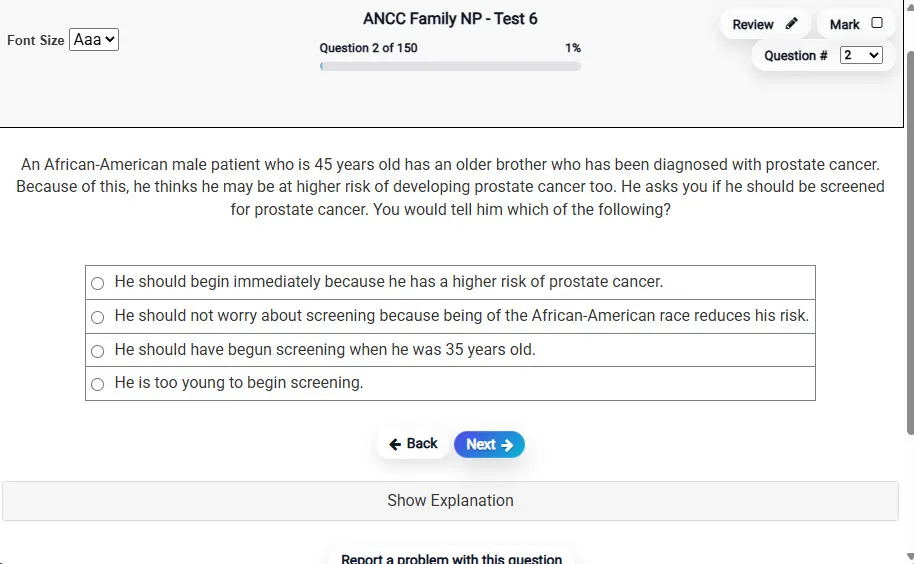
Answering a Question screen – Multiple-choice item view with navigation controls and progress tracker.
Answering a Question Multiple-choice item view with navigation controls and progress tracker.

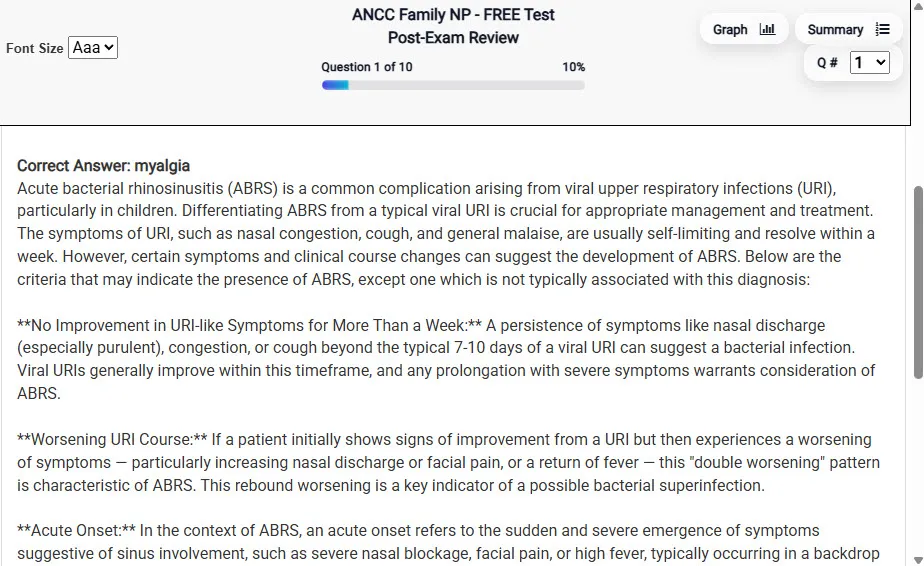
                           Detailed Explanation screen – 
                         Review mode showing chosen answer and rationale and references.
Detailed Explanation Review mode showing chosen answer and rationale and references.

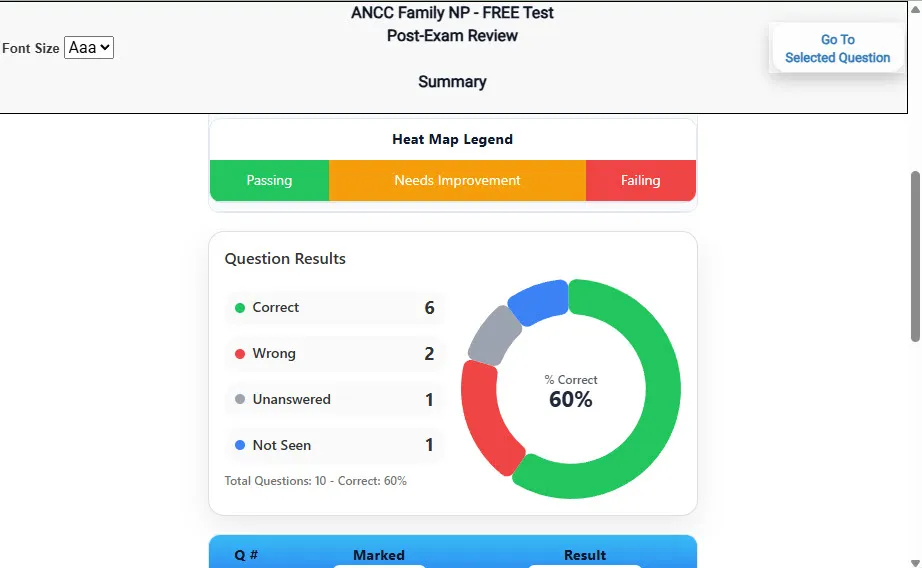
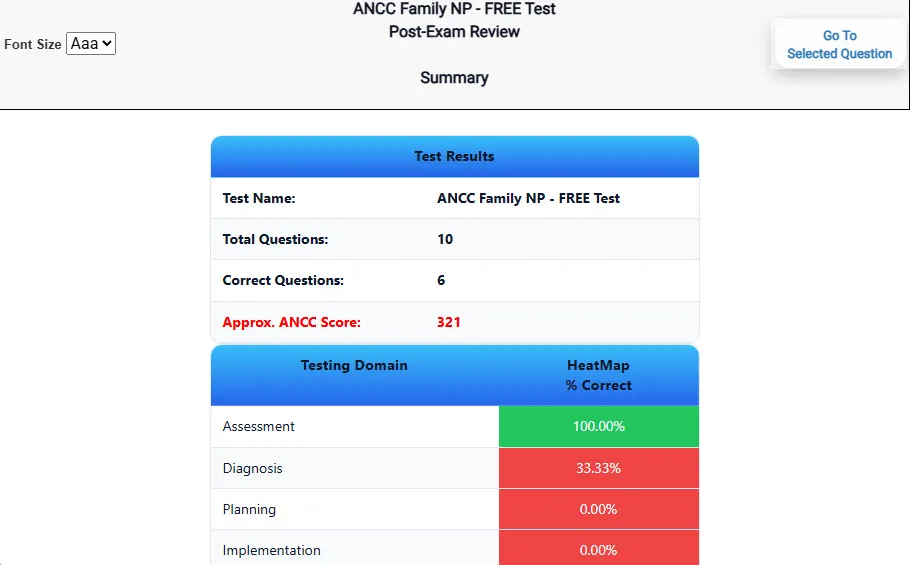
                           Review Summary 1 screen – 
                         Summary with counts for correct/wrong/unanswered and not seen items.
Review Summary 1 Summary with counts for correct/wrong/unanswered and not seen items.

                           Review Summary 2 screen – 
                         Advanced summary with category/domain breakdown and performance insights.
Review Summary 2 Advanced summary with category/domain breakdown and performance insights.

What Each Screen Shows

Answer Question Screen

  • Clean multiple-choice interface with progress bar.
  • Mark for review feature.
  • Matches real test pacing.

Detailed Explanation

  • Correct answer plus rationale.
  • Key concepts and guidelines highlighted.
  • Move between questions to fill knowledge gaps.

Review Summary 1

  • Overall results with total questions and scaled score.
  • Domain heatmap shows strengths and weaknesses.
  • Quick visual feedback on study priorities.

Review Summary 2

  • Chart of correct, wrong, unanswered, not seen.
  • Color-coded results for easy review.
  • Links back to missed items.

Top 10 Reasons to Use Exam Edge for your HESI Pediatric Nurse Practitioner Exam Prep

  1. Focused on the HESI Pediatric Nurse Practitioner Exam

    Our practice tests are built specifically for the HESI Pediatric NP exam — every question mirrors the real topics, format, and difficulty so you're studying exactly what matters.

  2. Real Exam Simulation

    We match the per-question time limits and pressure of the actual HESI exam, so test day feels familiar and stress-free.

  3. 10 Full Practice Tests & 1,000 Unique Questions

    You'll have more than enough material to master every HESI Pediatric NP concept — no repeats, no fluff.

  4. Lower Cost Than a Retake

    Ordering 5 practice exams costs less than retaking the HESI Pediatric Nurse Practitioner exam after a failure. One low fee could save you both time and money.

  5. Flexible Testing

    Need to step away mid-exam? Pick up right where you left off — with your remaining time intact.

  6. Instant Scoring & Feedback

    See your raw score and an estimated HESI Pediatric Nurse Practitioner score immediately after finishing each practice test.

  7. Detailed Explanations for Every Question

    Review correct and incorrect answers with clear, step-by-step explanations so you truly understand each topic.

  8. Trusted & Accredited

    We're fully accredited by the Better Business Bureau and uphold the highest standards of trust and transparency.

  9. Web-Based & Always Available

    No software to install. Access your HESI Pediatric NP practice exams 24/7 from any computer or mobile device.

  10. Expert Support When You Need It

    Need extra help? Our specialized tutors are highly qualified and ready to support your HESI exam prep.


Pass the HESI Pediatric Nurse Practitioner Exam with Realistic Practice Tests from Exam Edge

Preparing for your upcoming HESI Pediatric Nurse Practitioner () Certification Exam can feel overwhelming — but the right practice makes all the difference. Exam Edge gives you the tools, structure, and confidence to pass on your first try. Our online practice exams are built to match the real HESI Pediatric NP exam in content, format, and difficulty.

  • 📝 10 HESI Pediatric Nurse Practitioner Practice Tests: Access 10 full-length exams with 100 questions each, covering every major HESI Pediatric Nurse Practitioner topic in depth.
  • Instant Online Access: Start practicing right away — no software, no waiting.
  • 🧠 Step-by-Step Explanations: Understand the reasoning behind every correct answer so you can master HESI Pediatric NP exam concepts.
  • 🔄 Retake Each Exam Up to 4 Times: Build knowledge through repetition and track your improvement over time.
  • 🌐 Web-Based & Available 24/7: Study anywhere, anytime, on any device.
  • 🧘 Boost Your Test-Day Confidence: Familiarity with the HESI format reduces anxiety and helps you perform under pressure.

These HESI Pediatric Nurse Practitioner practice exams are designed to simulate the real testing experience by matching question types, timing, and difficulty level. This approach helps you get comfortable not just with the exam content, but also with the testing environment, so you walk into your exam day focused and confident.

Exam Edge HESI Reviews


I just took my Hesi exit PN today and got a Hesi score of 1205 and a conversion score of 99.99%. Thanks for the help. Doing all those tests helped so much. Not because I saw the same questions but because I learned so much from the answer reasoning section. Hope to fly through my boards in a couple ...
Read More
Sharon, Texas

I recently had to test out of my school with an 850 on the Hesi PN, so I purchased the exams from you guys, about 5 to 7 exams, and passed the exit HesiPn with a 988! First time around! Then I purchased the NclexPN exam tests from you guys and I passed my nclex the first time around! These tests rea ...
Read More
Welsh, NC

I want to thank you. The tests are really helpful. I took them three times and after using your exams, I finally passed. The tests helped me especially in the math section, in which I got a 90.

DIANA , Texas

I can't believe this website doesn't have a high following status. I bought 40 practice questions, and I did 20 practice questions and took my Hesi exit. I scored 1070. I completed all 40 practice exams and passed my boards for the first time. Exam Edge introduced me to a bunch of topics and boosted ...
Read More
Juliet M., Tarpon Springs, Florida


HESI Pediatric Nurse Practitioner Aliases Test Name

Here is a list of alternative names used for this exam.

  • HESI Pediatric Nurse Practitioner
  • HESI Pediatric Nurse Practitioner test
  • HESI Pediatric Nurse Practitioner Certification Test
  • HESI Pediatric NP test
  • HESI
  • HESI
  • test
  • HESI Pediatric Nurse Practitioner ()
  • Pediatric Nurse Practitioner certification