RHIT Registered Health Information Technician Practice Tests & Test Prep by Exam Edge - Additional Information
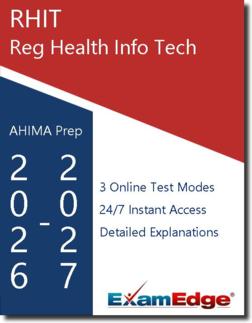
Based on 20 Reviews
- Real Exam Simulation: Timed questions and matching content build comfort for your AHMIA Reg Health Info Tech test day.
- Instant, 24/7 Access: Web-based AHMIA Registered Health Information Technician practice exams with no software needed.
- Clear Explanations: Step-by-step answers and explanations for your RHIT exam to strengthen understanding.
- Boosted Confidence: Reduces anxiety and improves test-taking skills to ace your AHMIA Registered Health Information Technician (RHIT).


AHMIA Registered Health Information Technician - Additional Information
AHMIA Registered Health Information Technician Study Guide
Prepare for the AHMIA Registered Health Information Technician with clear domain sections, detailed topic coverage, study guidance, and practice-focused resources.
test, 130 total questions, 240 minutes, passing score 350 | 51 practice tests available
What is the AHMIA Registered Health Information Technician?
The AHMIA Registered Health Information Technician study guide is designed to help candidates understand the main content areas, review the most important topics, and prepare in a more focused way.
This page organizes the available topic information for the RHIT test into clear study sections so candidates can prioritize review and practice more effectively.
How this study guide is organized
Use this study guide to review the content areas, understand how the exam is structured, and identify where to spend the most study time. Candidates usually get the best results by reviewing the highest-priority domains first, then reinforcing weaker areas with practice tests.
RHIT domain sections
The sections below show the available topic coverage for this exam. Where topic percentages are available, they can help you prioritize your study time.
Data Content, Structure, and Information
- Apply correct data definitions and capture standards (e.g., UHDDS, data dictionary) to ensure consistency—red flag: free-text fields used when a coded/structured element exists.
- Use appropriate clinical terminologies/classifications (ICD-10-CM/PCS, CPT/HCPCS, SNOMED CT, LOINC, RxNorm) for the intended purpose—common trap: using a classification code where a clinical terminology is required for interoperability.
- Validate document completeness and authentication (required elements, signature/attestation, date/time, author) per policy—priority rule: unsigned or late entries must be clearly identified and handled per governance.
- Maintain master data integrity (MPI, duplicate record prevention, record overlays) with standardized patient identity matching—red flag: merge requests without sufficient demographic verification.
- Support information exchange and record structure (EHR components, document types, CCD/C-CDA, HL7 messaging basics) with attention to data provenance—common trap: importing external data without source/time context.
- Ensure data quality across dimensions (accuracy, completeness, timeliness, consistency, uniqueness) using audits and edit checks—threshold cue: investigate outliers or sudden shifts in key indicators (e.g., missing present-on-admission, abnormal lab units).
Access, Disclosure, Privacy, and Security
- Apply the HIPAA minimum necessary standard to every release; red flag: sending an entire chart when only a date of service or specific report was requested.
- Differentiate treatment, payment, and healthcare operations (TPO) uses from non-TPO disclosures that require authorization; common trap: assuming “operations” covers releases to employers or attorneys.
- Verify identity and authority before disclosure (patient, personal representative, law enforcement, subpoena/court order); priority rule: don’t release on a subpoena alone if a court order or patient authorization is required.
- Manage patient rights (access, amendments, accounting of disclosures, restrictions, confidential communications) with timeliness; red flag: missing the HIPAA access deadline or charging impermissible fees.
- Safeguard ePHI with access controls, audit logs, encryption where appropriate, and workstation security; common trap: shared logins or unattended screens in clinical areas.
- Recognize and respond to potential breaches using risk assessment and notification rules; threshold cue: treat any impermissible use/disclosure as a presumed breach unless low probability of compromise is documented.
Data Analytics and Use
- Validate data quality before analysis (completeness, accuracy, timeliness, consistency) — red flag: reporting metrics from fields with high null/unknown rates without a documented data-quality check.
- Use correct denominators and definitions for rates (e.g., readmission, infection, case-mix adjusted outcomes) — common trap: mixing encounter-level counts with patient-level populations in the same metric.
- Interpret coded data with context (ICD-10-CM/PCS, CPT/HCPCS, DRGs) — red flag: trend conclusions based on a coding guideline change or encoder update that wasn’t accounted for.
- Apply appropriate basic statistics (mean vs median, percentiles, confidence intervals) — common trap: using averages on highly skewed LOS or charge data instead of medians/percentiles.
- Build dashboards and reports with clear purpose and audience (KPIs, benchmarks, drill-down) — priority rule: align every visualization to a decision question and avoid “vanity metrics” that don’t drive action.
- Protect privacy when using/sharing analytic outputs — red flag: small cell sizes or unique combinations that enable re-identification, requiring suppression/aggregation before release.
Revenue Cycle Management
- Verify payer requirements before coding/billing (coverage, prior auth, medical necessity) — red flag: missing or expired authorization can trigger an automatic denial.
- Apply correct code set selection and edits (ICD-10-CM/PCS, CPT/HCPCS, modifiers, NCCI/MUE) — common trap: mismatched diagnosis-to-procedure linkage or modifier misuse causing claim rejection.
- Manage claim submission timeliness and clean-claim standards — priority rule: track timely filing limits by payer because late claims are often non-appealable.
- Reconcile charges and documentation across departments — red flag: charge capture gaps (e.g., supplies, infusions, observation hours) leading to underbilling and revenue leakage.
- Support denial management workflows (categorize, correct, appeal, prevent) — common trap: appealing without addressing the root cause (coding vs. registration vs. medical necessity) wastes appeal windows.
- Monitor patient financial responsibility processes (estimates, eligibility, coordination of benefits, collections) — red flag: inaccurate insurance information at registration drives downstream denials and patient billing complaints.
Compliance
- Differentiate privacy vs. security vs. confidentiality and map each to policy and law; red flag: treating a technical safeguard (e.g., encryption) as a substitute for a required authorization.
- Apply HIPAA Minimum Necessary to use/disclosure decisions and role-based access; common trap: releasing an entire record when a targeted subset (e.g., dates of service, specific labs) meets the request.
- Follow documentation integrity rules (late entries, addenda, corrections) with clear audit trails; red flag: altering original entries without retaining the original content and timestamps.
- Use retention and destruction schedules aligned to legal, regulatory, and organizational requirements; common trap: destroying records during an active litigation hold or investigation.
- Support audits and monitoring (internal, payer, accreditation) by ensuring policies, training, and evidence are current; priority rule: if it isn’t documented (training logs, risk analysis, policies), it likely won’t count as compliant.
- Recognize and execute breach/incident response steps (contain, assess, document, notify) within required timeframes; red flag: delaying escalation because the incident seems “small” or involves only a few records.
Leadership
- Prioritize clear role delineation between HIM, IT, clinical staff, and coding/CDI to avoid duplicate work; red flag: no named data steward for key data sets (e.g., MPI, problem list, templates).
- Use change management (stakeholder mapping, super users, training, go-live support) when rolling out EHR or workflow changes; common trap: skipping end-user validation leading to shadow documentation and inconsistent data capture.
- Track team performance with defined KPIs (e.g., DNFB days, coding turnaround, query response time) and act on trends; priority rule: investigate sudden spikes immediately because they often signal workflow breakage or payer edits.
- Communicate escalation paths for privacy, security, and downtime events; red flag: staff unsure when to notify the privacy officer or how to document disclosures during system outages.
- Lead quality initiatives by linking documentation and coding practices to patient safety and reporting needs; common trap: focusing only on volume metrics while ignoring audit accuracy and data integrity.
- Manage staffing and competency (cross-training, credentialing, continuing education) to maintain coverage and compliance; threshold cue: if overtime becomes routine, reassess workload distribution before errors rise.
Key topics tested on the RHIT
Based on the available topic records, these are some of the main areas to review:
- Data Content, Structure, and Information
- Access, Disclosure, Privacy, and Security
- Data Analytics and Use
- Revenue Cycle Management
- Compliance
- Leadership
14-day study schedule (90 minutes a day, using all 3 test modes)
Modes referenced below: Mode 1 = Tutor/Study (untimed + explanations), Mode 2 = Timed, Mode 3 = Review (missed questions + weak areas).
| Day | Goal | What to do in 90 minutes |
|---|---|---|
| Day 1 | Baseline diagnostic |
|
| Day 2 | Weakest domain focus |
|
| Day 3 | Second weak domain |
|
| Day 4 | Mixed-topic reinforcement |
|
| Day 5 | Third and fourth domains |
|
| Day 6 | Speed and accuracy |
|
| Day 7 | Halfway progress check |
|
| Day 8 | Weak-area reset |
|
| Day 9 | High-weight content review |
|
| Day 10 | Mixed endurance practice |
|
| Day 11 | Full-content reinforcement |
|
| Day 12 | Full practice simulation |
|
| Day 13 | Final weak-spot cleanup |
|
| Day 14 | Final confidence check |
|
How to study for the RHIT
- Review the domain sections first and focus on the highest-priority topics.
- Use the topic descriptions to understand what each section is really testing.
- Spend extra time on areas where your knowledge is weakest.
- Use practice tests to improve pacing, accuracy, and confidence.
- Repeat difficult topics over multiple study sessions instead of cramming them all at once.
Frequently asked questions
What does the AHMIA Registered Health Information Technician cover?
The AHMIA Registered Health Information Technician covers the topic areas shown in the study guide below. Review each domain section and topic description to understand what knowledge areas to study.
What is the format of the RHIT test?
The exact format details available for this exam include 130 total questions and 240 minutes for the full test.
What is the passing score for the RHIT?
The passing score listed for this exam is 350. Candidates should still verify the latest scoring requirements before taking the real exam.
How should I study for the RHIT?
Start with the domain sections, focus first on weaker areas and higher-priority topics, then use repeated review and practice tests to improve pacing and confidence.
Why use practice tests for RHIT?
Practice tests help you identify weak areas, improve familiarity with the structure of the exam, and build confidence through repeated review.
Prepare for the RHIT
Use the study guide, review the official exam details, and strengthen your preparation with practice-focused resources.
Official Exam Info