This is the content of the pop-over!

Lightning Deal Alert – 12% Off Ends at Midnight!

Strike while the savings are hot! Use promo code FlashSale at checkout for 12% off any Exam Edge test or bundle. Hurry—the clock is ticking!

DOH EKG (DOH-EKG) Practice Tests & Test Prep by Exam Edge


DOH ElectrocardioGram  product image
(4.8)
Based on 29 Reviews

  • Real Exam Simulation: Timed questions and matching content build comfort for your DOH EKG test day.
  • Instant, 24/7 Access: Web-based DOH ElectrocardioGram practice exams with no software needed.
  • Clear Explanations: Step-by-step answers and explanations for your DOH exam to strengthen understanding.
  • Boosted Confidence: Reduces anxiety and improves test-taking skills to ace your DOH ElectrocardioGram (DOH-EKG).

Featured on

DOH ElectrocardioGram Online Practice Test Bundles

BEST VALUE
10 practice tests

$99.50

$399.50

SAVE $300

Only $9.95 per test!

  • 100% Pass Guarantee
  • 10 online practice tests
  • 100 questions per test
  • Bonus: 100 Flash Cards + Study Guide
  • Instant access
  • Detailed Explanations
  • Practice tests never expire
  • Timed, untimed, or study guide mode
5 practice tests

$69.75

$199.75

SAVE $130

Only $13.95 per test!

  • 5 online practice tests
  • 100 questions per test
  • Bonus: 100 Flash Cards + Study Guide
  • Instant access
  • Detailed Explanations
  • Practice tests never expire
  • Timed, untimed, or study guide mode
1 practice test

$39.95

  • 1 online practice test
  • 100 questions per test
  • Instant access
  • Detailed Explanations
  • Practice tests never expire
  • Timed, untimed, or study guide mode
Quick Select
Tap to choose a bundle

** All Prices are in US Dollars (USD) **


DOH EKG (DOH-EKG) Resources

Jump to the section you need most.

Understanding the exact breakdown of the DOH ElectrocardioGram test will help you know what to expect and how to most effectively prepare. The DOH ElectrocardioGram has multiple-choice questions . The exam will be broken down into the sections below:

DOH ElectrocardioGram Exam Blueprint
Domain Name % Number of
Questions
Medical Terminology 32% 32
Anatomy and Physiology 26% 26
Rhythm 24% 24
Basic Interpretations 18% 18

DOH ElectrocardioGram Study Tips by Domain

  • Use standard ECG lead nomenclature precisely (I, II, III, aVR, aVL, aVF, V1–V6); red flag: confusing aVR with aVL commonly flips axis/ischemia impressions.
  • Know waveform terms (P wave, PR interval, QRS complex, ST segment, T wave, QT interval) and what each label refers to; trap: calling the PR interval the same as the PR segment.
  • Apply rate terminology correctly (bradycardia <60 bpm, tachycardia >100 bpm) and state whether it’s sinus vs non-sinus; priority cue: always name the rhythm source when using these terms.
  • Differentiate conduction terms (bundle branch block, AV block, fascicular block) from rhythm diagnoses; common trap: labeling a wide QRS as “ventricular tachycardia” without confirming rhythm context.
  • Use ischemia/injury/infarct terminology accurately (ST depression = ischemia pattern, ST elevation = injury pattern) and avoid overcalling; red flag: baseline wander can mimic ST deviation.
  • Document ectopy and pacing terms correctly (PAC, PVC, couplet, bigeminy, paced rhythm, capture/fusion) with frequency when possible; contraindication cue: don’t call a spike “pacing” unless capture is evident.
  • Map conduction flow SA node → AV node → His-Purkinje and link it to the ECG: P = atrial depolarization, QRS = ventricular depolarization, T = ventricular repolarization; red flag: a missing or inverted P before most QRS complexes should trigger a non-sinus origin check.
  • Know standard paper calibration (25 mm/s, 10 mm/mV) and what each small box means (0.04 s, 1 mm); common trap: misreading intervals when the speed is changed to 50 mm/s without noting it.
  • Identify lead groupings and what they “see” (inferior II, III, aVF; lateral I, aVL, V5–V6; septal V1–V2; anterior V3–V4); priority rule: correlate contiguous-lead findings rather than a single lead abnormality.
  • Place electrodes correctly (limb leads on extremities, V1 4th ICS RSB, V2 4th ICS LSB, V4 5th ICS MCL, V3 between V2–V4, V5 anterior axillary line level with V4, V6 midaxillary line level with V4); red flag: swapped limb leads can mimic axis deviation and “inferior MI” patterns.
  • Relate cardiac anatomy to electrical vectors: septal activation left-to-right affects V1/V2, left ventricle mass dominates QRS in lateral leads; common trap: assuming a tall R in V1 is always RVH without considering lead misplacement or posterior infarct.
  • Understand autonomic and perfusion effects on rate and conduction (sympathetic increases rate/AV conduction, vagal slows); contraindication cue: avoid placing chest leads over open wounds, infection, or implanted device sites when possible and document any necessary deviation.
  • Verify rhythm regularity by comparing R–R intervals across the strip; a red flag is calling a rhythm “regular” when variability is >0.12 s (˜3 small boxes).
  • Determine rate using a consistent method (300 rule for regular, 6-second method for irregular); common trap: mixing methods mid-strip and reporting a falsely precise rate for an irregular rhythm.
  • Assess P waves for presence, uniform shape, and 1:1 relationship with QRS; priority rule: absent or chaotic P waves with irregularly irregular R–R suggests atrial fibrillation, not “sinus arrhythmia.”
  • Measure PR interval (0.12–0.20 s) and watch for progressive prolongation or dropped QRS; red flag: PR >0.20 s indicates first-degree AV block, while dropped beats require classifying the AV block type.
  • Evaluate QRS width (<0.12 s vs ≥0.12 s) to localize origin; common trap: labeling a wide-complex rhythm as SVT without considering ventricular rhythm or aberrancy.
  • Identify lethal rhythms promptly and apply the “check patient first” rule; red flag: VF/pulseless VT require immediate emergency response, and asystole must be confirmed in two leads to rule out loose leads.
  • Confirm standardization before interpreting: 25 mm/s and 10 mm/mV (1 mV = 10 mm) — red flag if calibration mark is missing or nonstandard, as intervals and voltage criteria will be unreliable.
  • Determine rate using the 300/150/100/75/60/50 method for regular rhythms or a 6-second strip (count QRS × 10) for irregular rhythms — common trap is using a regular method on an irregular strip.
  • Assess rhythm regularity and P:QRS relationship — priority rule is that every QRS should have a preceding P with consistent PR for sinus rhythm; red flag is more P waves than QRS complexes.
  • Measure key intervals: PR 0.12–0.20 s, QRS < 0.12 s, and QT/QTc (rate-adjusted) — red flag is a prolonged QRS suggesting bundle branch block or ventricular origin.
  • Evaluate axis and morphology basics: look for gross left/right axis deviation using lead I and aVF and scan for pathologic Q waves — common trap is calling infarct from Q waves without confirming they are ≥ 0.04 s and ≥ 25% of the following R wave in contiguous leads.
  • Recognize ischemia/injury patterns: ST elevation or depression and T-wave inversion in contiguous leads — priority cue is that ST elevation with reciprocal changes is more concerning than isolated nonspecific ST-T changes, and must be reported promptly per DOH facility policy.


Built to Fit Into Your Busy Life

Everything you need to prepare with confidence—without wasting a minute.

Three Study Modes

Timed, No Time Limit, or Explanation mode.

Actionable Analytics

Heatmaps and scaled scores highlight weak areas.

High-Yield Rationales

Concise explanations emphasize key concepts.

Realistic Interface

Matches the feel of the actual exam environment.

Accessible by Design

Clean layout reduces cognitive load.

Anytime, Anywhere

Web-based access 24/7 on any device.
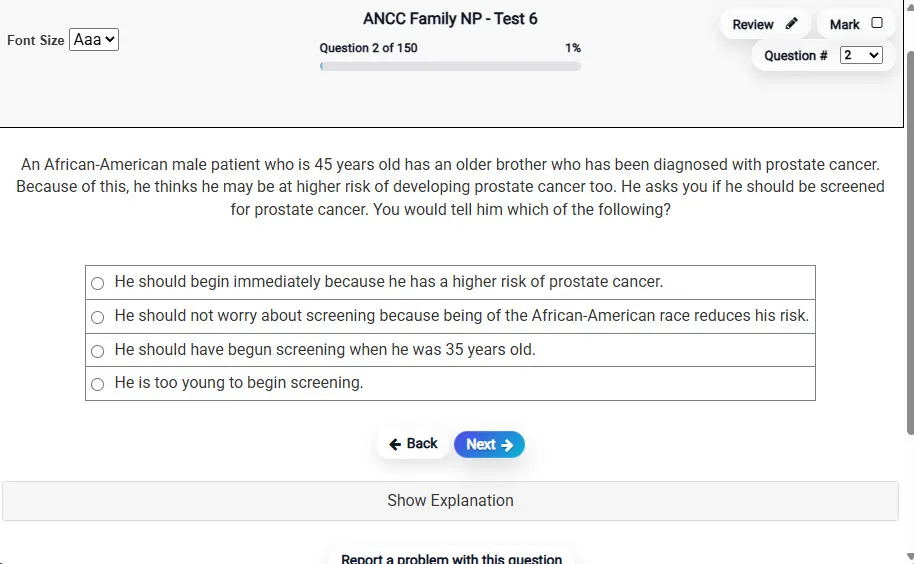
Answering a Question screen – Multiple-choice item view with navigation controls and progress tracker.
Answering a Question Multiple-choice item view with navigation controls and progress tracker.

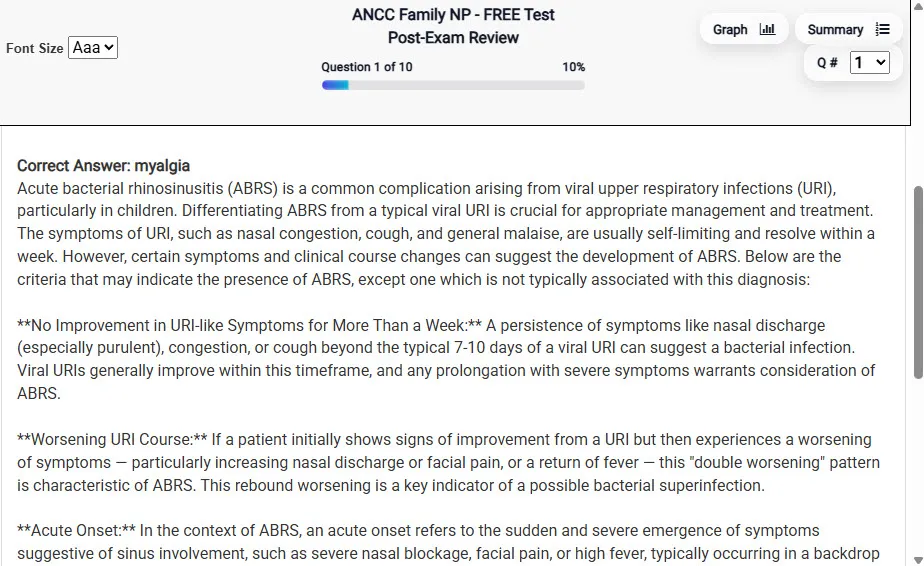
                           Detailed Explanation screen – 
                         Review mode showing chosen answer and rationale and references.
Detailed Explanation Review mode showing chosen answer and rationale and references.

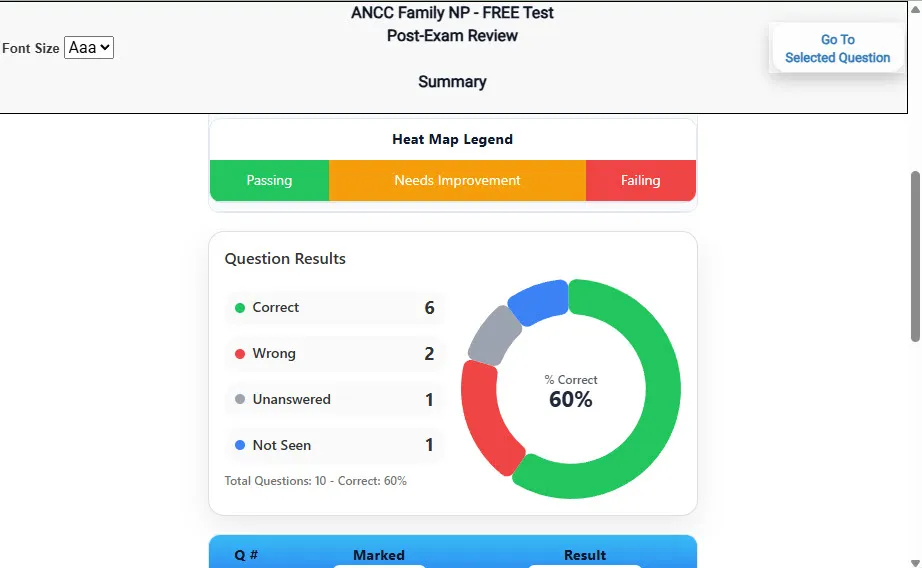
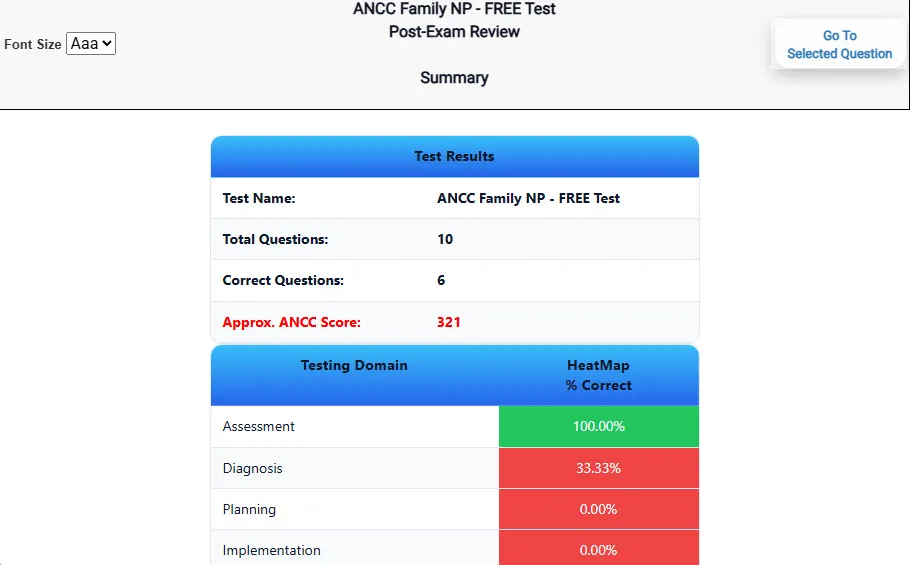
                           Review Summary 1 screen – 
                         Summary with counts for correct/wrong/unanswered and not seen items.
Review Summary 1 Summary with counts for correct/wrong/unanswered and not seen items.

                           Review Summary 2 screen – 
                         Advanced summary with category/domain breakdown and performance insights.
Review Summary 2 Advanced summary with category/domain breakdown and performance insights.

What Each Screen Shows

Answer Question Screen

  • Clean multiple-choice interface with progress bar.
  • Mark for review feature.
  • Matches real test pacing.

Detailed Explanation

  • Correct answer plus rationale.
  • Key concepts and guidelines highlighted.
  • Move between questions to fill knowledge gaps.

Review Summary 1

  • Overall results with total questions and scaled score.
  • Domain heatmap shows strengths and weaknesses.
  • Quick visual feedback on study priorities.

Review Summary 2

  • Chart of correct, wrong, unanswered, not seen.
  • Color-coded results for easy review.
  • Links back to missed items.

Top 10 Reasons to Use Exam Edge for your DOH ElectrocardioGram Exam Prep

  1. Focused on the DOH ElectrocardioGram Exam

    Our practice tests are built specifically for the DOH EKG exam — every question mirrors the real topics, format, and difficulty so you're studying exactly what matters.

  2. Real Exam Simulation

    We match the per-question time limits and pressure of the actual DOH exam, so test day feels familiar and stress-free.

  3. 10 Full Practice Tests & 1,000 Unique Questions

    You'll have more than enough material to master every DOH EKG concept — no repeats, no fluff.

  4. Lower Cost Than a Retake

    Ordering 5 practice exams costs less than retaking the DOH ElectrocardioGram exam after a failure. One low fee could save you both time and money.

  5. Flexible Testing

    Need to step away mid-exam? Pick up right where you left off — with your remaining time intact.

  6. Instant Scoring & Feedback

    See your raw score and an estimated DOH ElectrocardioGram score immediately after finishing each practice test.

  7. Detailed Explanations for Every Question

    Review correct and incorrect answers with clear, step-by-step explanations so you truly understand each topic.

  8. Trusted & Accredited

    We're fully accredited by the Better Business Bureau and uphold the highest standards of trust and transparency.

  9. Web-Based & Always Available

    No software to install. Access your DOH EKG practice exams 24/7 from any computer or mobile device.

  10. Expert Support When You Need It

    Need extra help? Our specialized tutors are highly qualified and ready to support your DOH exam prep.


Pass the DOH ElectrocardioGram Exam with Realistic Practice Tests from Exam Edge

Preparing for your upcoming DOH ElectrocardioGram (DOH-EKG) Certification Exam can feel overwhelming — but the right practice makes all the difference. Exam Edge gives you the tools, structure, and confidence to pass on your first try. Our online practice exams are built to match the real DOH EKG exam in content, format, and difficulty.

  • 📝 10 DOH ElectrocardioGram Practice Tests: Access 10 full-length exams with 100 questions each, covering every major DOH ElectrocardioGram topic in depth.
  • Instant Online Access: Start practicing right away — no software, no waiting.
  • 🧠 Step-by-Step Explanations: Understand the reasoning behind every correct answer so you can master DOH EKG exam concepts.
  • 🔄 Retake Each Exam Up to 4 Times: Build knowledge through repetition and track your improvement over time.
  • 🌐 Web-Based & Available 24/7: Study anywhere, anytime, on any device.
  • 🧘 Boost Your Test-Day Confidence: Familiarity with the DOH format reduces anxiety and helps you perform under pressure.

These DOH ElectrocardioGram practice exams are designed to simulate the real testing experience by matching question types, timing, and difficulty level. This approach helps you get comfortable not just with the exam content, but also with the testing environment, so you walk into your exam day focused and confident.


Exam Edge DOH Reviews


I am glad to inform you that I have successfully passed my HAAD ophthalmology exams, your mock tests were extremely helpful in my journey to this success, thank you once again

Farheen, Karnataka India

I took the exam and failed because I didn't review well and didn't know which topics to focus on, but after purchasing these 20 sets from haadrn.Com, I passed my second exam. I only finished up to 17 sets, I am thankful for this site because I can review online anytime, anywhere! Friends are asking ...
Read More
parrenas, Philippines

Thank you Exam Edge :) I passed the Haad RN exam :) Godbless :)

Fedi, Manila, Philippines

I just want to take this opportunity to thank Exam Edge since I passed my HAAD exam.

RHODALYN,


DOH ElectrocardioGram Aliases Test Name

Here is a list of alternative names used for this exam.

  • DOH ElectrocardioGram
  • DOH ElectrocardioGram test
  • DOH ElectrocardioGram Certification Test
  • DOH EKG test
  • DOH
  • DOH DOH-EKG
  • DOH-EKG test
  • DOH ElectrocardioGram (DOH-EKG)
  • ElectrocardioGram certification