This is the content of the pop-over!

DOH Dental Assistants (DOH-DA) Practice Tests & Test Prep by Exam Edge


DOH Dental Assistants  product image
(4.9)
Based on 28 Reviews

  • Real Exam Simulation: Timed questions and matching content build comfort for your DOH Dental Assistants test day.
  • Instant, 24/7 Access: Web-based DOH Dental Assistants practice exams with no software needed.
  • Clear Explanations: Step-by-step answers and explanations for your DOH exam to strengthen understanding.
  • Boosted Confidence: Reduces anxiety and improves test-taking skills to ace your DOH Dental Assistants (DOH-DA).

Featured on

DOH Dental Assistants Online Practice Test Bundles

BEST VALUE
20 practice tests

$174.00

$799.00

SAVE $625

Only $8.70 per test!

  • 100% Pass Guarantee
  • 20 online practice tests
  • 150 questions per test
  • Bonus: 100 Flash Cards + Study Guide
  • Instant access
  • Detailed Explanations
  • Practice tests never expire
  • Timed, untimed, or study guide mode
MOST POPULAR
10 practice tests

$99.50

$399.50

SAVE $300

Only $9.95 per test!

  • 10 online practice tests
  • 150 questions per test
  • Bonus: 100 Flash Cards + Study Guide
  • Instant access
  • Detailed Explanations
  • Practice tests never expire
  • Timed, untimed, or study guide mode
5 practice tests

$69.75

$199.75

SAVE $130

Only $13.95 per test!

  • 5 online practice tests
  • 150 questions per test
  • Bonus: 100 Flash Cards
  • Instant access
  • Detailed Explanations
  • Practice tests never expire
  • Timed, untimed, or study guide mode
1 practice test

$39.95

  • 1 online practice test
  • 150 questions per test
  • Instant access
  • Detailed Explanations
  • Practice tests never expire
  • Timed, untimed, or study guide mode
Quick Select
Tap to choose a bundle

** All Prices are in US Dollars (USD) **


DOH Dental Assistants (DOH-DA) Resources

Jump to the section you need most.

Understanding the exact breakdown of the DOH Dental Assistants test will help you know what to expect and how to most effectively prepare. The DOH Dental Assistants has multiple-choice questions . The exam will be broken down into the sections below:

DOH Dental Assistants Exam Blueprint
Domain Name
General Chairside  
     Collection and recording of clinical data  
     Chairside dental procedures  
     Chairside dental materials (preparation - manipulation - application)  
     Lab materials and procedures  
     Patient education and oral health management  
     Prevention and management of emergencies  
Radiation Health and Safety (RHS)  
     Expose and evaluate (intraoral - extraoral)  
     Process  
     Mount/label  
     Radiation safety-patient  
     Radiation safety-operator  
Infection Control (ICE)  
     Patient and dental healthcare worker education  
     Prevent cross-contamination and disease transmission  
     Maintain aseptic conditions  
     Perform sterilization procedures  
     Environmental asepsis  
     Occupational safety  

DOH Dental Assistants Study Tips by Domain

  • Confirm patient identity, procedure, and consent before seating; red flag: starting without verifying medical history updates and allergy status (especially latex and local anesthetics).
  • Maintain clear four-handed dentistry zones (operator, assistant, transfer, static); common trap: passing instruments over the patient’s face instead of using the transfer zone.
  • Manage suction and retraction to protect soft tissue and airway; priority rule: use high-volume evacuation for aerosols and pause if the patient shows gagging or breathing difficulty.
  • Prepare the operatory and tray setup in correct sequence; red flag: opening sterile or single-use items too early, increasing contamination and waste.
  • Handle sharps and burs with controlled placement and retrieval; common trap: recapping needles by hand instead of using a one-handed technique or safety device.
  • Document chairside observations and materials used as they occur; red flag: relying on memory for lot numbers, shade, or procedure details that DOH audits may scrutinize.
  • Verify patient identity using two identifiers and confirm informed consent status before recording findings; red flag: charting under the wrong patient due to similar names or open charts.
  • Record vital signs with units and time-stamp (e.g., BP mmHg, pulse bpm) and repeat abnormal readings after a short rest; common trap: documenting a single elevated BP without recheck or provider notification.
  • Document medical history with allergies, current meds, and significant conditions (e.g., anticoagulants, diabetes) and update at every visit; contraindication cue: allergy documented without reaction type or without clearly flagging it for the team.
  • Chart oral findings using standard tooth numbering and precise descriptors (location, size, surfaces) rather than vague terms; common trap: writing “pain LL” without tooth number, onset, duration, and triggers.
  • Record diagnostic data (periodontal probing depths, BOP, mobility, recession) exactly as measured and avoid rounding; red flag: transcribing values from memory instead of entering chairside measurements.
  • Correct entries per policy by single-line strike-through with date/initials (or approved electronic addendum) and never erase or backdate; priority rule: if it wasn’t documented, it didn’t happen during an audit.
  • Prepare the operatory and patient for treatment (PPE, bib, eyewear, suction setup) before tray set—red flag: starting without confirming the planned procedure and required instruments.
  • Anticipate four-handed dentistry sequence (transfer, retraction, evacuation, illumination) to maintain visibility—common trap: crossing over the patient or passing sharps unsafely hand-to-hand.
  • Use high-volume evacuation correctly during aerosol-generating procedures—priority rule: position the HVE tip close to the operative site (not just in the vestibule) to be effective.
  • Manage instruments and burs safely (count, inspect, secure) and keep sharp tips controlled—red flag: leaving burs in the handpiece when setting it down.
  • Support isolation and moisture control (cotton rolls, dry angles, saliva ejector, rubber dam assistance) tailored to the procedure—common trap: placing the saliva ejector against soft tissue, causing trauma.
  • Assist with patient comfort and procedural monitoring (positioning, communication, gag reflex, pain cues)—contraindication: do not continue if the patient reports sudden severe pain, dizziness, or difficulty breathing; alert the dentist immediately.
  • Confirm material type and working/setting time before you start; red flag: mixing before isolation and instruments are ready often leads to expired working time and a failed procedure.
  • Follow manufacturer ratio/dispense method exactly (scoops, drops, automix tips); common trap: “eyeballing” powder–liquid changes strength, set time, and marginal integrity.
  • Use correct mixing technique and speed (fold vs spatulate, avoid whipping air); red flag: visible bubbles or grainy mix indicates improper manipulation and increases voids.
  • Control moisture and temperature for materials that are hydrophilic/hydrophobic; priority rule: saliva/blood contamination before set is a contraindication for many adhesive steps and may require re-etch/rebond per office protocol.
  • Select and prepare trays/liners/dispensing surfaces appropriately (paper pad, glass slab, disposable wells); common trap: using eugenol-containing materials under resin can inhibit polymerization.
  • Apply materials with correct thickness and coverage (liners, bases, cements, temporary materials) and remove excess at the right stage; red flag: premature cleanup can pull material from margins while delayed cleanup can lock in overhangs.
  • When mixing gypsum (model stone), add powder to water (not water to powder) and vacuum-mix if available; red flag: rapid set and chalky casts usually mean incorrect W/P ratio or spatulation.
  • For alginate impressions, use correct water temperature and seating time; common trap: removing before full gel causes distortion and loss of detail, so follow manufacturer set time exactly.
  • Disinfect impressions and appliances per manufacturer compatibility (e.g., alginate vs. immersion time) and label as “disinfected”; DOH-style compliance trap: sending an undisinfected impression to the lab is a cross-contamination violation.
  • Pour impressions promptly (especially hydrocolloids) and store properly if delay is unavoidable; red flag: syneresis/imbibition leads to dimensional change and ill-fitting appliances.
  • When trimming casts and appliances, use eyewear, mask, and dust control; priority rule: treat acrylic/stone dust as an inhalation hazard—don’t dry-trim without suction.
  • For temporary crowns/orthodontic appliances, check margins, occlusion, and sharp edges before delivery; common trap: leaving residual monomer or rough edges can irritate tissue and triggers patient complaint.
  • Use teach-back for every home-care instruction; red flag: the patient can’t demonstrate or restate brushing/flossing steps in their own words.
  • Tailor oral hygiene aids to dexterity and anatomy (e.g., interdental brushes for open embrasures, floss holders for limited hand function); common trap: recommending standard floss when it predictably won’t be used.
  • Give clear anticaries guidance with a threshold: emphasize limiting between-meal sugar exposures and using fluoride toothpaste twice daily; red flag: frequent sipping/snacking despite “good brushing.”
  • Reinforce postoperative and sensitivity instructions with a priority rule: stop and call if pain/swelling worsens after 48–72 hours or there’s fever; trap: patients assuming “normal soreness” covers escalating symptoms.
  • Support periodontal self-care by setting a measurable goal (e.g., bleeding reduction and daily interdental cleaning); red flag: persistent bleeding that the patient interprets as a reason to avoid flossing.
  • Screen education for high-risk conditions and contraindications: tobacco use, diabetes, xerostomia meds; priority rule: document and escalate to the dentist when dry mouth or uncontrolled glucose is reported because caries/periodontal risk spikes.
  • Use the ABCDE priority rule (airway, breathing, circulation, disability, exposure) and activate EMS early if the patient is unresponsive or has trouble breathing—do not delay while searching for supplies.
  • For syncope, place the patient supine with legs elevated and loosen restrictive clothing; red flag: persistent altered consciousness or cyanosis requires immediate EMS activation.
  • For anaphylaxis, recognize rapid-onset hives/wheezing/hypotension and give epinephrine per office protocol without waiting for antihistamines—common trap: under-treating throat tightness as a mild allergy.
  • For chest pain suggestive of MI, stop treatment, position comfortably, administer oxygen/aspirin/nitroglycerin only as directed by dentist and within protocol; contraindication cue: do not give nitroglycerin if PDE-5 inhibitors were used within the last 24–48 hours.
  • For seizures, protect from injury and maintain airway without placing anything in the mouth; red flag: seizure lasting >5 minutes or repeated seizures warrants EMS and emergency medication per protocol.
  • For diabetic emergencies, treat suspected hypoglycemia with oral glucose if conscious; common trap: giving anything by mouth to a patient with decreased level of consciousness—activate EMS instead.
  • Verify patient identity and the correct prescription/authorization before any exposure—a missing or unclear order is a stop signal for DOH-style compliance.
  • Apply ALARA every time: use the fastest receptor available, proper collimation, and correct exposure settings—repeat images are a red flag unless the original is non-diagnostic.
  • Use patient protection correctly: lead apron with thyroid collar when indicated and proper positioning; do not place shielding if it interferes with the area of interest and forces retakes.
  • Operator protection is non-negotiable: stand 6 ft away at 90–135 degrees to the primary beam or behind a barrier—never hold the tubehead or receptor for the patient.
  • Prevent unnecessary exposure by using stable receptor holders and accurate positioning (paralleling when possible); a common trap is poor angulation causing cone-cuts or overlaps that require repeats.
  • Handle and store radiographic images securely with correct patient identifiers and date/time; mismatched labels or undocumented corrections are a compliance risk during audits.
  • Before exposure, verify patient ID, prescribed view(s), and remove removable prostheses/jewelry—red flag: retaking images due to missed metal artifacts is a common DOH compliance trap.
  • Select correct receptor size/placement (e.g., size 2 adult periapicals; size 0/1 pediatric) and use a holder—priority rule: aim for diagnostic quality on the first exposure to avoid unnecessary retakes.
  • Set exposure factors appropriate to receptor type and patient size (digital vs film; child vs adult)—red flag: using adult settings on pediatric patients increases dose and often overexposes.
  • For intraoral evaluation, check for cone cuts, overlapping contacts, elongation/foreshortening, and motion blur—common trap: poor horizontal angulation is the #1 cause of unreadable bitewings for interproximal caries.
  • For extraoral evaluation (e.g., pano), confirm mid-sagittal alignment, tongue-to-palate, and correct chin position—red flag: airspace from not placing tongue up can mimic pathology and forces retakes.
  • If an image is nondiagnostic, identify the specific error and correct only that step before re-exposure—priority rule: document/communicate the reason for retake rather than repeating the same setup.
  • Confirm items are fully cleaned and dried before packaging for processing; red flag: debris or moisture can prevent sterilant contact and trigger failed indicators.
  • Select the correct packaging (pouch/wrap/container) and load to allow circulation; common trap: overpacking or stacking pouches flat so steam/air can’t penetrate.
  • Use the correct cycle parameters for the device/material (time/temperature/pressure) and document the load; priority rule: if parameters don’t match the IFU, the load is nonsterile even if the tape changed.
  • Place chemical indicators appropriately and run biological indicators per policy; red flag: relying only on external indicator tape rather than an internal indicator/BI when required.
  • Complete drying and cooling before handling or storing processed items; common trap: wet packs or handling hot packs—considered contaminated and must be reprocessed.
  • Maintain traceability (date, sterilizer ID, load number, operator) and segregate any questionable load; priority rule: if there’s an alarm, incomplete printout, or missing log entry, quarantine and reprocess.
  • Before mounting, verify two patient identifiers and match the prescription to the images; red flag: any mismatch means stop and resolve before labeling.
  • Label each mount with patient name/ID, date, and dentist/operator initials per facility policy; common trap: writing only a last name creates mix-up risk in high-volume DOH settings.
  • Orient films/sensors correctly using the embossed dot or orientation marker; priority rule: the dot should face you (viewer) to prevent left/right reversal.
  • Arrange images in a standard sequence (e.g., maxillary right to left, then mandibular left to right) to support interpretation; red flag: inconsistent order can be mistaken for missing or duplicated views.
  • Mount or label immediately after processing/exposure and keep sets separated; common trap: stacking unmounted radiographs increases the chance of swapping patients.
  • Use permanent, legible labeling on mounts and avoid covering diagnostic areas; contraindication: do not place labels over apices or interproximal contacts where caries and pathology are assessed.
  • Verify patient identity and pregnancy status before exposing; red flag: proceeding when pregnancy is uncertain or documentation is missing—notify the dentist and follow facility policy.
  • Use thyroid collar and lead apron for intraoral radiographs unless contraindicated; common trap: skipping the thyroid collar on children or pregnant patients.
  • Apply ALARA by using the fastest image receptor available, correct exposure settings, and proper collimation; priority rule: never increase exposure to “fix” positioning errors—reposition instead.
  • Use proper patient positioning and stabilizing aids to prevent motion; red flag: asking a patient to hold the sensor/film with fingers—use holders to avoid repeat exposures.
  • Limit retakes by confirming receptor placement, PID alignment, and midline/occlusal plane before activating exposure; common trap: retaking without identifying the cause of the error (cone-cut, elongation/foreshortening, motion).
  • Protect special populations with extra caution—pediatrics, pregnant, gaggers, and patients with limited mobility; threshold cue: if repeated attempts are needed, stop and seek assistance rather than accumulating multiple exposures.
  • Stand behind a protective barrier or maintain operator position at 90–135 degrees to the primary beam and at least 6 feet away; red flag: never hold the PID or receptor during exposure.
  • Wear a personal dosimeter (e.g., badge) at the collar outside the lead apron when required and store it away from radiation sources; common trap: leaving badges in x-ray rooms or wearing someone else’s badge.
  • Use the lowest exposure settings consistent with diagnostic quality and avoid repeat exposures by verifying receptor placement before triggering; priority rule: repeats are a key compliance and safety failure.
  • Never bypass safety interlocks or defeat the exposure switch (dead-man switch) function; red flag: taped-down exposure button or unattended exposures.
  • Inspect barriers and lead apparel for defects and remove compromised items from service; practical cue: cracks, tears, or delamination are contraindications for use.
  • Report and document unusual exposure events immediately per DOH/clinic policy and seek evaluation if a badge indicates elevated dose; common trap: ignoring a high reading instead of initiating the incident process.
  • Apply CDC/DOH-standard precautions to every patient—common trap is relaxing PPE or hand hygiene for “healthy” patients.
  • Hand hygiene is required before donning gloves and immediately after glove removal; red flag is using sanitizer on visibly soiled hands (wash with soap and water instead).
  • Use appropriate PPE (mask, eye protection/face shield, gown, gloves) based on splash/aerosol risk; priority rule is change masks when wet/soiled and never wear contaminated PPE outside the operatory.
  • Prevent sharps injuries by using one-hand scoop or engineered recapping devices; contraindication is two-handed needle recapping or passing sharps hand-to-hand.
  • Manage clinical contact surfaces with barriers or EPA-registered disinfectant (correct contact time); common trap is wiping dry too soon or missing high-touch items (light handles, chair switches, X-ray controls).
  • Handle contaminated instruments as if all are infectious—transport in a closed, leak-resistant container and keep clean/dirty areas separated; red flag is hand-carrying loose instruments or mixing clean supplies on contaminated countertops.
  • Use the teach-back method for home-care instructions; red flag: a patient who can’t restate steps in their own words needs re-teaching before dismissal.
  • Give DOH-aligned infection-control reminders to staff (hand hygiene, PPE sequence); common trap: touching masks/face shields then handling clean instruments without changing gloves.
  • Communicate procedure expectations and consent basics in plain language; priority rule: stop and clarify whenever a patient indicates misunderstanding or asks safety-related questions.
  • Reinforce sharps safety and exposure reporting for workers; red flag: any needlestick or mucosal splash requires immediate first aid and prompt reporting per facility protocol.
  • Provide clear post-op and medication guidance including contraindications; common trap: failing to screen for allergies or anticoagulant use before giving instructions that increase bleeding risk.
  • Document education provided (topic, materials, patient response) and who received it; priority rule: if it isn’t recorded, DOH audits may treat it as not done.
  • Assume every patient is potentially infectious and use standard precautions every time—red flag: touching charts, drawers, or your phone with contaminated gloves.
  • Perform hand hygiene at the right moments (before donning gloves, after removing gloves, and after contact with contaminated surfaces)—common trap: using hand sanitizer when hands are visibly soiled (wash with soap and water).
  • Use correct PPE sequence and changes (mask, eyewear/face shield, gown, gloves) and replace between patients or when compromised—red flag: wearing the same mask below the nose or reusing a wet mask.
  • Maintain one-way instrument flow (dirty → clean → sterile) and keep contaminated items out of clean areas—common trap: setting used instruments on a clean counter or near packaged sterile items.
  • Prevent sharps injuries by using safety devices and immediate disposal in approved sharps containers—priority rule: never recap needles using two hands (use one-hand scoop or a recapping device if permitted).
  • Control environmental contamination with barriers and proper disinfection of clinical contact surfaces between patients—red flag: skipping disinfection because a barrier was used but was torn, displaced, or removed with contaminated gloves.
  • Maintain a clear clean-to-dirty workflow at chairside (setup → procedure → breakdown) and never reach from contaminated gloves into drawers—this is a common DOH audit red flag.
  • Change gloves immediately when torn, visibly soiled, or after touching nonclinical surfaces (phone, chart, door handle); a frequent trap is “double-gloving” and keeping the outer glove after contamination.
  • Use barriers (plastic wrap, sleeves, covers) on high-touch items and replace them between patients; priority rule: if a surface is hard to disinfect reliably during care, barrier it.
  • Maintain instrument field integrity by keeping sterile packs closed until point of use and keeping items above the waist and within the clean zone; red flag: placing sterile packs on a contaminated counter or patient napkin.
  • Perform hand hygiene at the required moments (before donning gloves and after removing them at minimum) and use soap-and-water after visible soil; trap: relying on sanitizer when hands are visibly contaminated.
  • Handle sharps and contaminated items with one-handed techniques or mechanical devices and never recap using two hands; contraindication: transporting uncovered sharps across the operatory.
  • Run sterilizers with the correct cycle parameters (time/temperature/pressure) and never overload packs—a red flag is wet packs at the end of the cycle, which are considered contaminated.
  • Use chemical indicators on/in every package and check they change appropriately; a common trap is assuming color change alone proves sterility without verifying the correct cycle was used.
  • Perform and document spore (biological) testing on the required schedule and after repairs/relocation; priority rule: a failed BI means stop using that sterilizer and quarantine items since the last negative test.
  • Allow instruments to dry and cool before bagging and avoid packaging closed/locked instruments; contraindication: sealed packages with trapped moisture increase failure risk and compromise sterility.
  • Label packs with date, contents, and sterilizer/load ID for traceability; red flag: unlabeled or improperly labeled packs should be treated as non-sterile and reprocessed.
  • Store sterile packs in clean, dry, closed cabinetry and inspect before use; common trap: using torn, punctured, or wet packaging—these must be reprocessed.
  • Treat all clinical contact surfaces as contaminated after every patient; red flag: wiping once without a disinfectant dwell time does not meet DOH expectations.
  • Use barriers (covers) on hard-to-clean items (light handles, chair controls, x-ray tube head); common trap: failing to change barriers between patients even when gloves were not visibly soiled.
  • Clean before disinfecting whenever blood/saliva/debris is present; priority rule: debris reduces disinfectant effectiveness and can cause a compliance failure.
  • Select the correct disinfectant level for the surface (EPA-registered, label directions followed); red flag: mixing chemicals or using “homemade” solutions without required concentration/contact time.
  • Work from clean-to-dirty areas and high-to-low surfaces during operatory turnover; common trap: reusing the same wipe on multiple zones and spreading contamination.
  • Maintain housekeeping controls for floors, sinks, and waste areas; red flag: storing clean supplies under sinks or near splash zones where moisture and aerosols can contaminate packaging.
  • Apply OSHA Bloodborne Pathogens rules—treat all blood/saliva as potentially infectious and never recap needles using two hands; red flag: a used needle left on a tray is an immediate sharps hazard.
  • Use required PPE correctly: mask, eye protection/face shield, gloves, and protective clothing; common trap: wearing contaminated gloves to touch drawers, phones, or charts.
  • Handle sharps safely—use engineered safety devices when available and dispose immediately into a puncture-resistant sharps container; priority rule: stop use when container is ~3/4 full to prevent overfill injuries.
  • Manage chemical hazards (disinfectants, etchants, monomers) by following SDS and proper ventilation; contraindication cue: never mix bleach with ammonia/acid cleaners due to toxic gas risk.
  • Prevent ergonomic and musculoskeletal injury with neutral posture, proper patient/operator positioning, and instrument transfer techniques; red flag: sustained wrist flexion or shoulder elevation during procedures increases injury risk.
  • Follow exposure incident protocol—wash/flush immediately, report at once, and document per facility policy for post-exposure evaluation; common trap: delaying reporting because the injury seems “minor.”


Built to Fit Into Your Busy Life

Everything you need to prepare with confidence—without wasting a minute.

Three Study Modes

Timed, No Time Limit, or Explanation mode.

Actionable Analytics

Heatmaps and scaled scores highlight weak areas.

High-Yield Rationales

Concise explanations emphasize key concepts.

Realistic Interface

Matches the feel of the actual exam environment.

Accessible by Design

Clean layout reduces cognitive load.

Anytime, Anywhere

Web-based access 24/7 on any device.
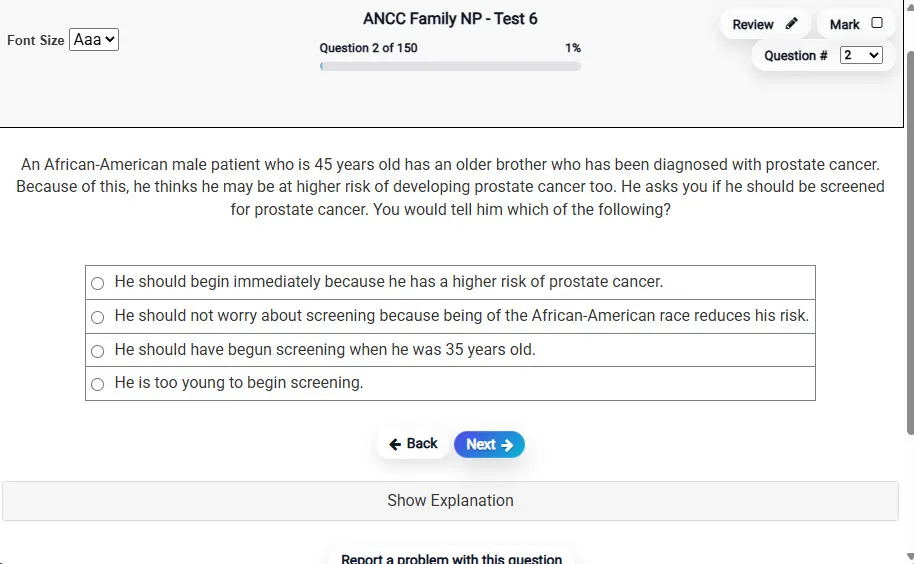
Answering a Question screen – Multiple-choice item view with navigation controls and progress tracker.
Answering a Question Multiple-choice item view with navigation controls and progress tracker.

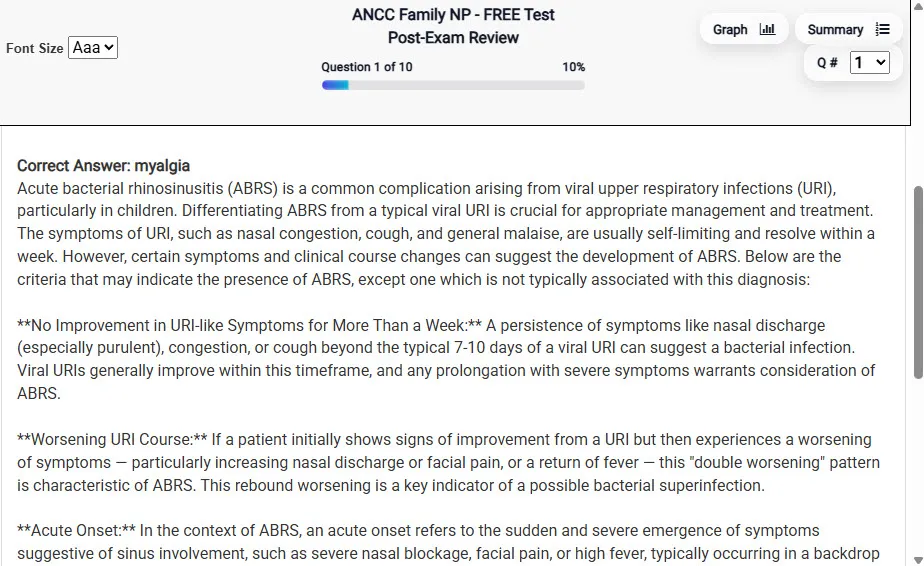
                           Detailed Explanation screen – 
                         Review mode showing chosen answer and rationale and references.
Detailed Explanation Review mode showing chosen answer and rationale and references.

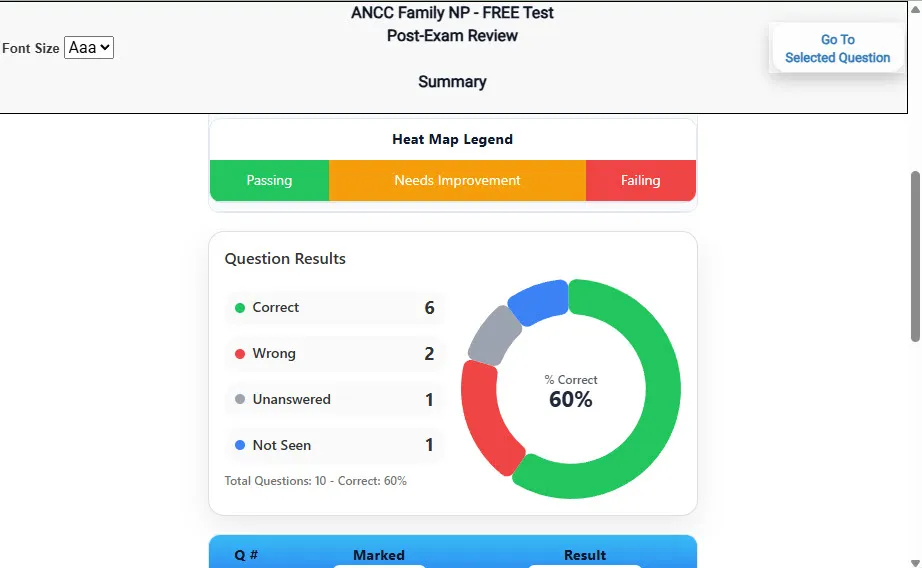
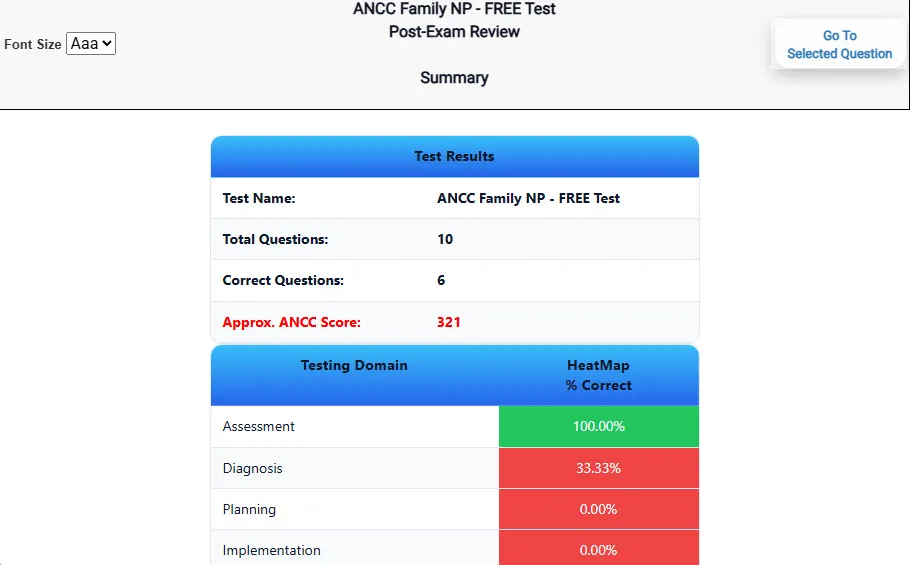
                           Review Summary 1 screen – 
                         Summary with counts for correct/wrong/unanswered and not seen items.
Review Summary 1 Summary with counts for correct/wrong/unanswered and not seen items.

                           Review Summary 2 screen – 
                         Advanced summary with category/domain breakdown and performance insights.
Review Summary 2 Advanced summary with category/domain breakdown and performance insights.

What Each Screen Shows

Answer Question Screen

  • Clean multiple-choice interface with progress bar.
  • Mark for review feature.
  • Matches real test pacing.

Detailed Explanation

  • Correct answer plus rationale.
  • Key concepts and guidelines highlighted.
  • Move between questions to fill knowledge gaps.

Review Summary 1

  • Overall results with total questions and scaled score.
  • Domain heatmap shows strengths and weaknesses.
  • Quick visual feedback on study priorities.

Review Summary 2

  • Chart of correct, wrong, unanswered, not seen.
  • Color-coded results for easy review.
  • Links back to missed items.

Top 10 Reasons to Use Exam Edge for your DOH Dental Assistants Exam Prep

  1. Focused on the DOH Dental Assistants Exam

    Our practice tests are built specifically for the DOH Dental Assistants exam — every question mirrors the real topics, format, and difficulty so you're studying exactly what matters.

  2. Real Exam Simulation

    We match the per-question time limits and pressure of the actual DOH exam, so test day feels familiar and stress-free.

  3. 20 Full Practice Tests & 3,000 Unique Questions

    You'll have more than enough material to master every DOH Dental Assistants concept — no repeats, no fluff.

  4. Lower Cost Than a Retake

    Ordering 5 practice exams costs less than retaking the DOH Dental Assistants exam after a failure. One low fee could save you both time and money.

  5. Flexible Testing

    Need to step away mid-exam? Pick up right where you left off — with your remaining time intact.

  6. Instant Scoring & Feedback

    See your raw score and an estimated DOH Dental Assistants score immediately after finishing each practice test.

  7. Detailed Explanations for Every Question

    Review correct and incorrect answers with clear, step-by-step explanations so you truly understand each topic.

  8. Trusted & Accredited

    We're fully accredited by the Better Business Bureau and uphold the highest standards of trust and transparency.

  9. Web-Based & Always Available

    No software to install. Access your DOH Dental Assistants practice exams 24/7 from any computer or mobile device.

  10. Expert Support When You Need It

    Need extra help? Our specialized tutors are highly qualified and ready to support your DOH exam prep.


Pass the DOH Dental Assistants Exam with Realistic Practice Tests from Exam Edge

Preparing for your upcoming DOH Dental Assistants (DOH-DA) Certification Exam can feel overwhelming — but the right practice makes all the difference. Exam Edge gives you the tools, structure, and confidence to pass on your first try. Our online practice exams are built to match the real DOH Dental Assistants exam in content, format, and difficulty.

  • 📝 20 DOH Dental Assistants Practice Tests: Access 20 full-length exams with 150 questions each, covering every major DOH Dental Assistants topic in depth.
  • Instant Online Access: Start practicing right away — no software, no waiting.
  • 🧠 Step-by-Step Explanations: Understand the reasoning behind every correct answer so you can master DOH Dental Assistants exam concepts.
  • 🔄 Retake Each Exam Up to 4 Times: Build knowledge through repetition and track your improvement over time.
  • 🌐 Web-Based & Available 24/7: Study anywhere, anytime, on any device.
  • 🧘 Boost Your Test-Day Confidence: Familiarity with the DOH format reduces anxiety and helps you perform under pressure.

These DOH Dental Assistants practice exams are designed to simulate the real testing experience by matching question types, timing, and difficulty level. This approach helps you get comfortable not just with the exam content, but also with the testing environment, so you walk into your exam day focused and confident.


Exam Edge DOH Reviews


I took the exam and failed because I didn't review well and didn't know which topics to focus on, but after purchasing these 20 sets from haadrn.Com, I passed my second exam. I only finished up to 17 sets, I am thankful for this site because I can review online anytime, anywhere! Friends are asking ...
Read More
parrenas, Philippines

Thank you Exam Edge :) I passed the Haad RN exam :) Godbless :)

Fedi, Manila, Philippines

I just want to take this opportunity to thank Exam Edge since I passed my HAAD exam.

RHODALYN,

I am glad to inform you that I have successfully passed my HAAD ophthalmology exams, your mock tests were extremely helpful in my journey to this success, thank you once again

Farheen, Karnataka India


DOH Dental Assistants Aliases Test Name

Here is a list of alternative names used for this exam.

  • DOH Dental Assistants
  • DOH Dental Assistants test
  • DOH Dental Assistants Certification Test
  • DOH
  • DOH DOH-DA
  • DOH-DA test
  • DOH Dental Assistants (DOH-DA)
  • Dental Assistants certification