This is the content of the pop-over!

Lightning Deal Alert – 12% Off Ends at Midnight!

Strike while the savings are hot! Use promo code FlashSale at checkout for 12% off any Exam Edge test or bundle. Hurry—the clock is ticking!

FTCE Spanish (039) Practice Tests & Test Prep by Exam Edge


FTCE Spanish K-12  product image
(4.7)
Based on 34 Reviews

  • Real Exam Simulation: Timed questions and matching content build comfort for your FTCE Spanish test day.
  • Instant, 24/7 Access: Web-based FTCE Spanish K-12 practice exams with no software needed.
  • Clear Explanations: Step-by-step answers and explanations for your FTCE exam to strengthen understanding.
  • Boosted Confidence: Reduces anxiety and improves test-taking skills to ace your FTCE Spanish K-12 (039).

Featured on

FTCE Spanish K-12 Online Practice Test Bundles

BEST VALUE
15 practice tests

$149.25

$599.25

SAVE $450

Only $9.95 per test!

  • 100% Pass Guarantee
  • 15 online practice tests
  • 80 questions per test
  • Bonus: 100 Flash Cards + Study Guide
  • Instant access
  • Detailed Explanations
  • Practice tests never expire
  • Timed, untimed, or study guide mode
MOST POPULAR
10 practice tests

$99.50

$399.50

SAVE $300

Only $9.95 per test!

  • 10 online practice tests
  • 80 questions per test
  • Bonus: 100 Flash Cards + Study Guide
  • Instant access
  • Detailed Explanations
  • Practice tests never expire
  • Timed, untimed, or study guide mode
5 practice tests

$69.75

$199.75

SAVE $130

Only $13.95 per test!

  • 5 online practice tests
  • 80 questions per test
  • Bonus: 100 Flash Cards
  • Instant access
  • Detailed Explanations
  • Practice tests never expire
  • Timed, untimed, or study guide mode
1 practice test

$39.95

  • 1 online practice test
  • 80 questions per test
  • Instant access
  • Detailed Explanations
  • Practice tests never expire
  • Timed, untimed, or study guide mode
Quick Select
Tap to choose a bundle

** All Prices are in US Dollars (USD) **


FTCE Spanish (039) Resources

Jump to the section you need most.

Understanding the exact breakdown of the FTCE Spanish K-12 test will help you know what to expect and how to most effectively prepare. The FTCE Spanish K-12 has 80 multiple-choice questions and 1 essay questions. The exam will be broken down into the sections below:

FTCE Spanish K-12 Exam Blueprint
Domain Name % Number of
Questions
Proficiency in presentational and interpersonal modes of communication (Speaking)  
Proficiency in presentational and interpersonal modes of communication (Writing)  
Proficiency in interpretive listening 25% 20
Proficiency in interpretive reading 25% 20
Knowledge of practices - products perspectives of Spanish-speaking cultures 12% 10
Knowledge of language structure 13% 10
Knowledge of effective teaching and learning strategies based on second language acquisition principles 25% 20
* The speaking section comprises 25% of the total score; the writing section comprises 15% of the total score  

FTCE Spanish K-12 Study Tips by Domain

  • Answer prompts with an organized mini-structure (opening → 2–3 supporting points → brief close); a common trap is listing ideas without clear transitions (p. ej., “primero”, “además”, “por eso”).
  • Maintain consistent register (tú/usted) and match formality to the scenario; red flag: switching between “tú” and “usted” or mixing informal slang in a formal context.
  • Use interactive moves in interpersonal speaking (ask a follow-up question, clarify, confirm agreement); priority rule: don’t monologue when the task implies a conversation.
  • Prioritize intelligibility over speed by cleanly producing key contrasts (r/rr, b/v, ll/y as appropriate) and placing stress correctly; common trap: racing through speech and losing comprehensibility.
  • Control high-frequency grammar in real time (ser/estar, por/para, preterite vs. imperfect, subjunctive after triggers like “es importante que”); red flag: repeated errors in these core areas that obscure meaning.
  • Show functional range with circumlocution when a word is missing (define, describe, give an example) instead of pausing in English; common trap: code-switching or abandoning the message when vocabulary gaps appear.
  • Write in an appropriate register (tú/usted) and maintain it consistently; red flag: switching forms of address mid-task without a clear reason.
  • Address all parts of the prompt with a clear purpose and audience; common trap: offering general commentary that doesn’t answer the specific scenario or request.
  • Use cohesive devices (por lo tanto, sin embargo, además) to organize ideas logically; red flag: sentence lists with few connectors or abrupt topic jumps.
  • Demonstrate control of verb tenses and agreement (ser/estar, preterite vs. imperfect, subjunctive triggers); priority rule: accuracy in high-frequency structures matters more than risky, error-prone complexity.
  • Use appropriate vocabulary and idiomatic expressions while avoiding English calques; common trap: literal translations like “aplicar para un trabajo” instead of “solicitar un trabajo”.
  • For interpersonal writing (e.g., email/message), include conventional openings/closings and polite requests; red flag: missing required format elements (saludo, despedida, firma) that make the response feel incomplete.
  • Identify the speaker’s main idea and purpose (inform, persuade, request) before details; red flag: choosing an option supported by a single catchy word rather than the overall message.
  • Track key time markers and sequencing (antes, luego, mientras, ya, todavía) to avoid timeline errors; common trap: confusing preterite vs. imperfect cues when the question asks what happened vs. what was ongoing.
  • Use context to disambiguate meaning of polysemous words (por/para, quedar, llevar, rato, en); priority rule: confirm meaning from surrounding phrases, not the first dictionary sense you recall.
  • Listen for negation and contrast (no, nunca, sino, aunque, sin embargo) because they often flip the correct inference; red flag: ignoring a late “pero” that reverses the speaker’s stance.
  • Infer attitudes and relationships from register and pragmatics (usted/tú, diminutives, hedges like “quizás”); common trap: treating polite indirect requests (Me podría…) as statements of ability.
  • Handle authentic audio features—connected speech, regional pronunciation (s aspiration, yeísmo), and filler words (este, pues)—by focusing on stressed content words; red flag: fixating on an unfamiliar accent and missing repeated key nouns/verbs.
  • Identify the main idea and supporting details across genres (articles, ads, emails, schedules) and don’t over-weight the first sentence as the thesis—that’s a common trap.
  • Infer meaning from context (cognates, word parts, surrounding cues) before reaching for “translation”; red flag: false cognates (e.g., “embarazada,” “asistir”) that flip the answer.
  • Track reference words (pronouns, demonstratives, relative clauses) to the correct antecedent; trap: choosing an option that matches a nearby noun instead of the referent.
  • Recognize author’s purpose, tone, and point of view using signal words (e.g., “sin embargo,” “por lo tanto”); priority rule: locate the sentence that justifies the inference, not just a general “vibe.”
  • Interpret details in authentic texts with numbers, dates, and restrictions (prices, times, conditions) accurately; red flag: missing negatives or limits (e.g., “salvo,” “a menos que,” “no se permite”).
  • Use text structure to answer questions (cause/effect, compare/contrast, sequence) and verify each choice against the passage; trap: selecting a true statement that is not the one the question asks for.
  • Distinguish the “3Ps” clearly: practices (what people do), products (what they make), and perspectives (values/beliefs)—red flag: describing a product (e.g., a dish) without linking it to an underlying perspective.
  • Compare cultures without stereotyping by using qualifiers (e.g., “in many regions”), and avoid treating Spain and Latin America as a single culture—common trap: overgeneralizing “los hispanos” as one homogeneous group.
  • Know how geography and regional identity shape cultural variation (e.g., dialects, holidays, cuisine) across Spanish-speaking countries—priority rule: be specific about where/when a practice occurs.
  • Connect cultural products (literature, art, music, media) to historical and social contexts (e.g., migration, colonial legacies, social movements)—red flag: name-dropping authors or genres without explaining cultural significance.
  • Identify sociolinguistic norms (register, forms of address, courtesy strategies, turn-taking) as cultural practices—common trap: using tú/usted or vos inconsistently with the social relationship implied.
  • Apply an intercultural lens (compare, interpret, and mediate misunderstandings) rather than judging behaviors by U.S. norms—contraindication: framing differences as “better/worse” instead of “different because of perspective.”
  • Master core grammar contrasts tested often: ser vs. estar, por vs. para, preterite vs. imperfect—red flag: choosing based on English translation instead of function and context.
  • Control pronouns and clitics (direct/indirect, se, reflexive) and placement with infinitives/gerunds/commands—common trap: incorrect order (e.g., *lo le) or forgetting accent marks when attaching.
  • Know subjunctive triggers (emotion, doubt, impersonal expressions, requests) and sequence of tenses—priority rule: present subjunctive after present/imperative and imperfect subjunctive after past triggers.
  • Apply agreement and noun phrase structure (gender/number, adjectives, articles) including apócope and position changes—red flag: adjective meaning shifts (e.g., grande vs. gran) ignored.
  • Handle verb morphology and irregularities across tenses (stem-changing, spelling changes, irregular preterites, commands)—common trap: incorrect formal commands (e.g., *no sabe instead of no sepa).
  • Use accurate syntax and cohesion (word order, negation, relative pronouns, connectors) with correct diacritics—threshold: persistent missing accents that change meaning (tú/tu, sí/si, más/mas) can signal weak structure.
  • Prioritize comprehensible input at i+1 with supports (gestures, visuals, sentence frames); red flag: lessons dominated by English explanations of grammar with little Spanish exposure.
  • Plan for interaction that negotiates meaning (information-gap tasks, turn-and-talk, jigsaw); common trap: “group work” where students read silently or one student does all the speaking.
  • Use explicit instruction strategically and briefly, then return to meaningful use; priority rule: form-focused feedback should target a few high-impact errors, not every mistake in fluency tasks.
  • Build vocabulary in context with multiple encounters and retrieval (spaced review, quick checks); red flag: long isolated word lists without recycling across days and modalities.
  • Differentiate via proficiency-based tasks and scaffolds (tiered prompts, choice of output, modeled exemplars); common trap: grading novices on advanced accuracy instead of comprehensibility and task completion.
  • Use corrective feedback matched to the goal (recasts during conversation, brief metalinguistic notes during editing); contraindication: interrupting students mid-message for repeated error correction, which can reduce risk-taking.
  • Budget prep time by weighting: speaking is 25% of the score and writing is 15%—a common trap is overstudying reading/listening while under-practicing timed speaking prompts.
  • Set a weekly minimum of two recorded speaking tasks and one timed writing task; red flag: you can explain grammar but cannot sustain coherent speech for the full response window.
  • Speaking scoring often rewards comprehensibility and task completion over perfection—priority rule: keep talking with accurate high-frequency structures rather than stopping to self-correct repeatedly.
  • For writing, aim for clear organization (intro–body–closure) and consistent verb control; common trap: great ideas but run-on sentences and missing accents/punctuation that reduce clarity.
  • Simulate test conditions: no pausing/restarting recordings and strict time limits; red flag: performance drops sharply only when you are timed, indicating pacing needs work.
  • Use a simple checklist to self-score each practice: address every prompt requirement, give specific details, and maintain appropriate register (tú/usted); common trap: answering partially and losing points despite strong language.


Built to Fit Into Your Busy Life

Everything you need to prepare with confidence—without wasting a minute.

Three Study Modes

Timed, No Time Limit, or Explanation mode.

Actionable Analytics

Heatmaps and scaled scores highlight weak areas.

High-Yield Rationales

Concise explanations emphasize key concepts.

Realistic Interface

Matches the feel of the actual exam environment.

Accessible by Design

Clean layout reduces cognitive load.

Anytime, Anywhere

Web-based access 24/7 on any device.
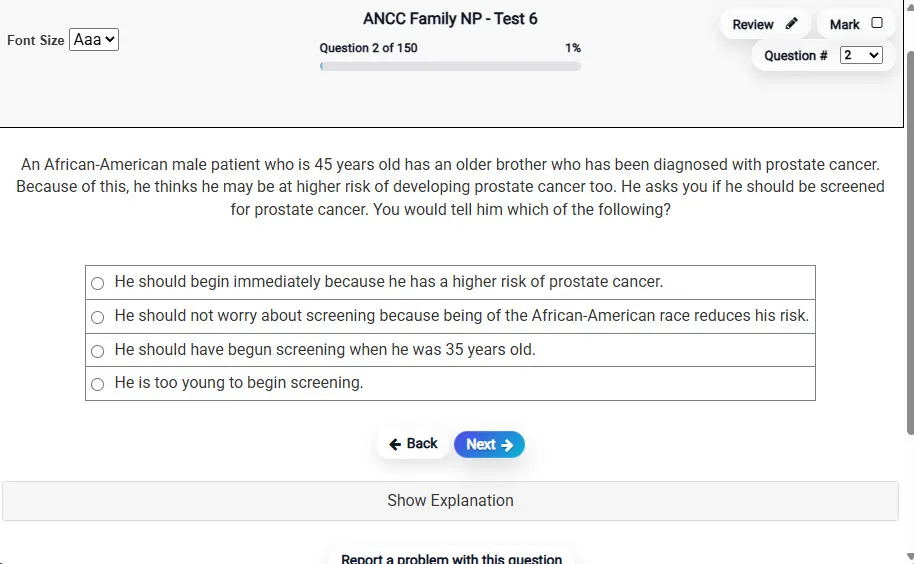
Answering a Question screen – Multiple-choice item view with navigation controls and progress tracker.
Answering a Question Multiple-choice item view with navigation controls and progress tracker.

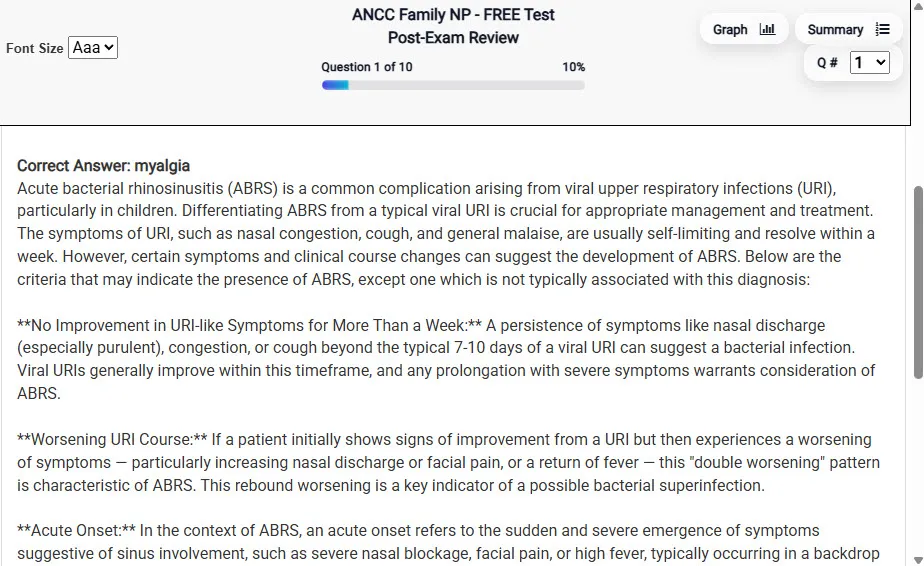
                           Detailed Explanation screen – 
                         Review mode showing chosen answer and rationale and references.
Detailed Explanation Review mode showing chosen answer and rationale and references.

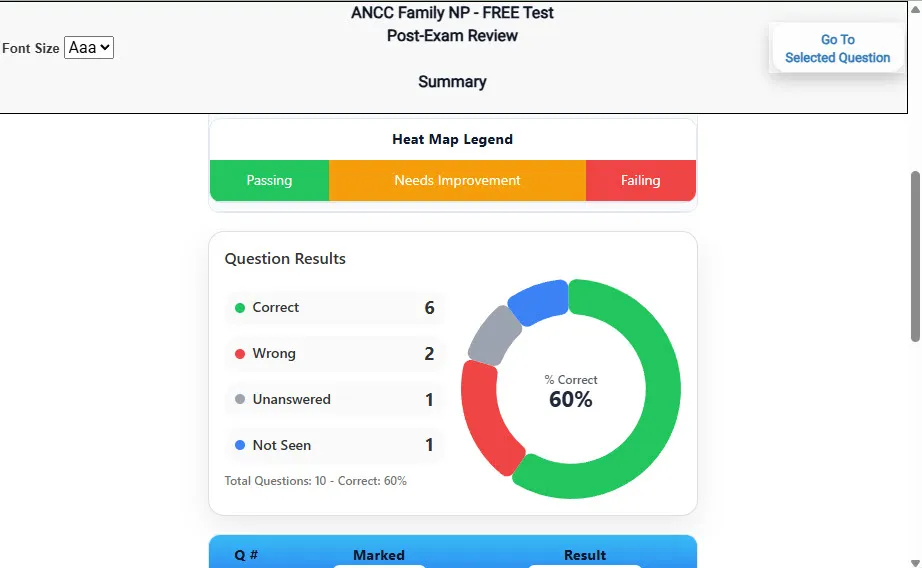
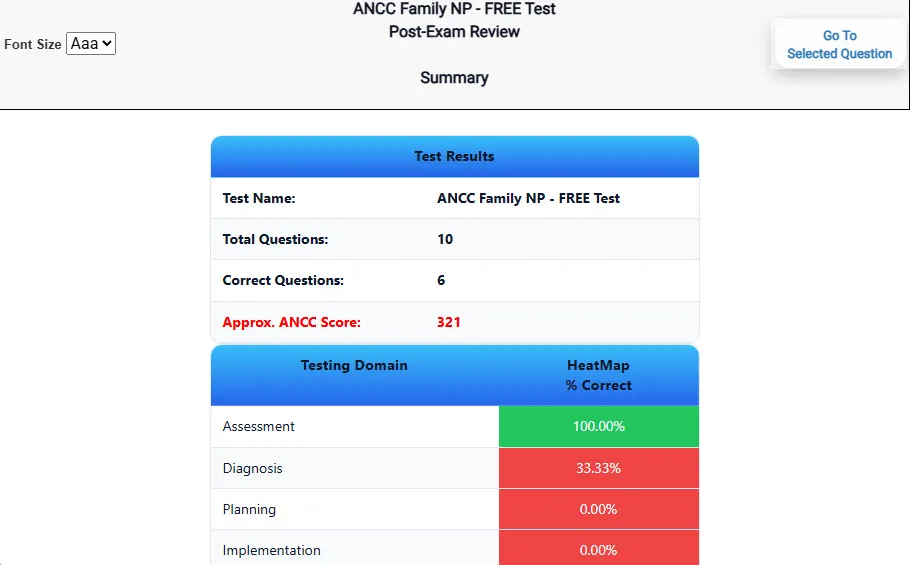
                           Review Summary 1 screen – 
                         Summary with counts for correct/wrong/unanswered and not seen items.
Review Summary 1 Summary with counts for correct/wrong/unanswered and not seen items.

                           Review Summary 2 screen – 
                         Advanced summary with category/domain breakdown and performance insights.
Review Summary 2 Advanced summary with category/domain breakdown and performance insights.

What Each Screen Shows

Answer Question Screen

  • Clean multiple-choice interface with progress bar.
  • Mark for review feature.
  • Matches real test pacing.

Detailed Explanation

  • Correct answer plus rationale.
  • Key concepts and guidelines highlighted.
  • Move between questions to fill knowledge gaps.

Review Summary 1

  • Overall results with total questions and scaled score.
  • Domain heatmap shows strengths and weaknesses.
  • Quick visual feedback on study priorities.

Review Summary 2

  • Chart of correct, wrong, unanswered, not seen.
  • Color-coded results for easy review.
  • Links back to missed items.

Top 10 Reasons to Use Exam Edge for your FTCE Spanish K-12 Exam Prep

  1. Focused on the FTCE Spanish K-12 Exam

    Our practice tests are built specifically for the FTCE Spanish exam — every question mirrors the real topics, format, and difficulty so you're studying exactly what matters.

  2. Real Exam Simulation

    We match the per-question time limits and pressure of the actual FTCE exam, so test day feels familiar and stress-free.

  3. 15 Full Practice Tests & 1,200 Unique Questions

    You'll have more than enough material to master every FTCE Spanish concept — no repeats, no fluff.

  4. Lower Cost Than a Retake

    Ordering 5 practice exams costs less than retaking the FTCE Spanish K-12 exam after a failure. One low fee could save you both time and money.

  5. Flexible Testing

    Need to step away mid-exam? Pick up right where you left off — with your remaining time intact.

  6. Instant Scoring & Feedback

    See your raw score and an estimated FTCE Spanish K-12 score immediately after finishing each practice test.

  7. Detailed Explanations for Every Question

    Review correct and incorrect answers with clear, step-by-step explanations so you truly understand each topic.

  8. Trusted & Accredited

    We're fully accredited by the Better Business Bureau and uphold the highest standards of trust and transparency.

  9. Web-Based & Always Available

    No software to install. Access your FTCE Spanish practice exams 24/7 from any computer or mobile device.

  10. Expert Support When You Need It

    Need extra help? Our specialized tutors are highly qualified and ready to support your FTCE exam prep.


Pass the FTCE Spanish K-12 Exam with Realistic Practice Tests from Exam Edge

Preparing for your upcoming FTCE Spanish K-12 (039) Certification Exam can feel overwhelming — but the right practice makes all the difference. Exam Edge gives you the tools, structure, and confidence to pass on your first try. Our online practice exams are built to match the real FTCE Spanish exam in content, format, and difficulty.

  • 📝 15 FTCE Spanish K-12 Practice Tests: Access 15 full-length exams with 80 questions each, covering every major FTCE Spanish K-12 topic in depth.
  • Instant Online Access: Start practicing right away — no software, no waiting.
  • 🧠 Step-by-Step Explanations: Understand the reasoning behind every correct answer so you can master FTCE Spanish exam concepts.
  • 🔄 Retake Each Exam Up to 4 Times: Build knowledge through repetition and track your improvement over time.
  • 🌐 Web-Based & Available 24/7: Study anywhere, anytime, on any device.
  • 🧘 Boost Your Test-Day Confidence: Familiarity with the FTCE format reduces anxiety and helps you perform under pressure.

These FTCE Spanish K-12 practice exams are designed to simulate the real testing experience by matching question types, timing, and difficulty level. This approach helps you get comfortable not just with the exam content, but also with the testing environment, so you walk into your exam day focused and confident.

Exam Edge FTCE Reviews


I am very glad I found this page. I passed the ESE test. It was worth paying for the practice test. The practice tests were a great help for me. All questions were related to the subject matter. The explanations were very helpful. Thank you very much.

Estrada, FL

Your site was recommended by a colleague as well as the district I currently teach in. The format is aligned the the updated exam structure. Thanks for asking how I feel about your product.

ARLEEN , MIAMI GARDENS, Florida

Good evening, I just had to email you and say thank you for creating such a great test prep tool. I have spent weeks studying for my test and found your website just a few weeks ago. The test I took with ExamEdge was by far the most similar to the actual exam and by far the biggest bang for the buck ...
Read More
Rebecca, Pembroke Pines, FL

I failed the Earth Space Science test 3 times... on the second time I started using Exam Edge. I was taking the practice tests but I wasn't using them as a serious study tool. I really thought I was never going to pass the test, when I began taking the practice test just like I would the real th ...
Read More
Londann , FL

I just passed my FTCE Earth/Space Science 6-12 exam, and I used your practice tests to study! it was excellent and super helpful. I love the way that each of the choices are explained for the questions, and the format is basically identical to the real test. Definitely the highest value use of my st ...
Read More
Jason K, Michigan

I'm a third-year teacher and I needed to take my professional exam because my temporary certification is expiring this June. I decided to give your site a try because I wanted to pass the exam on the first try. I bought two practice tests and I love how the practice tests were set up! By studying wi ...
Read More
Ayisha , Florida


FTCE Spanish K-12 Aliases Test Name

Here is a list of alternative names used for this exam.

  • FTCE Spanish K-12
  • FTCE Spanish K-12 test
  • FTCE Spanish K-12 Certification Test
  • FTCE Spanish test
  • FTCE
  • FTCE 039
  • 039 test
  • FTCE Spanish K-12 (039)
  • Spanish K-12 certification