This is the content of the pop-over!

FTCE Reading (035) Practice Tests & Test Prep by Exam Edge


FTCE Reading K-12  product image
(4.7)
Based on 40 Reviews

  • Real Exam Simulation: Timed questions and matching content build comfort for your FTCE Reading test day.
  • Instant, 24/7 Access: Web-based FTCE Reading K-12 practice exams with no software needed.
  • Clear Explanations: Step-by-step answers and explanations for your FTCE exam to strengthen understanding.
  • Boosted Confidence: Reduces anxiety and improves test-taking skills to ace your FTCE Reading K-12 (035).

Featured on

FTCE Reading K-12 Online Practice Test Bundles

BEST VALUE
20 practice tests

$174.00

$799.00

SAVE $625

Only $8.70 per test!

  • 100% Pass Guarantee
  • 20 online practice tests
  • 100 questions per test
  • Bonus: 100 Flash Cards + Study Guide
  • Instant access
  • Detailed Explanations
  • Practice tests never expire
  • Timed, untimed, or study guide mode
MOST POPULAR
10 practice tests

$99.50

$399.50

SAVE $300

Only $9.95 per test!

  • 10 online practice tests
  • 100 questions per test
  • Bonus: 100 Flash Cards + Study Guide
  • Instant access
  • Detailed Explanations
  • Practice tests never expire
  • Timed, untimed, or study guide mode
5 practice tests

$69.75

$199.75

SAVE $130

Only $13.95 per test!

  • 5 online practice tests
  • 100 questions per test
  • Bonus: 100 Flash Cards
  • Instant access
  • Detailed Explanations
  • Practice tests never expire
  • Timed, untimed, or study guide mode
1 practice test

$39.95

  • 1 online practice test
  • 100 questions per test
  • Instant access
  • Detailed Explanations
  • Practice tests never expire
  • Timed, untimed, or study guide mode
Quick Select
Tap to choose a bundle

** All Prices are in US Dollars (USD) **


FTCE Reading (035) Resources

Jump to the section you need most.

Understanding the exact breakdown of the FTCE Reading K-12 test will help you know what to expect and how to most effectively prepare. The FTCE Reading K-12 has 100 multiple-choice questions . The exam will be broken down into the sections below:

FTCE Reading K-12 Exam Blueprint
Domain Name % Number of
Questions
Knowledge of research and theories of reading processes 10% 10
Knowledge of text types and structures 10% 10
Knowledge of reading assessment and evaluation 10% 10
Knowledge of learning environments and procedures that support reading 10% 10
Knowledge of oral and written language acquisition and beginning reading 11% 11
Knowledge of phonics and word recognition 12% 12
Knowledge of vocabulary acquisition and use 12% 12
Knowledge of reading fluency and reading comprehension 15% 15
Knowledge of reading program development - implementation coordination 10% 10

FTCE Reading K-12 Study Tips by Domain

  • Distinguish major theoretical models (e.g., bottom-up, top-down, interactive/compensatory) and apply them to instruction; red flag: choosing a single model as “best” for all learners rather than matching to task and reader needs.
  • Use the Simple View of Reading (Reading Comprehension = Decoding × Language Comprehension) to diagnose breakdowns; priority rule: if either factor is near zero, overall comprehension will be severely limited.
  • Connect Scarborough’s Reading Rope (word recognition + language comprehension strands) to multi-component instruction; common trap: overemphasizing one strand (e.g., phonics) while ignoring background knowledge, syntax, and verbal reasoning.
  • Apply the Matthew Effect in reading to justify early, intensive intervention; red flag: waiting for a student to “mature” when data show widening gaps over time.
  • Interpret research quality (experimental vs. correlational, effect size, fidelity, and replicability) when selecting practices; common trap: treating a single study or anecdote as sufficient evidence for program adoption.
  • Use developmentally informed theories (e.g., stage/phase models of word reading and orthographic mapping) to sequence instruction; contraindication: introducing advanced morphology/etymology as the primary focus before students have secure phoneme-grapheme proficiency.
  • Distinguish literary vs. informational texts by purpose and features; red flag: treating a memoir or narrative nonfiction as purely “fiction” and ignoring its factual claims.
  • Match text structure to comprehension strategy (e.g., compare/contrast → Venn diagram, cause/effect → causal chain); common trap: using the same graphic organizer for every passage.
  • Use signal words to identify organization (e.g., “however,” “similarly,” “as a result,” “first/next/finally”); priority rule: teach students to locate signal words before summarizing.
  • Recognize narrative elements (setting, plot, conflict, theme, point of view) and how they shape meaning; red flag: confusing theme with a one-word topic (e.g., “friendship”).
  • Analyze argumentative/persuasive structures (claim, reasons, evidence, counterclaim, rebuttal); common trap: counting anecdotes as sufficient evidence without checking relevance and credibility.
  • Interpret structural features (headings, captions, charts, indexes, glossaries, hyperlinks) as meaning-making tools; contraindication: skipping text features when answering questions about key ideas and details.
  • Match assessment type to purpose—screening identifies risk, diagnostic pinpoints skill deficits, progress monitoring tracks growth, and summative evaluates outcomes; red flag: using a high-stakes benchmark test to diagnose specific decoding or language needs.
  • Prioritize validity and reliability when selecting tools; common trap: drawing conclusions from a measure with poor inter-rater reliability (e.g., inconsistent oral reading fluency scoring) or weak alignment to the intended construct.
  • Use multiple data points before changing instruction placement or intensity; priority rule: confirm a pattern across measures (e.g., phonics inventory + decoding in text + spelling) rather than relying on a single low score.
  • Interpret norm-referenced vs. criterion-referenced results correctly; red flag: treating percentile rank as “percent correct” or assuming a small percentile change always reflects real growth.
  • Ensure accommodations don’t invalidate the construct being measured; contraindication: reading a decoding/word recognition test aloud (it shifts the skill assessed) while allowing extended time may be appropriate depending on the construct.
  • Link evaluation findings to targeted instructional next steps and document progress with goal-based criteria; common trap: reporting broad labels (e.g., “low comprehension”) without specifying whether the primary issue is fluency, vocabulary, background knowledge, or comprehension strategy use.
  • Establish explicit routines for independent reading (book selection, stamina, conferencing) with a clear expectation for time-on-task—red flag: “silent reading” with no accountability or feedback cycle.
  • Arrange the classroom to support small-group instruction and easy access to texts at varied levels; common trap: grouping students permanently by “low/middle/high” rather than using flexible, data-driven groups.
  • Teach and reinforce discussion norms (turn-taking, text-based evidence, respectful disagreement) to build comprehension; priority rule: require students to cite specific words/lines from the text, not opinions only.
  • Differentiate supports (sentence frames, visuals, chunked directions, assistive tech) while keeping the same learning target; red flag: lowering the task instead of scaffolding the language or process.
  • Use previewing and purpose-setting routines (learning target, essential question, success criteria) before reading; common trap: starting reading without clarifying what students should be able to do with the text afterward.
  • Maintain a print-rich environment (word walls by pattern/meaning, anchor charts, genre features) that students actively use; contraindication: decorative displays that aren’t referenced during instruction or student work.
  • Distinguish language acquisition (implicit, meaning-driven) from language learning (explicit, rule-driven); red flag: treating multilingual learners’ transfer errors as disabilities without evidence across settings.
  • Support phonological awareness development (word → syllable → onset-rime → phoneme); common trap: jumping straight to letter-sound drills before students can segment/blend sounds orally.
  • Build concepts of print (directionality, spacing, return sweep, book handling); priority rule: address print concepts first when a child can talk about a story but cannot track print accurately.
  • Use interactive read-alouds with dialogic prompts (wh- questions, recasts, expansions) to grow oral language; red flag: asking only yes/no questions that limit expressive language practice.
  • Teach alphabet knowledge with both letter names and letter sounds plus formation; common trap: expecting decoding progress when students confuse visually similar letters (b/d/p/q) and need explicit discrimination practice.
  • Connect emergent writing (scribbles → letter strings → invented spelling) to beginning reading; contraindication: correcting every spelling error during drafting instead of using errors diagnostically to plan phoneme-grapheme instruction.
  • Teach phonemic awareness before or alongside phonics (e.g., blending/segmenting) — red flag: jumping straight to letter worksheets when students can’t manipulate sounds orally.
  • Use explicit, systematic phonics with a planned scope and sequence (CVC → digraphs → blends → vowel teams) — common trap: random “phonics of the week” without cumulative review.
  • Target decoding by analyzing error patterns (e.g., short-vowel confusion vs. consonant digraph errors) — priority rule: reteach the specific grapheme–phoneme correspondence, not just reread the passage.
  • Build word recognition through orthographic mapping (connect phonemes to graphemes in spelling/reading) — red flag: memorizing whole words without linking to sounds leads to weak transfer to new words.
  • Teach syllable types and division for multisyllabic decoding (closed, open, VCe, vowel team, r-controlled, consonant-le) — common trap: students guessing long words from the first syllable and pictures.
  • Differentiate phonics vs. phonological awareness vs. phonemic awareness vs. morphology — test cue: prefixes/suffixes and roots are morphology, so don’t label them as phonics interventions.
  • Prioritize explicit, repeated instruction in Tier 2 (high-utility academic) words across contexts; red flag: spending most vocabulary time on low-frequency Tier 3 terms with little transfer.
  • Teach morphology (roots, prefixes, suffixes) and use it for meaning-making; common trap: treating affixes as isolated lists instead of applying them to decode and infer word meaning in text.
  • Use multiple exposures with student-friendly definitions, examples/nonexamples, and active use (speaking/writing); priority rule: plan at least 6–10 meaningful encounters for durable learning.
  • Link vocabulary to comprehension strategies (context clues, semantic mapping, word relationships like synonyms/antonyms); red flag: relying on “look it up” dictionary tasks as the primary approach.
  • Differentiate for English Learners and diverse dialect/background knowledge by preteaching critical terms and using visuals/realia; contraindication: penalizing students for accent/dialect when assessing word knowledge.
  • Assess vocabulary with both receptive and expressive measures (e.g., matching/selection and use in sentence or explanation) and align to instruction; common trap: using only weekly multiple-choice quizzes that overestimate depth of knowledge.
  • Teach fluency as accuracy + rate + prosody; red flag: timing students without first ensuring they can decode and read words correctly.
  • Use repeated reading with a clear model (teacher/audio) and brief feedback; common trap: assigning “round-robin” oral reading, which reduces practice and increases anxiety.
  • Build comprehension with explicit before/during/after strategies (predict, question, clarify, summarize); priority rule: align the strategy to the text purpose and the student’s need, not a one-size routine.
  • Monitor comprehension through retellings, think-alouds, and text-dependent questions; red flag: relying only on literal recall questions that miss inference and integration.
  • Address breakdowns by diagnosing the source (vocabulary/knowledge, syntax, cohesion, decoding, attention) and reteaching targeted skills; common trap: giving more silent reading time as the only intervention.
  • Differentiate for narrative vs. informational texts using structure cues (story grammar vs. headings, captions, cause/effect); red flag: students reading smoothly but unable to identify main idea, supporting details, or author’s purpose.
  • Align program goals, scope-and-sequence, and materials to Florida’s reading standards and district pacing; red flag: activities that don’t map to explicit outcomes or assessment expectations.
  • Use a tiered service model (core instruction plus targeted/supplemental intervention) with documented entry/exit criteria; common trap: assigning interventions by label or grade level instead of data.
  • Plan implementation with explicit roles (classroom, interventionist, coach, admin) and a fidelity checklist; priority rule: if fidelity is low, don’t attribute poor results to the program.
  • Schedule protected instructional time and intervention blocks with minimal pull-out conflicts; red flag: frequent interruptions that reduce time-on-task for foundational skills.
  • Coordinate progress monitoring (who, how often, which measures) and set decision rules for instructional changes; common trap: collecting data without a pre-set action plan when scores stall.
  • Provide ongoing professional learning (modeling, coaching cycles, and follow-up) tied to observed needs; contraindication: one-time trainings without classroom practice checks or feedback loops.


Built to Fit Into Your Busy Life

Everything you need to prepare with confidence—without wasting a minute.

Three Study Modes

Timed, No Time Limit, or Explanation mode.

Actionable Analytics

Heatmaps and scaled scores highlight weak areas.

High-Yield Rationales

Concise explanations emphasize key concepts.

Realistic Interface

Matches the feel of the actual exam environment.

Accessible by Design

Clean layout reduces cognitive load.

Anytime, Anywhere

Web-based access 24/7 on any device.
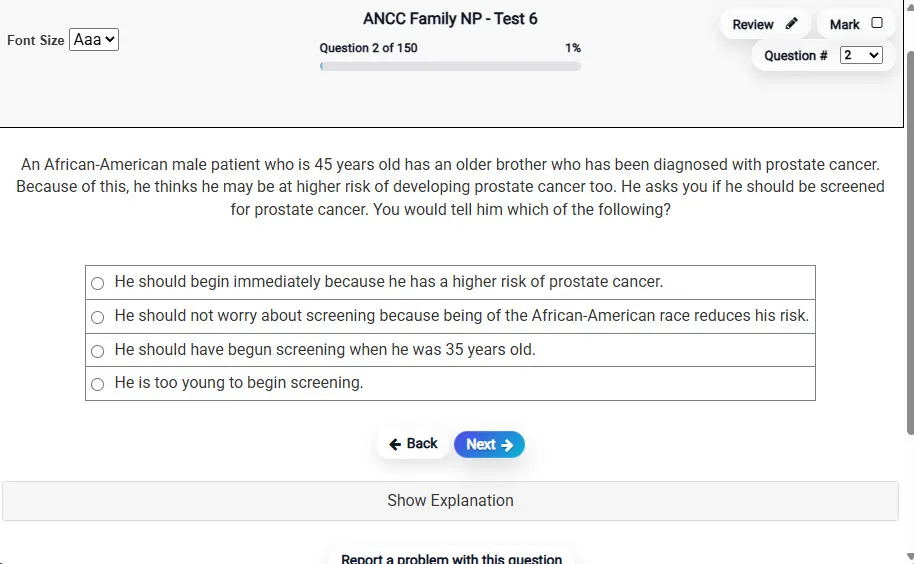
Answering a Question screen – Multiple-choice item view with navigation controls and progress tracker.
Answering a Question Multiple-choice item view with navigation controls and progress tracker.

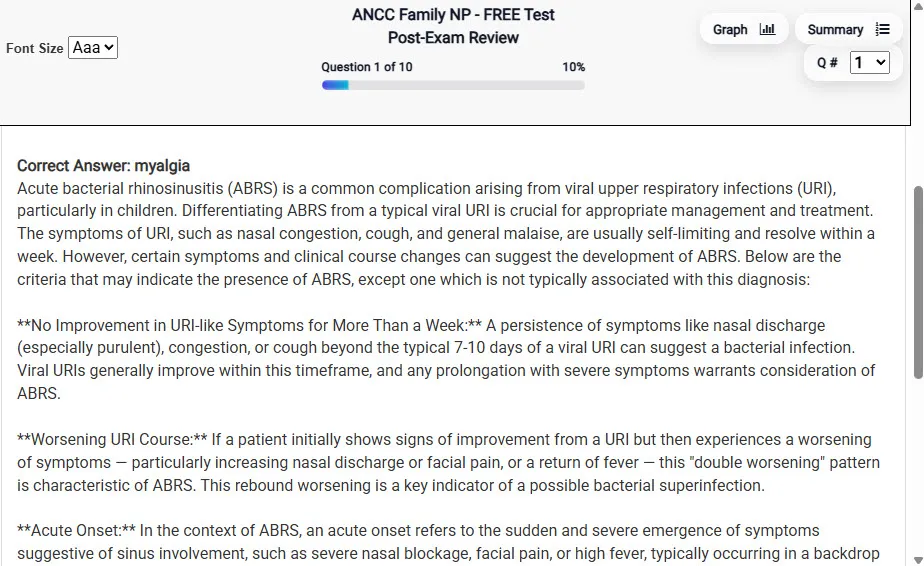
                           Detailed Explanation screen – 
                         Review mode showing chosen answer and rationale and references.
Detailed Explanation Review mode showing chosen answer and rationale and references.

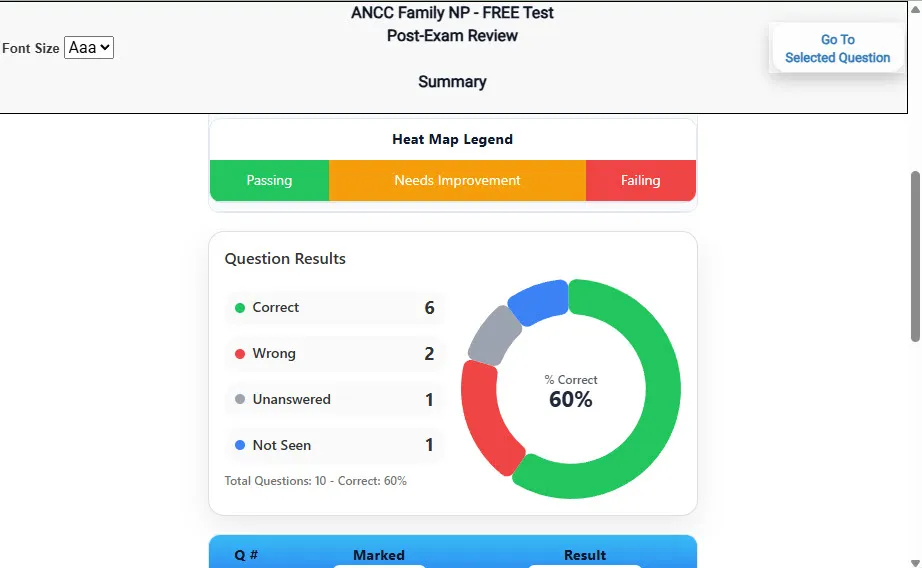
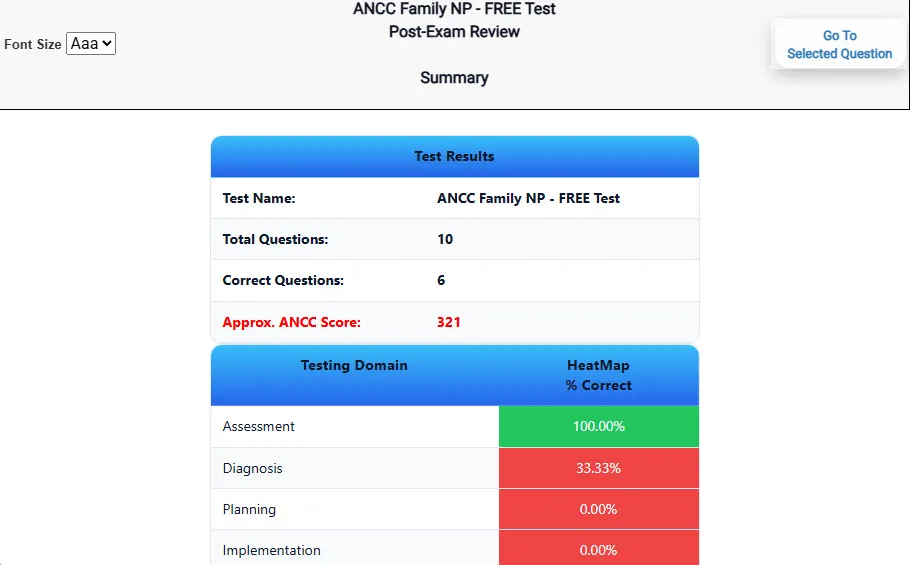
                           Review Summary 1 screen – 
                         Summary with counts for correct/wrong/unanswered and not seen items.
Review Summary 1 Summary with counts for correct/wrong/unanswered and not seen items.

                           Review Summary 2 screen – 
                         Advanced summary with category/domain breakdown and performance insights.
Review Summary 2 Advanced summary with category/domain breakdown and performance insights.

What Each Screen Shows

Answer Question Screen

  • Clean multiple-choice interface with progress bar.
  • Mark for review feature.
  • Matches real test pacing.

Detailed Explanation

  • Correct answer plus rationale.
  • Key concepts and guidelines highlighted.
  • Move between questions to fill knowledge gaps.

Review Summary 1

  • Overall results with total questions and scaled score.
  • Domain heatmap shows strengths and weaknesses.
  • Quick visual feedback on study priorities.

Review Summary 2

  • Chart of correct, wrong, unanswered, not seen.
  • Color-coded results for easy review.
  • Links back to missed items.

Top 10 Reasons to Use Exam Edge for your FTCE Reading K-12 Exam Prep

  1. Focused on the FTCE Reading K-12 Exam

    Our practice tests are built specifically for the FTCE Reading exam — every question mirrors the real topics, format, and difficulty so you're studying exactly what matters.

  2. Real Exam Simulation

    We match the per-question time limits and pressure of the actual FTCE exam, so test day feels familiar and stress-free.

  3. 20 Full Practice Tests & 2,000 Unique Questions

    You'll have more than enough material to master every FTCE Reading concept — no repeats, no fluff.

  4. Lower Cost Than a Retake

    Ordering 5 practice exams costs less than retaking the FTCE Reading K-12 exam after a failure. One low fee could save you both time and money.

  5. Flexible Testing

    Need to step away mid-exam? Pick up right where you left off — with your remaining time intact.

  6. Instant Scoring & Feedback

    See your raw score and an estimated FTCE Reading K-12 score immediately after finishing each practice test.

  7. Detailed Explanations for Every Question

    Review correct and incorrect answers with clear, step-by-step explanations so you truly understand each topic.

  8. Trusted & Accredited

    We're fully accredited by the Better Business Bureau and uphold the highest standards of trust and transparency.

  9. Web-Based & Always Available

    No software to install. Access your FTCE Reading practice exams 24/7 from any computer or mobile device.

  10. Expert Support When You Need It

    Need extra help? Our specialized tutors are highly qualified and ready to support your FTCE exam prep.


Pass the FTCE Reading K-12 Exam with Realistic Practice Tests from Exam Edge

Preparing for your upcoming FTCE Reading K-12 (035) Certification Exam can feel overwhelming — but the right practice makes all the difference. Exam Edge gives you the tools, structure, and confidence to pass on your first try. Our online practice exams are built to match the real FTCE Reading exam in content, format, and difficulty.

  • 📝 20 FTCE Reading K-12 Practice Tests: Access 20 full-length exams with 100 questions each, covering every major FTCE Reading K-12 topic in depth.
  • Instant Online Access: Start practicing right away — no software, no waiting.
  • 🧠 Step-by-Step Explanations: Understand the reasoning behind every correct answer so you can master FTCE Reading exam concepts.
  • 🔄 Retake Each Exam Up to 4 Times: Build knowledge through repetition and track your improvement over time.
  • 🌐 Web-Based & Available 24/7: Study anywhere, anytime, on any device.
  • 🧘 Boost Your Test-Day Confidence: Familiarity with the FTCE format reduces anxiety and helps you perform under pressure.

These FTCE Reading K-12 practice exams are designed to simulate the real testing experience by matching question types, timing, and difficulty level. This approach helps you get comfortable not just with the exam content, but also with the testing environment, so you walk into your exam day focused and confident.

Exam Edge FTCE Reviews


Good evening, I just had to email you and say thank you for creating such a great test prep tool. I have spent weeks studying for my test and found your website just a few weeks ago. The test I took with ExamEdge was by far the most similar to the actual exam and by far the biggest bang for the buck ...
Read More
Rebecca, Pembroke Pines, FL

I failed the Earth Space Science test 3 times... on the second time I started using Exam Edge. I was taking the practice tests but I wasn't using them as a serious study tool. I really thought I was never going to pass the test, when I began taking the practice test just like I would the real th ...
Read More
Londann , FL

I just passed my FTCE Earth/Space Science 6-12 exam, and I used your practice tests to study! it was excellent and super helpful. I love the way that each of the choices are explained for the questions, and the format is basically identical to the real test. Definitely the highest value use of my st ...
Read More
Jason K, Michigan

I'm a third-year teacher and I needed to take my professional exam because my temporary certification is expiring this June. I decided to give your site a try because I wanted to pass the exam on the first try. I bought two practice tests and I love how the practice tests were set up! By studying wi ...
Read More
Ayisha , Florida

Easy to use and full of questions to prep for the real deal!

Stacie , Silver Spring , MD

Just wanted to let you guys know that your tests really helped me prepare for the ftce math exam. I took it yesterday and passed. I will tell other people about your site.

Shawna M, Florida


FTCE Reading K-12 Aliases Test Name

Here is a list of alternative names used for this exam.

  • FTCE Reading K-12
  • FTCE Reading K-12 test
  • FTCE Reading K-12 Certification Test
  • FTCE Reading test
  • FTCE
  • FTCE 035
  • 035 test
  • FTCE Reading K-12 (035)
  • Reading K-12 certification