This is the content of the pop-over!

Lightning Deal Alert – 12% Off Ends at Midnight!

Strike while the savings are hot! Use promo code FlashSale at checkout for 12% off any Exam Edge test or bundle. Hurry—the clock is ticking!

FTCE Exceptional Student (061) Practice Tests & Test Prep by Exam Edge


FTCE Exceptional Student Education K-12  product image
(4.7)
Based on 34 Reviews

  • Real Exam Simulation: Timed questions and matching content build comfort for your FTCE Exceptional Student test day.
  • Instant, 24/7 Access: Web-based FTCE Exceptional Student Education K-12 practice exams with no software needed.
  • Clear Explanations: Step-by-step answers and explanations for your FTCE exam to strengthen understanding.
  • Boosted Confidence: Reduces anxiety and improves test-taking skills to ace your FTCE Exceptional Student Education K-12 (061).

Featured on

FTCE Exceptional Student Education K-12 Online Practice Test Bundles

BEST VALUE
15 practice tests

$149.25

$599.25

SAVE $450

Only $9.95 per test!

  • 100% Pass Guarantee
  • 15 online practice tests
  • 100 questions per test
  • Bonus: 100 Flash Cards + Study Guide
  • Instant access
  • Detailed Explanations
  • Practice tests never expire
  • Timed, untimed, or study guide mode
MOST POPULAR
10 practice tests

$99.50

$399.50

SAVE $300

Only $9.95 per test!

  • 10 online practice tests
  • 100 questions per test
  • Bonus: 100 Flash Cards + Study Guide
  • Instant access
  • Detailed Explanations
  • Practice tests never expire
  • Timed, untimed, or study guide mode
5 practice tests

$69.75

$199.75

SAVE $130

Only $13.95 per test!

  • 5 online practice tests
  • 100 questions per test
  • Bonus: 100 Flash Cards
  • Instant access
  • Detailed Explanations
  • Practice tests never expire
  • Timed, untimed, or study guide mode
1 practice test

$39.95

  • 1 online practice test
  • 100 questions per test
  • Instant access
  • Detailed Explanations
  • Practice tests never expire
  • Timed, untimed, or study guide mode
Quick Select
Tap to choose a bundle

** All Prices are in US Dollars (USD) **


FTCE Exceptional Student (061) Resources

Jump to the section you need most.

Understanding the exact breakdown of the FTCE Exceptional Student Education K-12 test will help you know what to expect and how to most effectively prepare. The FTCE Exceptional Student Education K-12 has 100 multiple-choice questions . The exam will be broken down into the sections below:

FTCE Exceptional Student Education K-12 Exam Blueprint
Domain Name % Number of
Questions
Knowledge of foundations of exceptional student education 24% 24
Knowledge of assessment and evaluation 13% 13
Knowledge of instructional practices in exceptional student education 21% 21
Knowledge of positive behavioral support process 12% 12
Knowledge of multiple literacies and communication skills 22% 22
Knowledge of the transition process 8% 8

FTCE Exceptional Student Education K-12 Study Tips by Domain

  • Know IDEA eligibility categories and the FAPE/LRE mandate — red flag: recommending a more restrictive placement “because it’s easier” without documenting why supports in the general setting won’t work.
  • Distinguish IEP vs. 504 plan vs. MTSS — common trap: using a 504 to deliver specially designed instruction, which belongs under an IEP.
  • Follow required IEP components (present levels, measurable annual goals, services, accommodations/modifications, progress reporting) — priority rule: goals must be measurable and tied to identified needs, not a wish list.
  • Apply procedural safeguards (parent consent, notice, due process, confidentiality/FERPA) — red flag: changing placement or initiating/revoking services without proper notice and consent documentation.
  • Use nondiscriminatory practices in evaluation/placement (cultural/linguistic considerations, multiple data sources) — common trap: relying on one test score or ignoring limited English proficiency when interpreting results.
  • Understand roles/responsibilities and collaboration requirements (ESE teacher, general educator, related services, parents, LEA rep) — contraindication: excluding the general education teacher or failing to implement IEP accommodations across settings.
  • Use multiple data sources (screening, diagnostic, progress monitoring, outcome) and match the tool to the decision; red flag: using a single test score as the sole basis for eligibility.
  • Apply psychometric basics—reliability, validity, standard error of measurement, and confidence intervals; common trap: over-interpreting small score differences that fall within the confidence band.
  • Follow nondiscriminatory assessment requirements (native language, cultural/linguistic factors, multiple measures); red flag: evaluating an English learner only in English without documenting language proficiency impacts.
  • Know eligibility decision rules and documentation (RTI/MTSS data, adverse impact on educational performance, need for specially designed instruction); common trap: confusing lack of instruction with a disability.
  • Write measurable IEP goals aligned to present levels and link them to progress monitoring methods and frequency; priority rule: goals must be observable and quantifiable (avoid “will understand” or “will improve”).
  • Interpret classroom and functional assessments (FBA data, behavior rating scales, curriculum-based measures) to plan supports; red flag: collecting ABC data without identifying the maintaining consequence or function.
  • Use explicit instruction (model–guided practice–independent practice) with frequent checks for understanding; red flag: moving on when students can’t demonstrate the skill to criterion (e.g., 80–90% accuracy across sessions).
  • Differentiate by adjusting content, process, product, and learning environment while holding the standard constant; common trap: giving “easier work” instead of providing accommodations or scaffolded access.
  • Implement systematic instruction for skill acquisition (task analysis, prompting hierarchy, and planned fading); priority rule: fade prompts quickly to avoid prompt dependency.
  • Apply evidence-based reading instruction (phonological awareness, phonics, fluency, vocabulary, comprehension) with intensive intervention as needed; red flag: using only comprehension strategies when decoding deficits are present.
  • Support access to grade-level curriculum using assistive technology and Universal Design for Learning (multiple means of engagement, representation, action/expression); common trap: selecting devices/apps without matching features to the student’s specific barriers and tasks.
  • Collect progress-monitoring data and adjust instruction using a decision rule (e.g., 3–4 consecutive data points below the aimline triggers a change); red flag: relying solely on quarterly grades instead of frequent, skill-specific measures.
  • Use a Functional Behavioral Assessment (FBA) to define the behavior in observable terms and identify its function; red flag: writing a Behavior Intervention Plan (BIP) based on assumptions or labels (e.g., “defiant”) rather than data.
  • Design interventions that match function (e.g., teach a replacement behavior and adjust antecedents); common trap: relying on punitive consequences when the behavior is maintained by escape/avoidance.
  • Prioritize prevention with antecedent strategies (structure, choices, clear routines, prompts) before consequence changes; cue: if problem behavior spikes during transitions, tighten predictable transition routines and pre-corrects.
  • Use positive reinforcement with clear criteria and immediacy, and ensure the reinforcer actually functions as reinforcement; red flag: “rewarding” with something the student doesn’t value or delivering it too late to strengthen the desired behavior.
  • Collect progress-monitoring data (frequency, duration, latency, ABC notes) and make data-based adjustments; cue: if data aren’t improving after a set period, change one variable at a time instead of overhauling everything at once.
  • Ensure safety and compliance in behavior plans (least restrictive, dignified, culturally responsive) and document crisis procedures when needed; contraindication: using seclusion/restraint as a planned behavior reduction strategy rather than only for imminent danger per policy.
  • Match communication supports to the student’s primary mode (e.g., AAC, sign, pictures, verbal) and document consistent use across settings—red flag: changing symbols/devices without team agreement or data.
  • Address language vs. speech vs. reading differences explicitly (phonological awareness, decoding, comprehension, pragmatics)—common trap: treating a decoding deficit as a comprehension problem (or vice versa) without targeted screening data.
  • Use explicit, systematic instruction for literacy (model, guided practice, cumulative review) with frequent progress monitoring—priority rule: if the student is not improving after 2–3 data points, adjust intensity (time, group size, prompts).
  • Provide accessible texts and writing options (audio, enlarged print, captioning, speech-to-text, graphic organizers) while maintaining grade-level standards—red flag: lowering expectations instead of providing accommodations.
  • Teach and assess functional communication skills (requesting, rejecting, turn-taking, repair strategies) in authentic routines—common trap: measuring communication only in therapy-like drills rather than classroom interactions.
  • For English learners with disabilities, distinguish second-language acquisition from disability-related needs using multiple measures and language-appropriate supports—red flag: identifying disability based on limited English exposure alone.
  • Start transition planning by age 14 (or earlier if appropriate) and update annually—red flag: an IEP with no measurable postsecondary goals in education/training, employment, and (as needed) independent living.
  • Base transition services on age-appropriate transition assessments (interest inventories, vocational/functional assessments)—common trap: selecting courses or job goals without data to justify the match.
  • Write measurable annual IEP goals and aligned transition services (instruction, related services, community experiences, employment, daily living, functional vocational evaluation)—priority rule: each service should clearly support a postsecondary goal.
  • Ensure student invitation to any meeting where transition is discussed and document it—red flag: no evidence the student was invited or their preferences/interests were considered.
  • Coordinate with outside agencies (e.g., VR, postsecondary disability services, community providers) with parent/adult-student consent—common trap: naming an agency in the plan without documented consent or a clear role/responsibility.
  • Prepare for transfer of rights at age 18 by notifying the student at least one year in advance and teaching self-advocacy—contraindication: continuing to route decisions solely through parents once rights have transferred.


Built to Fit Into Your Busy Life

Everything you need to prepare with confidence—without wasting a minute.

Three Study Modes

Timed, No Time Limit, or Explanation mode.

Actionable Analytics

Heatmaps and scaled scores highlight weak areas.

High-Yield Rationales

Concise explanations emphasize key concepts.

Realistic Interface

Matches the feel of the actual exam environment.

Accessible by Design

Clean layout reduces cognitive load.

Anytime, Anywhere

Web-based access 24/7 on any device.
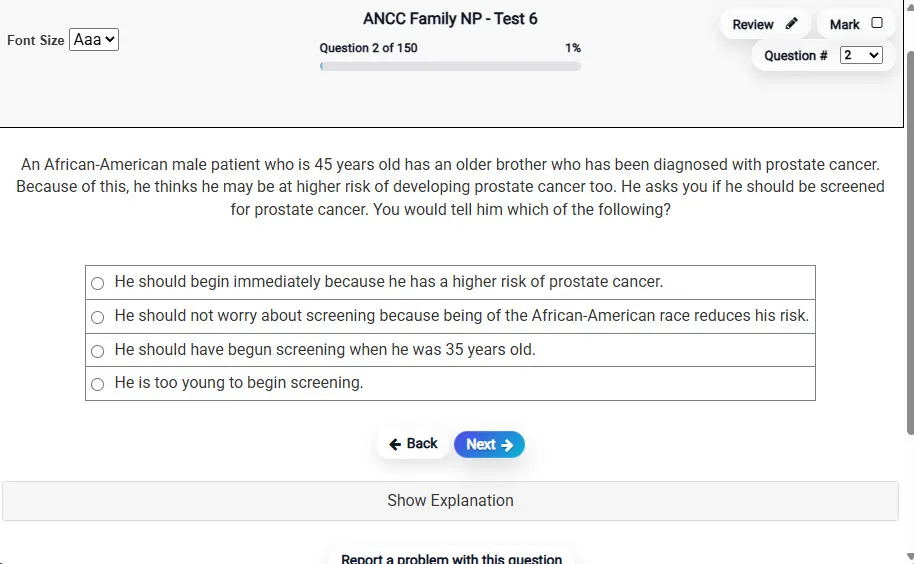
Answering a Question screen – Multiple-choice item view with navigation controls and progress tracker.
Answering a Question Multiple-choice item view with navigation controls and progress tracker.

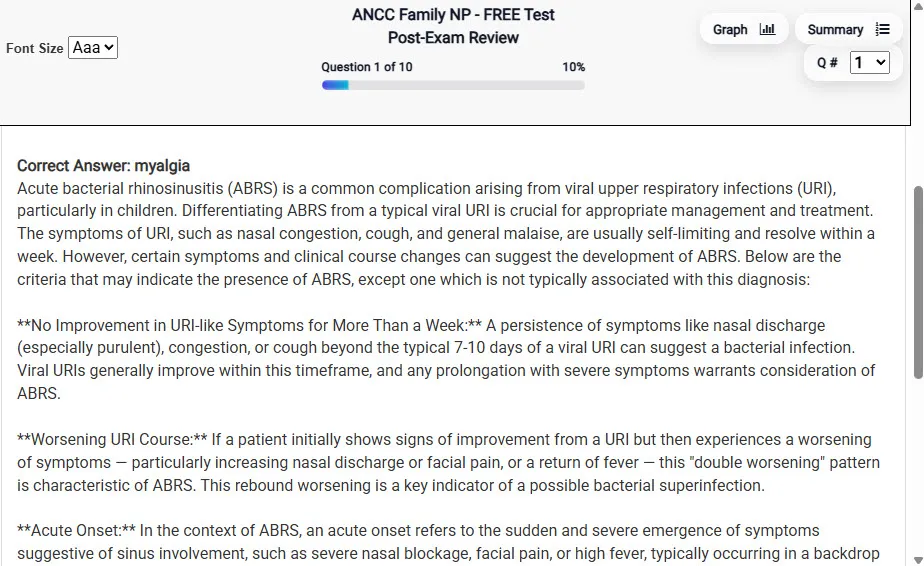
                           Detailed Explanation screen – 
                         Review mode showing chosen answer and rationale and references.
Detailed Explanation Review mode showing chosen answer and rationale and references.

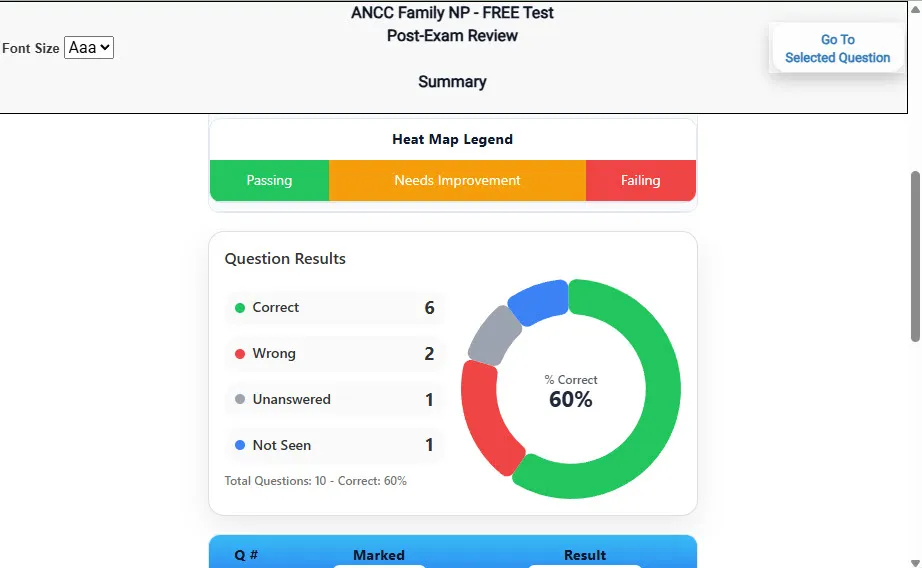
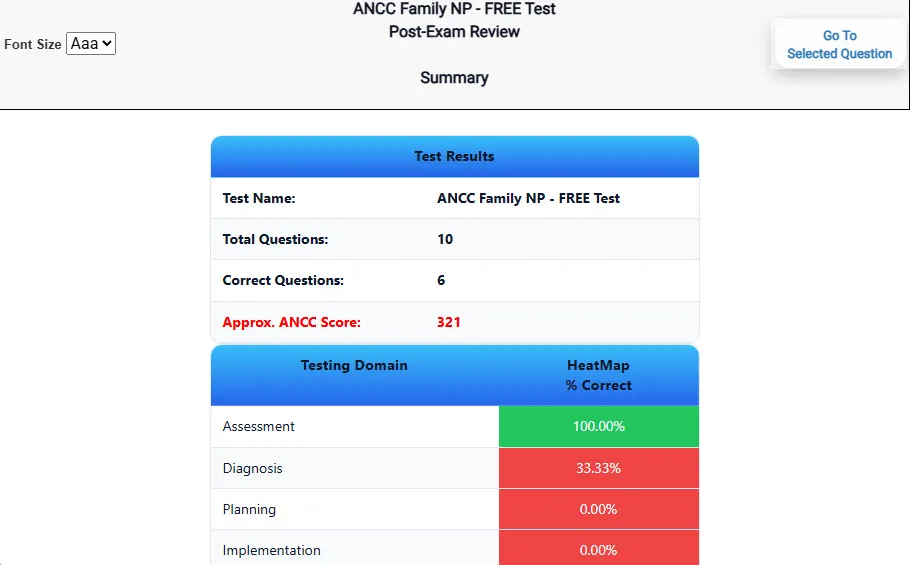
                           Review Summary 1 screen – 
                         Summary with counts for correct/wrong/unanswered and not seen items.
Review Summary 1 Summary with counts for correct/wrong/unanswered and not seen items.

                           Review Summary 2 screen – 
                         Advanced summary with category/domain breakdown and performance insights.
Review Summary 2 Advanced summary with category/domain breakdown and performance insights.

What Each Screen Shows

Answer Question Screen

  • Clean multiple-choice interface with progress bar.
  • Mark for review feature.
  • Matches real test pacing.

Detailed Explanation

  • Correct answer plus rationale.
  • Key concepts and guidelines highlighted.
  • Move between questions to fill knowledge gaps.

Review Summary 1

  • Overall results with total questions and scaled score.
  • Domain heatmap shows strengths and weaknesses.
  • Quick visual feedback on study priorities.

Review Summary 2

  • Chart of correct, wrong, unanswered, not seen.
  • Color-coded results for easy review.
  • Links back to missed items.

Top 10 Reasons to Use Exam Edge for your FTCE Exceptional Student Education K-12 Exam Prep

  1. Focused on the FTCE Exceptional Student Education K-12 Exam

    Our practice tests are built specifically for the FTCE Exceptional Student exam — every question mirrors the real topics, format, and difficulty so you're studying exactly what matters.

  2. Real Exam Simulation

    We match the per-question time limits and pressure of the actual FTCE exam, so test day feels familiar and stress-free.

  3. 15 Full Practice Tests & 1,500 Unique Questions

    You'll have more than enough material to master every FTCE Exceptional Student concept — no repeats, no fluff.

  4. Lower Cost Than a Retake

    Ordering 5 practice exams costs less than retaking the FTCE Exceptional Student Education K-12 exam after a failure. One low fee could save you both time and money.

  5. Flexible Testing

    Need to step away mid-exam? Pick up right where you left off — with your remaining time intact.

  6. Instant Scoring & Feedback

    See your raw score and an estimated FTCE Exceptional Student Education K-12 score immediately after finishing each practice test.

  7. Detailed Explanations for Every Question

    Review correct and incorrect answers with clear, step-by-step explanations so you truly understand each topic.

  8. Trusted & Accredited

    We're fully accredited by the Better Business Bureau and uphold the highest standards of trust and transparency.

  9. Web-Based & Always Available

    No software to install. Access your FTCE Exceptional Student practice exams 24/7 from any computer or mobile device.

  10. Expert Support When You Need It

    Need extra help? Our specialized tutors are highly qualified and ready to support your FTCE exam prep.


Pass the FTCE Exceptional Student Education K-12 Exam with Realistic Practice Tests from Exam Edge

Preparing for your upcoming FTCE Exceptional Student Education K-12 (061) Certification Exam can feel overwhelming — but the right practice makes all the difference. Exam Edge gives you the tools, structure, and confidence to pass on your first try. Our online practice exams are built to match the real FTCE Exceptional Student exam in content, format, and difficulty.

  • 📝 15 FTCE Exceptional Student Education K-12 Practice Tests: Access 15 full-length exams with 100 questions each, covering every major FTCE Exceptional Student Education K-12 topic in depth.
  • Instant Online Access: Start practicing right away — no software, no waiting.
  • 🧠 Step-by-Step Explanations: Understand the reasoning behind every correct answer so you can master FTCE Exceptional Student exam concepts.
  • 🔄 Retake Each Exam Up to 4 Times: Build knowledge through repetition and track your improvement over time.
  • 🌐 Web-Based & Available 24/7: Study anywhere, anytime, on any device.
  • 🧘 Boost Your Test-Day Confidence: Familiarity with the FTCE format reduces anxiety and helps you perform under pressure.

These FTCE Exceptional Student Education K-12 practice exams are designed to simulate the real testing experience by matching question types, timing, and difficulty level. This approach helps you get comfortable not just with the exam content, but also with the testing environment, so you walk into your exam day focused and confident.


Exam Edge FTCE Reviews


I am very glad I found this page. I passed the ESE test. It was worth paying for the practice test. The practice tests were a great help for me. All questions were related to the subject matter. The explanations were very helpful. Thank you very much.

Estrada, FL

Your site was recommended by a colleague as well as the district I currently teach in. The format is aligned the the updated exam structure. Thanks for asking how I feel about your product.

ARLEEN , MIAMI GARDENS, Florida

Just wanted to let you guys know that your tests really helped me prepare for the ftce math exam. I took it yesterday and passed. I will tell other people about your site.

Shawna M, Florida

I passed my FTCE today! This was the second time I took the test. My first time I scored 192 and then I took your tests and passed on my second try. Taking your practice tests helped me a great deal, because several types of questions on the real test were also on your practice tests. Thanks so mu ...
Read More
TIm F, Florida

For the last year, I have been trying to pass the reading section of the FTCE. I had taken it six times and if I did not pass it this month, then I could not take my college courses in education. I went to Google and typed in practice reading tests and your website came up. I clicked on, signed up a ...
Read More
Stacy S, Florida

Thank you so much for your reading tests. I just passed the real FTCE Reading test by 12 points! After failing it 3 other times, I thought I would have to quit. I've already told everyone in my class about your site.

Sara L, Florida


FTCE Exceptional Student Education K-12 Aliases Test Name

Here is a list of alternative names used for this exam.

  • FTCE Exceptional Student Education K-12
  • FTCE Exceptional Student Education K-12 test
  • FTCE Exceptional Student Education K-12 Certification Test
  • FTCE Exceptional Student test
  • FTCE
  • FTCE 061
  • 061 test
  • FTCE Exceptional Student Education K-12 (061)
  • Exceptional Student Education K-12 certification