This is the content of the pop-over!

DHA Medical Laboratory Technologist (DHA-MLT) Practice Questions and Tests


DHA Medical Laboratory Technologist  product image
(4.9)
Based on 37 Reviews

  • Real Exam Simulation: Timed questions and matching content build comfort for your DHA MLT test day.
  • Instant, 24/7 Access: Web-based DHA Medical Laboratory Technologist practice exams with no software needed.
  • Clear Explanations: Step-by-step answers and explanations for your DHA exam to strengthen understanding.
  • Boosted Confidence: Reduces anxiety and improves test-taking skills to ace your DHA Medical Laboratory Technologist (LABTO).

Featured on

DHA Medical Laboratory Technologist Online Practice Test Bundles

BEST VALUE
20 practice tests

$174.00

$799.00

SAVE $625

Only $8.70 per test!

  • 100% Pass Guarantee
  • 20 online practice tests
  • 100 questions per test
  • Bonus: 100 Flash Cards + Study Guide
  • Instant access
  • Detailed Explanations
  • Practice tests never expire
  • Timed, untimed, or study guide mode
MOST POPULAR
10 practice tests

$99.50

$399.50

SAVE $300

Only $9.95 per test!

  • 10 online practice tests
  • 100 questions per test
  • Bonus: 100 Flash Cards + Study Guide
  • Instant access
  • Detailed Explanations
  • Practice tests never expire
  • Timed, untimed, or study guide mode
5 practice tests

$69.75

$199.75

SAVE $130

Only $13.95 per test!

  • 5 online practice tests
  • 100 questions per test
  • Bonus: 100 Flash Cards
  • Instant access
  • Detailed Explanations
  • Practice tests never expire
  • Timed, untimed, or study guide mode
1 practice test

$39.95

  • 1 online practice test
  • 100 questions per test
  • Instant access
  • Detailed Explanations
  • Practice tests never expire
  • Timed, untimed, or study guide mode
Quick Select
Tap to choose a bundle

** All Prices are in US Dollars (USD) **


DHA MLT (LABTO) Resources

Jump to the section you need most.

Understanding the exact breakdown of the DHA Medical Laboratory Technologist test will help you know what to expect and how to most effectively prepare. The DHA Medical Laboratory Technologist has 100 multiple-choice questions . The exam will be broken down into the sections below:

DHA Medical Laboratory Technologist Exam Blueprint
Domain Name
General Laboratory  
Chemistry  
Hematology  
Immunology/Immunohematology  
Microbiology  
Urinalysis  

DHA Medical Laboratory Technologist Study Tips by Domain

  • Verify patient identification using at least two identifiers before collection/processing; red flag: unlabeled or mislabeled specimens must be rejected and recollected per policy.
  • Follow proper specimen handling and transport (time, temperature, light protection) to preserve analyte stability; common trap: leaving samples at room temperature when they require refrigeration or prompt separation causes false results.
  • Use quality control (QC) rules to decide if a run is reportable; priority rule: do not release patient results when QC is out of range—troubleshoot, document corrective action, and rerun.
  • Perform calibration and calibration verification at required intervals and after major maintenance or reagent lot changes; red flag: accepting shifted trends without recalibration can indicate systematic error.
  • Apply biosafety and infection control (PPE, sharps disposal, spill response) consistently; contraindication: never recap needles—use engineered safety devices to prevent needlestick injury.
  • Maintain accurate documentation and traceability (reagent lot/expiry, maintenance logs, proficiency testing records); common trap: using expired reagents or undocumented maintenance can invalidate results during DHA audits.
  • Verify specimen integrity before analysis—hemolysis falsely elevates K+, LDH, AST and can bias many chemistry assays (red flag: pink/red serum or gross lipemia/icterus).
  • Apply correct order of draw and tube type—EDTA contamination causes pseudo-hyperkalemia and low Ca/Mg (common trap: using lavender-top plasma or drawing after EDTA without proper discard).
  • Use internal QC rules consistently (e.g., Westgard)—do not release patient results when 13s or 22s violations occur; troubleshoot first (priority rule: patient safety over turnaround time).
  • Calibrate/verify linearity when results exceed analytical measurement range (AMR)—perform validated dilution and apply dilution factor only when within reportable range (common trap: reporting “diluted” values without documenting dilution and rerun).
  • Recognize preanalytical glucose errors—delayed separation lowers glucose due to glycolysis; use fluoride/oxalate or prompt centrifugation (threshold cue: significant decline can occur within 1–2 hours at room temp).
  • Interpret critical values with immediate notification per DHA-aligned policy—document time, recipient, and read-back (red flag: releasing critical K+, glucose, Ca without confirmed repeat when indicated or without notification).
  • Confirm specimen integrity before running CBCs—red flag: clotted, hemolyzed, or underfilled EDTA tubes can falsely lower platelets/RBC indices and must be recollected per policy.
  • Review CBC flags and histograms against a smear—common trap: reporting automated differentials when analyzer flags blasts/atypical lymphs or platelet clumps without manual confirmation.
  • Apply anticoagulation monitoring correctly—priority rule: use PT/INR for warfarin and aPTT (or anti-Xa per protocol) for unfractionated heparin; mixing these up leads to incorrect dose adjustment.
  • Interpret anemia using indices and morphology together—red flag: a normal MCV can mask mixed deficiencies (e.g., iron deficiency plus B12/folate), so correlate RDW and smear findings.
  • Handle thrombocytopenia workups carefully—common trap: EDTA-dependent pseudothrombocytopenia; if platelet clumps are seen, repeat in citrate and correct for dilution before reporting.
  • Follow critical value escalation and delta checks—priority rule: urgently verify and communicate critical Hgb/Hct, platelets, or blasts per DHA-aligned lab policy, and do not release results that fail QC or patient ID verification.
  • ABO/Rh(D) testing: if forward and reverse grouping disagree, treat as an unresolved ABO discrepancy and do not issue ABO-specific blood until resolved (use group O RBCs and AB plasma as needed).
  • Pretransfusion testing must include an antibody screen; a positive screen is a red flag requiring antibody identification and selection of antigen-negative units before crossmatch.
  • Crossmatch priority rule: electronic/IS crossmatch is acceptable only with a current negative antibody screen and no history of clinically significant antibodies—otherwise perform an antiglobulin (AHG) crossmatch.
  • DAT vs IAT: a positive DAT indicates in vivo sensitization (e.g., AIHA/HDFN/transfusion reaction); common trap is confusing it with IAT, which detects serum antibodies in vitro.
  • Hemolytic disease of the fetus/newborn workup: for Rh-negative mothers, confirm timing/need for RhIG; contraindication/red flag is administering RhIG when the mother is already alloimmunized (anti-D present).
  • Transfusion reaction immunohematology: if suspected, stop transfusion and initiate clerical check, repeat ABO/Rh and DAT; a newly positive DAT post-transfusion is a key cue for an immune-mediated hemolysis investigation.
  • Specimen quality drives accuracy—reject and recollect when sputum is saliva-dominant (many squamous epithelial cells on Gram stain) or when transport delays/temperature are inappropriate (red flag: dried swabs for culture).
  • Follow biosafety and containment for high-risk agents—use a BSC for aerosol-generating steps and escalate per lab policy when AFB smear is positive or TB is suspected (common trap: opening centrifuge tubes outside the BSC).
  • Interpret Gram stains with clinical context—a single morphotype with many PMNs supports true infection, while mixed flora with few PMNs suggests contamination (priority rule: correlate with specimen site and collection method).
  • Culture workup depends on media and atmosphere—use selective/differential media appropriately (e.g., MacConkey for GNR, blood/chocolate for fastidious) and do not report “no growth” before required incubation time (threshold: hold blood cultures per protocol before final).
  • Antimicrobial susceptibility testing must follow standards—ensure correct inoculum density (0.5 McFarland), medium, and incubation conditions, and confirm unusual resistance patterns (red flag: reporting vancomycin resistance without verification/controls).
  • Rapid tests improve turnaround but have limits—confirm when indicated (e.g., negative rapid antigen with high suspicion) and avoid testing formed stool for C. difficile (contraindication: only unformed stool meets criteria unless ileus).
  • Specimen integrity drives validity: test within 2 hours at room temp or refrigerate at 2–8 °C; red flag—alkaline pH with low glucose/positive nitrite often signals an old or contaminated sample.
  • Dipstick interferences are common traps: high ascorbic acid can cause false-negative blood/glucose/nitrite; cue—if clinical picture conflicts, repeat with fresh specimen or confirm by microscopy/chemical method.
  • Protein assessment: persistent ≥1+ protein on dipstick should be correlated with specific gravity and pH; red flag—highly alkaline urine can yield false-positive protein, so consider sulfosalicylic acid confirmation when indicated.
  • Hematuria evaluation: “blood” pad detects hemoglobin/myoglobin as well as RBCs; cue—positive blood with few/no RBCs on microscopy suggests hemolysis or rhabdomyolysis and warrants clinical correlation.
  • UTI screening priorities: nitrite requires sufficient bladder dwell time and nitrate-reducing organisms; red flag—negative nitrite does not exclude UTI, so weigh leukocyte esterase and microscopic WBC/bacteria.
  • Microscopy reporting must be standardized: identify casts in low-power then confirm at high-power; red flag—RBC casts (even rare) strongly suggest glomerular bleeding and should be escalated as a critical finding per lab policy.


Built to Fit Into Your Busy Life

Everything you need to prepare with confidence—without wasting a minute.

Three Study Modes

Timed, No Time Limit, or Explanation mode.

Actionable Analytics

Heatmaps and scaled scores highlight weak areas.

High-Yield Rationales

Concise explanations emphasize key concepts.

Realistic Interface

Matches the feel of the actual exam environment.

Accessible by Design

Clean layout reduces cognitive load.

Anytime, Anywhere

Web-based access 24/7 on any device.
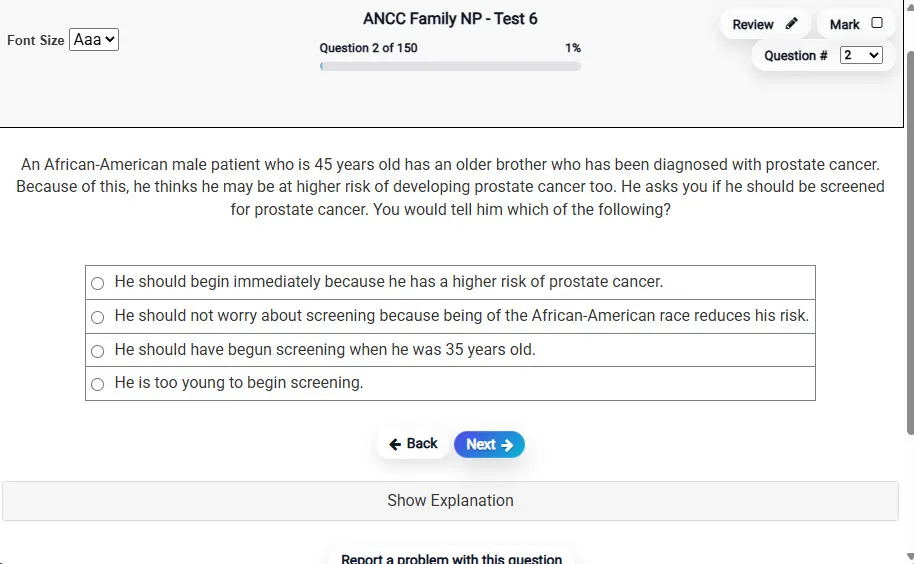
Answering a Question screen – Multiple-choice item view with navigation controls and progress tracker.
Answering a Question Multiple-choice item view with navigation controls and progress tracker.

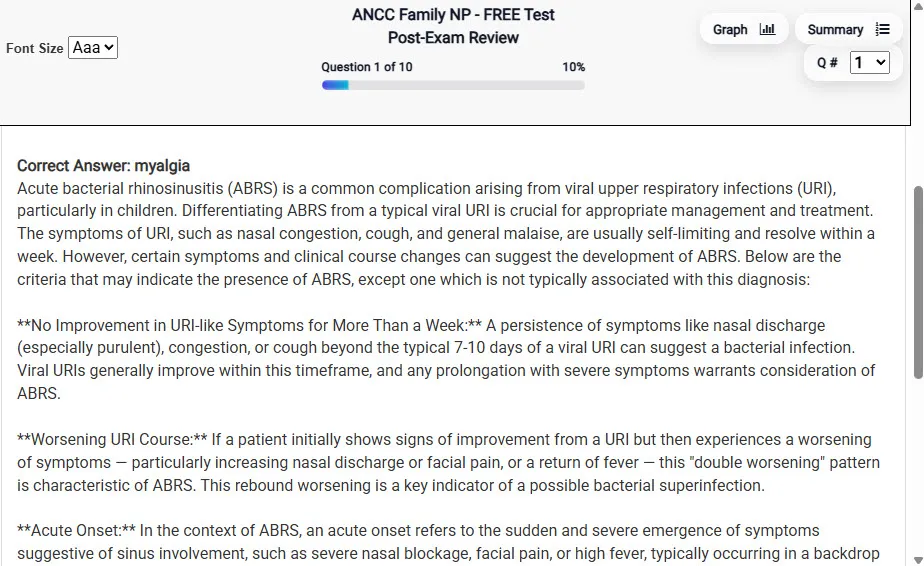
                           Detailed Explanation screen – 
                         Review mode showing chosen answer and rationale and references.
Detailed Explanation Review mode showing chosen answer and rationale and references.

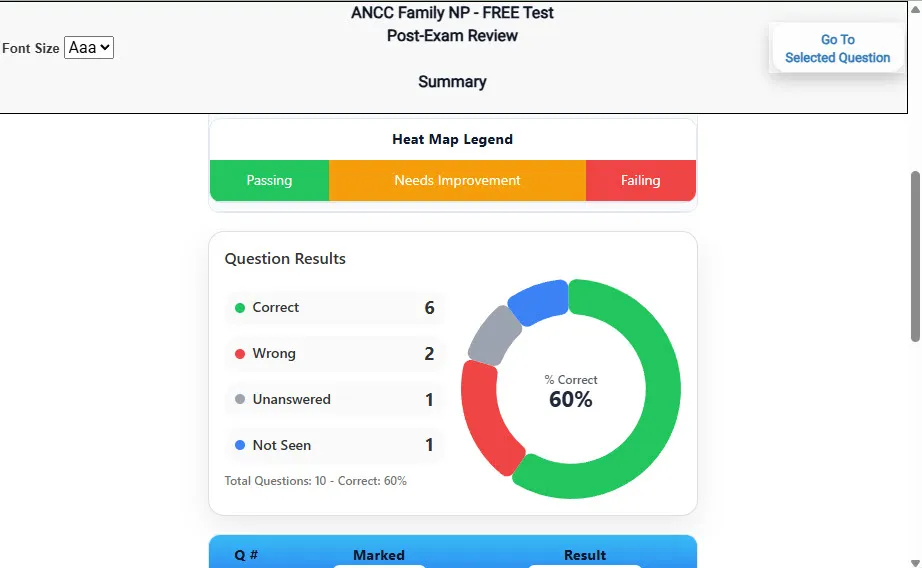
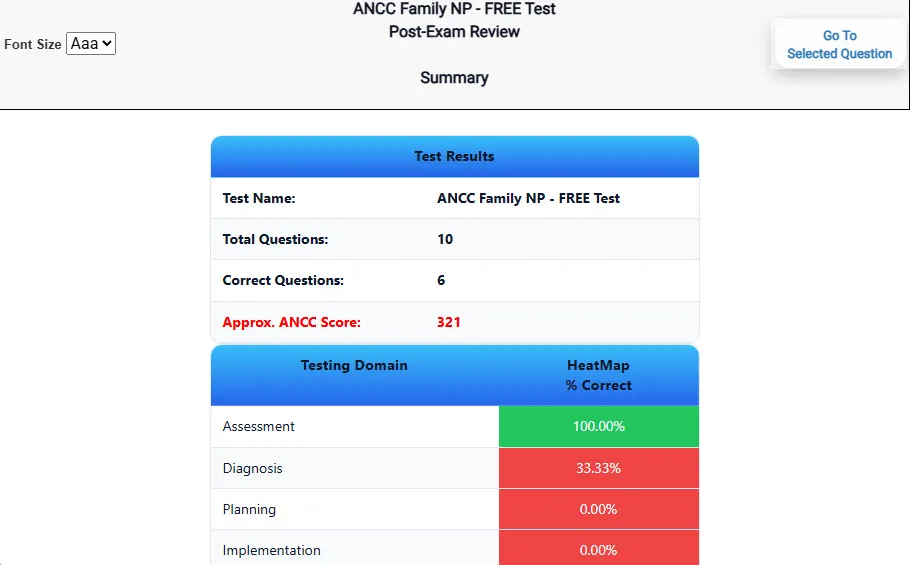
                           Review Summary 1 screen – 
                         Summary with counts for correct/wrong/unanswered and not seen items.
Review Summary 1 Summary with counts for correct/wrong/unanswered and not seen items.

                           Review Summary 2 screen – 
                         Advanced summary with category/domain breakdown and performance insights.
Review Summary 2 Advanced summary with category/domain breakdown and performance insights.

What Each Screen Shows

Answer Question Screen

  • Clean multiple-choice interface with progress bar.
  • Mark for review feature.
  • Matches real test pacing.

Detailed Explanation

  • Correct answer plus rationale.
  • Key concepts and guidelines highlighted.
  • Move between questions to fill knowledge gaps.

Review Summary 1

  • Overall results with total questions and scaled score.
  • Domain heatmap shows strengths and weaknesses.
  • Quick visual feedback on study priorities.

Review Summary 2

  • Chart of correct, wrong, unanswered, not seen.
  • Color-coded results for easy review.
  • Links back to missed items.

Top 10 Reasons to Use Exam Edge for your DHA Medical Laboratory Technologist Exam Prep

  1. Focused on the DHA Medical Laboratory Technologist Exam

    Our practice tests are built specifically for the DHA MLT exam — every question mirrors the real topics, format, and difficulty so you're studying exactly what matters.

  2. Real Exam Simulation

    We match the per-question time limits and pressure of the actual DHA exam, so test day feels familiar and stress-free.

  3. 20 Full Practice Tests & 2,000 Unique Questions

    You'll have more than enough material to master every DHA MLT concept — no repeats, no fluff.

  4. Lower Cost Than a Retake

    Ordering 5 practice exams costs less than retaking the DHA Medical Laboratory Technologist exam after a failure. One low fee could save you both time and money.

  5. Flexible Testing

    Need to step away mid-exam? Pick up right where you left off — with your remaining time intact.

  6. Instant Scoring & Feedback

    See your raw score and an estimated DHA Medical Laboratory Technologist score immediately after finishing each practice test.

  7. Detailed Explanations for Every Question

    Review correct and incorrect answers with clear, step-by-step explanations so you truly understand each topic.

  8. Trusted & Accredited

    We're fully accredited by the Better Business Bureau and uphold the highest standards of trust and transparency.

  9. Web-Based & Always Available

    No software to install. Access your DHA MLT practice exams 24/7 from any computer or mobile device.

  10. Expert Support When You Need It

    Need extra help? Our specialized tutors are highly qualified and ready to support your DHA exam prep.


Pass the DHA Medical Laboratory Technologist Exam with Realistic Practice Tests from Exam Edge

Preparing for your upcoming DHA Medical Laboratory Technologist (LABTO) Certification Exam can feel overwhelming — but the right practice makes all the difference. Exam Edge gives you the tools, structure, and confidence to pass on your first try. Our online practice exams are built to match the real DHA MLT exam in content, format, and difficulty.

  • 📝 20 DHA Medical Laboratory Technologist Practice Tests: Access 20 full-length exams with 100 questions each, covering every major DHA Medical Laboratory Technologist topic in depth.
  • Instant Online Access: Start practicing right away — no software, no waiting.
  • 🧠 Step-by-Step Explanations: Understand the reasoning behind every correct answer so you can master DHA MLT exam concepts.
  • 🔄 Retake Each Exam Up to 4 Times: Build knowledge through repetition and track your improvement over time.
  • 🌐 Web-Based & Available 24/7: Study anywhere, anytime, on any device.
  • 🧘 Boost Your Test-Day Confidence: Familiarity with the DHA format reduces anxiety and helps you perform under pressure.

These DHA Medical Laboratory Technologist practice exams are designed to simulate the real testing experience by matching question types, timing, and difficulty level. This approach helps you get comfortable not just with the exam content, but also with the testing environment, so you walk into your exam day focused and confident.


Exam Edge DHA Reviews


Hi Ma'am, thank you so much. I cleared my DHA exam, and this time the question papers helped me a lot. I will surely recommend DHA prep to all my friends. Thanks once again.

Shafana ,

Very helpful and quick response.

Roxan , United Kingdom


DHA Medical Laboratory Technologist Aliases Test Name

Here is a list of alternative names used for this exam.

  • DHA Medical Laboratory Technologist
  • DHA Medical Laboratory Technologist test
  • DHA Medical Laboratory Technologist Certification Test
  • DHA MLT test
  • DHA
  • DHA LABTO
  • LABTO test
  • DHA Medical Laboratory Technologist (LABTO)
  • Medical Laboratory Technologist certification