This is the content of the pop-over!

DANB's CRFDA (CFRDA) Practice Tests & Test Prep by Exam Edge


DANB's Certified Restorative Functions Dental Assistant   product image
(5.0)
Based on 40 Reviews

  • Real Exam Simulation: Timed questions and matching content build comfort for your DANB's CRFDA test day.
  • Instant, 24/7 Access: Web-based DANB's Certified Restorative Functions Dental Assistant practice exams with no software needed.
  • Clear Explanations: Step-by-step answers and explanations for your DANB's exam to strengthen understanding.
  • Boosted Confidence: Reduces anxiety and improves test-taking skills to ace your DANB's Certified Restorative Functions Dental Assistant (CFRDA).

Featured on

DANB's Certified Restorative Functions Dental Assistant Online Practice Test Bundles

BEST VALUE
10 practice tests

$99.50

$399.50

SAVE $300

Only $9.95 per test!

  • 100% Pass Guarantee
  • 10 online practice tests
  • 210 questions per test
  • Bonus: 100 Flash Cards + Study Guide
  • Instant access
  • Detailed Explanations
  • Practice tests never expire
  • Timed, untimed, or study guide mode
5 practice tests

$69.75

$199.75

SAVE $130

Only $13.95 per test!

  • 5 online practice tests
  • 210 questions per test
  • Bonus: 100 Flash Cards + Study Guide
  • Instant access
  • Detailed Explanations
  • Practice tests never expire
  • Timed, untimed, or study guide mode
1 practice test

$39.95

  • 1 online practice test
  • 210 questions per test
  • Instant access
  • Detailed Explanations
  • Practice tests never expire
  • Timed, untimed, or study guide mode
Quick Select
Tap to choose a bundle

** All Prices are in US Dollars (USD) **


DANB's CRFDA (CFRDA) Resources

Jump to the section you need most.

Understanding the exact breakdown of the DANB's Certified Restorative Functions Dental Assistant test will help you know what to expect and how to most effectively prepare. The DANB's Certified Restorative Functions Dental Assistant has multiple-choice questions . The exam will be broken down into the sections below:

DANB's Certified Restorative Functions Dental Assistant Exam Blueprint
Domain Name % Number of
Questions
AMP  
     Head and neck 15% 6
     Oral cavity 25% 11
     Tooth anatomy - morphology related characteristics 20% 8
     Tooth numbering systems 15% 6
     Occlusion 15% 6
     Oral pathology 10% 4
IM  
     Purpose of impressions 15% 6
     Taking impressions 55% 23
     Patient management techniques 10% 4
     Bite/occlusal registrations 10% 4
     Infection Control/OSHA protocol 10% 4
TMP  
     Temporary/provisional Restorations 65% 27
     Temporary Cement 20% 8
     Infection Control/occupational Safety And Health Administration (OSHA) Protocol 15% 6
SE  
     Purpose Of Sealants 10% 4
     Indications And Contraindications For Sealant Application 40% 17
     Acid Etching 10% 4
     Sealants 40% 17
RF  
     Cavity Liners And Bases 7% 3
     Cavity Classifications 7% 3
     Amalgam Restorations 20% 8
     Composite - Glass Ionomer And Compomer Restorations 30% 13
     Stainless Steel Crowns 12% 5
     Procedural Considerations 15% 6
     Infection Control/occupational Safety And Health Administration (OSHA) Protocol 9% 4

DANB's Certified Restorative Functions Dental Assistant Study Tips by Domain

  • Know the “why” of AMP on DANB-style questions: it tests accurate mixing/placing/handling of dental materials and preventing failures; red flag—selecting a step that contaminates a clean field (e.g., touching material or instruments with contaminated gloves).
  • Follow manufacturer’s instructions for proportioning and working/setting times; common trap—trying to “fix” a fast set by adding liquid or water, which weakens the material.
  • Maintain proper isolation and moisture control during placement; priority rule—if saliva or blood contaminates the field, stop and correct isolation before continuing.
  • Use correct instrument selection and handling to avoid voids and overhangs; red flag—insufficient condensation/adaptation leading to marginal gaps or postoperative sensitivity.
  • Prevent cross-contamination when dispensing/mixing; common trap—returning unused material to the original container or touching dispensing tips/bottles with contaminated gloves.
  • Recognize when a material failure requires immediate correction vs. documentation; priority rule—if the restoration/material is compromised (voids, open margins, gross contamination), notify the dentist before dismissal.
  • Know key head/neck landmarks for intraoral/dental charting (maxilla, mandible, TMJ, zygoma) — red flag: confusing the TMJ location with the parotid region can misdirect pain-history questions.
  • Differentiate major salivary glands (parotid, submandibular, sublingual) and duct openings — common trap: assuming swelling at the mandibular angle is submandibular when it may be parotid.
  • Map cranial nerves most relevant to dentistry (V for sensation/mastication, VII for facial expression, IX/X for gag, XII for tongue movement) — priority rule: new unilateral facial droop or numbness requires immediate escalation, not routine scheduling.
  • Identify cervical lymph node regions (submental, submandibular, anterior/posterior cervical) — red flag: firm, fixed, non-tender nodes persisting beyond ~2 weeks warrant prompt referral documentation.
  • Recognize muscles of mastication (masseter, temporalis, medial/lateral pterygoids) and their actions — common trap: attributing limited opening solely to patient anxiety instead of possible muscle spasm/TMD.
  • Understand airway-related structures (nasopharynx/oropharynx, larynx, trachea) relevant to dental emergencies — contraindication cue: any signs of stridor, rapidly spreading neck swelling, or difficulty swallowing should be treated as a potential airway compromise.
  • Identify major oral cavity structures and landmarks (lips, buccal mucosa, hard/soft palate, floor of mouth, tongue, frena, salivary duct openings)—red flag: confusing Stensen’s duct (parotid) with Wharton’s duct (submandibular) can misdirect suction or retraction.
  • Recognize normal tissue appearance (pink, stippled attached gingiva; moist, smooth mucosa; symmetric structures)—common trap: assuming all pigmentation is pathologic; document and compare bilateral symmetry before escalating.
  • Locate and describe gingival components (free vs attached gingiva, interdental papilla, mucogingival junction)—priority rule: bleeding on gentle manipulation is not “normal” and should be noted for periodontal evaluation.
  • Differentiate dorsal/ventral tongue surfaces and floor-of-mouth anatomy (lingual frenulum, sublingual folds, plica fimbriata)—red flag: persistent ulcer or indurated lesion on the lateral/ventral tongue warrants prompt follow-up/referral.
  • Understand saliva sources and functions (parotid, submandibular, sublingual; lubrication, buffering, remineralization)—common trap: ignoring xerostomia complaints; low saliva increases caries risk and can compromise restorative isolation.
  • Know typical patient positioning and retraction points for clear visibility of oral cavity regions—contraindication cue: avoid aggressive retraction in patients with angular cheilitis, mucositis, or thin friable mucosa to prevent tearing.
  • Know the Universal system for DANB-style questions: permanent teeth are numbered 1–32 starting at maxillary right third molar (#1) to mandibular right third molar (#32)—red flag if the count direction or arch is reversed.
  • Primary teeth in the Universal system are labeled A–T from maxillary right second molar (A) to mandibular right second molar (T)—common trap is mixing primary letters with permanent numbers for the same quadrant.
  • In FDI/ISO notation, the first digit is quadrant (1–4 permanent, 5–8 primary) and the second digit is tooth position from midline (1–8 or 1–5)—priority rule: say “one-one” not “eleven” to prevent charting errors.
  • In Palmer notation, identify quadrant brackets plus tooth number/letter from the midline (1–8 or A–E)—red flag is writing the correct number but the wrong quadrant symbol.
  • When converting systems, anchor on the midline: central incisors are #8/#9 (Universal), 11/21 (FDI), and 1 with the appropriate Palmer bracket—common trap is swapping left/right when viewing the patient vs the chart.
  • Use tooth numbering to verify treatment and radiographs during chairside assisting—contraindication to proceeding: any mismatch between the planned tooth number and the tooth visually identified must be clarified before instrumentation.
  • Differentiate centric relation (CR) vs maximum intercuspation (MIP)—common trap is assuming they are always the same, which can mislead bite registration accuracy.
  • Know excursive movements (protrusive, right/left lateral) and guidance patterns—red flag is working/nonworking interferences that can fracture restorations or cause postoperative sensitivity.
  • Identify supporting vs non-supporting cusps and how they contact fossae/marginal ridges—priority rule: avoid heavy contact on marginal ridges because it promotes food impaction and fracture.
  • Recognize occlusal discrepancies after restorations—practical cue: patient reports “high bite” or can’t chew comfortably; don’t dismiss it because even small premature contacts can trigger pain.
  • Understand occlusal trauma indicators (mobility, fremitus, widened PDL on radiograph) vs periodontal disease—common trap is attributing mobility solely to inflammation without checking occlusion.
  • Apply occlusal marking paper concepts (hold, pull-through, and interpretation)—red flag is equating darker/larger marks with heavier force without confirming with shimstock or patient feedback.
  • Know lesion descriptors (color, border, texture, size, duration) and document with exact location and measurements — red flag: any ulcer or mass persisting >2 weeks needs prompt dentist evaluation/biopsy referral consideration.
  • Differentiate plaque-induced gingivitis vs periodontitis basics (bleeding/inflammation vs attachment/bone loss) — common trap: assuming heavy calculus alone proves periodontitis without documented pocketing and attachment loss.
  • Recognize common infections: candidiasis (wipeable white plaques/erythema), HSV (clusters/ulcers), and aphthous ulcers (non-keratinized mucosa) — contraindication cue: active herpetic lesions are a reason to defer elective care due to contagion/aerosol risk.
  • Screen for potentially malignant disorders (leukoplakia, erythroplakia, speckled lesions) — priority rule: red lesions (erythroplakia) carry higher dysplasia risk than white lesions and warrant urgent follow-up.
  • Identify traumatic lesions (cheek biting linea alba, fibroma, denture sore spots) and their causes — common trap: labeling frictional keratosis as “leukoplakia” without removing the irritant and reassessing.
  • Connect systemic/medication factors to oral findings (xerostomia, candidiasis, bleeding, delayed healing) — red flag: spontaneous gingival bleeding or petechiae can indicate hematologic issues and should be escalated before invasive procedures.
  • Identify impression material types and typical uses (alginate for study models vs elastomerics for crowns/bridges)—red flag: using alginate when a fixed prosthesis master impression is required.
  • Mixing/working/setting times must be controlled by water-to-powder ratio and temperature—common trap: adding extra water to “extend” working time, which weakens and distorts the impression.
  • Tray selection and adhesive use are critical for accuracy—priority rule: apply the correct tray adhesive for the material and allow full dry time to prevent pull-away.
  • Moisture and field control affect detail reproduction—red flag: saliva/blood contamination on hydrophobic VPS/putty-wash impressions leading to voids and pulls.
  • Pouring and disinfection timing matters—common trap: delaying alginate pour beyond recommended time, causing syneresis/imbibition distortion even if stored in a wet towel.
  • Evaluate impressions before dismissing the patient: check coverage of critical anatomy, no voids at margins, and proper occlusal capture—priority rule: retake immediately if margin detail is missing.
  • Impressions create a negative replica used to fabricate casts/dies for indirect restorations, appliances, and diagnostic models—red flag: sending an impression without required patient ID, date, and tooth/arch notation invites remakes.
  • They support treatment planning and communication (lab prescriptions, specialist consults)—common trap: unclear prescription details (material, shade, margin design) lead to incorrect lab work.
  • They capture occlusal/incisal relationships when paired with bite registrations for mounted casts—priority rule: verify the bite is fully seated and stable before dismissal or you risk an inaccurate vertical dimension.
  • They help evaluate and document baseline conditions (wear, edentulous areas, pre-op records)—red flag: failing to record missing teeth and existing restorations can make the cast misleading for diagnosis.
  • They can be used to fabricate provisional restorations (matrix/putty index from a pre-op impression)—common trap: not capturing full cervical contours may produce overhanging or open margins in the provisional.
  • They aid in appliance fabrication (custom trays, mouthguards, bleaching trays, study models for orthodontic/occlusal analysis)—contraindication cue: postpone or modify technique if the patient has an exaggerated gag reflex or cannot tolerate posterior tray placement without a management plan.
  • Select the correct tray size and extension before mixing—a common trap is a tray that impinges on frena or is too short to capture tuberosities/retromolar pads, forcing a remake.
  • Verify and document the material and technique ordered (e.g., alginate vs. elastomeric; full-arch vs. quadrant)—red flag: proceeding without a clear prescription can produce an unusable impression for the intended restoration/appliance.
  • Control moisture and soft tissues (dry field, retract lips/cheeks, manage tongue) and apply adhesive when indicated—priority rule: if the material pulls away from the tray, the impression is unreliable.
  • Mix/load properly (correct powder-to-water ratio and working time; avoid incorporating air) and seat with steady pressure—common trap: rocking the tray causes distortion and occlusal inaccuracy.
  • Evaluate immediately for critical errors—voids in margins, tray show-through, pulls/tears, or missing landmarks are automatic retake cues rather than “patching” with extra material.
  • Follow DANB-style infection control handling: rinse, disinfect for the manufacturer’s contact time, and label/transport promptly—red flag: delayed pouring or improper storage (dehydration/imbibition) can distort alginate.
  • Confirm patient identity and planned procedure before seating—red flag: mismatched tooth number/surface in the chart versus the patient’s chief complaint.
  • Use a concise medical history update (allergies, meds, conditions, pregnancy) at every visit—common trap: failing to note anticoagulants or latex allergy before isolation and tray setup.
  • Manage anxiety with tell-show-do, neutral language, and brief breaks—priority rule: stop immediately if the patient raises a hand or reports dizziness, chest pain, or trouble breathing.
  • Obtain and document informed consent/assent per office policy before restorative or sealant steps—red flag: patient cannot repeat back the plan/risks, indicating inadequate understanding.
  • Use effective communication and behavioral guidance with children (voice control, positive reinforcement) while maintaining safety—contraindication cue: do not proceed with rubber dam or impression trays if gagging/airway compromise is escalating.
  • Address complaints professionally using AIDET-style explanation and timely escalation—common trap: promising outcomes or discussing diagnosis/treatment changes beyond the assistant’s scope instead of deferring to the dentist.
  • Confirm the provider’s goal before mixing material—MIP vs centric relation vs protrusive/lateral record—because recording the wrong position is a common redo trap.
  • Dry field and isolate; saliva contamination is a red flag for distorted bite records and can cause inaccurate mounting/occlusal adjustment later.
  • Use minimal record thickness and trim excess; a common DANB-style pitfall is leaving bulky material that prevents full closure into the intended occlusion.
  • Guide the patient to close gently and hold still until set; clenching or shifting during setting is a priority cue for remaking the registration.
  • Verify stability intraorally after removal—it should reseat without rocking—and if it doesn’t seat repeatedly, treat it as inaccurate and redo.
  • Label and protect the record (patient ID, date, arch/side, intended jaw relation) and avoid heat/pressure; warpage during transport is a common lab remount error.
  • Assume every patient is potentially infectious and follow Standard Precautions; red flag: skipping hand hygiene when moving from contaminated to clean tasks (e.g., after touching chart/phone).
  • Use correct PPE sequence and change it at the right time; common trap: wearing the same mask or gloves between patients or leaving the operatory with contaminated gloves.
  • Sharps safety is an OSHA high-risk area—use one-hand scoop or a recapping device; red flag: two-handed recapping, passing unsheathed needles, or overfilled sharps containers.
  • Separate cleaning, disinfection, and sterilization steps for instruments; priority rule: if an instrument is heat tolerant, it must be heat sterilized—don’t substitute surface disinfectant for sterilization.
  • Manage clinical contact surfaces with barriers or EPA-registered hospital disinfectant using proper wet contact time; common trap: wiping dry immediately, which invalidates the disinfectant label claim.
  • Follow OSHA exposure control procedures for bloodborne pathogens; red flag: failing to report and document an exposure promptly or delaying post-exposure evaluation and follow-up.
  • Know what TMP covers on DANB RF exams: fabrication, contouring, finishing, and removal of provisional restorations—red flag: confusing temporary cement selection with provisional material selection.
  • Material handling is time-critical (bis-acryl vs PMMA/acrylic); common trap: delayed seating or over-manipulation leading to drag lines, voids, and open margins.
  • Matrix/spot-etch or isolating techniques must prevent bonding of the provisional to tooth structure—contraindication cue: do not etch/bond when using a provisional that must be easily removed.
  • Occlusal adjustment is mandatory before final set/finish; priority rule: check centric contacts first, then excursive interferences to avoid post-op sensitivity and fracture.
  • Emergence profile and proximal contacts must be verified with floss and explorer—red flag: tight contact causing floss shredding (overhang/flash) or open contact risking food impaction and gingival inflammation.
  • Removal should protect tooth and gingiva; common trap: using excessive force that cracks enamel or dislodges a core—section the provisional if needed and clean all cement/resin remnants before recementation.
  • Select the provisional type based on duration and load (e.g., short-term vs. long-term, single unit vs. multi-unit)—red flag: thin margins or heavy occlusion often means fracture risk and needs reinforcement.
  • Maintain proper contour and proximal contacts to protect gingiva and prevent drifting—common trap: leaving an open contact can lead to food impaction and rapid sensitivity complaints.
  • Manage exothermic heat and monomer exposure when using acrylic provisionals—priority rule: remove the provisional during peak set to avoid pulpal irritation and soft-tissue burns.
  • Verify occlusion in centric and excursions before final set—red flag: high spot on a provisional can cause postoperative pain and may fracture or dislodge the temporary.
  • Finish and polish margins to reduce plaque retention and inflammation—common trap: rough, overhanging margins can mimic recurrent decay symptoms and trigger gingival bleeding.
  • Use temporary cement appropriately (non-eugenol if a resin final is planned)—contraindication cue: eugenol-containing materials can inhibit resin polymerization and compromise the final bond.
  • Select temporary cement by indication—use eugenol-free when a resin composite or resin cement is planned later (trap: ZOE can inhibit resin polymerization and reduce bond strength).
  • Mix to the manufacturer’s powder-to-liquid ratio and timing; a runny mix is a red flag for low retention and increased microleakage.
  • Apply a thin, even layer inside the restoration and avoid overfilling; common trap: excess cement prevents complete seating and creates a high occlusion.
  • Maintain isolation and a dry field; moisture contamination is a contraindication to proper set and is a cue for early washout at margins.
  • Remove excess at the proper stage (rubbery set is the priority) and floss contacts carefully; red flag: snapping floss can dislodge a provisional or leave subgingival cement.
  • Verify occlusion and margins after cementation and document postoperative instructions; priority rule: advise the patient to avoid sticky/chewy foods to prevent debonding.
  • Assume every patient and item is potentially infectious—perform hand hygiene before donning gloves and immediately after glove removal (common trap: using sanitizer on visibly soiled hands instead of soap and water).
  • Wear task-appropriate PPE (mask, protective eyewear/face shield, gown) and change masks between patients or when damp—red flag: touching the front of the mask or eyewear during treatment.
  • Heat-sterilize critical and semi-critical instruments after cleaning and packaging; do not rely on surface disinfectant for instruments—priority rule: keep sterilization logs/indicator results and address failed indicators immediately.
  • Use EPA-registered, dental-approved disinfectants with correct dilution and wet contact time on clinical contact surfaces—common trap: wiping dry too soon, which invalidates disinfection.
  • Follow OSHA’s Bloodborne Pathogens Standard with an Exposure Control Plan, hepatitis B vaccination offer, and post-exposure protocol—red flag: not reporting a needlestick promptly or delaying evaluation.
  • Handle sharps safely: never recap with two hands; use one-handed scoop or a recapping device and dispose in labeled, puncture-resistant sharps containers—threshold: replace containers before they reach the fill line (about 3/4 full).
  • Know sealant indications: deep pits/fissures on newly erupted permanent molars/premolars and patients with elevated caries risk; red flag—placing sealant on a tooth you can’t isolate well invites early failure.
  • Contraindications include cavitated lesions, frank proximal caries, and inability to maintain a dry field; common trap—sealing over suspected dentinal caries without provider evaluation.
  • Surface prep must remove plaque/debris (pumice/no oil) and rinse thoroughly; priority rule—if etching is used, any saliva contamination means re-etch (or per product IFU) before placing sealant.
  • Light-curing: verify curing light output/tip cleanliness and keep the tip close and stable; red flag—short cure time or distant tip leads to incomplete polymerization and premature loss.
  • After placement, check margins and occlusion and adjust high spots; common trap—skipping the occlusal check, resulting in patient discomfort and sealant fracture.
  • Follow-up is required: document tooth/areas sealed and re-evaluate retention at recalls with repair as needed; threshold cue—partial loss should be repaired/resealed rather than “wait and see.”
  • Sealants are placed to prevent occlusal caries by physically sealing pits and fissures; red flag: placing a sealant on a tooth with suspected occlusal caries without provider evaluation can mask decay progression.
  • The primary benefit is caries prevention on susceptible surfaces (especially newly erupted molars) by blocking bacterial and nutrient access; common trap: assuming smooth-surface caries prevention—sealants target pits/fissures, not broad facial/lingual areas.
  • Sealants reduce the need for future restorative treatment when retention is maintained; priority rule: emphasize recall checks because lost or partially retained sealant provides less protection and may need repair/reseal.
  • A key purpose is to protect deep, narrow fissure anatomy that is hard to clean even with good hygiene; red flag: sealing over plaque/debris because the goal is isolation—contamination undermines preventive intent.
  • Sealants can be used as part of a risk-based preventive plan (high-caries-risk patients often benefit most); common trap: applying routinely without assessing caries risk, eruption status, and fissure morphology.
  • Another purpose is to arrest very early non-cavitated fissure lesions by cutting off the biofilm environment; contraindication cue: if a lesion is cavitated or has soft dentin, a sealant alone is not the intended treatment.
  • Indicate sealants for patients at elevated caries risk, especially on newly erupted permanent molars/premolars with deep pits and fissures; priority rule: target surfaces most likely to decay before sealing low-risk, self-cleansing grooves.
  • Sealant is indicated when pits/fissures are susceptible even if the tooth is sound; common trap: waiting for “stain” to become cavitation—seal early if the fissure morphology is high risk and the surface is non-cavitated.
  • Contraindication: obvious cavitated caries or suspected dentinal involvement on the surface to be sealed; red flag: explorer “catches” with softness or visible breakdown—requires restorative evaluation, not sealing.
  • Contraindication: inability to maintain effective isolation and a dry field; practical cue: if saliva control cannot be achieved (e.g., partially erupted molar with tissue covering), delay or consider alternative treatment because contamination markedly reduces retention.
  • Sealants are indicated as part of caries management when opposing tooth or adjacent surfaces show active/recent caries; common trap: sealing only one tooth while ignoring overall risk factors (diet, xerostomia, poor hygiene) that DANB-style questions often test.
  • Contraindication: surfaces already well protected by fluoride exposure and shallow, cleansable fissures with no caries history; threshold cue: if a tooth has remained caries-free for years in a low-risk patient, the benefit of sealing is limited versus monitoring.
  • Etch only clean enamel/dentin; if saliva or blood contaminates after etching, treat as a redo trigger (re-etch per office protocol) because bond strength drops sharply.
  • Typical phosphoric acid concentration is about 35%–37%; a common trap is over-etching dentin, which can increase sensitivity and reduce adhesion if the collagen collapses.
  • Rinse thoroughly and suction without desiccating dentin; red flag: “chalky” enamel is desired, but dentin should remain slightly moist (avoid overdrying).
  • Use isolation (rubber dam/cotton rolls with HVE) as a priority rule; if the patient can’t maintain dryness, consider whether an alternative material/technique is indicated per provider direction.
  • Protect soft tissues and eyes; contraindication cue: etchant contact with mucosa is a chemical burn risk—immediately rinse and document per office policy.
  • Etch time varies by substrate (enamel vs dentin) and product; common DANB-style test trap is assuming one fixed time for all situations—follow manufacturer instructions exactly.
  • Sealants are resin (or glass ionomer) coatings placed in pits and fissures to prevent caries; red flag: a sealant on a tooth that cannot be adequately isolated is likely to fail early.
  • Isolation is critical—use cotton rolls/dry angles and high-volume suction, and consider rubber dam when feasible; common trap: saliva contamination after etch requires re-etch before proceeding.
  • Etch-and-rinse sealants require proper etch time and a frosty enamel appearance before placement; cue: if enamel looks shiny rather than frosty, re-etch and re-rinse/dry.
  • Apply a thin, bubble-free layer and avoid overfilling to prevent occlusal interference; priority rule: always check occlusion with articulating paper and adjust high spots immediately.
  • Light-cure technique matters—position the tip close, perpendicular, and cure for the manufacturer’s time; red flag: a weak curing light or short cure increases marginal breakdown and loss.
  • Evaluate retention and seal after curing using an explorer and visual inspection; common trap: skipping post-op instructions and periodic recall checks can miss partial loss that needs repair.
  • Know RF as the restorative functions component—expect questions on assisting with placement, carving/finishing, and post-op instructions; red flag: performing irreversible steps without documented dentist authorization.
  • Matrix/wedge selection is a frequent RF test point—choose based on tooth/box location and contact formation; common trap: inadequate wedge leading to gingival overhang and open contact.
  • Isolation and moisture control drive success in RF procedures; priority rule: if contamination occurs during adhesive steps, stop and re-isolate before proceeding.
  • Material handling errors are commonly tested—follow manufacturer’s ratios/timing for triturated capsules and hand-mixed materials; red flag: extending working time by “retempering” or adding liquid/powder.
  • Finishing/polishing protocols matter—use the correct sequence for the restorative material to avoid heat and marginal damage; common trap: polishing too early on materials that require set time, causing pullouts or rough margins.
  • Patient safety and documentation are emphasized by DANB-style items—verify allergies/contraindications and chart restorative material, tooth number/surfaces, and shade if applicable; red flag: missing lot/brand documentation when your office policy requires it.
  • Differentiate liner vs base: liners are thin chemical barriers (e.g., calcium hydroxide) while bases replace dentin for insulation/support—common trap is placing a thick “liner” that compromises restoration thickness.
  • Place liners/bases only where indicated (deep preparations near pulp); red flag: routine use in shallow/moderate preps can reduce bond strength and increase microleakage under composites.
  • Calcium hydroxide is primarily for deepest areas/near exposures to stimulate reparative dentin—priority rule: keep it confined to the deepest spot and cover with a stronger base if needed.
  • Resin-modified glass ionomer (RMGI) bases provide fluoride release and a good seal but can interfere with some bonding steps—common trap is contaminating the field before adhesive placement (maintain strict isolation).
  • For amalgam, a base may be needed for thermal insulation in deep preparations; contraindication cue: do not use eugenol-containing materials under resin-based composites due to potential polymerization inhibition.
  • Follow manufacturer mixing/setting times precisely—red flag: placing restorative material before a base has fully set can cause displacement, postoperative sensitivity, or loss of seal.
  • Know G.V. Black classes I–VI and their typical locations; red flag: mixing up Class V (cervical 1/3 facial/lingual) with Class III (proximal anteriors without incisal edge).
  • Class II involves posterior proximal surfaces and commonly requires a matrix/wedge; common trap: forgetting the proximal component and calling an MO/DO lesion Class I.
  • Class III vs Class IV hinges on incisal edge involvement; practical cue: any incisal angle/edge fracture or caries extending to the incisal edge makes it Class IV.
  • Class I includes pits and fissures (occlusal of posteriors, lingual pits of maxillary anteriors); priority rule: “pit/fissure” is the cue—not whether it is small or large.
  • Class VI (cusp tips/incisal edges) is commonly tested as an exception; red flag: misclassifying a worn cusp tip lesion as Class I simply because it is on an occlusal surface.
  • Record restorative surfaces accurately (O, M, D, B/F, L) alongside the class; common DANB-style trap: listing the wrong surface letter (B vs F) for an anterior restoration description.
  • Know the amalgam alloy components and why they matter: high-copper alloys reduce the weak gamma-2 phase—red flag for failure is marginal breakdown with older/low-copper mixes.
  • Proper trituration is critical—common trap: undertriturated amalgam looks dull/crumbly and overtriturated looks soupy/shiny; either can reduce strength and increase corrosion.
  • Condense in small increments with adequate pressure to minimize voids—red flag is a “spongy” mass that doesn’t develop a firm surface during condensation.
  • Carving should recreate occlusal anatomy and margins without ditching—priority rule: remove overhangs and establish proper contact because an overhang is a classic periodontal irritation trap.
  • Burnishing (pre- and post-carve) improves adaptation and surface finish—common trap is aggressive burnishing that pulls material away from margins, creating a gap.
  • Post-op instructions: avoid heavy chewing until set and expect normal thermal sensitivity briefly—red flag for concern is persistent high occlusion pain on biting, suggesting premature contact that needs adjustment.
  • Composite resin requires a dry field for predictable bond strength—red flag: saliva/blood contamination after etch/prime means you must re-isolate and typically re-etch/reapply adhesive per manufacturer.
  • Light-curing success depends on time, distance, and tip cleanliness—common trap: curing with the light tip several millimeters away or resin buildup on the tip leads to undercured, weak restorations.
  • Place resin in increments to reduce polymerization shrinkage—priority rule: keep most increments ≤2 mm (or per product) to avoid voids, postoperative sensitivity, and marginal leakage.
  • Glass ionomer bonds chemically and releases fluoride, but is moisture-sensitive during early set—contraindication cue: if you can’t protect from saliva/desiccation, expect surface crazing and poor strength unless you use a protective coating/varnish.
  • Compomers (polyacid-modified composites) need an adhesive and light-cure like composites—common trap: treating them like glass ionomer (no bonding agent) reduces retention and increases marginal staining.
  • Finishing and polishing should respect material timing—red flag: aggressive early finishing on glass ionomer can tear the surface; follow product guidance (immediate with protection vs delayed) and verify occlusion to prevent high-spot fractures.
  • Select the correct SSC by tooth and arch and verify the marginal ridge height/occlusal table before trying it in—common trap: choosing a size that fits mesiodistally but sits too “high” in occlusion.
  • Try-in should show a “snap” fit with margins seated at/just below the gingival margin; red flag: blanching or tissue impingement suggests the crown is too long or margins are overextended and need trimming/contouring.
  • Trim the crown to follow the gingival contour and smooth the edge; priority rule: after trimming, re-crimp/contour or you’ll create open margins that lead to recurrent decay.
  • Check occlusion after seating and before cement cleanup; common trap: failing to adjust a high spot can cause postoperative pain and premature contact on the SSC.
  • Use proper isolation and remove excess cement promptly (especially interproximally); red flag: retained cement can cause gingival inflammation and patient complaint of “sore gums.”
  • Know typical DANB exam emphasis on indications for SSCs (e.g., extensive caries, after pulp therapy) and contraindications; common trap: attempting SSC placement when the tooth is non-restorable or there is uncontrolled moisture/bleeding preventing cement seal.
  • Verify the procedure, tooth number, and material setup before seating the patient; a major red flag is any mismatch between the chart and the tray (stop and clarify).
  • Maintain strict isolation appropriate to the material (rubber dam or effective cotton-roll/dry-angle control); a common trap is proceeding with bonding steps when contamination with saliva or blood has occurred.
  • Have a sequenced armamentarium layout (anesthetic supplies, matrix/wedge, curing light, finishing/polishing) to avoid breaking field control; a practical cue is to test the curing light output/function before starting.
  • Use correct matrix, wedge, and contact formation technique for the tooth and preparation; red flag: an open contact or overhang risk when the band is not fully adapted at the gingival margin.
  • Manage moisture and soft tissue with suction, retraction, and hemostasis as needed; priority rule: if gingival bleeding cannot be controlled, pause before adhesive procedures that require a dry field.
  • Confirm occlusion and proximal contacts before dismissing the patient and document materials/lot numbers per office protocol; common trap: skipping a final bite check leads to postoperative high-spot complaints.
  • Follow standard precautions for every patient; red flag: allowing “known medical history” to change PPE choices or hand hygiene steps.
  • Choose PPE in the correct order (gown, mask/respirator, eyewear, gloves) and remove without self-contamination; common trap: touching face/phone/keyboard with contaminated gloves.
  • Reprocess instruments by category—critical and semicritical items must be heat-sterilized or single-use; red flag: wiping handpieces or burs instead of sterilizing them.
  • Maintain sterilization assurance with mechanical, chemical, and biologic monitoring; priority rule: a failed spore test requires taking the sterilizer out of service and recalling items since the last negative test per office policy.
  • Implement safe sharps practices—never recap with two hands and use puncture-resistant containers; red flag: overfilled sharps containers or needles left on trays.
  • Manage exposure incidents immediately (wash/flush, report, document, and seek post-exposure evaluation); common trap: delaying reporting because the patient is “low risk” or symptoms are absent.


Built to Fit Into Your Busy Life

Everything you need to prepare with confidence—without wasting a minute.

Three Study Modes

Timed, No Time Limit, or Explanation mode.

Actionable Analytics

Heatmaps and scaled scores highlight weak areas.

High-Yield Rationales

Concise explanations emphasize key concepts.

Realistic Interface

Matches the feel of the actual exam environment.

Accessible by Design

Clean layout reduces cognitive load.

Anytime, Anywhere

Web-based access 24/7 on any device.
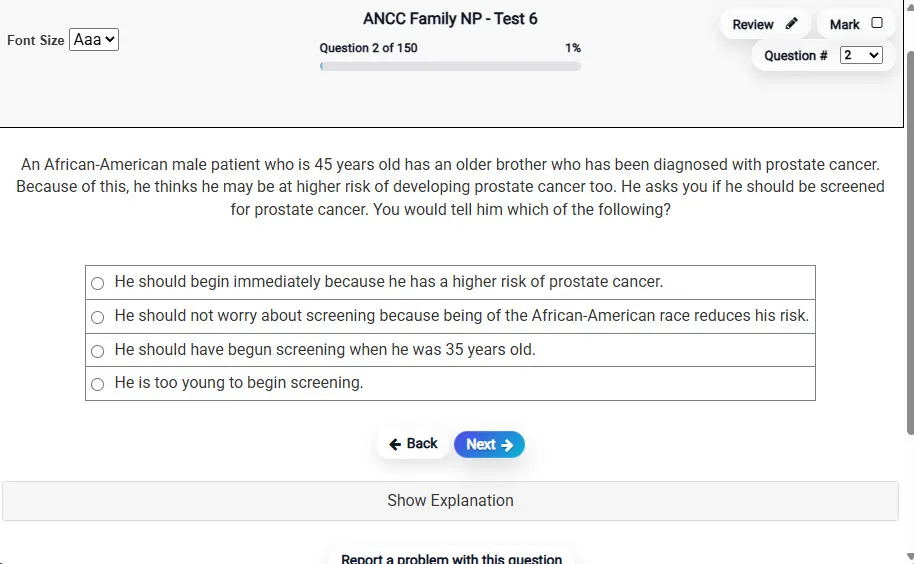
Answering a Question screen – Multiple-choice item view with navigation controls and progress tracker.
Answering a Question Multiple-choice item view with navigation controls and progress tracker.

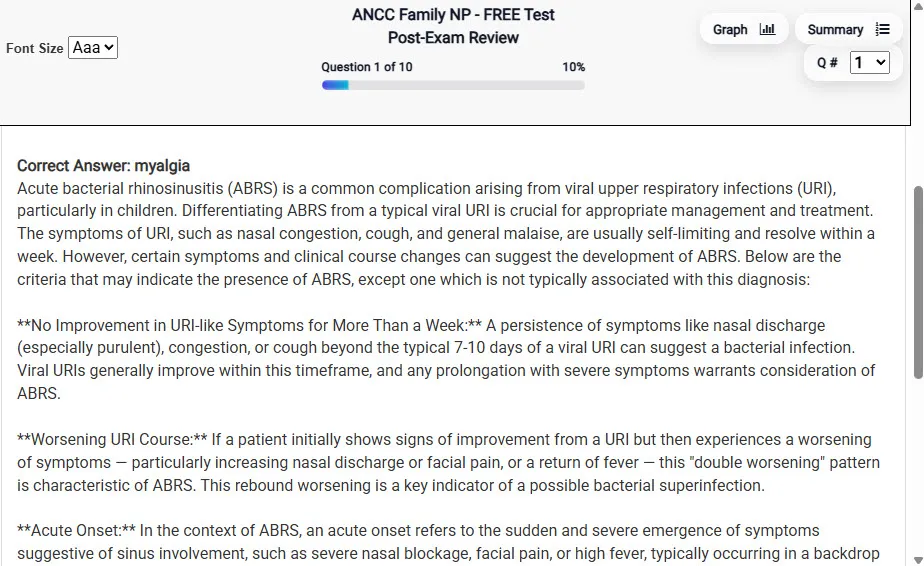
                           Detailed Explanation screen – 
                         Review mode showing chosen answer and rationale and references.
Detailed Explanation Review mode showing chosen answer and rationale and references.

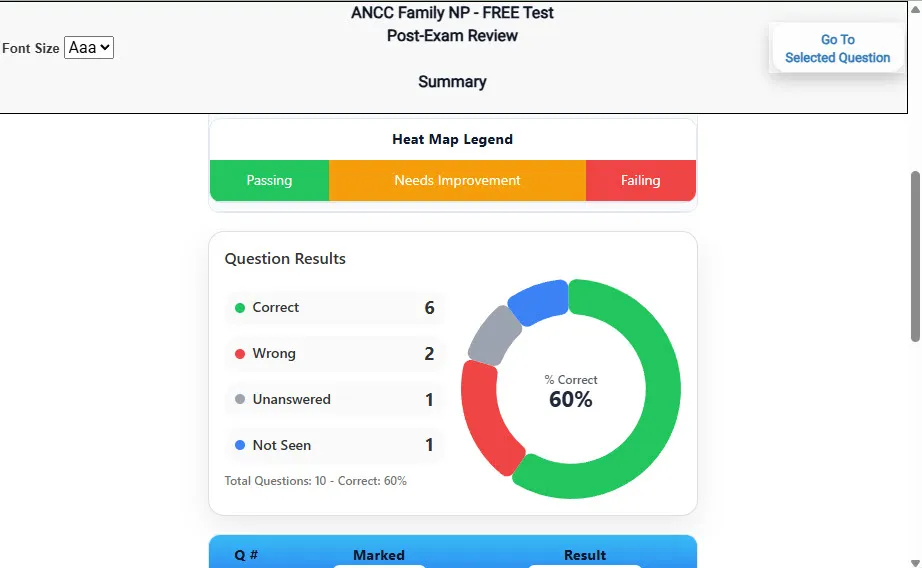
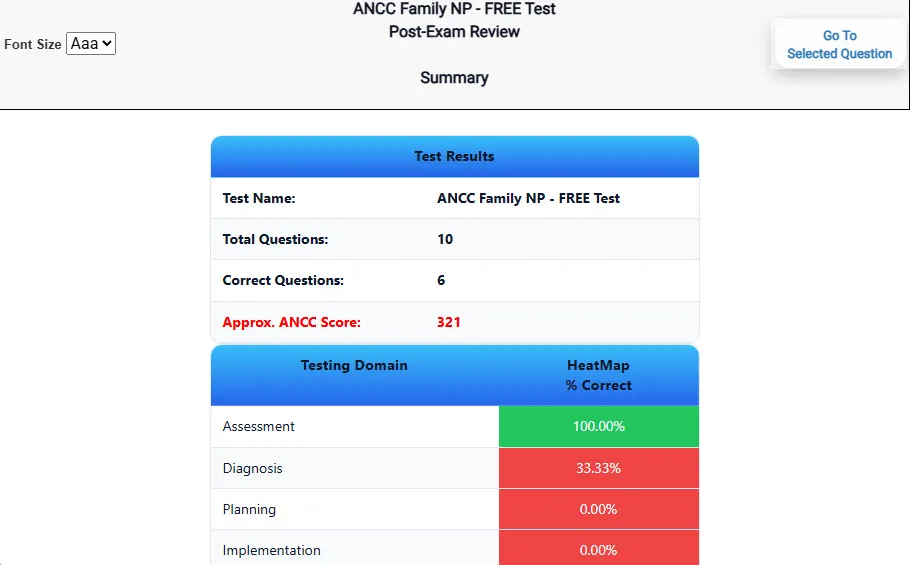
                           Review Summary 1 screen – 
                         Summary with counts for correct/wrong/unanswered and not seen items.
Review Summary 1 Summary with counts for correct/wrong/unanswered and not seen items.

                           Review Summary 2 screen – 
                         Advanced summary with category/domain breakdown and performance insights.
Review Summary 2 Advanced summary with category/domain breakdown and performance insights.

What Each Screen Shows

Answer Question Screen

  • Clean multiple-choice interface with progress bar.
  • Mark for review feature.
  • Matches real test pacing.

Detailed Explanation

  • Correct answer plus rationale.
  • Key concepts and guidelines highlighted.
  • Move between questions to fill knowledge gaps.

Review Summary 1

  • Overall results with total questions and scaled score.
  • Domain heatmap shows strengths and weaknesses.
  • Quick visual feedback on study priorities.

Review Summary 2

  • Chart of correct, wrong, unanswered, not seen.
  • Color-coded results for easy review.
  • Links back to missed items.

Top 10 Reasons to Use Exam Edge for your DANB's Certified Restorative Functions Dental Assistant Exam Prep

  1. Focused on the DANB's Certified Restorative Functions Dental Assistant Exam

    Our practice tests are built specifically for the DANB's CRFDA exam — every question mirrors the real topics, format, and difficulty so you're studying exactly what matters.

  2. Real Exam Simulation

    We match the per-question time limits and pressure of the actual DANB's exam, so test day feels familiar and stress-free.

  3. 10 Full Practice Tests & 2,100 Unique Questions

    You'll have more than enough material to master every DANB's CRFDA concept — no repeats, no fluff.

  4. Lower Cost Than a Retake

    Ordering 5 practice exams costs less than retaking the DANB's Certified Restorative Functions Dental Assistant exam after a failure. One low fee could save you both time and money.

  5. Flexible Testing

    Need to step away mid-exam? Pick up right where you left off — with your remaining time intact.

  6. Instant Scoring & Feedback

    See your raw score and an estimated DANB's Certified Restorative Functions Dental Assistant score immediately after finishing each practice test.

  7. Detailed Explanations for Every Question

    Review correct and incorrect answers with clear, step-by-step explanations so you truly understand each topic.

  8. Trusted & Accredited

    We're fully accredited by the Better Business Bureau and uphold the highest standards of trust and transparency.

  9. Web-Based & Always Available

    No software to install. Access your DANB's CRFDA practice exams 24/7 from any computer or mobile device.

  10. Expert Support When You Need It

    Need extra help? Our specialized tutors are highly qualified and ready to support your DANB's exam prep.


Pass the DANB's Certified Restorative Functions Dental Assistant Exam with Realistic Practice Tests from Exam Edge

Preparing for your upcoming DANB's Certified Restorative Functions Dental Assistant (CFRDA) Certification Exam can feel overwhelming — but the right practice makes all the difference. Exam Edge gives you the tools, structure, and confidence to pass on your first try. Our online practice exams are built to match the real DANB's CRFDA exam in content, format, and difficulty.

  • 📝 10 DANB's Certified Restorative Functions Dental Assistant Practice Tests: Access 10 full-length exams with 210 questions each, covering every major DANB's Certified Restorative Functions Dental Assistant topic in depth.
  • Instant Online Access: Start practicing right away — no software, no waiting.
  • 🧠 Step-by-Step Explanations: Understand the reasoning behind every correct answer so you can master DANB's CRFDA exam concepts.
  • 🔄 Retake Each Exam Up to 4 Times: Build knowledge through repetition and track your improvement over time.
  • 🌐 Web-Based & Available 24/7: Study anywhere, anytime, on any device.
  • 🧘 Boost Your Test-Day Confidence: Familiarity with the DANB's format reduces anxiety and helps you perform under pressure.

These DANB's Certified Restorative Functions Dental Assistant practice exams are designed to simulate the real testing experience by matching question types, timing, and difficulty level. This approach helps you get comfortable not just with the exam content, but also with the testing environment, so you walk into your exam day focused and confident.


Exam Edge DANB Reviews


I found the practice tests extremely helpful. I passed the DANB RHS exam and felt that the subject matter was thoroughly covered by your practice tests. The viewing of films and answering questions on them was especially helpful. Thank you very much for the assistance in preparing for the DANB RHS e ...
Read More
Rofiah, Turnersville NJ

Easy to purchase & easily accessible. Great tool to use

Kay , Milton, Indiana

Yesterday I passed my CDA test. Your test really helped me and I just wanted to say thank you.

Charisse, NY


DANB's Certified Restorative Functions Dental Assistant Aliases Test Name

Here is a list of alternative names used for this exam.

  • DANB's Certified Restorative Functions Dental Assistant
  • DANB's Certified Restorative Functions Dental Assistant test
  • DANB's Certified Restorative Functions Dental Assistant Certification Test
  • DANB's CRFDA test
  • DANB
  • DANB CFRDA
  • CFRDA test
  • DANB's Certified Restorative Functions Dental Assistant (CFRDA)
  • 's Certified Restorative Functions Dental Assistant certification